
Braces treatment for adults typically takes about 18 to 24 months. Simple cosmetic alignment of the front teeth may take around 6 months, while complex bite problems can extend beyond 2 years.
You're probably doing this calculation around real life. Maybe you're looking at photos and finally tired of hiding a tooth that sticks out, or you're planning around work, family events, and a busy Orange County schedule. The honest question behind How Long Do Braces Take for Adults isn't usually curiosity. It's whether you're signing up for a short project or for a year or more of appointments, food rules, and learning to smile with brackets. That's a fair thing to think through carefully, because the calendar you live with depends on more than the first estimate you're given.
Table of Contents
- What a Realistic Adult Braces Timeline Looks Like
- Why Adult Teeth Move at the Pace They Do
- Comparing Braces, Clear Aligners, and Lingual Options for Adults
- The Factors That Actually Control Your Timeline
- Walking the Adult Braces Journey Month by Month
- How to Avoid Adding Months to Your Treatment
- Planning Your Own Braces Timeline in Orange County
What a Realistic Adult Braces Timeline Looks Like
You're sitting at your kitchen table in Santa Ana, Costa Mesa, or Tustin, comparing websites that seem to promise everything from a few months to several years. That spread is confusing, and it's not entirely your fault for finding it hard to read. Different sites are often describing different kinds of treatment.
The Planning Range Most Adults Should Use
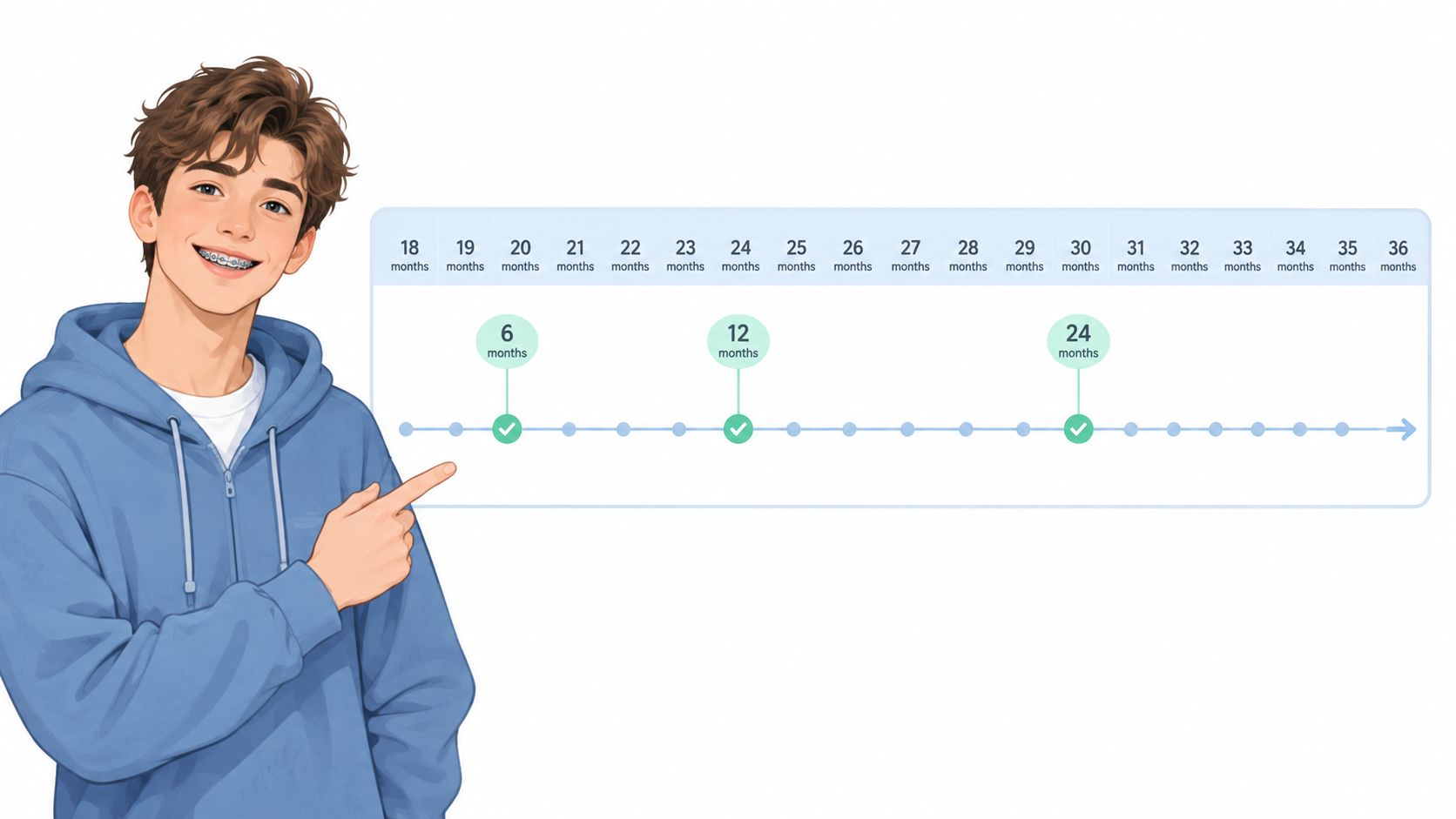
For full correction, plan on roughly one to two years, with many adults landing around 18 to 24 months. Braces treatment for adults typically takes about 18 to 24 months, the British Orthodontic Society states that improving how the teeth meet commonly takes 1 to 2 years, and the NHS guidance on braces describes fixed-brace treatment as usually lasting 1 to 2 years.
That range covers the middle of the road. It doesn't cover every mouth.
When Shorter or Longer Makes Sense
A shorter course usually means a narrower goal.
- Limited cosmetic alignment. Straightening mainly the front teeth can finish sooner, but it may not fully move tooth roots or correct how your back teeth meet.
- Full correction. Aligning both arches and improving your bite takes longer because more teeth move, and they have to finish in a coordinated position.
- Complex cases. Severe crowding, buried or impacted teeth, missing teeth, or treatment combined with jaw surgery can push treatment beyond the usual range.
A useful way to read any estimate. Ask what it's actually fixing. A timeline for tidying front teeth and a timeline for correcting a bite aren't measuring the same job.
The Hidden Calendar
There's also a second calendar that rarely shows up in advertisements. Missed adjustment visits, broken brackets, and elastics left in a drawer don't pause treatment neatly. They add repair time, delay the next planned step, and sometimes let teeth drift back before the next change is made.
That hidden calendar is why two adults with similar starting points can finish months apart. Your initial estimate assumes steady progress. Your real finish date depends on whether that steady progress happens, month after month.
If you'd like an estimate based on your own bite rather than a general range, a consultation with Dr. Andrew Finley can help you understand whether your case looks limited, full, or complex.
Why Adult Teeth Move at the Pace They Do
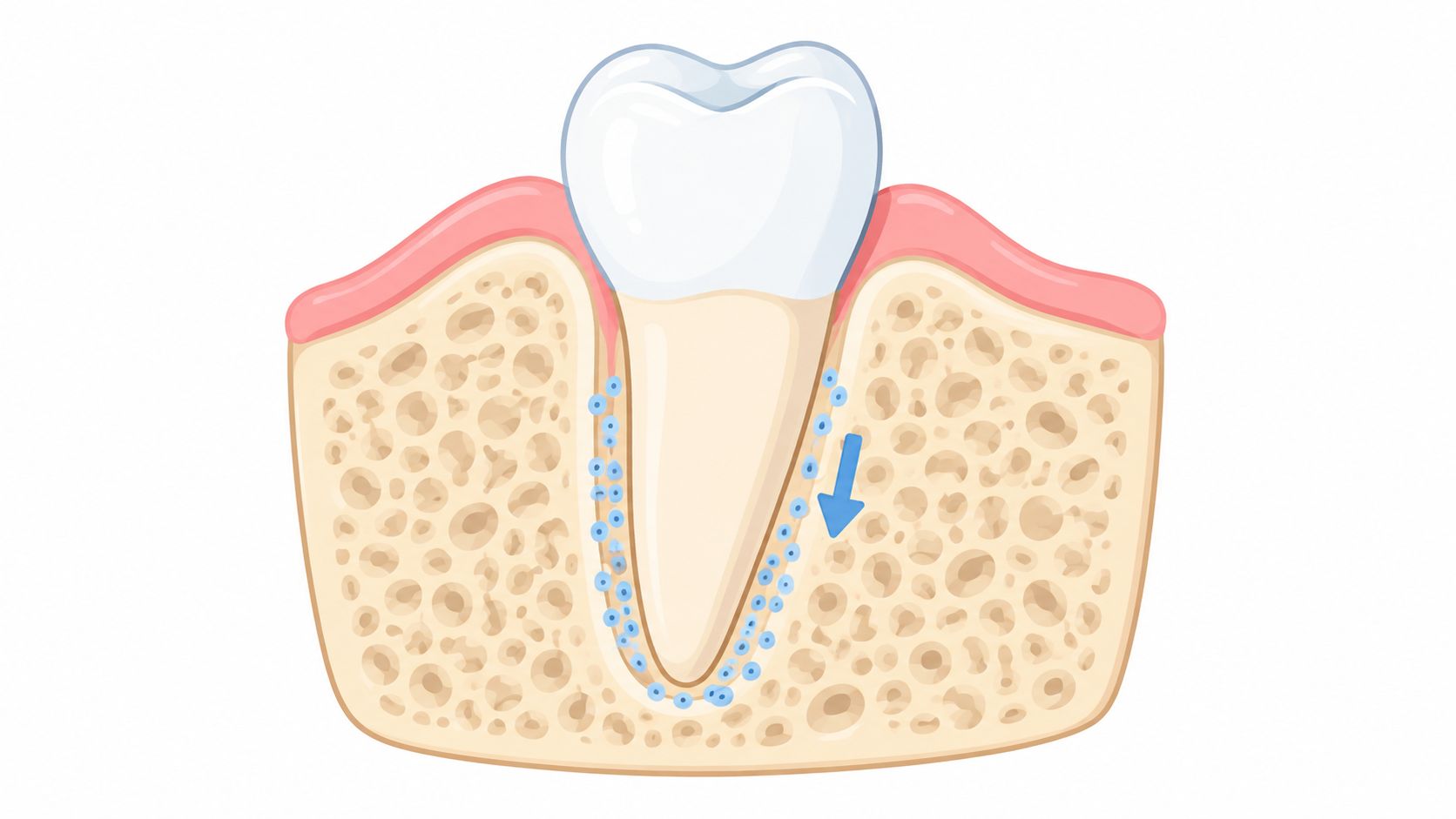
Braces don't drag teeth through bone the way you'd slide furniture across a floor. They apply gentle, steady pressure, and your body does the slow work of remodeling the bone around each root so the tooth can settle into a new position. You're not just moving the white part you see in the mirror. You're moving the whole tooth, including the root below the gumline.
Moving a fence post set in packed soil is like moving a garden chair. The visible part is only half the story. What lies below the surface must shift too, and the ground around it has to rebuild so it stays put.
Movement Measured in Millimeters
This is why orthodontists talk about gradual progress rather than overnight change. In a 2024 clinical study of 30 adult orthodontic patients, the group receiving micro-osteoperforations showed an average tooth-movement rate of 1.5 millimeters per month, while the control group averaged 0.8 millimeters per month.
Read those numbers carefully. Even in the experimental group, movement was measured in small monthly amounts. That study doesn't prove the technique is right for everyone, and it doesn't guarantee a shorter total treatment time for any individual patient. What it does show is the scale of the work. Teeth move slowly because biology sets the speed limit.
Why Rushing Is Not the Same as Finishing
Moving a tooth crown quickly without giving the root and bone time to follow can leave you with a result that looks straight but isn't stable. Short treatment that doesn't fully reposition roots or correct the bite can raise the risk that teeth drift back afterward. That's called relapse, and it's one reason careful treatment takes the time it takes.
Straight is not the same as finished. The last part of treatment is often about root position and how your teeth meet, not just how they look in a photo.
Inflammation matters here too. Sore, unhealthy gums and poor cleaning around brackets can complicate treatment and slow the steady progress you're counting on. Healthy tissue responds more predictably, which is one more reason daily hygiene isn't a side instruction. It's part of how treatment works.
Once you understand that pace, the rest of the decision gets clearer. No appliance removes the biology. The choices you're making are about how treatment fits your case and your life while that biology does its work.
Comparing Braces, Clear Aligners, and Lingual Options for Adults
Adults often assume the appliance determines the timeline. It influences it, but it rarely decides it on its own. Your bite, the distance teeth need to travel, and how consistently you follow instructions usually matter more than whether the hardware is visible. In other words, the calendar you control tends to outweigh the brackets you pick.
It also helps to clear up an age concern early. In a 2020 systematic review, researchers found no statistically significant difference in full fixed-appliance treatment duration between adults and younger patients, with a reported mean difference of -0.8 months and P = 0.65. Being an adult doesn't automatically mean a much longer course.
Adult Orthodontic Options at a Glance
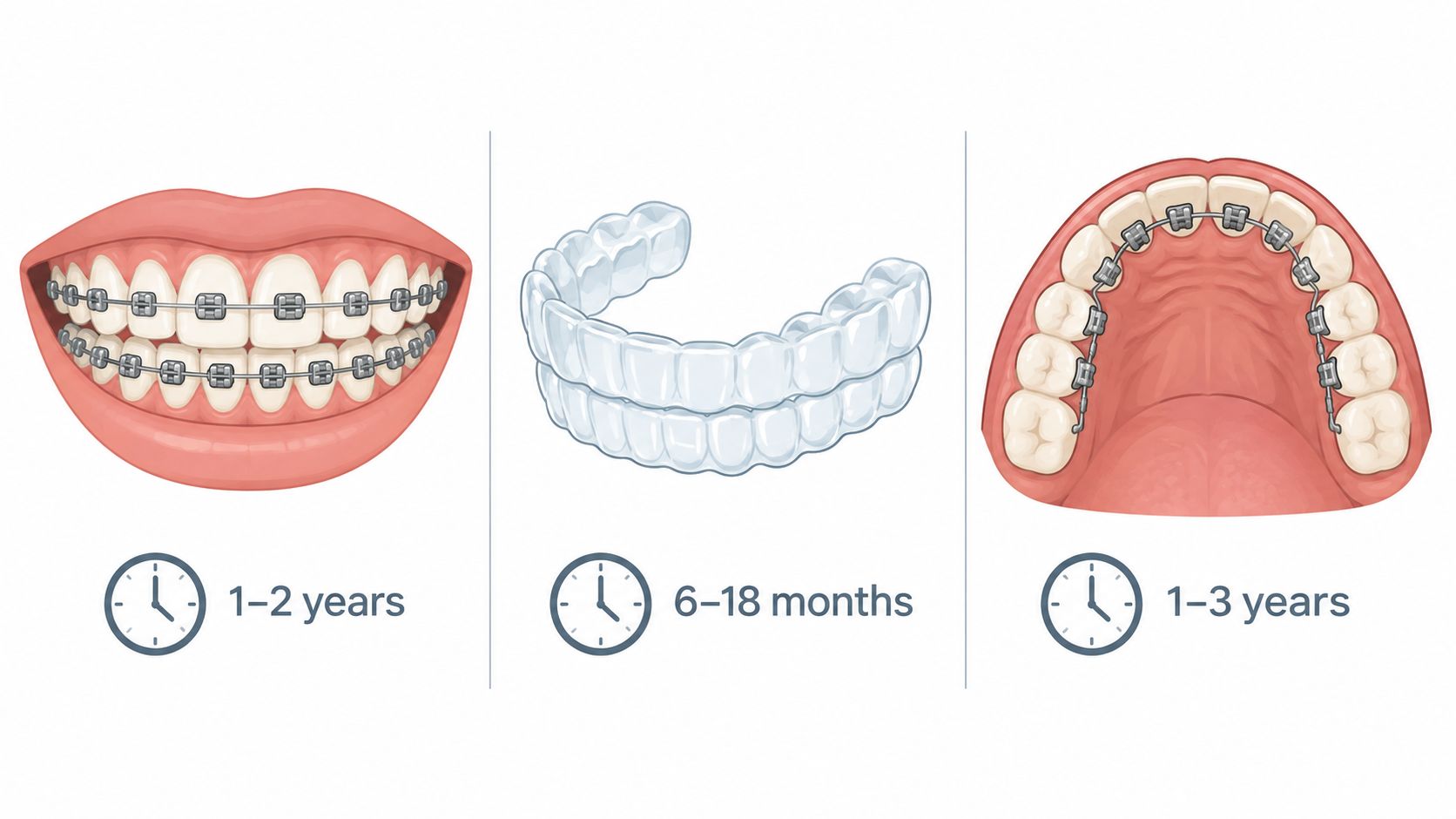
| Option | Typical duration | Best for | Key compliance factor |
|---|---|---|---|
| Fixed metal or ceramic braces | Full-correction cases commonly follow the 18 to 24 month planning range | A wide range of alignment and bite problems, including complex movements | Protecting brackets and keeping adjustment visits |
| Clear aligners such as Invisalign | Varies with case complexity and consistent wear | Many mild to moderate alignment concerns and adults who want a removable option | Wearing trays as instructed and changing them on schedule |
| Lingual braces | Generally comparable to fixed braces for similar cases | Adults who want fixed treatment placed behind the teeth | Keeping adjustment visits and adapting to cleaning around hidden brackets |
What the Table Does and Doesn't Tell You
Fixed braces stay on your teeth, so they keep working whether or not you remember to put something back in after lunch. That built-in consistency helps some patients. The trade-off is visibility, food restrictions, and more effort cleaning around brackets and wires. There's also a delay risk worth knowing: a broken bracket can pause progress until it's repaired, so protecting the hardware protects your finish date.
Clear aligners are removable, which many adults prefer for eating, brushing, and important meetings. That freedom is also the risk. Trays left out too long don't move teeth, and teeth that don't track with a tray can require extra steps. For aligners, your daily wear habits are part of the prescription, not an optional extra.
Lingual braces are fixed behind the teeth, so they're hard for other people to see. They can take some getting used to for speech and tongue comfort, and adjustments may feel more fiddly. Their timeline follows the case, not the hiding place.
Plain truth. No option on that list magically turns a full bite correction into a brief cosmetic tidy-up.
The right question isn't which option is fastest in general. It's which option can do the movements your teeth need, and which one you'll realistically keep up with for the full course. A realistic answer to that second part protects your timeline more than any marketing claim, because most added months come from the hidden calendar of skipped wear, missed visits, and repairs, not from the appliance itself.
The Factors That Actually Control Your Timeline
If appliances don't decide everything, what does? Mostly, it's the size of the job you started with and how steadily treatment proceeds. A helpful anchor is that a 2024 adult orthodontic study reported a mean treatment duration of 18.6 ± 4.8 months, supporting the use of roughly 18 months as a planning midpoint rather than a guarantee. Your own case can sit well on either side of that midpoint.
The Bite and Crowding You Start With
Malocclusion is the clinical word for how your teeth and jaws don't line up ideally, and it's the dominant driver of duration. Mild crowding needs less travel. Severe crowding, large gaps, rotated teeth, and bite discrepancies where the upper and lower teeth meet poorly need more steps, in a careful order.
Sequence matters. An orthodontist often has to create space before aligning, align before correcting the bite, and correct the bite before fine detailing. You can't safely skip to step three because you're eager to finish.
Age, With One Notable Exception
Many adults walk in assuming their age alone adds a penalty. As covered in the earlier section, research doesn't support that assumption for routine treatment. Missed appointments, broken appliances, complex movements, and surgery tend to extend treatment more than adult age itself.
There is an exception worth knowing about. Impacted or palatally displaced canines, meaning eye teeth stuck out of position, can take longer to align in adults. If that applies to you, your clinician should explain it specifically rather than folding it into a vague warning about age.
Your Dental History and Gum Health
- Missing teeth or large spaces. Closing or managing gaps changes the plan and can add stages.
- Buried teeth or jaw surgery. These cases involve coordination beyond brackets alone and often run longer.
- Existing restorations. Crowns, bridges, or implants may limit how certain teeth can move, since an implant doesn't move like a natural tooth.
- Periodontal health. Gum and bone health need to be stable enough to support movement, and addressing problems first protects both your health and your result.
A Word on Accelerated Treatment
You may see add-on techniques promoted as shortcuts. Current evidence suggests appliance design and acceleration methods generally have limited effects compared with the malocclusion itself, clinician factors, and your compliance. That doesn't mean every technique is useless. It means you shouldn't buy a shortcut expecting it to override a complex bite or inconsistent habits.
Your estimate is really two numbers added together. There's the time your biology and bite require, and the time preventable delays add on top.
Understanding which factors you can't change, and which ones you can, is what turns a vague average into a plan you can manage.
Walking the Adult Braces Journey Month by Month
A two-year estimate sounds abstract until you break it into seasons of your actual life. Most adults find treatment easier to accept once they can picture the rhythm, so here's the usual arc from first visit to retainers.
Getting Started
Your first visits are about information, not hardware. Expect an examination, photos, scans or impressions, and a discussion of what you'd like to change. That assessment is where Dr. Finley can tell you whether you're looking at limited alignment, braces, clear aligners, or something more involved.
Then comes fitting day. Brackets are bonded and a first wire placed, or your first aligner trays are delivered with instructions. Your teeth may feel tender as they adjust, and soft foods help while you settle in. This early phase is also when you learn the cleaning routine that will carry you through treatment.
The Middle Months
After that, treatment settles into a pattern. Newcastle Hospitals NHS Foundation Trust says that orthodontic appointments are usually scheduled every six to eight weeks for brace adjustments, and identifies missed or canceled appointments and broken braces as reasons treatment may take longer. Adjustment visits are where wires are changed, progress is checked, and elastics or other mechanics are added when needed.
The middle of treatment is often where you'll see the most obvious visual change. Teeth that overlapped start lining up, and gaps begin to close. It can feel like you're nearly done, but the bite work that follows is less visible and just as important. Elastics, if prescribed, usually do their work during this stretch, and they only work while you're wearing them.
Here's how a typical journey breaks down in practice.
- Consultation and records. Assessment, imaging, and a personal treatment plan.
- Fitting and early alignment. Appliance placed, first movements begin, new routines form.
- Working phase. Regular adjustments, space closure, and bite correction with elastics if needed.
- Detailing. Small refinements to root position and how teeth meet.
- Removal and retention. Braces come off, and retainers hold the result.
After the Braces Come Off
Removal day is a milestone, not the end of orthodontics. Teeth have a natural tendency to drift, so retention follows active treatment. Your retainer might be removable, fixed behind the teeth, or a combination, and wearing it as instructed protects the months you just invested.
For adults fitting visits around work in Irvine, school runs in Garden Grove, or commutes across Orange County, that predictable six to eight week rhythm is the point. Treatment isn't an open-ended interruption. It's a series of planned checkpoints, and each one you keep moves the finish date closer rather than pushing it away.
How to Avoid Adding Months to Your Treatment
This is the part of your timeline you control. You can't change the distance a tooth needs to travel, but you can remove a surprising amount of dead time from your calendar. Start with this finding. A systematic review reported that appointment reminders improved adherence and were associated with an average treatment-duration reduction of 7.3 weeks, with a 95% confidence interval of 3.7 to 11.6 weeks.
Appointment reminders. Not a special bracket, not an expensive add-on. Showing up when you're supposed to.
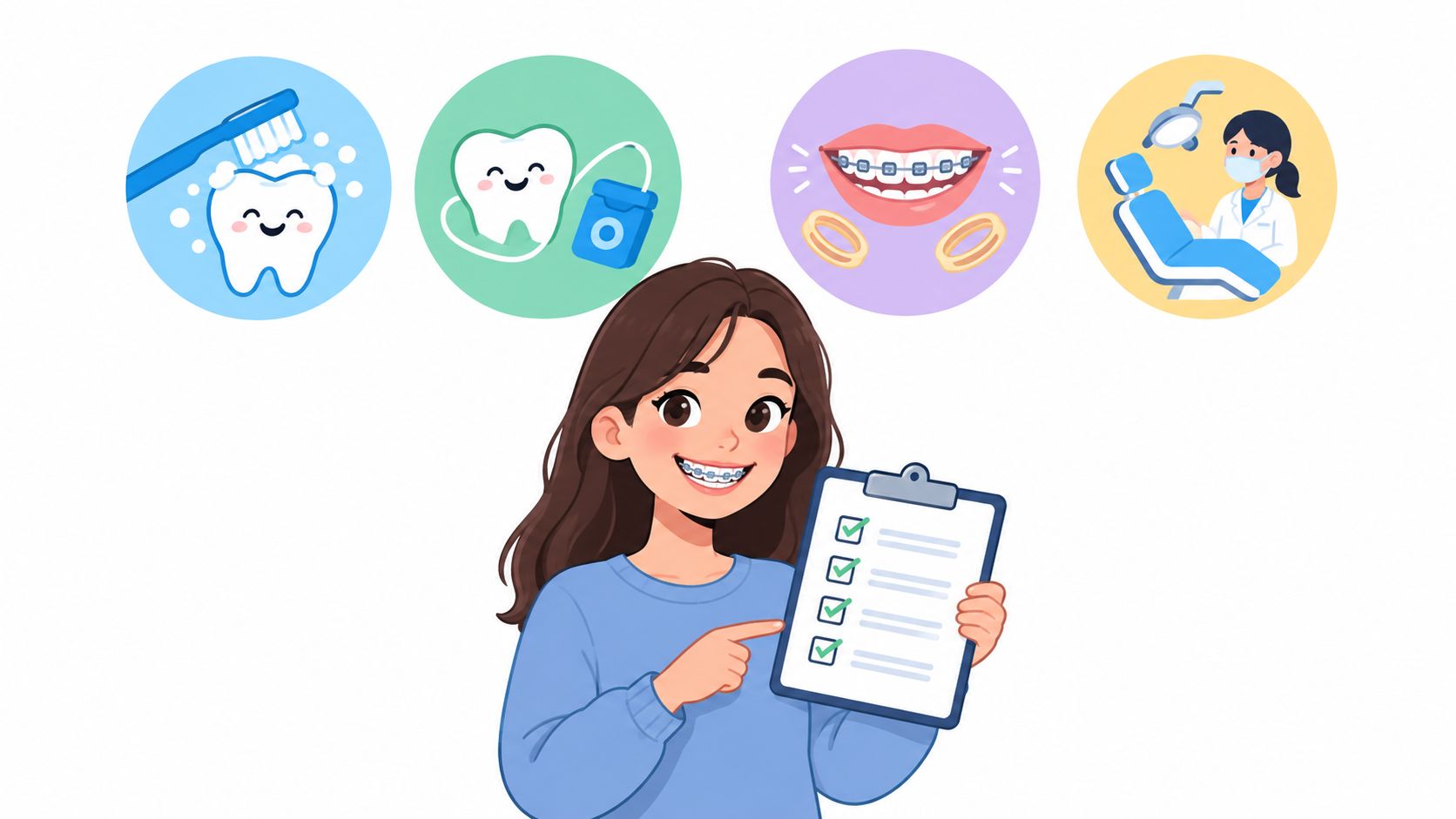
Your Delay Prevention Checklist
- Keep every adjustment visit. Put appointments in your calendar with reminders on, and reschedule immediately if something unavoidable comes up. A missed visit doesn't just cost that week. It delays the next planned change.
- Wear elastics and trays as instructed. These aren't suggestions. Elastics correct your bite only while they're on, and aligner trays left in a case move nothing.
- Protect your brackets. Skip the hard, sticky, and chewy foods that snap brackets and bend wires. Every breakage can mean an extra repair visit and lost progress.
- Report damage right away. A loose bracket or poking wire won't fix itself, and waiting until your next routine visit can let a tooth drift off course.
- Clean carefully every day. Brush and clean between teeth as instructed so plaque and gum inflammation don't complicate treatment or slow healthy movement.
Why Small Lapses Compound
Adults sometimes think of compliance as a character trait. It's really arithmetic. Skip elastics for a stretch and the bite correction stalls. Break a bracket and that tooth stops receiving the intended force. Miss a visit and the wire change that would have started the next movement waits another cycle.
None of those lapses feels dramatic on the day it happens. Added together across a year or more, they're exactly how an 18 month plan becomes a much longer one.
You probably can't make your teeth move faster than biology allows. You can absolutely stop giving back the progress biology already made.
Build Habits That Survive Busy Weeks
Keep spare elastics where you will use them, like your bag, desk, and bathroom. Keep a travel brush handy so cleaning after lunch isn't a production. If you wear aligners, build the habit of putting trays back in immediately after eating rather than telling yourself you'll do it in a few minutes.
Ask yourself the most useful question in adult orthodontics. What can I personally do to avoid adding months? That question, answered plainly on day one, does more for your finish date than shopping for the appliance with the boldest speed claim.
Planning Your Own Braces Timeline in Orange County
By now the picture should feel less like a single number and more like a range you can reason about. The American Association of Orthodontists states that slight corrections may take only a few months, while complex cases involving many teeth or jaw repositioning can take years. Where you fall in that spread depends on your bite, your dental history, and the habits covered above.
Averages are planning tools, not promises, and no website can tell you How Long Do Braces Take for Adults in your specific case. Only an examination can show whether you're a candidate for limited cosmetic alignment, braces, or Invisalign, and what each would realistically involve.
At Bristol Dental & Orthodontics in Santa Ana, Dr. Andrew Finley reviews patient information carefully and builds estimates around the individual case in front of him. Patients from Santa Ana, Costa Mesa, Tustin, Irvine, and Garden Grove can expect a calm conversation about goals, options, and likely timelines, without pressure and without guarantees about a specific outcome.
If you're weighing treatment against a wedding, a job change, or a year you'd like to plan well, bring those dates to your consultation. A realistic timeline built around your life is far more useful than an optimistic one built around an average.
If you're ready to replace general averages with a timeline based on your own teeth and bite, Bristol Dental & Orthodontics offers orthodontic consultations for adults considering braces or clear aligners, alongside family, cosmetic, and restorative care in Santa Ana. Schedule a consultation with Dr. Andrew Finley to talk through your options, likely treatment length, and the habits that will help you finish on schedule. Visit Bristol Dental and Orthodontics to get started.