

For most mild-to-moderate, non-extraction cases, clear aligners typically take roughly 11 to 22 months from the first tray through the last refinement, not a fixed number of weeks. Limited cosmetic corrections may take less time, while full bite correction, extraction-based treatment, missed wear, and refinements can extend the schedule.
You may be asking because you have a wedding, a new job, family photos, or a smile you've been meaning to address for years. You've probably seen short treatment estimates online and wondered whether they apply to your teeth. The honest answer is that clear-aligner treatment is a range, not a countdown.
At Bristol Dental & Orthodontics, Dr. Andrew Finley evaluates the starting position of your teeth, your bite, the movements required, and how consistently you can wear the aligners. Those details matter more than the appliance label alone. The same clear-aligner system can produce a very different timetable for two people.
Table of Contents
- A Straight Answer Before the Details
- How a Series of Trays Moves Teeth
- Realistic Timelines by Case Complexity
- What Patients Can Control
- Three Santa Ana Patient Scenarios
- Safe Ways to Stay on Schedule
- Where to Go From Here in Santa Ana
A Straight Answer Before the Details
For a relatively limited front-tooth concern, treatment may fall near the shorter end of the published range. For mild-to-moderate crowding or spacing that involves broader alignment, a realistic estimate is often about 11 to 22 months, including the possibility of refinement trays. More involved bite correction or extraction-based treatment may take about 18 to 24 months or longer, depending on the movements involved. Published evidence places mild-to-moderate cases in a broad range of roughly 6 to 18 months, while complex cases may extend to 24 months or longer (published clinical evidence).
These figures describe groups of patients. They aren't a promise for an individual smile. Your timeline depends on four connected factors:
- Case complexity: Small spacing is different from a bite problem or significant crowding.
- Daily wear: Aligners can only guide movement when you wear them as directed.
- Biological response: Teeth and supporting tissues don't respond on an identical schedule.
- Refinements: The first series may not be the final series.
A 2022 randomized controlled trial involving 44 orthodontic patients reported an average clear-aligner duration of 11.55 months, compared with 15.73 months for fixed appliances in non-extraction cases. The difference was about 26%, and it was statistically significant, with P < 0.001 (European Journal of Orthodontics study). That result is useful context, but it shouldn't be treated as a universal timetable. The study involved a particular sample and treatment design.
The sentence to remember
If you want one practical answer to repeat to a family member, use this: “Clear aligners often take around 11 to 22 months for mild-to-moderate, non-extraction treatment, but my diagnosis and daily wear determine where I fall in that range.”
The rest of the schedule becomes easier to understand once you know how trays move teeth, which movements take longer, and how home habits affect tracking. If you want a specific estimate for your own teeth in Santa Ana, a consultation with Dr. Finley can turn a broad range into a personalized discussion.
How a Series of Trays Moves Teeth
A clear aligner is a thin, custom-molded shell that guides teeth toward planned positions. Each tray has a slightly different shape, creating the next small stage of movement. The series works step by step, rather than trying to place every tooth in its final position at once.
Each aligner advances the treatment plan by a small amount. The full result emerges only after the trays are worn in sequence. One tray is one stage in a longer process, so reaching the last numbered tray does not always mean every planned movement is complete.
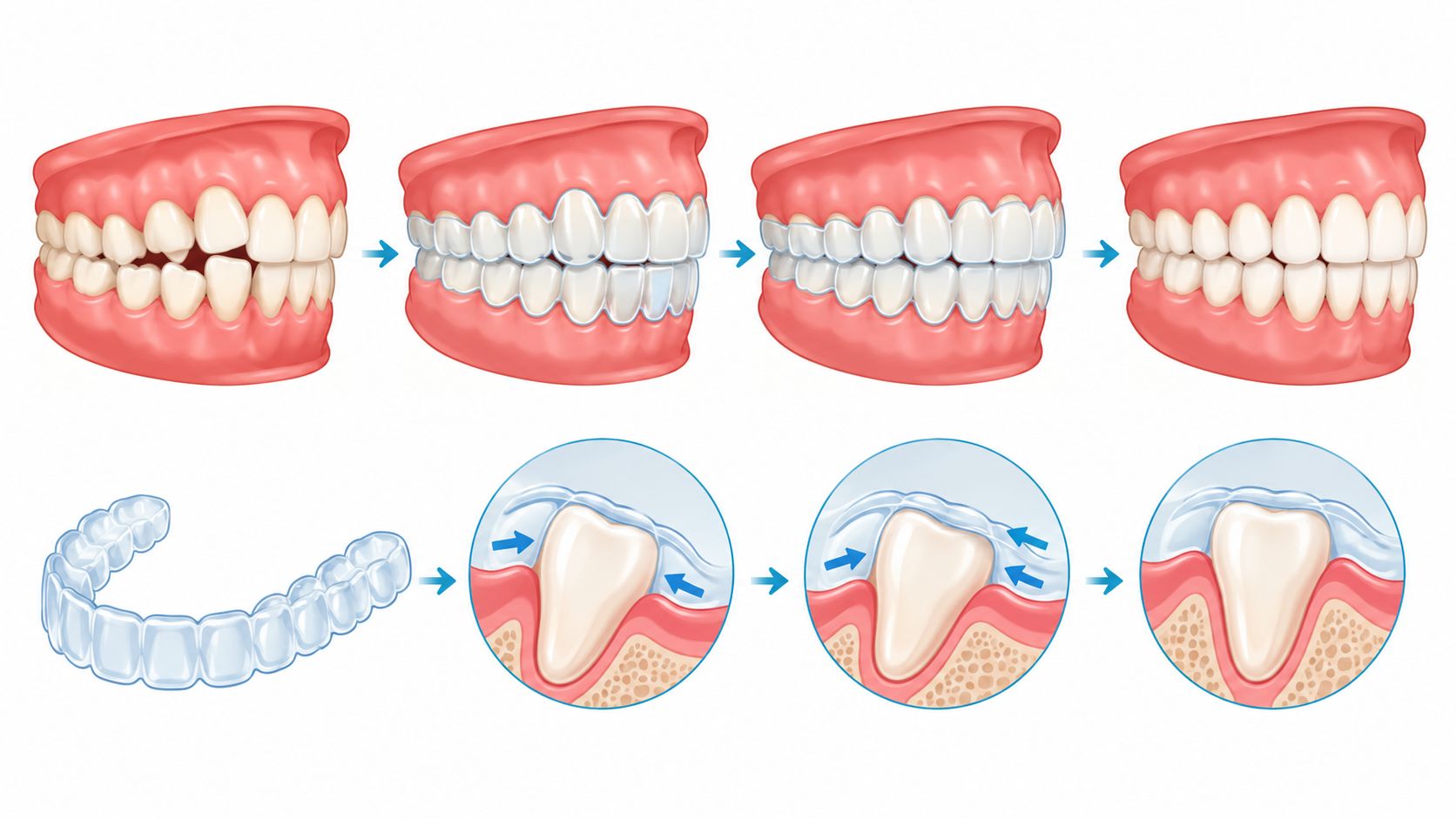
Why tray changes aren't the same as finishing
Patients commonly wear each tray for about 7 to 14 days and generally wear aligners for 20 to 22 hours per day (American Association of Orthodontists guidance). Your treating dentist sets the change interval according to the plan and your clinical progress. The schedule is about giving teeth enough time to respond, not racing through tray numbers.
The first group is usually called the initial series. It covers the movements planned at the start, but teeth may not follow the digital simulation perfectly. Differences can result from wear habits, how fully a tray seats, attachment performance, the type of movement, and your individual biology.
Refinement trays address movements that still need attention. Your dentist may rescan your teeth and prescribe another series to improve rotations, close a small remaining space, settle the bite, or finish other details. Refinements do not automatically signal a problem. They are often part of completing orthodontic treatment accurately.
The role of Invisalign
Invisalign is a widely recognized clear-aligner brand. Clear aligners as a category follow the same basic staged-movement principle. The meaningful questions are whether the plan fits your diagnosis, whether the trays fit and track properly, and whether you can follow the prescribed routine.
A tray may feel tight without producing the intended movement. It may also feel comfortable while a tooth needs more time. Tray count alone therefore cannot answer how long clear aligners take. The fit, the movement being attempted, and your wear pattern all affect how the schedule unfolds.
Realistic Timelines by Case Complexity
A person with slightly crowded front teeth may need a very different schedule from someone whose treatment must change the bite, move back teeth, or close space after an extraction. The clearest estimate comes from the scope of movement, rather than the number of trays alone.
| Treatment Scope | Typical Duration | Common Variables |
|---|---|---|
| Limited cosmetic alignment | Roughly 6 to 9 months | Front-tooth crowding, small spacing, limited movement |
| Mild-to-moderate full-arch alignment | Roughly 11 to 22 months | Crowding, spacing, rotations, bite details, refinements |
| Full bite correction or extraction-based treatment | About 18 to 24 months or longer | Vertical changes, molar movement, space closure, root control, refinements |
These ranges provide a useful starting framework for discussion. Published evidence reports mild-to-moderate treatment durations across a broad range of roughly 6 to 18 months, while complex cases may continue for 24 months or longer (clinical evidence summary).
Limited cosmetic corrections
A person with mild crowding in the front teeth or a small gap may be considering a limited cosmetic correction. If the bite already functions well and the planned movements are straightforward, treatment may fall near the shorter end of the range. Roughly 6 to 9 months can be a realistic estimate for some carefully selected cases, although an examination is needed to confirm that the concern is truly limited.
A photograph can make front-tooth alignment look simple. The tooth may also be rotated, tipped, or influenced by the way the upper and lower teeth meet. Those details can require additional tray stages and change the schedule.
Mild-to-moderate alignment
For broader treatment without extractions, 14 to 22 months is a clinically realistic benchmark often used for mild-to-moderate crowding (PLOS ONE evidence summary). A randomized study reported an average clear-aligner duration of 11.55 months in its non-extraction sample (randomized controlled trial).
A separate 2025 randomized clinical study involving 120 patients with mild-to-moderate malocclusions reported an average clear-aligner duration of 18.2 ± 3.1 months, compared with 14.5 ± 2.8 months for fixed appliances, with comparable improvement in the PAR orthodontic index (2025 randomized clinical study). The practical lesson is simple: for similar corrections, aligners can sometimes require more time.
Movements that push treatment longer
Rotations, vertical changes, molar movement, and extraction-space closure demand tighter control than a small adjustment to a visible front tooth. Extraction treatment may involve root control, torque, and bodily translation, rather than simple crown tipping (evidence summary on treatment duration).
The same type of aligner can therefore produce very different timelines. Treatment scope sets the amount of work, while how consistently each stage is completed affects whether the schedule stays close to its original projection.
What Patients Can Control
Your daily routine can determine whether treatment stays near the shorter or longer end of its projected range. Three decisions sit most directly in your hands: daily wear hours, advancing to the next tray on schedule, and keeping follow-up appointments.
Aligners are generally worn close to full time, commonly 20 to 22 hours per day. Remove them for meals, drinks other than water, and brushing and flossing. One missed period may seem minor, like skipping one practice in a training plan. Repeated interruptions can leave a tray underused and give the teeth less time to respond.
A 2024 adherence study found that 50.75% of participants showed high adherence. Compliance was significantly lower among patients whose treatment lasted more than one year than among those treated for one year or less. The pattern creates a feedback loop: a longer course can make the routine harder to maintain, while weaker adherence can extend the course further.

The compliance feedback loop: Missed wear can cause tracking problems. Tracking problems may require longer tray use or new scans, and additional trays can lengthen the overall course.
Follow the change plan, not the calendar
Your dentist may prescribe a weekly or two-week tray change. Do not advance early just because a tray feels comfortable, and do not extend it automatically because progress seems slow. The right interval depends on fit, tooth movement, attachments, gum health, and clinical checks.
Appointments provide the clinical checkpoint. Your dental team can confirm whether the teeth are tracking as planned, then continue the schedule, adjust it, or arrange a refinement. If a tray is lost, damaged, unusually loose, or no longer seats properly, contact the Bristol Dental & Orthodontics office instead of improvising.
A quoted timeline is a partnership estimate. Your dentist designs and monitors the plan. You control the daily habits and the small choices between visits.
Three Santa Ana Patient Scenarios
Consider three representative patterns. They aren't promises or case reports. They show why asking how long clear aligners take requires more information than a photograph of the front teeth.
A limited front-tooth correction
A busy professional in Santa Ana wants to improve mild front-tooth crowding before a wedding. If the bite is stable and the plan involves limited movement, the estimate may sit near the shorter end of the published range. Consistent wear remains important, because a small cosmetic goal can still require refinement if the teeth don't track as planned.
The key question is whether the goal is only visual straightening or whether the treatment also needs to coordinate the bite. Those are different scopes, even when the concern appears in the same few front teeth.
Moderate crowding during teenage years
A teenager in Costa Mesa has moderate crowding and needs aligners during school, sports, and social activities. A broader mild-to-moderate plan may fall somewhere within the 11-to-22-month range, with the actual estimate depending on the movements and response to treatment (clear-aligner duration evidence).
For this patient, the practical challenge may be remembering to replace the trays after meals, keeping them safe during sports, and maintaining the prescribed routine during travel. Parents and teens can make the schedule easier by agreeing on where the case stays and what happens if an aligner is misplaced.
Bite correction with a longer route
An older adult in Tustin has crowding along with a bite concern, and the plan may involve extraction. That treatment is more likely to trend toward the longer end because space closure and controlled root movement require a different level of movement than simple front-tooth alignment.
Refinements may also play a greater role when the plan includes several types of movement. A patient in Irvine or Garden Grove with a similar diagnosis may receive a different estimate based on the starting position, treatment design, and response over time.
The same technology doesn't create the same schedule. Starting anatomy and daily behavior shape the timeline together.
Whether you live in Santa Ana, Costa Mesa, Tustin, Irvine, or Garden Grove, bring your actual goal to the consultation. “I want straighter front teeth” may describe a limited cosmetic plan, while “I want my bite corrected” points to a broader orthodontic objective.
Safe Ways to Stay on Schedule
A treatment estimate becomes more useful when you treat it as a routine, not a deadline. Small daily decisions help the trays deliver the movements planned for your front teeth or bite.
- Build a wear routine: Keep aligners in except when eating, drinking anything besides water, or brushing, unless your dentist gives different instructions.
- Protect the trays: Put them in a case whenever they are out. Keep a spare case and small travel kit at work, school, or during family visits.
- Follow the assigned interval: Do not skip ahead, change early, or stretch a tray without checking with the dental team. A tray that no longer fits may need more time or an evaluation.
- Attend check-ins: Appointments let the dentist confirm that teeth are tracking and that the next stage is appropriate.
- Call when something changes: Contact the office if an aligner is lost, damaged, cracked, or no longer seats as expected.
Weekly and two-week change intervals can both be clinically appropriate. In a randomized clinical study of 80 patients, a 7-day protocol produced an average initial-series duration of about 5 months, compared with approximately 9 months for a 14-day protocol, with no clinically significant difference in the measured treatment outcome (randomized aligner-change study).
Those findings do not make faster changes suitable for everyone. Your treating dentist must confirm that movement and biological response are adequate. Some movements need more time, and that is not a failure on your part.

Where to Go From Here in Santa Ana
A clear-aligner timeline on a brochure or treatment preview is a starting estimate, not a guaranteed finish date. The final schedule reflects treatment scope, daily wear, biological response, and refinements.
Refinements are a routine part of many digital treatment plans. One study found that 99.4% of patients required at least one refinement phase, with a median of two refinement plans and 21 refinement aligners per dental arch (digital treatment-planning study). That doesn't mean every patient will follow the same pattern, but it does explain why an initial series shouldn't automatically be treated as the final endpoint.
Dr. Andrew Finley at Bristol Dental & Orthodontics can assess your teeth and bite, discuss whether Invisalign or another clear-aligner approach fits your goals, and explain which movements may affect the schedule. Patients from Santa Ana and nearby Orange County communities, including Costa Mesa, Tustin, Irvine, and Garden Grove, can schedule a consultation to discuss a personalized treatment range. Every article from the practice is reviewed by Dr. Finley before publishing.
Bristol Dental and Orthodontics offers Invisalign and orthodontic consultations alongside family, cosmetic, restorative, sleep apnea, implant, and emergency dental care in Santa Ana. Visit Bristol Dental and Orthodontics to learn more and request a consultation about your clear-aligner timeline.