

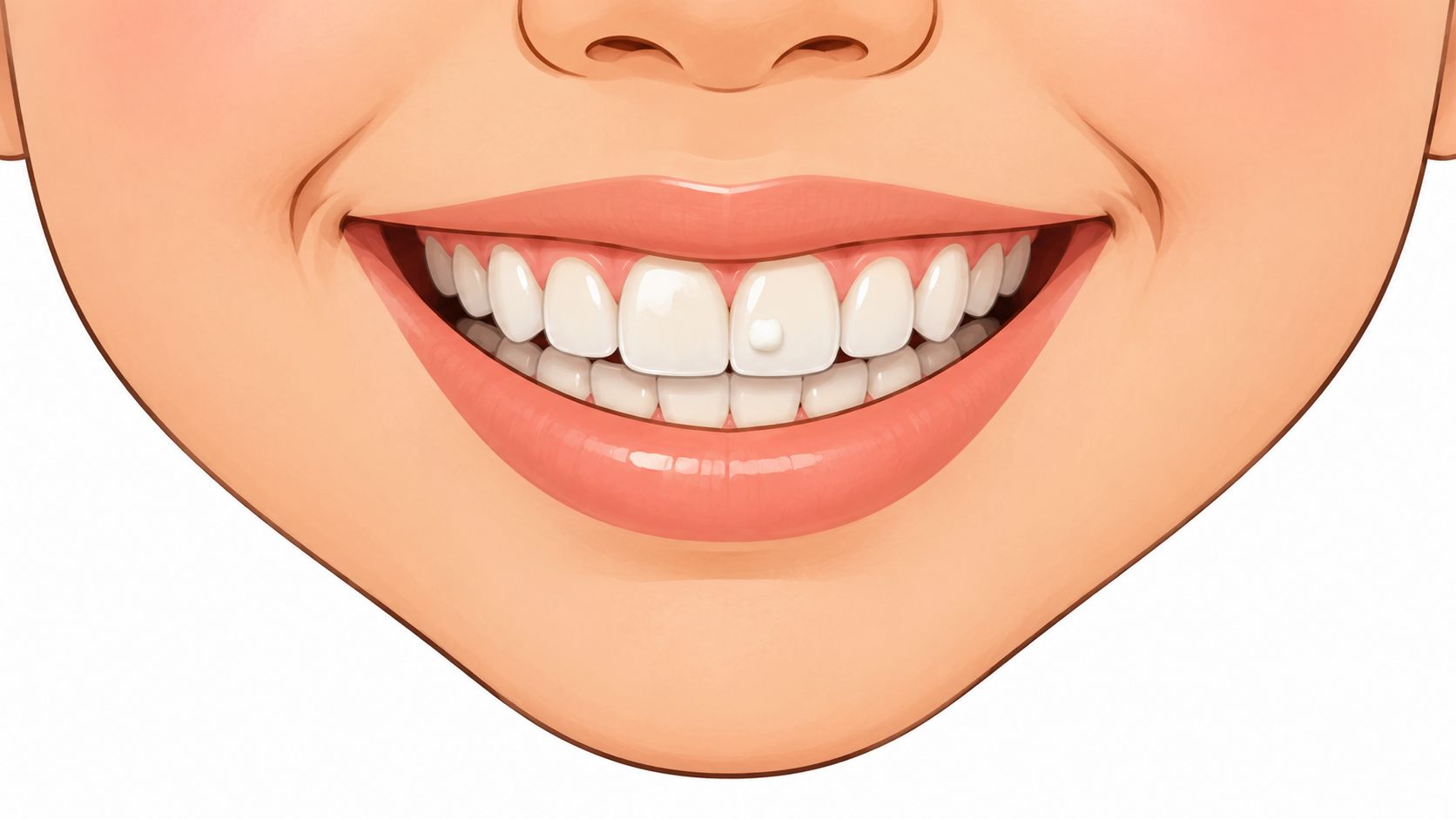
You're halfway through Invisalign treatment when your tongue finds a small bump on a front tooth. The aligner still fits, but the bump feels unfamiliar, and you may wonder whether it's part of the tray, a temporary filling, or something that shouldn't be there.
That bump is likely an Invisalign attachment, a small composite feature bonded to the tooth to help guide a specific movement. Attachments aren't automatically a sign that treatment is more complicated, and they aren't a guarantee that every planned movement will happen exactly as shown digitally. They're movement-specific tools, and their value depends on the tooth, the bite, the design, and how well the aligner is worn.
Table of Contents
- What Invisalign Attachments Actually Are
- Why Attachments Change the Way Aligners Work
- Common Shapes and Where They Go
- How Attachments Are Placed and Removed
- What Attachments Can and Cannot Fix
- What Daily Life Feels Like with Attachments
- Caring for Attachments and Handling Common Issues
- Planning Your Invisalign Journey in Santa Ana
What Invisalign Attachments Actually Are
An Invisalign attachment is a small, tooth-colored composite shape bonded temporarily to selected teeth. The composite is similar to the material used for certain tooth-colored dental repairs. Once it's bonded, the attachment becomes a defined contact point between the enamel and the clear aligner.
A simple analogy helps. Think of the aligner as a glove and the attachment as a small handle on the object inside it. A smooth glove can cover an object, but it may slide when you try to turn or lift that object. A handle gives the glove something more specific to grip. Invisalign describes attachments as handles that help guide planned tooth movement in its explanation of how Invisalign attachments work.
What an attachment is not
Attachments aren't brackets, wires, or metal braces hardware. They aren't separate aligners, and they don't replace the clear tray. The aligner remains the appliance that applies the programmed pressure, while the attachment gives that pressure a more controlled surface to work against.
Your orthodontic team plans the attachment's shape and location digitally before bonding. Not every tooth needs one. Some teeth may have a natural contour that gives the aligner enough contact, while others need an added feature for rotation, extrusion, intrusion, translation, or root control.
The attachments stay bonded while the aligners need them. When that part of treatment is complete, the clinician gently removes the composite and polishes the enamel. The tooth underneath shouldn't be changed by the attachment when the bonding and removal are performed properly.
Practical rule: An attachment isn't a promise that a tooth will move perfectly. It's a planned mechanical aid that gives the aligner a better chance to direct the intended movement.
That distinction matters because aligners fit over curved, uneven tooth surfaces. The next question is why a small composite shape changes that relationship so much.
Why Attachments Change the Way Aligners Work
Clear plastic aligners are shaped to fit over the teeth and apply pressure as the teeth gradually move. A smooth tooth surface can limit how precisely that pressure is delivered. The tray may press against the crown, but it can also slide over the enamel instead of creating the force pattern needed for a particular movement.
An attachment adds a more defined contact relationship. The aligner contains a corresponding space, or recess, that fits over the composite shape. This gives the plastic a purchase point, allowing the orthodontic team to direct pressure with greater control.
From simple pressure to directed movement
The word force means a push or pull. A moment describes the tendency of that force to turn an object around a point. You don't need an engineering background to understand the practical difference. Pushing near the center of a door may move it, while pushing near one edge may also make it rotate.
Teeth can tip, rotate, move inward or outward, move up or down, or translate with the crown and root moving in a more coordinated way. Those movements place different demands on the aligner. A 2024 biomechanics review explains that attachments increase contact between the tray and tooth, while computer modeling can examine stress, periodontal-ligament strain, and tooth displacement in clear-aligner attachment biomechanics.
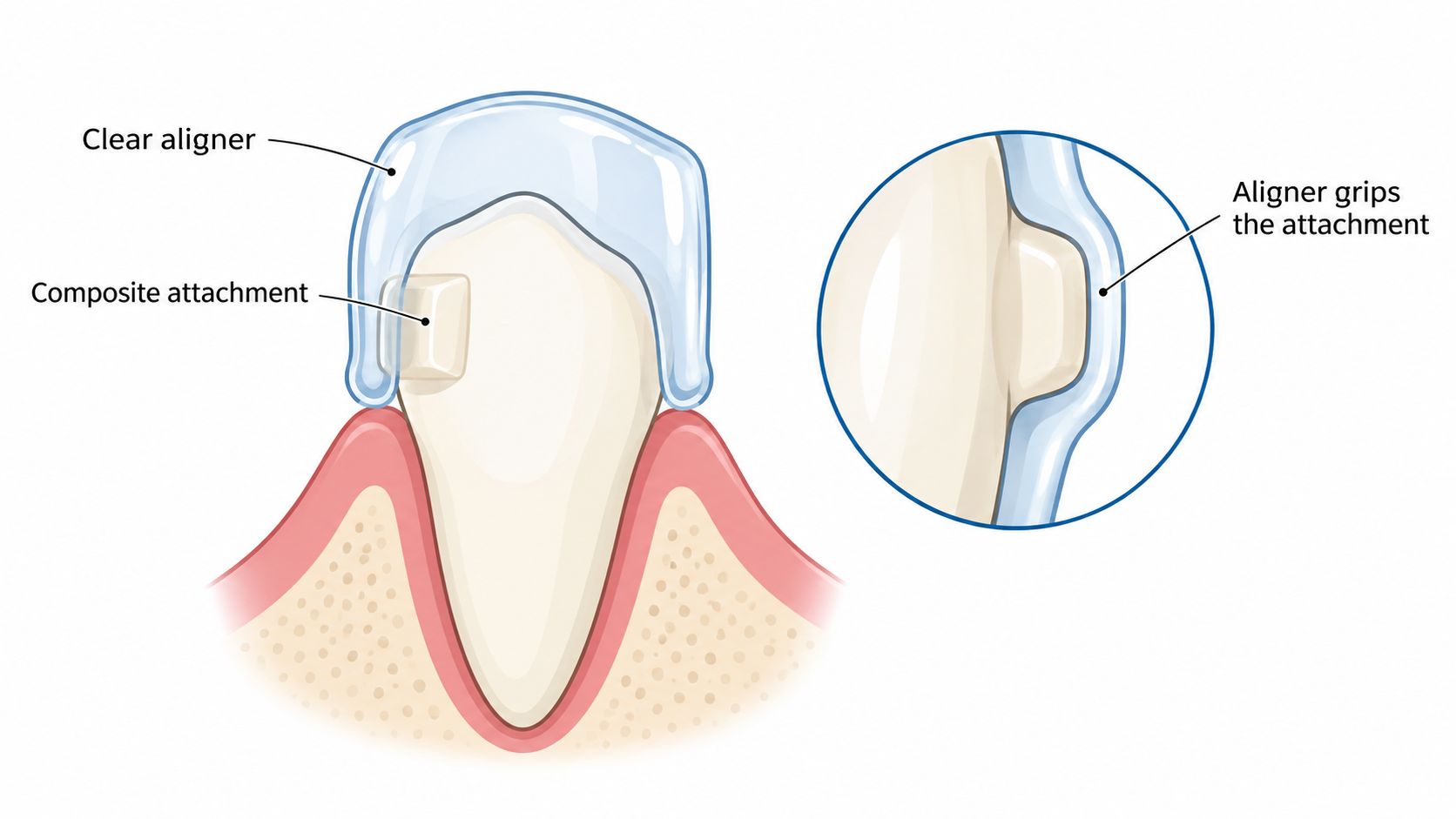
An attachment doesn't mean that the orthodontist is using more force. The objective is usually better-targeted force, applied through a shape and position selected for the intended movement. Changing the attachment's geometry, orientation, or location can change how stress is distributed through the aligner, tooth, periodontal ligament, and supporting structures.
Why the design has to match the movement
Laboratory testing of attachment designs for simulated extrusion of an upper lateral incisor by 0.2 millimeters found that a rectangular attachment in the middle third of the crown generated an extrusive force of 7.498 N, compared with 6.338 N for a hemi-ellipsoid cervical attachment and 5.948 N for a rectangular incisal attachment. The study found that shape and location affected generated forces and moments, with p < 0.01 for most comparisons, as reported in the same attachment design study.
Those laboratory values aren't personal treatment targets or guarantees. They illustrate a broader point: two bumps that look similar to a patient may behave differently mechanically. The shape and vertical placement are selected for the movement being attempted, which is why standardized attachments can't answer every orthodontic problem.
Common Shapes and Where They Go
Attachment names can sound more complicated than they feel in the mouth. The important idea is that shape, orientation, and placement work together. A rectangular feature may help the aligner grip a tooth in one direction, while a beveled or optimized feature may provide a different contact relationship for rotation or root control.
A canine that needs rotation doesn't necessarily need the same design as a premolar that needs to move bodily through the bone. The attachment may be positioned closer to the gumline, nearer the center of the crown, or in another location selected in the digital setup. The exact plan depends on tooth anatomy, the direction of movement, the bite, and the surrounding teeth.
| Shape | Typical Placement | Movement It Supports |
|---|---|---|
| Optimized shape | Selected on the crown according to the planned movement | Complex rotation, extrusion, intrusion, or translation |
| Horizontal rectangular shape | Across part of the crown, with orientation matched to the force direction | Extrusion, tipping, or certain root-control objectives |
| Vertical rectangular shape | More upright on the crown | Intrusion, extrusion, or control of the tooth's long axis |
| Beveled or wedge shape | Placed where a smaller, directional contact is useful | Fine detailing, rotation, or controlled finishing movements |
| Paired or coordinated features | On selected teeth within the same movement group | Force distribution and reciprocal control |
A 2025 finite-element analysis found that attachment orientation affected modeled molar distalization. Ninety-degree attachments performed most effectively for distalization overall, while 135-degree attachments performed better when intrusion was included and 45-degree attachments performed better under extrusion. These are computational findings, not a guarantee of the same result in every patient, but they show why orientation matters in attachment geometry and molar movement modeling.
Why placement matters
A canine attachment may be positioned to help resist unwanted sliding while the tooth rotates. A premolar attachment may be placed nearer the center of the crown to support a more bodily movement. Those examples are general, not prescriptions. Your clinician must account for the tooth's shape and the movement shown in your treatment plan.
More attachments don't automatically mean better control. Research summarized in a systematic review found that adding attachments to neighboring teeth, or placing them on both the cheek and tongue sides, didn't consistently improve rotation. Attachment selection should be explained as part of the movement plan, not as a universal upgrade.
How Attachments Are Placed and Removed
Attachment bonding is usually a straightforward chairside procedure. The clinician first retracts the lips and cheeks, cleans and lightly prepares the enamel, and keeps the teeth dry so the bonding material can adhere properly.
A template aligner or placement guide fits over the teeth. It contains the planned spaces for the composite shapes, which helps the clinician place each attachment in the correct position. The bonding resin and composite are then placed through the template.
What you'll feel during bonding
A small blue curing light hardens the material. You may notice pressure from the cheek retractor, the sound of instruments, or a cool-water rinse. The bonding process generally doesn't require anesthetic because the clinician is working on the enamel surface rather than drilling into the tooth.
After curing, the template comes out and the clinician removes excess composite. Your actual treatment aligner is then seated to confirm that each attachment engages its corresponding space. A visit may take roughly twenty to forty minutes, depending on how many attachments are planned and how easily they can be accessed. Individual appointment length varies.
The first time you seat the aligner, you may feel a distinct click as the plastic fits over the attachments. That sensation should be different from sharp pain. If the tray won't seat, rocks, or leaves a visible gap, tell the dental team before leaving or contact the office for guidance.
What happens at removal
When the attachment is no longer needed, the clinician uses a specialized instrument to gently remove the composite. The remaining material is polished from the enamel until the surface feels smooth again. You may notice that the tooth looks freshly polished, but the attachment shouldn't leave a permanent bump.
The removal appointment depends on the number and location of the attachments. Don't try to scrape or pull one off at home. Uncontrolled removal can damage the enamel or leave rough material that interferes with the aligner.
What Attachments Can and Cannot Fix
Attachments can improve control, but they don't make clear aligners behave exactly like fixed braces. They give the tray a better grip, yet the result still depends on the movement being attempted, the amount programmed into each stage, aligner wear, fit, and the biological response of the teeth and supporting tissues.
They're often useful when a tooth must rotate, move vertically, or receive more deliberate control than a smooth aligner surface can provide. Rotation of a rounded tooth, extrusion of a tooth with limited visible crown, and certain tipping movements may benefit from a carefully selected attachment.
Where attachments may help
A 2022 systematic review found that attachments can support difficult movements such as anterior root torque, tooth rotation, mesiodistal movement, and posterior anchorage. The same review also found that outcomes depended on attachment shape, size, number, and position, rather than on the simple presence of an attachment. You can review the evidence in the systematic review of clear-aligner attachments.
| Movement | Attachment Help Level | Often Still Needed |
|---|---|---|
| Rotation of a rounded tooth | Often useful, especially when the tooth needs a defined grip | Monitoring, and sometimes refinement aligners |
| Incisor extrusion | May improve vertical control | Careful tracking and possible refinement |
| Certain tipping movements | Can direct pressure more deliberately | Bite evaluation and stage-by-stage checks |
| Root movement or torque | May help create a controlled couple | Additional planning and close monitoring |
| Large bite correction | Limited as a stand-alone solution | Elastics, other auxiliaries, or a different approach |
| Major vertical change | May assist but can't guarantee movement | Additional aligners or adjunctive treatment |
| Complex skeletal or surgical correction | Not something an attachment can correct | Comprehensive orthodontic or surgical assessment |
The limits are clinically important
Severe bite corrections, large vertical changes, and complex root movements may require elastics, interproximal reduction, temporary anchorage, or surgical assistance. A tooth may also fail to track even when the attachment design is sound. In that situation, the clinician may adjust the plan, add refinement aligners, or use another auxiliary.
A recent review reported 81.5% success with optimized attachments and weekly aligner changes compared with 76.5% with fourteen-day changes in one clinical dataset. Those figures describe reviewed study conditions, not a personal prediction, and they don't mean every patient should change aligners weekly. The same review of clear-aligner biomechanics emphasizes that compliance, fit, and biology remain important.
What Daily Life Feels Like with Attachments
On the first evening after attachments are placed, you may notice them before you notice anything else. Your tongue can find each small composite feature, especially on a front tooth. With the aligner in place, the tray may click over the attachment, then create pressure around the teeth it is meant to guide. The sensation reflects the movement being planned, not just the presence of a bump.
Speech can feel slightly different at first. Some patients develop a mild lisp while the tongue learns where the aligner and attachments sit. The tongue may also notice a gritty surface, and a rough edge can briefly catch the cheek. These sensations often settle as your mouth adapts, though individual adjustment varies.
Eating and drinking
You remove the aligners for meals, so the trays should not interfere with ordinary chewing. The attachments stay bonded to the teeth, which means food and plaque can collect around their edges. Sticky foods may make the trays harder to remove, while hard foods can put more stress on the bonded composite.
Coffee, tea, curry, and smoking may discolor composite or stain areas that are difficult to brush. That does not mean every attachment will change color, or that you must avoid every preferred food. Water after staining drinks and consistent cleaning can reduce residue. Your own risk depends on habits, attachment location, and how well the surfaces stay clean.
What feels normal and what doesn't
Mild tenderness around selected teeth after a new aligner is common. A feeling of fullness may also fade as the cheeks and tongue become familiar with the attachments. A small annoyance that is steadily improving usually differs from a problem that is worsening.
Patient comfort matters alongside the mechanics of tooth movement. A 2025 scoping review found that attachment research has concentrated on mechanics, bonding, and materials, with comfort, acceptability, and safety receiving less study. A review of patient experience with clear-aligner attachments supports separating normal adaptation from persistent irritation or a treatment problem.
Call the orthodontic team if discomfort continues, a rough area repeatedly scratches the cheek, an attachment feels loose, gum inflammation worsens, or the tray no longer seats fully. An attachment is a movement-specific tool, so a change in how it feels can affect how accurately the aligner engages it. Your clinician can decide whether it needs checking or replacement.
Caring for Attachments and Handling Common Issues
A simple routine keeps the composite, enamel, gums, and aligners easier to manage. Attachments don't require a special home device, but they do require attention at the margins where the composite meets the tooth.
A practical daily checklist
- Brush around each bump: Use a soft toothbrush and angle the bristles slightly around the attachment, rather than brushing only across the broad front surface.
- Clean between the teeth: Floss with a threader or use a water flosser if that fits your clinician's instructions. The area where composite meets enamel can collect plaque.
- Rinse after staining drinks or foods: Water after coffee, tea, or curry can remove residue before it sits around the attachment.
- Wash the aligners: A cloudy or stained tray can make clean attachments look discolored. Follow the cleaning method recommended by your dental team.
- Remove trays evenly: Loosen the back teeth first and work around both sides instead of pulling hard from one front corner.
- Protect the front teeth: Don't bite directly into hard foods with the front teeth while the attachments are bonded.
Mild pressure after a new aligner and slight tongue awareness can be part of adjustment. A rough edge that scratches the cheek, an attachment that feels loose, a click when the tray comes out, sudden sensitivity that lingers, or a tray that no longer seats fully deserves a call to the office.
What to do if something changes
Orthodontic wax can cover a sharp edge temporarily while you arrange professional advice. Don't glue a loose attachment back onto the tooth, and don't file it down yourself. If a composite piece comes off, keep it if you find it and tell the dental team which tooth was affected.
A missing attachment doesn't always mean treatment must stop, but its importance depends on the movement assigned to that tooth. Continue wearing the aligner unless your clinician tells you otherwise, and contact the office promptly if the tray feels loose, won't stay in place, or no longer fits as it did.
Whitening toothpaste may be better reserved until treatment is complete unless your dental professional recommends otherwise. Abrasive products can make cleaning feel harsher without solving the mechanical issue. The useful rule is simple: if the aligner seats with a gentle click and you have no pain beyond mild pressure, the system may be tracking normally, but a changed fit still warrants professional review.
Planning Your Invisalign Journey in Santa Ana
Attachment planning starts before anything is bonded. At an Invisalign consultation, Dr. Andrew Finley can evaluate your teeth, bite, tooth shape, periodontal health, and goals rather than relying on a generic online comparison. Patients from Santa Ana and nearby Orange County communities, including Costa Mesa, Tustin, Irvine, and Garden Grove, may have very different attachment needs even when they describe their concern in the same words, such as crowding or spacing.
What the planning process may include
A new patient visit can include photographs, a digital scan, and a conversation about the changes you want to see. The digital setup can show the planned tooth movements and the map of attachment locations. That preview is useful because it lets you discuss visibility, movement priorities, and possible limitations before bonding.
The attachment map isn't improvised chairside. It's part of the planned mechanics, although the clinician may revise the plan if the teeth don't respond as expected. The final number and shape can depend on the bite and the movements selected.
Once treatment begins, patients generally wear their aligners for the prescribed daily schedule and change trays according to the clinician's instructions. Some plans use changes every one to two weeks, but the appropriate interval depends on fit, biology, compliance, and the specific treatment design. A bonding appointment may take about thirty to sixty minutes, depending on how many attachments are planned and how the visit is organized.
Why refinement is part of responsible planning
Some patients need refinement aligners or a later visit for fine-tuning and contouring. That doesn't automatically mean the original plan was poor. Teeth respond biologically, and the movement shown in a digital setup is a plan, not a guarantee.
A 2025 finite-element study found a trade-off between force transmission and biological loading. In one model, flat attachments produced approximately 18% more average tooth displacement than curved attachments across four simulated molar movements, while increasing attachment length from 2 millimeters to 5 millimeters increased crown and root displacement but also raised periodontal-ligament strain. The same research reported that the average proportion of effective movement was 40% for canines, 25% for second premolars, and 17% for first molars, demonstrating why attachment behavior varies by tooth type. These computational results aren't patient risk thresholds, as explained in the finite-element study of attachment design.
A consultation at Bristol Dental & Orthodontics in Santa Ana can answer the questions that matter in daily life: how many attachments your case may require, where they may be placed, which movements carry greater tracking risk, and what options exist if a tooth doesn't follow the digital plan. Schedule an Invisalign consultation to discuss your specific goals and understand what treatment may feel like from the first day.
Bristol Dental & Orthodontics offers Invisalign and complete family and cosmetic dental care for patients in Santa Ana and surrounding Orange County communities. Visit Bristol Dental and Orthodontics to learn more and schedule a consultation with Dr. Andrew Finley about attachments, aligner treatment, and your individual smile goals.