
If ceramic braces look less noticeable, does that automatically make them the better choice for your smile? No. The true decision is whether the brackets fit your bite, daily habits, treatment goals, and willingness to manage repairs and cleaning.
Ceramic and metal braces can both move teeth effectively. Ceramic brackets blend more closely with natural tooth color, while stainless-steel brackets generally offer a more forgiving option when durability and mechanical control matter most. At Bristol Dental & Orthodontics, Dr. Andrew Finley helps Santa Ana and Orange County patients weigh those differences before treatment begins.
Table of Contents
- What This Comparison Will Help You Decide
- How Ceramic and Metal Braces Actually Differ
- Side-by-Side Comparison of Key Factors
- Daily Life With Braces and What the Numbers Mean
- Who Each Option Is Best Suited For
- Making the Decision and Preparing for Your Consultation
- Questions Patients Ask Before Choosing
What This Comparison Will Help You Decide
Most patients don't need a winner. They need a clear answer to a more useful question: Which bracket type fits my life and orthodontic plan?
You may be considering ceramic braces because you work with clients in Irvine, attend school in Santa Ana, or don't want your appliance to dominate photographs. You may be leaning toward metal braces because you play sports in Tustin, have a complex bite problem, or want the option known for strength and predictable handling. Both concerns are reasonable.
Use four criteria to make the choice:
- Appearance: Ceramic brackets are tooth-colored or translucent and less noticeable. Metal brackets are visible, although some patients enjoy choosing colored ties.
- Durability: Stainless steel is generally associated with strength. Ceramic materials have improved, but they remain harder and more brittle than metal.
- Daily demands: Both options require careful brushing, flossing, and food choices. Ceramic treatment may require extra attention to staining and bracket protection.
- Treatment mechanics: Bracket design, wire type, tooth position, bite forces, and the complexity of movement all influence how treatment proceeds.
Treatment time deserves a careful explanation. Ceramic brackets don't automatically move teeth more slowly, and metal brackets don't guarantee a shorter course. Your orthodontist also has to account for rotations, extraction spaces, bite correction, missed appointments, hygiene, and broken brackets.
Practical rule: Choose the appliance that supports your treatment plan first, then use appearance and lifestyle preferences to refine the decision.
This guide is for teens, adults, and families comparing fixed braces before a consultation. It won't predict your individual result, because only an examination can show how your teeth fit together and which bracket system suits the planned movements. It will help you arrive at Bristol Dental & Orthodontics with better questions and a realistic understanding of the trade-offs.
The central takeaway is simple. Ceramic braces are a sensible choice when discretion matters and your bite and habits support them. Metal braces are usually the more forgiving choice when strength, complexity, or lower maintenance matters more. In some cases, using both materials makes more sense than choosing only one.
How Ceramic and Metal Braces Actually Differ
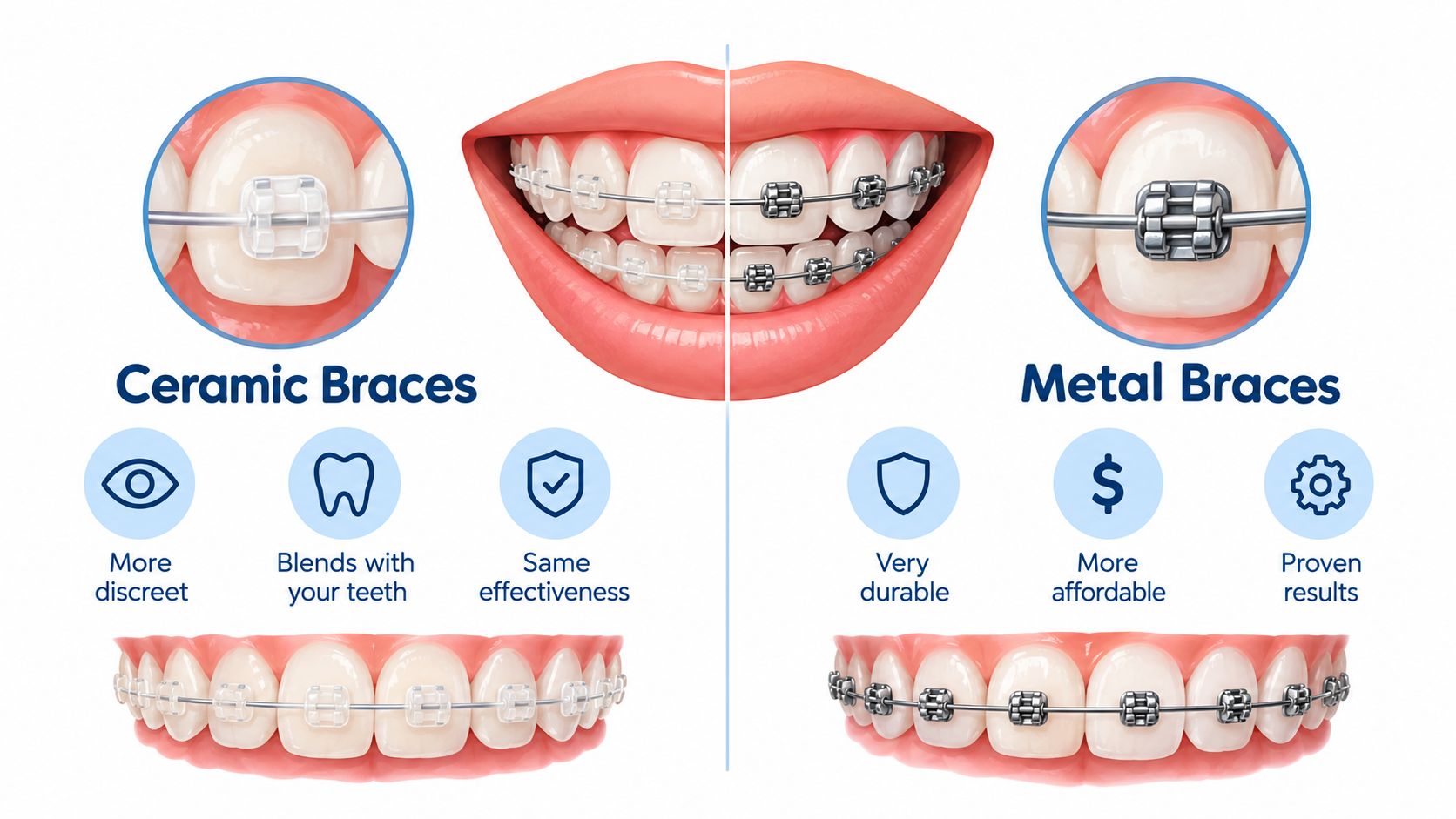
The bracket material changes how the appliance looks and how it behaves. Ceramic brackets are commonly made from tooth-colored or translucent alumina, while metal brackets use stainless steel. The wire and bonding process still do much of the orthodontic work, but the bracket slot, surface, and strength affect how that wire interacts with each tooth.
Ceramic braces became a mainstream aesthetic alternative to stainless-steel braces during the 1980s, with one orthodontic review identifying 1987 as a key introduction date. Early designs were more fragile, could fracture or lose tie-wings, and raised concerns about enamel damage during removal, as described in this orthodontic review of ceramic bracket history.
Material changes the trade-off
Modern ceramic systems have addressed some early weaknesses through improved designs and materials. That doesn't make ceramic universally superior. It means patients can consider a less noticeable fixed appliance while still needing to respect the material's limitations.
Metal brackets became the established reference because stainless steel offers high strength, predictable handling, and broad clinical use. Ceramic brackets prioritize appearance. That distinction matters most when the orthodontist needs to place stronger mechanics, manage heavy biting forces, or work in areas where a broken bracket would be difficult to repair.
Not every ceramic bracket behaves identically. Ask which design is being proposed:
- Conventional ceramic brackets use a ceramic slot and may create more resistance as the wire slides.
- Ceramic brackets with metal-reinforced slots combine a less visible bracket body with a metal contact surface.
- Metal self-ligating brackets use a built-in closure rather than a separate elastic tie, though their behavior still depends on the wire and alignment.
The slot material, ligation method, wire alloy, wire size, and angulation all influence friction. A label such as “ceramic” or “metal” doesn't tell the whole mechanical story.
Appearance is the reason many patients ask about ceramic braces. Material behavior is the reason an orthodontist may recommend them selectively.
Side-by-Side Comparison of Key Factors
Which trade-off matters most for your treatment: a less noticeable appliance, greater mechanical flexibility, or easier management if a bracket breaks? Ceramic and metal braces fit different patient situations, so the better choice depends on your bite, lifestyle, and treatment goals.
Appearance is ceramic's clearest advantage. Tooth-colored or translucent brackets blend more closely with the teeth, although the wire and ties remain visible. Metal brackets are more obvious, while some patients prefer their familiar appearance or choose colored ties to personalize treatment.
Durability depends on more than whether a bracket is ceramic or metal. Failure patterns vary with bracket design, tooth location, bonding technique, and patient factors. One 12-month comparison recorded 14 metal-bracket failures, or 7.2%, compared with 2 ceramic-bracket failures, or 1.1%, while another prospective trial found higher ceramic failure rates in particular locations. A later review found no statistically significant difference between the materials overall. Your orthodontist should therefore assess the proposed system and tooth position, rather than rely on the material label alone. The evidence is summarized in this clinical comparison of bracket failures.
For your schedule, the friction data matters less than it sounds. Friction is a laboratory measurement, not a promise about treatment length. In one in-vitro study, conventional ceramic brackets produced a static friction force of 4.34 N with a 0.014-inch round wire, while conventional metal brackets produced significantly less friction under the same conditions, according to this bracket friction study. Larger wires and greater wire-to-bracket angulation can increase resistance.
Treatment time remains case-specific. A review found no statistically significant difference in tooth-movement rate, approximately 0.66 mm per month for ceramic brackets versus 0.64 mm per month for metal brackets, as reported in this review of orthodontic tooth movement. Total treatment still depends on case complexity, cooperation, appointments, mechanics, and repairs.
| Criterion | Ceramic Braces | Metal Braces |
|---|---|---|
| Appearance | Tooth-colored or translucent, less noticeable | Clearly visible stainless steel |
| Durability | Improved modern designs, but more brittle | Strong and mechanically predictable |
| Friction | Can create greater wire resistance in some configurations | Often produces lower laboratory friction |
| Treatment movement | Comparable movement rates in available review evidence | Comparable movement rates in available review evidence |
| Repairs | May require careful management, especially in high-force areas | Often better suited to heavy biting forces |
| Cost factors | Material and repair considerations may increase overall expense | Often the more economical material option |
Choose ceramic when discretion matters and your bite places manageable demands on the appliance. Choose metal when durability, heavy-force mechanics, or easier repair decisions matter more. The right bracket is the one that suits the clinical demands of your case, not just the one that looks better in a photograph.
Daily Life With Braces and What the Numbers Mean
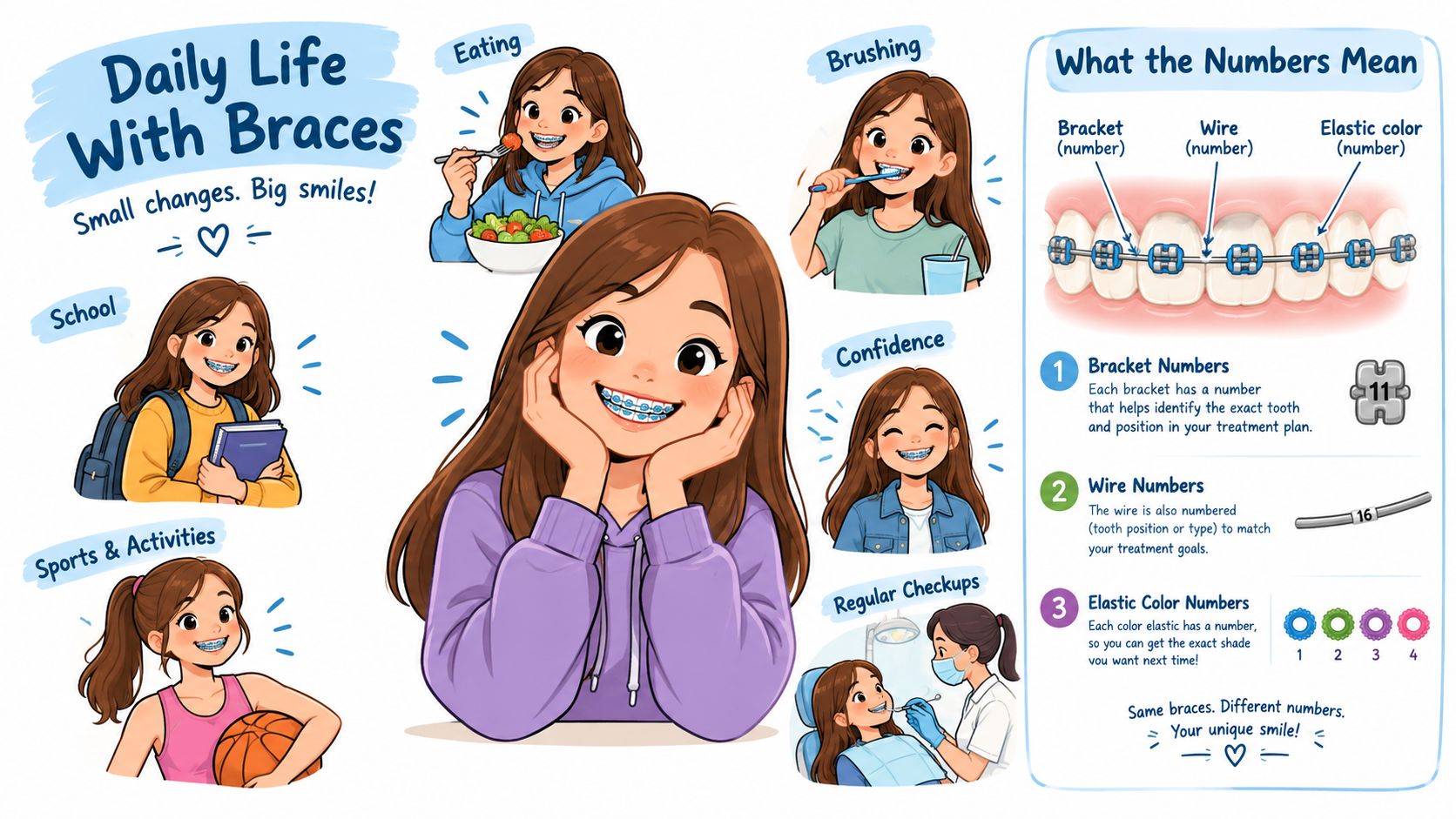
Your bracket choice changes more than your smile in photographs. It affects how carefully you clean, which foods you avoid, how you respond to a loose bracket, and how much inconvenience a repair could create.
Both appliances collect food around the brackets and wire. Brush carefully around every attachment, clean between teeth with the method your dental team recommends, and keep regular hygiene visits. Hard, sticky, and chewy foods can damage either type of braces, so your diet matters regardless of the material.
Ceramic brackets themselves aren't the only source of discoloration. Patients often notice staining in the adhesive or elastic ties around the bracket, especially when plaque or strongly colored foods remain around the appliance. Good cleaning habits help protect the appearance of ceramic treatment, but no bracket choice removes the need for daily care.
Repairs can affect the schedule
A prospective clinical study found a higher ceramic-bracket failure risk than stainless-steel brackets, with an adjusted hazard ratio of 1.62. The same study associated each additional failed bracket with approximately 0.6 months of extra treatment time, as reported in this prospective study of bracket failure and treatment duration.
Those figures describe a group of patients, not your guaranteed experience. Failure risk can change with enamel contamination, bite interference, diet, appliance design, bonding technique, and adherence to instructions. A loose bracket doesn't mean treatment has failed, but it can mean an additional visit and a temporary change in the treatment sequence.
That is why many orthodontists think about location, not just material. Ceramic may be appropriate on the upper front teeth, where visibility matters most. Metal may be preferable on posterior teeth or in the lower arch, where chewing forces and access can make a repair more consequential.
Friction affects planning
Ceramic friction results also have a practical implication. If the wire meets more resistance inside a ceramic slot, Dr. Finley may select a different bracket design, wire sequence, or movement strategy. Patients don't need to manage the mechanics themselves, but they should understand why two people with “ceramic braces” may receive different treatment plans.
A bracket that looks discreet still has to withstand the forces created by your bite and the movements planned for your teeth.
Who Each Option Is Best Suited For
A high school student in Santa Ana may care most about senior portraits, school presentations, and feeling comfortable smiling with friends. If the orthodontic plan allows it, ceramic brackets on visible upper teeth could reduce the appliance's visual presence. That student still needs to accept careful cleaning, sensible food choices, and the possibility that a repair could interrupt the schedule.
An adult professional in Costa Mesa or Irvine may make a similar choice for client meetings. Ceramic brackets can provide a more discreet appearance, but they aren't invisible, and the patient must be willing to protect them from hard foods and follow a thorough hygiene routine. For someone who values discretion and can manage those responsibilities, ceramic may be a reasonable fit.
A teen athlete in Tustin presents a different calculation. Contact, falls, mouthguard use, and strong biting forces can make bracket durability more important than appearance. Metal may be the more sensible option, particularly where a ceramic fracture or debonding event would create inconvenience or interfere with planned movement.
Then consider a patient in Garden Grove with substantial rotations, extraction spaces, or a difficult bite correction. The orthodontist may want the strongest mechanics available in selected areas. Ceramic may still be possible on some visible teeth, but metal brackets can provide a more forgiving foundation where forces and control matter most.
Why location matters
A 12-month clinical comparison found significantly higher ceramic failure rates in certain locations, particularly the lower arch and posterior areas, as described in this clinical study of bracket failure by location. That doesn't rule ceramic out. It explains why an orthodontist may avoid placing it everywhere.
A hybrid plan can balance priorities:
- Ceramic in front: Reduce visibility where people notice the appliance most.
- Metal in back: Add durability in areas exposed to greater chewing forces.
- Selective material use: Match the bracket to the movement and location rather than applying one material automatically.
Families from Santa Ana, Tustin, Irvine, Costa Mesa, and Garden Grove should ask where ceramic brackets would be placed and why. The answer may be different for a cosmetic alignment than for a bite correction.
Making the Decision and Preparing for Your Consultation
Start by choosing your top priority. Is it appearance, durability, complex movement, simpler maintenance, or controlling treatment-related costs? You can care about all of these, but identifying the one that matters most helps your orthodontist recommend a practical plan.
Next, review your routine:
- Think about activity. Contact sports and frequent impacts may favor metal in selected areas.
- Review your habits. If cleaning around brackets is already difficult, a less visible appliance won't solve the underlying problem.
- Consider your bite. Lower-arch and posterior forces may make ceramic less attractive for particular teeth.
- List your movements. Rotations, extraction spaces, and bite correction may require different mechanics from a straightforward alignment.
- Plan for repairs. Any loose bracket can create an extra appointment, regardless of how attractive the appliance looks.
No online guide can predict your individual failure risk or treatment duration. Enamel condition, bite interference, bonding conditions, archwire sequence, bracket design, diet, and appointment attendance all influence the course.
Bring practical questions to Bristol Dental & Orthodontics:
- Which ceramic and metal bracket systems are available?
- Would a hybrid arrangement make sense for my teeth?
- Which teeth would receive ceramic, and which would receive metal?
- How will the bracket design affect the planned wire sequence?
- What repair patterns has the practice seen in cases similar to mine?
- How will appearance goals be balanced against bite mechanics?
- Would Invisalign be appropriate for my alignment, or are fixed braces more suitable?
Dr. Andrew Finley and the team can recommend a specific plan only after examining your teeth, bite, and treatment needs. A consultation is the right place to discuss braces alongside other orthodontic and cosmetic options, including Invisalign, rather than choosing from appearance alone.
Questions Patients Ask Before Choosing
Do ceramic braces move teeth more slowly than metal braces?
A review found no statistically significant difference in tooth movement between ceramic and metal brackets, as discussed in this review of comparative tooth movement. Treatment length depends more on the movements required, attendance, cooperation, appliance mechanics, and repairs.
What happens when ceramic braces are removed?
The orthodontist debonds each bracket and cleans away the remaining adhesive. Ceramic is harder and more brittle than metal, so removal requires careful technique. Research has examined enamel effects, adhesive remnants, bond strength, and temperature changes during different methods in this systematic review of bracket removal techniques.
Will ceramic braces stain?
The ceramic bracket itself is not usually the main source of discoloration. Plaque, food, adhesive, and elastic ties can change the appearance around the appliance. Brush carefully and follow advice about foods and drinks to keep the brackets looking cleaner.
Can I use ceramic braces on top and metal braces on the bottom?
Yes. A mixed setup can suit patients who want less visible brackets on the upper front teeth while using metal where durability or bite clearance matters more. Your orthodontist must check the bite, planned movements, bracket design, and cleaning routine before recommending it.
Are ceramic braces worth the extra cost?
That depends on how much appearance matters during treatment and whether ceramic brackets fit your planned movements. Ask for the full fee, repair policy, retainer costs, and any difference between ceramic, metal, or mixed arrangements before choosing.
Bring these questions to Bristol Dental & Orthodontics in Santa Ana. The team can assess your smile, bite, and daily routine, then discuss fixed braces and other suitable options. Visit Bristol Dental and Orthodontics to request a consultation with Dr. Andrew Finley.