
“Wear your retainer for life” is familiar advice, but it answers only half of the question. How long do retainers last after braces can mean how long your teeth need support, or how long the physical retainer remains safe and effective. Those timelines aren't the same.
Your teeth can continue shifting after orthodontic treatment, even when your retainer looks perfectly fine. At the same time, plastic can crack, wire can detach, and an appliance can lose its fit. Understanding both timelines helps you replace a retainer when it needs attention without assuming that retention itself has an expiration date.
Table of Contents
- The Two Meanings of Retainer Lifespan
- Comparing Fixed and Removable Retainer Durability
- Hidden Factors That Shorten Retainer Life
- Clear Signs Your Retainer Needs Replacement
- Building a Realistic Long-Term Care Routine
- Protecting Your Smile with Professional Support
The Two Meanings of Retainer Lifespan
A retainer has two separate jobs. First, it holds teeth in their new positions after braces or Invisalign. Second, the appliance itself must remain intact, comfortable, clean, and accurately fitted.
The first job may continue for a very long time. A 2006 British Orthodontic Society systematic review reported that teeth can relapse after the initial post-treatment period, and noted that some clinicians recommend retention for longer periods, sometimes indefinitely, because stopping after a fixed period doesn't guarantee permanent stability. You can review the British Orthodontic Society evidence on orthodontic retention for the background.
That doesn't necessarily mean you'll wear a removable retainer all day forever. Many patients move from more frequent wear soon after treatment to a nighttime maintenance routine, but the exact transition depends on the original tooth movement, your bite, growth and aging, the retainer type, and your orthodontist's assessment.
Retention is not an expiration date
Think of retention as maintaining a result rather than completing a short course. The tissues around your teeth and normal forces from chewing, your bite, and aging can permit movement over time. A fixed period, such as one or two years, doesn't guarantee that your alignment will remain unchanged after you stop wearing a retainer.
The appliance has a different timeline. A clear tray may become distorted, a Hawley retainer may break or be lost, and a bonded wire may detach from one tooth while appearing secure elsewhere. In each case, the device may need repair or replacement even though your need for retention continues.
Practical rule: Don't ask only, “How old is my retainer?” Ask, “Does it still fit fully, stay secure, and remain in good condition?”
Comparing Fixed and Removable Retainer Durability
Retainer design changes both durability and responsibility. A fixed lingual retainer is bonded behind the teeth, so it doesn't rely on remembering to put it in at night. A removable retainer gives you easier access for cleaning, but it works only when you wear and protect it.
A retrospective analysis of 591 retainers found a median survival of 1,604 days, about 4.4 years, for lingual fixed retainers, followed by 1,529 days for Hawley removable retainers. Vacuum-formed retainers had a much shorter median survival of 105 days in that analysis. These are population findings, not personal expiration dates. The retainer survival analysis also used failure to include loss, breakage, detachment, repair, or replacement.
| Retainer Type | Average Physical Lifespan | Primary Failure Risks |
|---|---|---|
| Bonded lingual wire | Median 1,604 days, about 4.4 years in one analysis | Bonding failure, wire fracture or distortion, trapped plaque, unnoticed detachment |
| Hawley removable retainer | Median 1,529 days in one analysis | Loss, breakage, altered fit, damage from storage or handling |
| Clear vacuum-formed retainer | Median 105 days in one analysis | Cracking, warping, heat damage, chewing or grinding forces, loss of fit |
The table shows why a single answer such as “retainers last five years” can mislead. A well-cared-for appliance may remain useful longer, while another may fail sooner because of grinding, damage, loss, hygiene problems, or tooth movement.
Fixed doesn't mean maintenance-free
A bonded retainer can look normal while one end has loosened. That small failure can let a tooth move, especially if nobody checks the bond. Fixed wires also make brushing and flossing more demanding, so your daily cleaning routine matters.
Removable retainers have a different weakness: adherence. You must remember to wear them, keep them in a protective case, and bring them to appointments. If the tray no longer seats completely, don't assume you need to push harder. Ask an orthodontic professional to evaluate the fit.
Hidden Factors That Shorten Retainer Life
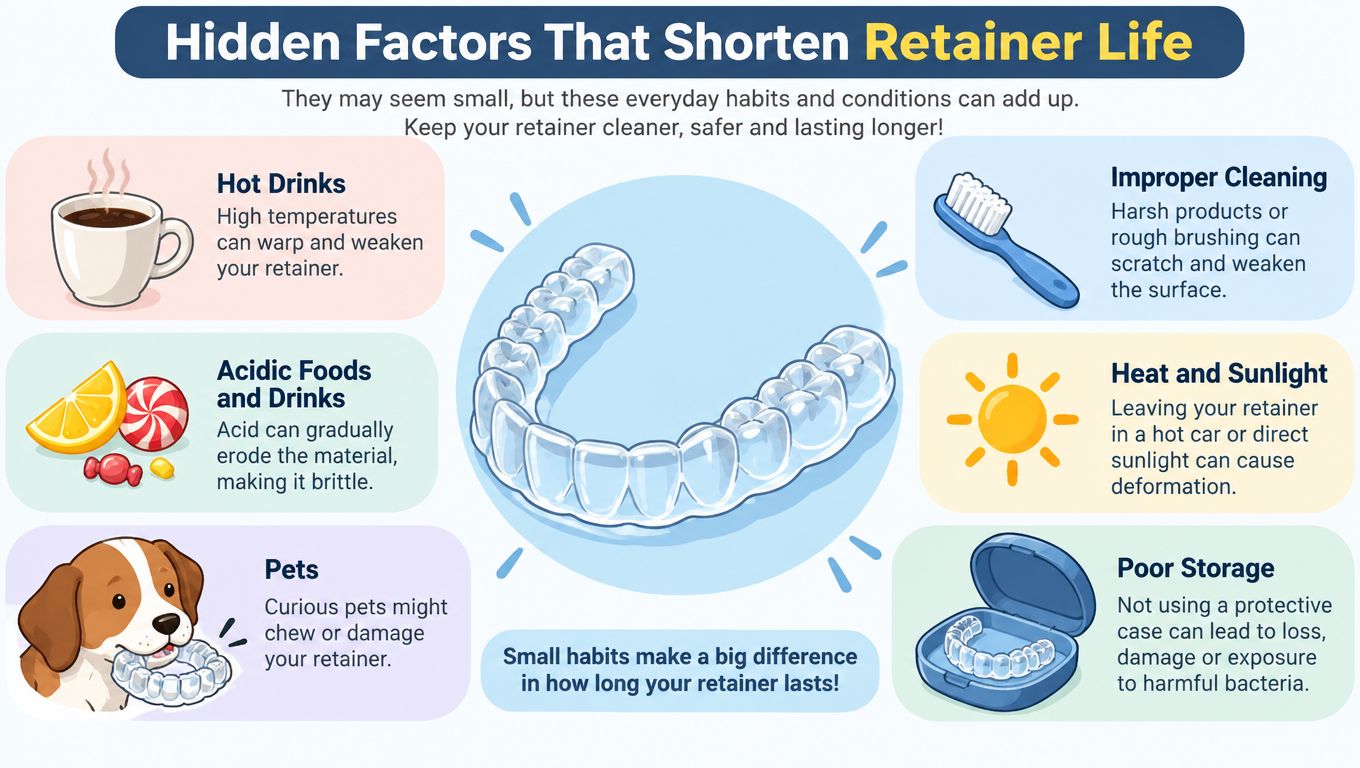
A retainer's material has limits, and everyday habits can expose it to more stress than it was designed to handle. Hot water can deform clear plastic. A pet can chew an appliance left on a nightstand. A loose retainer in a bag can bend, crack, or disappear.
Heat, pressure, and cleaning technique
Use the cleaning method recommended for your appliance. Very hot water can change the shape of clear plastic, while aggressive brushing can scratch its surface. Scratches and rough areas can make cleaning harder, so a gentle approach is usually more appropriate than treating the retainer like a dish that needs scrubbing.
Grinding deserves special attention. A laboratory study of vacuum-formed retainer materials tested 1,000 wear cycles and found that mean wear depth varied significantly by plastic type. The authors concluded that greater wear resistance may improve survival and cautioned that clear retainers may be unsuitable when they face substantial opposing biting forces, such as grinding. The laboratory research on vacuum-formed retainer wear doesn't predict exactly how long your appliance will last, but it explains why material and bite forces matter.
Your storage habit can be just as important as the material. Put a removable retainer in its case whenever it isn't in your mouth, keep it away from pets and hot surfaces, and don't wrap it in a napkin where it can be mistaken for trash.
Clear Signs Your Retainer Needs Replacement
Don't wait for a removable retainer to split in half or a bonded wire to fall completely away. A retainer can stop doing its job before the failure looks dramatic.
Check your appliance when you clean it. Contact your dental or orthodontic office if you notice:
- Cracks or distortion: A visible fracture, warped plastic, or changed shape can affect how evenly the appliance holds your teeth.
- An incomplete fit: A removable retainer that no longer seats fully may indicate appliance damage or tooth movement. Don't force it into place.
- Sharp or irritating edges: Rough plastic or a wire that suddenly feels sharp can injure soft tissue and needs assessment.
- Persistent odor: Odor that remains after appropriate cleaning may signal buildup or surface damage that makes the appliance difficult to keep clean.
- Loose bonding: If a fixed wire moves against a tooth, feels detached, or changes your bite, arrange an evaluation promptly.
- A new change in alignment: Crowding, a reopening space, or a bite that feels different deserves professional attention, even if the retainer appears intact.
A 2025 randomized clinical trial found that after 12 months, vacuum-formed retainers had a 60.9% failure rate, compared with 20.8% for bonded multi-strand wire retainers. The comparison shows why a retainer can fail mechanically before you notice obvious relapse, and the Cochrane evidence summary on maintaining tooth position explains the limitations around retention evidence.
A tight retainer isn't always a retainer that is “working better.” It may be telling you that the appliance or your tooth position needs evaluation.
If you miss wear and the retainer feels unusually tight, don't force it over shifted teeth. Keep the appliance and contact your orthodontic office for guidance. A professional may need to determine whether the retainer can still be used safely or whether a new appliance is appropriate.
Building a Realistic Long-Term Care Routine
Long-term retention succeeds when the routine fits your life. Your orthodontist may prescribe more frequent wear early in the retention phase, followed by nighttime or maintenance wear. Don't change that schedule independently just because the retainer feels comfortable.
A simple routine can prevent many avoidable problems:
- Create one storage location. Keep the case in the same place each morning, rather than setting the retainer on a counter, in a pocket, or beside a meal.
- Clean it consistently. Follow the cleaning instructions for your specific appliance, use a soft approach, and avoid exposing clear plastic to hot water.
- Build a reminder into an existing habit. Pair nighttime wear with brushing your teeth, charging your phone, or another routine you already follow.
- Bring the appliance to appointments. The clinician can assess fit, condition, hygiene, and the security of a bonded wire.
- Plan for replacement access. Know whom to contact if the retainer is lost, cracked, or suddenly doesn't fit.
Missing a few nights doesn't automatically mean your treatment has failed, but the right response depends on whether the retainer still fits and how much movement has occurred. Don't compensate by forcing it or inventing a new schedule. Contact the office if it feels painful, won't seat fully, or changes your bite.
Research involving university students found that 35% were no longer wearing retainers, with difficulty accessing replacements and declining adherence over time linked to practical difficulties and changing beliefs about relapse risk. The qualitative research on retainer adherence supports a realistic lesson: replacement access and reminders are part of retention care, not minor details.
Protecting Your Smile with Professional Support
A retainer is a long-term medical appliance, not a one-time accessory. Professional reviews can identify problems you can't see at home, including a fixed wire that has detached from one tooth while remaining attached to the others.
A long-term observational study found that 74.4% of retainers bonded across four incisors had no recorded failure over 10 to 15 years, while detachments were the most common first failure. The observational study of long-term fixed-retainer performance illustrates why an apparently intact wire still deserves periodic checks.
Dr. Andrew Finley and the team at Bristol Dental & Orthodontics can assess whether your current retainer remains secure, cleanable, comfortable, and appropriate for your bite and daily routine. A retention visit can also help families plan replacements, evaluate tooth movement after missed wear, and coordinate orthodontic care with broader needs such as Invisalign, dental implants, cosmetic dentistry, sleep apnea and oral appliance therapy, or emergency dentistry for Santa Ana patients and neighboring Orange County communities including Costa Mesa, Tustin, Irvine, and Garden Grove.
The right replacement schedule isn't based on age alone. It depends on condition, fit, appliance design, oral hygiene, bite forces, and whether the retainer continues to hold your teeth as intended.
Bristol Dental & Orthodontics provides personalized retainer evaluations and orthodontic guidance for children, teens, and adults in Santa Ana. If your appliance is cracked, loose, uncomfortable, or no longer fits fully, schedule a consultation by visiting Bristol Dental and Orthodontics.