
You've finished breakfast, checked the mirror, and spotted bread tucked beneath a wire. Your teeth feel brushed, but the edges of the brackets still look fuzzy. During your first week with braces, it's normal to wonder whether your usual routine is reaching everything.
Learning how to brush teeth with braces on means changing where you aim, not just brushing more often. Work above, directly over, and below every bracket, then clean the spaces your regular toothbrush can't reach. A deliberate route is more useful than scrubbing harder or racing against a timer.
Table of Contents
- Tools and Toothpastes to Keep on Hand
- How to Brush Around Brackets and Wires
- Interdental Cleaning and Common Mistakes
- Daily Brushing Schedule for Braces Wearers
- Know When to Schedule a Braces Check
Tools and Toothpastes to Keep on Hand
Start with a small-headed toothbrush, fluoride toothpaste, and appropriately sized interdental brushes. Keep a travel brush at school or work so cleaning doesn't depend on getting home first.
For everyday use, a soft-bristled manual or powered brush is a sensible starting point. Some orthodontic services recommend a small-headed manual brush with medium bristles, as described in this fixed-brace care guidance. Ask your orthodontic team which texture suits your gums rather than assuming firmer bristles will clean better.
Braces cleaning tools and what to look for
| Tool | What to Look For | What It Does With Braces |
|---|---|---|
| Manual toothbrush | Small head; soft-to-medium texture, with medium bristles if your clinician recommends them | Reaches behind and around brackets using small circular motions |
| Powered toothbrush | Replaceable head with a small brush area | Cleans each surface when held still near the gumline |
| Orthodontic toothbrush | Trimmed or V-shaped head designed around brackets | Helps position bristles at the gumline and above and below brackets |
| Interdental brush | Size recommended by the orthodontic team | Cleans accessible spaces between teeth and beneath the archwire |
| Floss threader | Stiff loop that passes floss under the wire | Lets floss reach between teeth without snagging on the wire |
| Fluoride toothpaste | About 1,350 to 1,500 ppm, consistent with hospital fixed-brace guidance | Supports enamel and serves as the everyday default |
| Fluoride mouthrinse or higher-strength paste | Use only after an individual risk review | Supplements brushing, never replaces it |
Choose for access, not extra force
A manual brush gives you direct control over the angle. A powered brush may make the movement easier, but you still have to position it around every bracket. Neither option excuses missed edges.
An orthodontic-shaped head is an option, not a requirement to buy another product. What matters is whether you can reach the gumline and bracket margins comfortably with the brush you have.
Interdental-brush size shouldn't be a guess. A brush that fits beneath one section of wire may not suit another space, and it shouldn't need to be forced through.
At a visit, Bristol Dental & Orthodontics in Santa Ana can demonstrate which sizes fit your braces and how to direct them safely. Bring your current tools so the team can assess what you're using before you buy more.
How to Brush Around Brackets and Wires
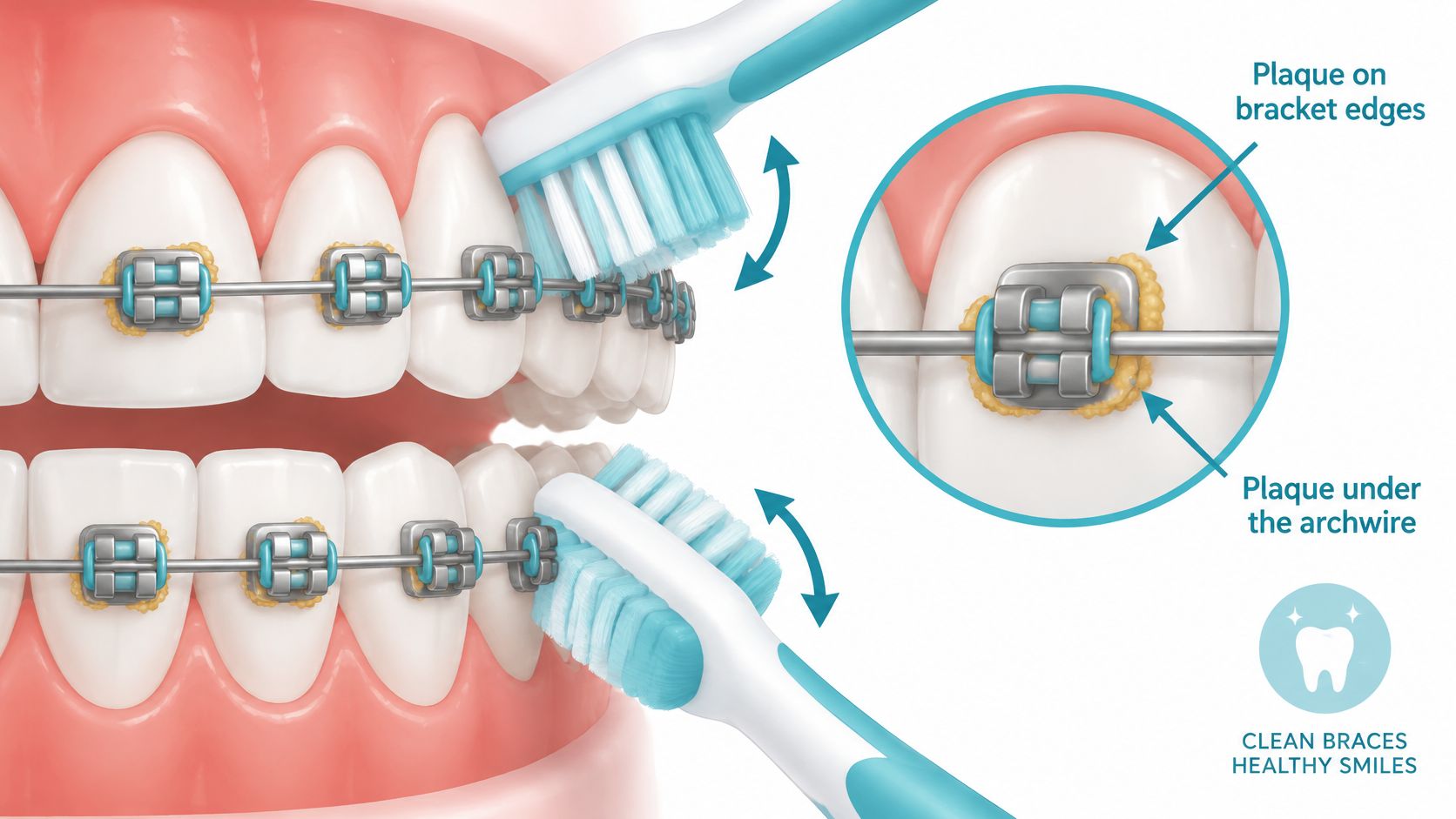
Brackets and wires create small ledges where plaque can collect. Sweeping across the front of your teeth may clean the broad surfaces while missing the narrow margins around the appliance.
The distinction matters. A systematic review of orthodontic oral-hygiene interventions reported that enamel demineralization and gingivitis associated with plaque buildup affected approximately 50% to 70% of patients with fixed appliances. That isn't a prediction for your mouth, but it explains why careful coverage deserves attention from the start.
Follow a bracket-by-bracket route
The following approach reflects hospital instructions for cleaning fixed braces, including small circular movements, careful powered-brush placement, and interdental cleaning while toothpaste remains in your mouth.
Stand at a mirror and remove permitted removable pieces. Take out elastics or other components only as your orthodontic team has shown you, so you can see and reach the appliance without disturbing fixed parts.
Rinse away loose food, then apply fluoride toothpaste. A pea-sized amount is recommended in the hospital instructions linked above; rinsing first clears larger pieces that would otherwise get in your way.
Start at the gumline above each bracket. Angle the bristles toward the gums and clean the narrow strip between the gum margin and the bracket, rather than placing the brush only on the metal.
Brush directly over the bracket and archwire. Reposition the head so the bristles contact the appliance and surrounding tooth surface instead of sliding across the outside.
Angle below each bracket toward the chewing surface. Clean along the lower bracket edge, where an otherwise thorough-looking brushing session can leave a missed strip.
Cover the remaining tooth surfaces. Brush the chewing surfaces, exposed cheek-facing areas, and tongue-facing surfaces, including the back teeth that are harder to see.
Match your movement to your toothbrush. Use small circles with a manual brush; with a powered brush, hold the head on each surface and let it work instead of adding a vigorous scrubbing motion.
Keep the toothpaste in your mouth for interdental cleaning. Don't spit yet, because the smaller brush can work around the brackets while fluoride toothpaste is still present.
Use coverage as your checkpoint
Move through the mouth in the same order each time. For example, finish the outside of the upper teeth before switching to their inside surfaces, rather than jumping between whichever brackets catch your eye.
Practical rule: Reposition the brush before increasing pressure. A missed edge usually needs a better angle, not a harder scrub.
Use light, controlled pressure. If you're pushing the brush against the wire or rubbing the gums aggressively, pause and reset your grip.
A timer can support the routine, but it can't tell you which bracket you skipped. Ask Dr. Andrew Finley to watch your sequence at a visit, especially if a particular corner feels impossible to reach.
Interdental Cleaning and Common Mistakes
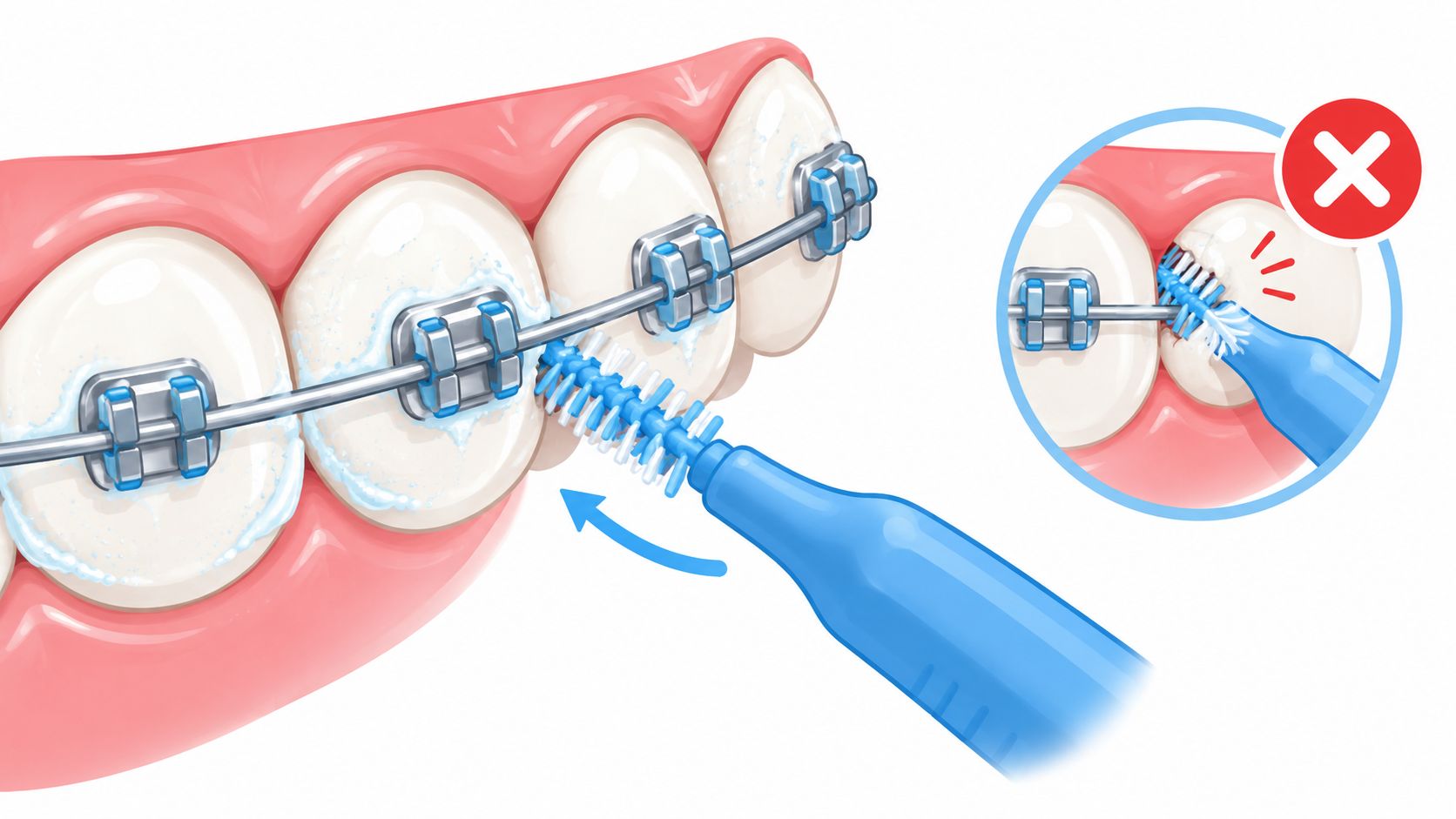
Food can sit beneath the wire or beside a bracket even after the visible tooth surfaces feel clean. Use an interdental brush to reach these smaller areas, choosing a size that fits the space without force. If it catches or meets resistance, stop and reassess rather than pushing it through.
Clean beneath the wire and between teeth
Choose the recommended brush size. Use the size your orthodontic team selected for the space. A brush that is too large may catch, while one that is too small may not clean the area effectively.
Guide the brush between the tooth and archwire with a controlled movement. Keep it clear of the gums, and avoid using the wire as a support to push against.
Work around each bracket and along the arch. Clean the spaces on both sides of each bracket, then continue in the same direction so no area is skipped.
To floss, pass the floss threader beneath the wire and guide the floss between the teeth. Move it gently up and down, then use a clean section for the next space.
If a brush or floss catches, stop and reposition it. Pulling sharply can irritate tissue or put pressure on the appliance. If you cannot pass the tool through comfortably, ask your orthodontic team to check the fit and show you another approach.
The four-week randomized trial involving patients with fixed appliances reported lower plaque levels with a combined routine of a powered brush, irrigator, and mouthrinse than with the comparison routine. The results apply to that combination, so they do not establish what any one device will do on its own.
Mistakes that leave areas unclean
The small spaces beside brackets and between teeth need a tool that fits and a route you can repeat. Watch for these problems:
- Using the wrong brush size: If it will not enter the space easily, do not push. Try the size recommended for that area or ask your orthodontic team to check.
- Forcing a tight contact: Resistance can mean the brush is too large or floss is a better fit. Stop and get guidance if you are unsure which tool to use.
- Skipping the spaces beneath the wire: Look closely at both sides of each bracket as you work around the arch. A quick look at the front of your teeth cannot confirm that these spaces are clean.
- Stopping when the front teeth feel smooth: Continue through the planned route. A smooth surface does not tell you whether food or plaque remains beside a bracket or between teeth.
When another cleaning aid may help
An irrigator or rinse may help when you are having difficulty managing plaque around the appliance. Use it as an addition to direct cleaning, not as a substitute for reaching around brackets and between teeth.
A new device is useful only if it helps you clean an area you're currently missing.
After cleaning between teeth, spit out the toothpaste without rinsing. Bring your toothbrush and interdental brushes to your visit at Bristol Dental & Orthodontics. The team can check that the brush sizes fit and help you adjust any steps that are difficult.
Daily Brushing Schedule for Braces Wearers
A sandwich eaten between classes can leave crumbs tucked under a wire, even when the front teeth look clear. Set a morning and bedtime routine, then plan how to handle meals and snacks away from home. Focus on cleaning above, over, and below each bracket; technique matters more than adding extra brushing without a clear route.
The American Dental Association's home-care guidance recommends brushing twice daily for two minutes with fluoride toothpaste. Use that schedule as your baseline, and make sure your route reaches all three zones around every bracket.
Braces brushing schedule by time of day
| Time | What to Do | Why It Matters |
|---|---|---|
| After breakfast | Brush with fluoride toothpaste, then clean between the teeth | Clears morning food and plaque around the appliance |
| After lunch or snacks | Brush if you can; otherwise rinse with water and carefully clear trapped food | Removes visible debris before it sits around brackets until evening |
| After acidic or sugary foods and drinks | Rinse with water and wait before brushing | Gives softened enamel time before brushing |
| Before bed | Complete the full routine, including interdental cleaning; spit without rinsing | Leaves fluoride on the teeth |
The NHS guidance for people wearing braces recommends brushing with fluoride toothpaste in the morning, at night, and after meals, as well as cleaning between teeth daily. Keep a travel kit available for school, work, or activities so you can brush when it's practical.
Make the schedule realistic
After acidic or sugary food and drinks, wait about 30 minutes before brushing, as the American Dental Association's home-care guidance advises. Your clinician may recommend a longer interval based on your needs, so follow their instructions.
For busy days: Rinse with water to loosen food when brushing isn't possible. Complete your full routine later.
For a child, a parent can check each bracket after brushing: look above, across, and below it for visible food or plaque. Guide the child to revisit missed spots, then gradually let them manage the route independently. A teen with a sandwich caught under a wire can rinse, clear what they can, and brush after school if a toothbrush isn't available.
This schedule is a starting point. Dr. Andrew Finley at Bristol Dental & Orthodontics can adjust it to your appliance, oral-health needs, and daily routine.
Know When to Schedule a Braces Check
Bleeding when you first clean around brackets can signal gum inflammation. Keep cleaning gently, and contact your orthodontic office if bleeding persists or worsens. While waiting for advice, use a soft brush and light pressure, and avoid skipping the areas that bleed.
Signs that deserve an appointment
- Bleeding that continues: Call if it persists despite careful cleaning, especially if it worsens or occurs with other symptoms.
- Swelling or pain: Ask the team to assess symptoms that make cleaning difficult or do not settle.
- Loose or irritating hardware: Report a loose bracket or band, or a wire poking your cheek.
- New white spots or repeated food trapping: Arrange a review if white spots appear or spread, or food repeatedly catches in the same area.
Ask before adding stronger fluoride
Fluoride mouthrinse or prescription-strength toothpaste may suit some patients, but they are not necessary for everyone. A systematic review of fluoride mouthrinse during fixed orthodontic treatment found a small additional benefit alongside fluoride toothpaste, with insufficient evidence for a general recommendation.
Ask your clinician about prevention suited to your needs if you have had cavities, visible white-spot changes, dry mouth, frequent sugar or acid exposure, or trouble cleaning around brackets. Children should use prescription-strength toothpaste only with professional instruction.
Schedule a braces check with Dr. Andrew Finley at Bristol Dental & Orthodontics on South Bristol Street in Santa Ana, serving Costa Mesa, Tustin, Irvine, and Garden Grove. You can also ask whether clear aligners suit your situation.
Bristol Dental & Orthodontics offers family dental care and orthodontic guidance for cleaning around braces. Visit Bristol Dental and Orthodontics to schedule a consultation with Dr. Andrew Finley. Bring your cleaning tools so you can review your technique together.