

Most clear aligner plans call for roughly 20 to 22 hours a day, and the American Association of Orthodontists advises at least 22 hours, with removal only for eating, drinking anything other than water, brushing, and flossing. Your treating orthodontist's prescription takes priority over a general guideline.
You might be reading this with your trays beside a half-finished coffee, wondering whether to put them back in or wait until lunch. That's where aligner wear becomes challenging: not during sleep, but during the small interruptions that stretch across a busy day. A workable routine needs to account for those interruptions without sacrificing meals or oral hygiene.
Table of Contents
- What the 20 to 22 Hour Daily Target Means
- Why Consistent Wear Keeps Treatment on Track
- Building a Daily Wear Routine Around Meals and Hygiene
- Shorter Wear Schedules and Other Exceptions
- Troubleshooting Low Wear Time and Poor Fit
- Next Steps for Staying on Track in Santa Ana
What the 20 to 22 Hour Daily Target Means
Nearly full-time wear is the clearest way to understand the recommendation. Standard guidance places clear aligner wear at approximately 20 to 22 hours daily, while the American Association of Orthodontists recommends at least 22 hours, leaving roughly 2 hours for meals, non-water drinks, and cleaning your teeth, as summarized in this review of clear aligner wear guidance.
That allowance isn't just eating time. It includes the period between finishing breakfast and brushing, the coffee you carry into work, and any delay before reinserting your trays. Those gaps deserve attention, but you shouldn't rush meals or skip flossing to protect a wear-time total.
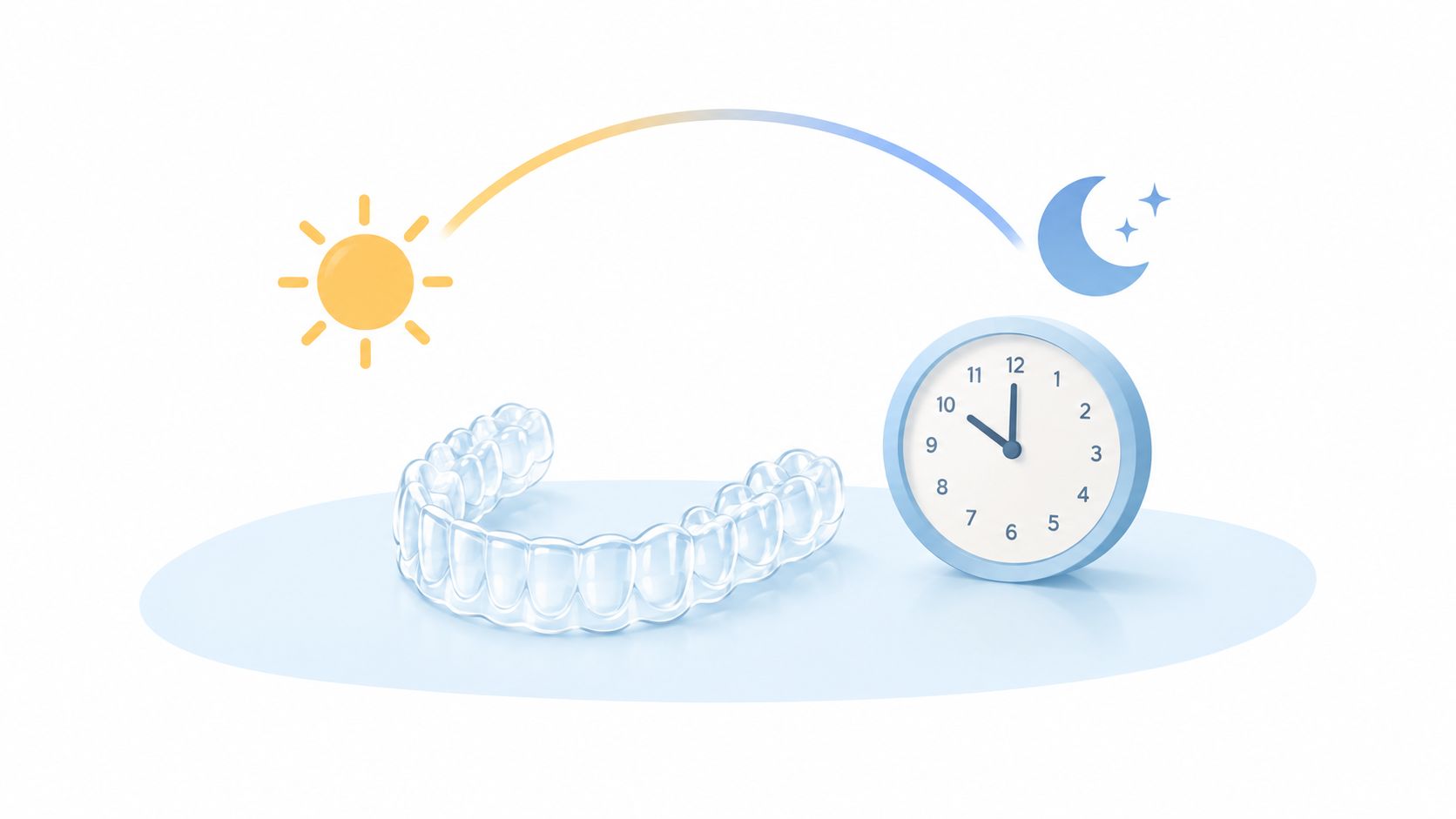
Think in terms of necessary removal
Aligners apply tooth-moving forces only while they're in your mouth. Leaving them on the bathroom counter doesn't contribute to the planned movement, even if you remember to wear them overnight. The wear guidance above describes a near-continuous schedule, not an overnight-only approach.
Use the prescription from your treating clinician to decide:
- When trays come out: Reserve removal for meals, non-water drinks, and oral hygiene unless you've been told otherwise.
- When trays go back in: Make reinsertion part of finishing your cleaning routine, rather than something you'll remember later.
- Which instructions control: Follow your own treatment plan if its wear or tray-change directions differ from general advice.
For a typical Santa Ana weekday, that means wearing trays during the commute, at school or work, through errands, and overnight. Meals and cleaning are the planned interruptions, not the stretches between activities.
Practical rule: Build your day around wearing your aligners, with deliberate breaks for eating and cleaning, rather than trying to fit wear around everything else.
Why Consistent Wear Keeps Treatment on Track
Being able to remove aligners is convenient. It also puts a meaningful part of treatment in the patient's hands. Understanding the schedule and following it consistently are different challenges, especially when work, family meals, and changing routines compete for attention.
A 2024 scoping review reported that a study involving 2,644 patients found only 36% followed their prescribed daily aligner wear; it also noted nonadherence as high as 92% in some orthodontic settings, as described in the provided aligner adherence and treatment overview. Those figures describe particular research settings, not your personal likelihood of having difficulty. They show why practical support matters alongside treatment instructions.
Each tray is part of a sequence
The same treatment overview traces Invisalign development to March 1997, market clearance from the U.S. Food and Drug Administration to September 1998, and commercial introduction to 1999. It describes sequential tooth movement and tray changes typically occurring about weekly, according to current professional guidance.
The important point for patients isn't the product's age. It's that each tray belongs to a progression. A date on the calendar tells you when a change is planned, but it doesn't establish that your teeth have completed the movement needed for the next tray.
Wear time and tray fit belong together. If you regularly leave trays out, advancing through the sequence doesn't automatically make up for that missing wear. Your clinician may need to reassess the schedule or the trays rather than asking you to continue as though nothing changed.
A tray-change date is an instruction within a treatment plan, not proof that the current tray has finished its job.
Consistency doesn't require pretending that busy days won't happen. It requires noticing when your routine isn't supporting the prescription and discussing that openly with your treating team. That conversation is more useful than guessing at your wear time or feeling embarrassed about it.
Building a Daily Wear Routine Around Meals and Hygiene
Start the morning with a clear endpoint: breakfast, oral hygiene, then trays back in. If you drink coffee with breakfast, consider finishing it within that meal rather than carrying it through the morning. The goal isn't to eliminate enjoyable routines, but to avoid turning a short removal into an open-ended break.
The American Association of Orthodontists advises removing aligners for food and anything except tap water, then cleaning teeth before reinsertion. Its guidance on eating and drinking with clear aligners explains that soft drinks, flavored water, and sports drinks may contain acid, sugar, or both; liquid trapped around covered teeth can contribute to staining and decay.

Where a weekday tends to slip
Consider a commuter with a short lunch break. Eating may be straightforward, but finding a place to brush can be the obstacle. Packing a toothbrush, floss, and the aligner case makes the intended sequence easier: remove, eat, clean, reinsert. Waiting until the commute home because the trays are already out is the habit to avoid.
A parent moving between school pickups may face a different problem: repeated snacks. Instead of grazing throughout the afternoon, plan a defined snack break when practical. That doesn't mean skipping food you need. It means recognizing that every snack creates another removal, cleaning, and reinsertion decision.
Try making the transitions more visible:
- At work: Keep cleaning supplies with your lunch bag rather than in a drawer you rarely open.
- During errands: Bring the case and supplies before leaving home, even if you don't expect to eat.
- At bedtime: Brush, floss, insert your trays, and keep the case within reach for the next morning.
Don't solve the wear-time problem by sipping sugary drinks with your trays in. That trades a scheduling difficulty for an oral-health concern.
Dr. Andrew Finley at Bristol Dental & Orthodontics can review your actual routine, including commuting, family meals, and access to brushing facilities. Bring the inconvenient details. They're exactly what a useful wear plan needs to address.
Shorter Wear Schedules and Other Exceptions
A shorter schedule can sound appealing when you're struggling to fit aligners around daily life. There is emerging evidence worth discussing, but it doesn't establish that part-time wear is interchangeable with a conventional prescription.
A 2025 randomized clinical trial of 50 adults compared 22-hour and 12-hour daily wear. The reduced-wear group achieved comparable changes in several measures, including distances between canine and molar teeth, overjet, and overbite, but the longer-wear group had significantly better correction of lower-front-tooth crowding, according to the trial's published research record.
Wear Time Options and What the Evidence Shows
The comparison below summarizes that trial rather than prescribing a schedule for readers.
| Daily wear pattern | What the evidence describes | Practical takeaway |
|---|---|---|
| Standard near-full-time wear | Better correction of lower-front-tooth crowding in the trial | Don't shorten a prescribed schedule because another patient wears trays less |
| Clinician-directed reduced wear | Comparable changes for some measured outcomes in selected adults | Suitability depends on the movements being treated |
| Self-directed intermittent wear | Not equivalent to the monitored reduced-wear protocol | Unplanned removals shouldn't be treated as an evidence-based alternative |
Comparable findings for some measurements don't mean equivalent treatment for every patient. The trial was small and procedure-specific. Its findings don't justify changing your own prescription, particularly when lower-front alignment is part of the treatment.
What an individualized decision involves
A clinician needs to consider the tooth movements planned, the appliance system, the current fit, and how progress will be monitored. A schedule that may be workable for a selected movement may be less suitable for another. Reduced wear may also mean less efficient correction or a longer treatment course rather than the same treatment with less effort.
For patients in Santa Ana, Costa Mesa, and Tustin, Bristol Dental & Orthodontics reviews these questions individually. Ask whether your plan allows any flexibility and what signs would require reassessment. Until your treating clinician changes the prescription, follow the schedule you were given.
Troubleshooting Low Wear Time and Poor Fit
Missing an evening isn't the same as repeatedly leaving trays out for long stretches. Both deserve attention, but the response should account for the pattern and the current fit rather than treating every lapse as a reason to panic.
A 2025 systematic review summarized a cohort in which only 36% met the recommendation of at least 22 hours daily, while approximately one-quarter showed poor compliance. The review of clear aligner compliance and treatment outcomes also connects lower wear with risks such as incomplete tracking and longer treatment.
Check fit before assuming you can catch up
Watch for changes that are worth reporting:
- Incomplete seating: The tray doesn't sit fully over the teeth.
- Tracking gaps: Visible spaces develop between the tray and teeth.
- Persistent tightness: Fit remains concerning instead of settling as expected.
- Repeated schedule extensions: You keep delaying changes because the current aligner doesn't feel right.
An isolated lapse generally calls for returning promptly to the prescribed routine, provided the tray seats appropriately. Recurring missed wear calls for a closer look at why it's happening. Don't independently advance trays or decide how much extra time will compensate.
Fit matters: Forcing a poorly tracking aligner isn't a reliable way to recover missed wear.
Respond to the problem, not just the calendar
For example, suppose a patient skips a night because the tray feels tight. The next step isn't to force the following tray into place or assume a longer session will fix everything. Check whether the current tray seats, explain the missed wear and tightness to the treating team, and ask what to do before advancing.
A longitudinal review of adherence patterns supports distinguishing occasional deviations from an ongoing pattern and cautions against assuming catch-up wear will restore planned movement. Contact your clinician if fit doesn't improve, and use seating aids only when directed. Honest information about missed wear helps the team make a safer, more useful recommendation.
Next Steps for Staying on Track in Santa Ana
The useful answer to how many hours a day to wear aligners combines the prescribed target with a routine you can realistically sustain. Necessary meal and hygiene breaks should be planned, shorter schedules should be clinician-directed, and fit concerns shouldn't be dismissed because a tray-change date has arrived.
Before your next appointment, record your wear for a few days without trying to make the record look perfect. Note when trays come out, when they go back in, and what happened during longer breaks. Include practical obstacles such as an extended coffee, a missed brushing opportunity, or trays left at home.
Bring a routine, not just an estimate
Use that record to prepare questions:
- Daily interruptions: Which parts of your routine need a more workable plan?
- Tray fit: Have you noticed gaps, persistent tightness, or difficulty seating a tray?
- Upcoming changes: Will travel, school, or a new work schedule make adherence harder?
- Clinical decisions: Should your wear or tray-change instructions be reassessed?
Bristol Dental & Orthodontics is a family and cosmetic dental practice on South Bristol Street in Santa Ana, led by Dr. Andrew Finley. The team serves patients from Santa Ana and surrounding Orange County communities, including Costa Mesa, Tustin, Irvine, and Garden Grove.
Each case is individual, so a consultation should focus on your prescribed movements, current trays, and daily constraints rather than a promised timeline. This educational guidance doesn't replace individualized advice. Dr. Finley must review this article before publication.
Make reinsertion part of finishing meals and oral hygiene, and ask your treating team before changing the plan.
Bristol Dental & Orthodontics offers Invisalign and orthodontic care with guidance on daily wear, tray fit, and treatment routines. Visit Bristol Dental and Orthodontics to schedule a consultation with Dr. Andrew Finley and discuss a plan that accounts for your teeth and your everyday schedule.