
If you're researching dental implant cost, you may already be in a familiar spot. You lost a tooth, or you know one may need to come out. You started searching online, saw a wide range of quotes, and ended up with more questions than answers.
That confusion is normal. One office may advertise a starting price, another may describe a full treatment fee, and a third may be talking about a different kind of restoration entirely. For many patients in Santa Ana, Costa Mesa, Tustin, Irvine, and Garden Grove, the hardest part isn't deciding whether they want a long-term solution. It's understanding what they're paying for.
Dr. Andrew Finley reviews every educational article before publishing because dental decisions deserve clarity, not guesswork. This guide is written to help you understand why implant quotes vary, what should be included, and how to evaluate value, not just the lowest number on a page.
Table of Contents
- Thinking About Dental Implants
- What Is Included in a Dental Implant Price
- Key Factors That Influence the Final Cost
- Comparing Implants to Bridges and Dentures
- Navigating Insurance Coverage and Financing
- Your Dental Implant Journey What to Expect
- Schedule Your Personalized Consultation in Santa Ana
Thinking About Dental Implants
A patient often starts with one practical question: "How much is this going to cost me?" That makes sense. Replacing a missing tooth isn't a small decision, and patients want to understand the financial side before they commit to anything.
But dental implants don't work like buying a single item off a shelf. They're closer to rebuilding one part of a home. Before you can put in the visible piece, someone has to check the foundation, confirm the measurements, and make sure the final result fits the structure around it.
That helps explain why a quick online number can feel incomplete. A simple case may involve fewer steps. A more complex case may need imaging, site preparation, or treatment before the implant can be placed safely.
Practical rule: If two implant quotes are very different, don't assume one is a bargain and the other is overpriced. First ask whether they're describing the same treatment.
For some patients, the concern is appearance. They don't want a gap to show when they smile. Others are thinking about function. They want to chew comfortably again, protect nearby teeth, or avoid a removable option if possible.
Those are all reasonable goals. Dental implants are often chosen because they can replace a missing tooth in a way that feels stable and natural-looking, but candidacy depends on factors such as bone support, gum health, and overall oral condition. That's why an in-person evaluation matters so much.
A calm, useful consultation should leave you with answers to questions like these:
- What's included: Is the quote for the full tooth replacement or only part of it?
- What's missing: Are scans, extractions, grafting, sedation, or follow-up visits separate?
- What's custom: Will the final crown be designed specifically for your bite and smile?
- What's realistic: Is this a straightforward case, or does your mouth need preparation first?
When patients understand the parts of the process, the cost starts to make more sense. That's where the conversation becomes much less overwhelming.
What Is Included in a Dental Implant Price
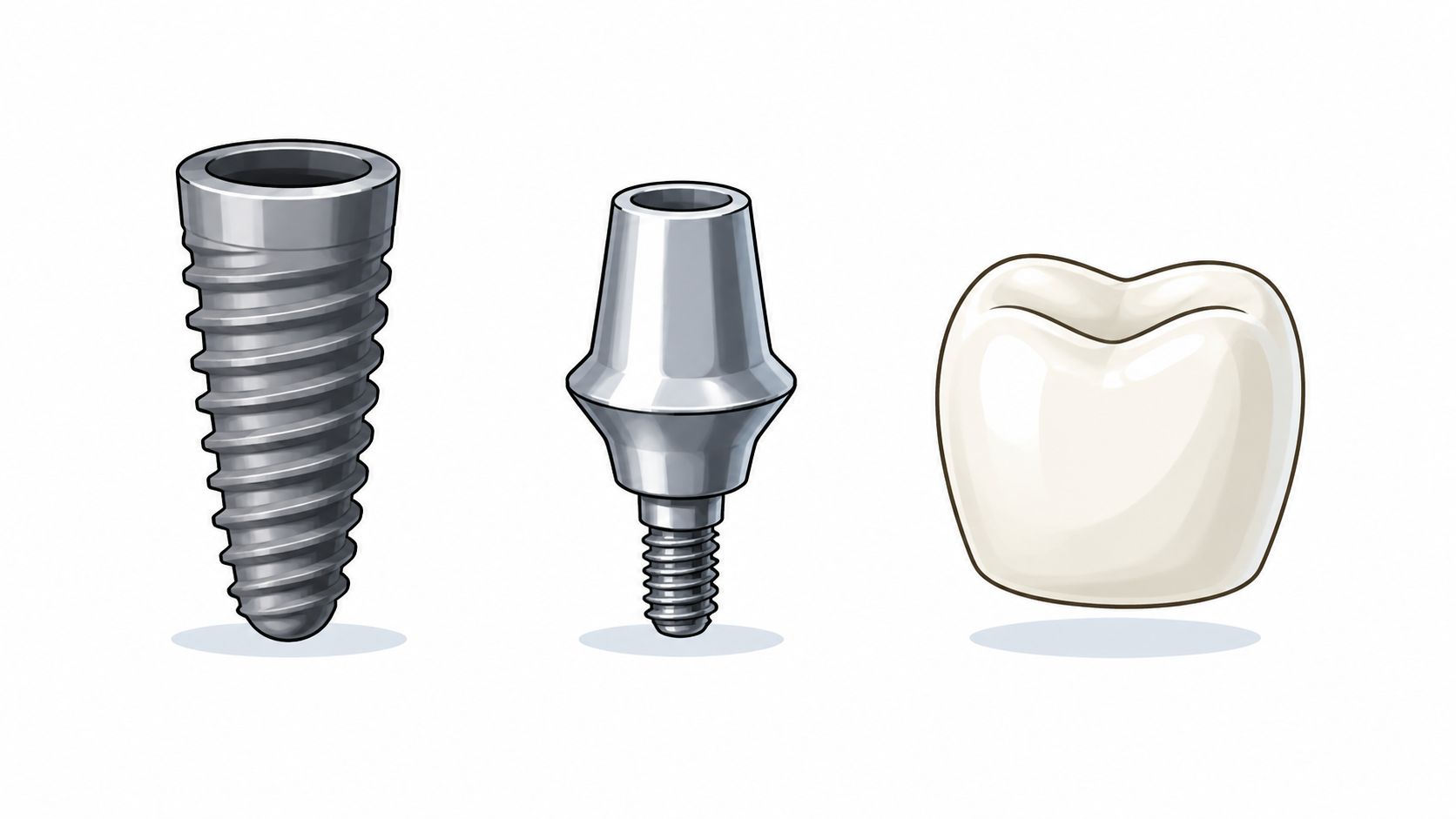
A single implant isn't one object. It's a small system made of separate parts that work together. According to the American Academy of Implant Dentistry overview of implant costs, the total cost of a single-tooth dental implant is a composite of three key components: the implant post (a screw-like fixture), the abutment (a connector piece), and the crown (the prosthetic tooth), with the specific material chosen for the crown being a significant variable in the final investment.
The three parts of one replacement tooth
A helpful analogy is a custom table.
The part below the floor has to be secure. The support in the middle has to connect properly. The visible top has to look right and function well. If any one part is weak or poorly fitted, the whole piece suffers.
A dental implant works the same way:
- Implant post: This is the screw-like portion placed in the jawbone. It's the foundation.
- Abutment: This is the connector between the implant and the visible tooth.
- Crown: This is the part people see. It's shaped and shaded to blend with the surrounding teeth.
When a patient sees an ad for implant pricing, the confusion often comes from not knowing which of those pieces the office is talking about. Some quotes refer mainly to the surgical part. Others include the restoration. Others bundle multiple visits into one total.
That distinction matters. You're not only paying for a device. You're paying for diagnosis, planning, surgery, healing oversight, and the custom restoration that finishes the case.
Why the crown changes the total
The crown isn't just a cap placed at the end. It's the part that has to match your smile and your bite. It also has to tolerate daily chewing forces.
That means the visible tooth is both cosmetic and functional. Materials, esthetic goals, and how much customization the case needs can affect the final dental implant cost.
A useful question to ask is, "Does this quote include the post, the abutment, and the final crown, or only one phase of treatment?"
Patients are often relieved when they learn this, because it explains why "implant cost" isn't a single universal number. It also gives them better questions for a consultation.
Here are the basics to confirm before comparing treatment plans:
| What to confirm | Why it matters |
|---|---|
| Surgery included or separate | Some estimates describe placement only |
| Abutment included or separate | This connector is essential, not optional |
| Final crown included | The visible tooth may be billed as its own step |
| Lab customization included | Shade, shape, and bite design affect the final restoration |
| Follow-up visits included | Healing checks and restoration visits may be part of the total |
If you understand the components first, the rest of the pricing conversation gets much easier.
Key Factors That Influence the Final Cost
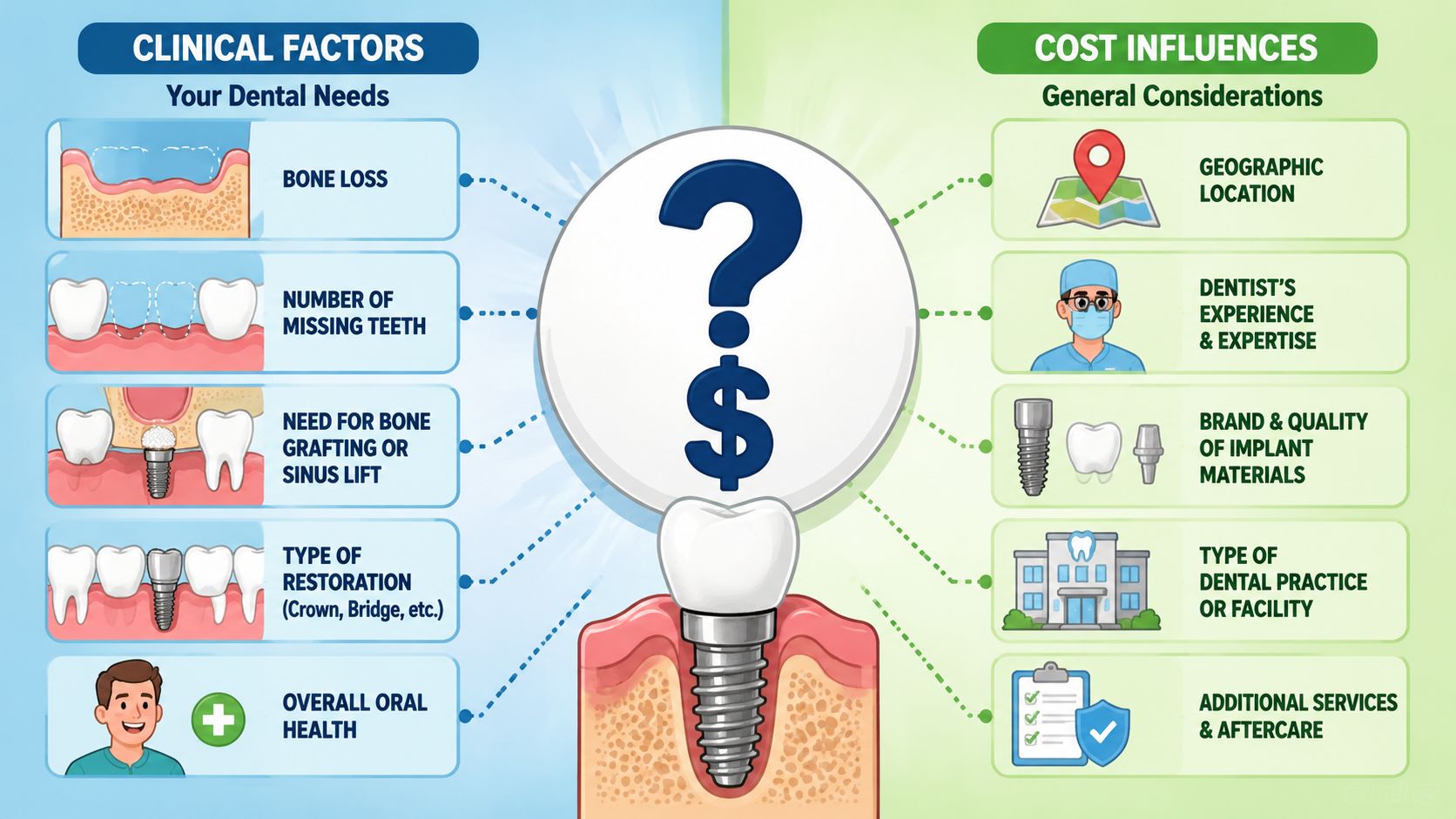
A dental implant quote changes for two broad reasons. First, every mouth is different. Second, every office doesn't plan and deliver care the same way.
Your mouth determines the starting point
The biggest variable is often what has to happen before the implant itself.
According to Real Dental Costs' discussion of hidden implant expenses, a patient's final quote can increase significantly when necessary preparatory procedures are included, such as diagnostic 3D scans, bone grafting to ensure a solid foundation for the implant, sedation for comfort, or extractions of failing teeth, which are often not included in an initial base price.
Consider the process of placing a fence post. If the ground is solid and ready, the job is simpler. If the soil needs reinforcement first, the project becomes more involved.
Common reasons a quote changes include:
- Bone support: If the area has lost bone after a tooth has been missing for a while, grafting may be needed.
- Tooth removal first: A damaged or failing tooth may need to be extracted before implant treatment can move forward.
- Comfort measures: Some patients want sedation or need it for a smoother experience.
- Site-specific anatomy: The amount of space, gum contour, and bite pressure can all affect complexity.
None of that means something is wrong. It usually means the treatment is being customized for your actual condition rather than forced into a one-price-fits-all package.
Technology and planning affect the quote
Planning matters as much as the implant itself. A careful workup helps the dentist see where the bone is, where nearby structures are located, and how the final tooth should function once treatment is complete.
That planning may include digital X-rays and 3D imaging. These tools can add to the total, but they also help make treatment more precise and safer to plan.
A lower quote isn't always lower for the reason patients hope. Sometimes it simply leaves out the planning steps that give the dentist a clearer map.
Material quality also plays a role. The visible restoration isn't only about appearance. It has to fit your bite, hold up under use, and integrate with the rest of the treatment plan.
Why Orange County quotes may not match other areas
Patients in Santa Ana often compare local quotes with prices they found elsewhere online. That's understandable, but it can be misleading.
Orange County practices may differ in overhead, technology, lab relationships, and how thoroughly they build treatment into one quote. A simple listing from another region may not reflect the same standard of diagnostics or the same assumptions about what's included.
The most useful comparison isn't local versus national. It's this:
- What treatment is being proposed
- Which steps are included
- How the office plans for safety and fit
- Whether the case is straightforward or more complex
For patients also exploring broader smile and oral health goals, treatment planning may overlap with services such as Invisalign, cosmetic dentistry, sleep apnea treatment, or emergency dentistry. That doesn't mean every service is needed. It means a good exam looks at the whole picture, not just one missing tooth in isolation.
Comparing Implants to Bridges and Dentures
Cost matters, but it isn't the only question. A better question is often, "What am I getting in return for this option over time?"
How they differ in everyday life
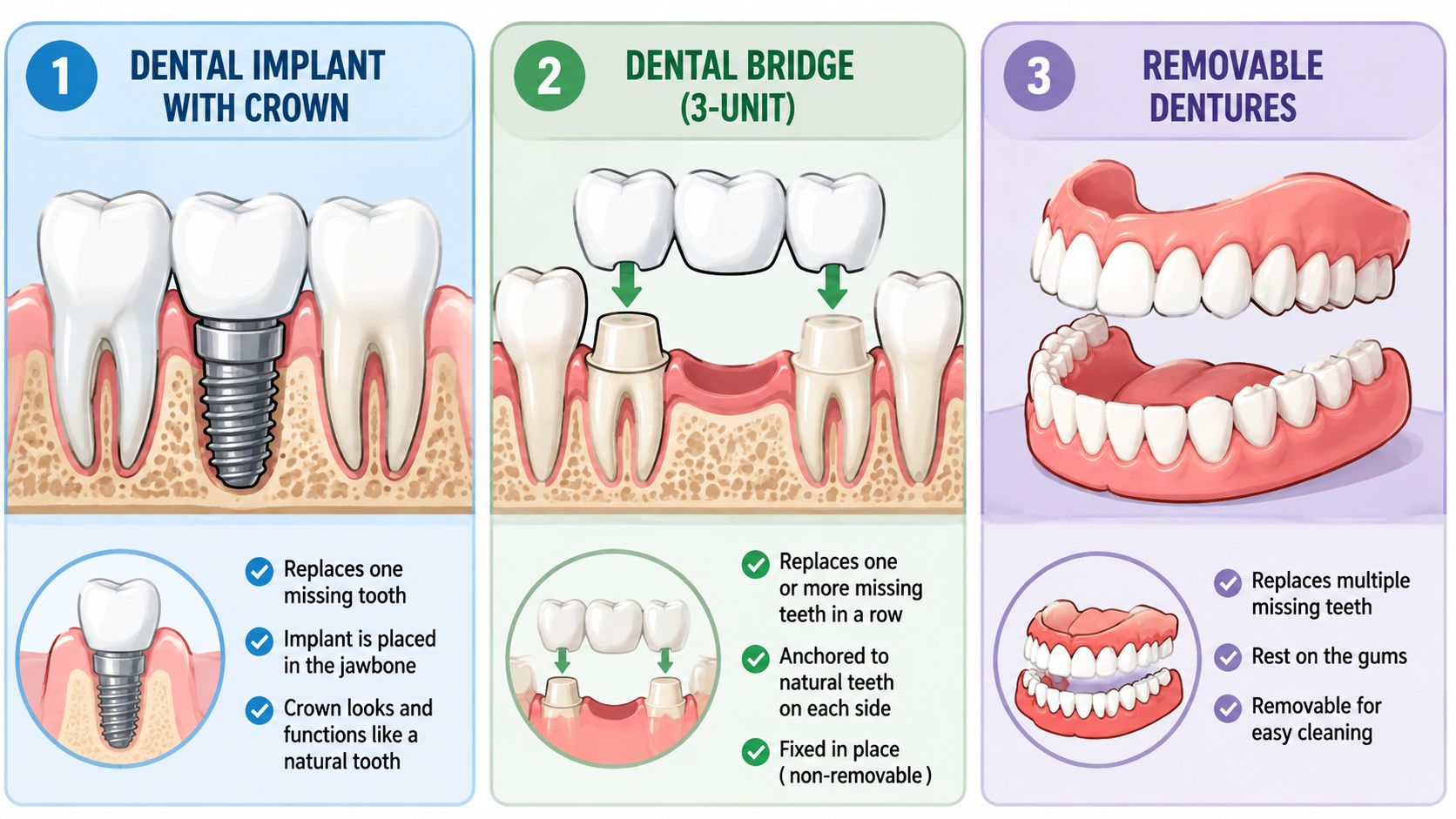
A dental implant replaces a missing tooth by anchoring support in the jaw and then attaching a custom crown. For many patients, that feels closest to having an individual tooth back.
A bridge usually uses neighboring teeth for support. That can be a very reasonable treatment in the right situation, but it often depends on the condition of the teeth next to the space.
A removable denture replaces missing teeth without being fixed in the same way. Some patients choose this because it can be a practical option, especially when multiple teeth are missing.
This side-by-side view helps simplify the decision:
| Option | Main strength | Main tradeoff |
|---|---|---|
| Implant | Replaces one tooth as its own unit | Requires surgical treatment and planning |
| Bridge | Fixed option for some patients | Usually depends on adjacent teeth |
| Removable denture | Can replace multiple teeth in one appliance | May feel less natural or stable for some people |
The right choice isn't the same for every patient. Oral health, comfort, anatomy, goals, and budget all matter.
Maintenance also differs. An implant is cleaned differently from a bridge, and a removable appliance has its own routine. That daily reality matters more than many people expect.
When full-arch treatment changes the math
If many teeth are missing, the conversation shifts.
According to the CareCredit overview of implant treatment costs, while single implants have a distinct per-tooth cost, full-arch solutions like "All-on-4" create efficiency by using a small number of implants to support an entire arch of teeth, often resulting in a lower overall cost-per-tooth compared to replacing each tooth individually.
That doesn't mean full-arch treatment is simple. It means the structure works differently. Instead of replacing each tooth one by one, several implants support a full restoration.
Patients considering that kind of care are often weighing:
- Stability: Fixed support can feel very different from a removable appliance.
- Efficiency: One coordinated plan may be more practical than replacing many teeth separately.
- Long-term function: Chewing, speaking, and confidence often shape the decision as much as cost.
A bridge may be ideal for one person. A removable denture may make sense for another. An implant may be the better long-term fit for someone else. The best option is the one that matches the condition of your mouth and your priorities.
Navigating Insurance Coverage and Financing
Financial questions often become less stressful once patients understand the language insurers use.
What insurance usually means by major treatment
Dental implants are often treated as a major procedure. That doesn't automatically tell you what your own plan will pay, but it does explain why coverage can feel limited.
According to Forbes' explanation of dental implant insurance coverage, private dental insurance may cover a portion of major procedures like dental implants, but this is often limited by an annual maximum benefit that typically caps the total amount an insurance company will pay in a given year.
In plain language, that means a plan may contribute something, but only up to a certain ceiling. After that, the remaining balance becomes the patient's responsibility.
A few practical questions can help:
- Is the implant itself covered: Some plans separate surgical and restorative phases.
- Are related procedures handled differently: Exams, imaging, extractions, and crowns may not all fall under the same category.
- Does timing matter: Benefits may be tied to a calendar year.
If you've ever tried to understand a health or pharmacy claim and felt buried in codes and categories, you're not alone. A plain-English guide to prescription claim processing can help you understand the bigger idea of how claim systems work, even though dental plans have their own rules.
Ways patients spread out the cost
Patients don't always pay for everything at one moment. Implant treatment commonly happens in phases, and that can make planning more manageable.
Some offices also offer payment options or work with third-party healthcare financing services such as CareCredit. Availability and terms vary, so it's smart to ask for details specific to your case.
Ask the office for a written treatment plan that separates phases, estimated timing, and what may be billed at each stage. That usually reduces surprises.
You can also ask the front desk or treatment coordinator to help you understand the difference between an estimate and a guarantee. Insurance pre-estimates can be helpful, but final payment decisions usually come from the insurer, not the dental office.
Your Dental Implant Journey What to Expect
For most patients, implant treatment feels less intimidating once they can see the sequence. It isn't one giant appointment. It's a series of planned steps.
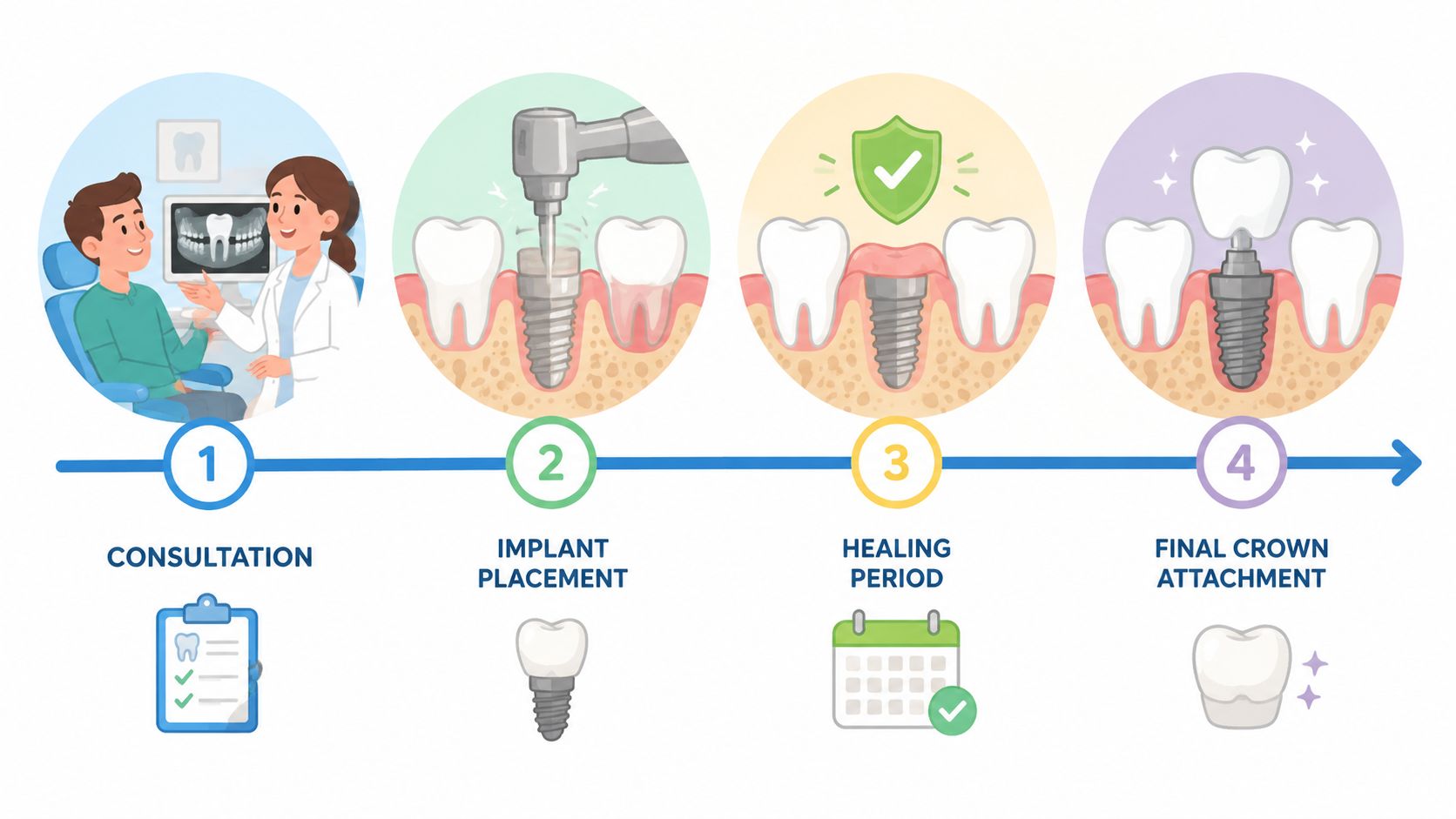
Step one through step four
It usually starts with a consultation. The dentist examines the area, reviews your health and dental history, and determines whether an implant is appropriate for your case. If the tooth is already missing, the discussion centers on the site itself. If the tooth is still present but failing, the conversation may include timing and preparation.
The next phase is diagnostics and planning. Records are gathered, the bone and surrounding anatomy are evaluated, and the treatment steps are mapped out in order.
Then comes implant placement. The implant post is positioned in the jaw, and the area is allowed to heal. That healing period matters because the bone needs time to integrate with the implant before the final restoration is attached.
The last stage is restoration. Once healing is complete, the connector and custom crown are placed so the tooth looks and functions as intended.
Why the process takes time
Patients sometimes worry when they hear that implants can take months. In reality, that timeline is often a sign that the body is being given time to heal properly.
A rushed process can be the wrong process. The implant isn't just inserted and finished the same day in every case. The site has to be stable, the tissues have to respond well, and the final crown needs to fit accurately.
Here's how many patients experience the journey emotionally:
- At first: They focus on the missing tooth and the fear of cost.
- After the exam: They start to understand the sequence and why each phase exists.
- During healing: They realize the process is more methodical than dramatic.
- At the end: They appreciate that the treatment was built around function, not just speed.
Patients often feel better once they know the treatment is staged. It turns a big unknown into a series of manageable decisions.
This phased structure also helps explain why dental implant cost is often discussed in parts rather than one simple number.
Schedule Your Personalized Consultation in Santa Ana
The most important thing to remember is simple. Dental implant cost isn't just about a single advertised figure. It's about the condition of the site, the planning required, the materials used, and whether the quote reflects the full treatment or only one piece of it.
One of the most commonly overlooked parts of that planning is imaging. As noted by Bonita Del Rey Dental's overview of hidden implant costs, critical diagnostic tools like cone beam CT scans provide a detailed 3D view of the jawbone and are considered standard practice for ensuring safe and precise implant placement, but their cost is often a separate line item from the base implant price. That kind of detail matters when you're comparing estimates.
A personalized consultation gives you something internet research can't. It shows what your mouth needs, what your options are, and what questions you should ask before making a decision. It also helps you compare treatment plans fairly, instead of comparing incomplete numbers.
If you're in Santa Ana or nearby Orange County communities and you're weighing implants against other solutions, the next step doesn't need to feel like a commitment. It can be an information visit. You can discuss your goals, review the condition of the area, and learn what a thoughtful treatment plan would look like for your situation.
If you'd like a clear, no-pressure evaluation, Bristol Dental & Orthodontics in Santa Ana can help you understand your options for dental implants, Invisalign, cosmetic dentistry, sleep apnea oral appliance therapy, and emergency dental care. Schedule a consultation with Dr. Andrew Finley to get a personalized treatment plan built around your needs, your oral health, and your questions.