
If you're searching for dental implants near me, there's a good chance something has changed recently. Maybe you lost a tooth, maybe an older bridge is failing, or maybe you've been living with a gap longer than you wanted and you're finally ready to fix it.
That situation affects more than appearance. A missing tooth can change how you chew, how you speak, and how confident you feel when you smile at work, out with family, or running errands around Santa Ana, Costa Mesa, or Tustin. Most patients want the same thing. They want a replacement that feels stable, looks natural, and doesn't make daily life harder.
Dental implants are one of the most dependable ways to replace missing teeth. This guide is meant to make the process easier to understand, step by step, in plain language. You'll learn what an implant is, who may be a candidate, what treatment usually involves, how implants compare with bridges and dentures, and what long-term care looks like. Every article must be reviewed by Dr. Finley before publishing.
Table of Contents
- Your Guide to Dental Implants in Santa Ana
- What Exactly Is a Dental Implant
- Are You a Candidate for Dental Implants
- Your Dental Implant Journey Step by Step
- Implants Compared to Bridges and Dentures
- Investment Recovery and Long-Term Care
- Your Consultation at Bristol Dental and Orthodontics
Your Guide to Dental Implants in Santa Ana
Searching for dental implants often starts at the end of a long day. You notice the gap when you eat, when you smile, or when food keeps catching in the same spot. Then the questions start. Is an implant the right fix for me? How involved is this? How do I choose a local office I can work with through the whole process?
That uncertainty is normal. Implant treatment has several stages, and the words dentists use can make it sound more complicated than it feels from the patient side. A clearer way to look at it is this: you are not just replacing a tooth. You are deciding how that space will be restored, how your bite will function, how the area will heal, and what caring for it will look like years from now.
That is why this guide focuses on the full patient journey in Santa Ana, not just the definition of an implant.
Why local context matters
Implant care usually happens over time, not in one appointment. You may need an exam, imaging, treatment planning, placement, healing visits, and follow-up care. Having a practice in Santa Ana can make that process easier to manage, especially if you live nearby or commute from surrounding Orange County neighborhoods.
Local care also gives your dentist a better view of the bigger picture. A missing tooth can connect to other concerns, such as shifting teeth, older dental work, bite problems, or plans to improve your smile. Those details affect timing and treatment decisions. They are easier to sort through when you have a dentist who can follow the case from start to finish.
An implant works a bit like rebuilding a house on a damaged lot. The final result matters, but so do the foundation, the plan, and the follow-up.
What patients usually want to know first
Patients in Santa Ana usually begin with practical questions, not technical ones:
- Am I a candidate? People often worry they have waited too long or have already ruled themselves out.
- What will the process feel like? Fear usually comes from not knowing what happens at each stage.
- How long will it take? A real timeline helps more than a vague estimate.
- How does it compare with a bridge or denture? The answer depends on your goals, bone support, budget, and the condition of nearby teeth.
At Bristol Dental & Orthodontics, Dr. Andrew Finley approaches those questions the way a good teacher would. He starts with what applies to your mouth, explains the reasoning behind each option, and helps you understand the tradeoffs before you decide.
What Exactly Is a Dental Implant
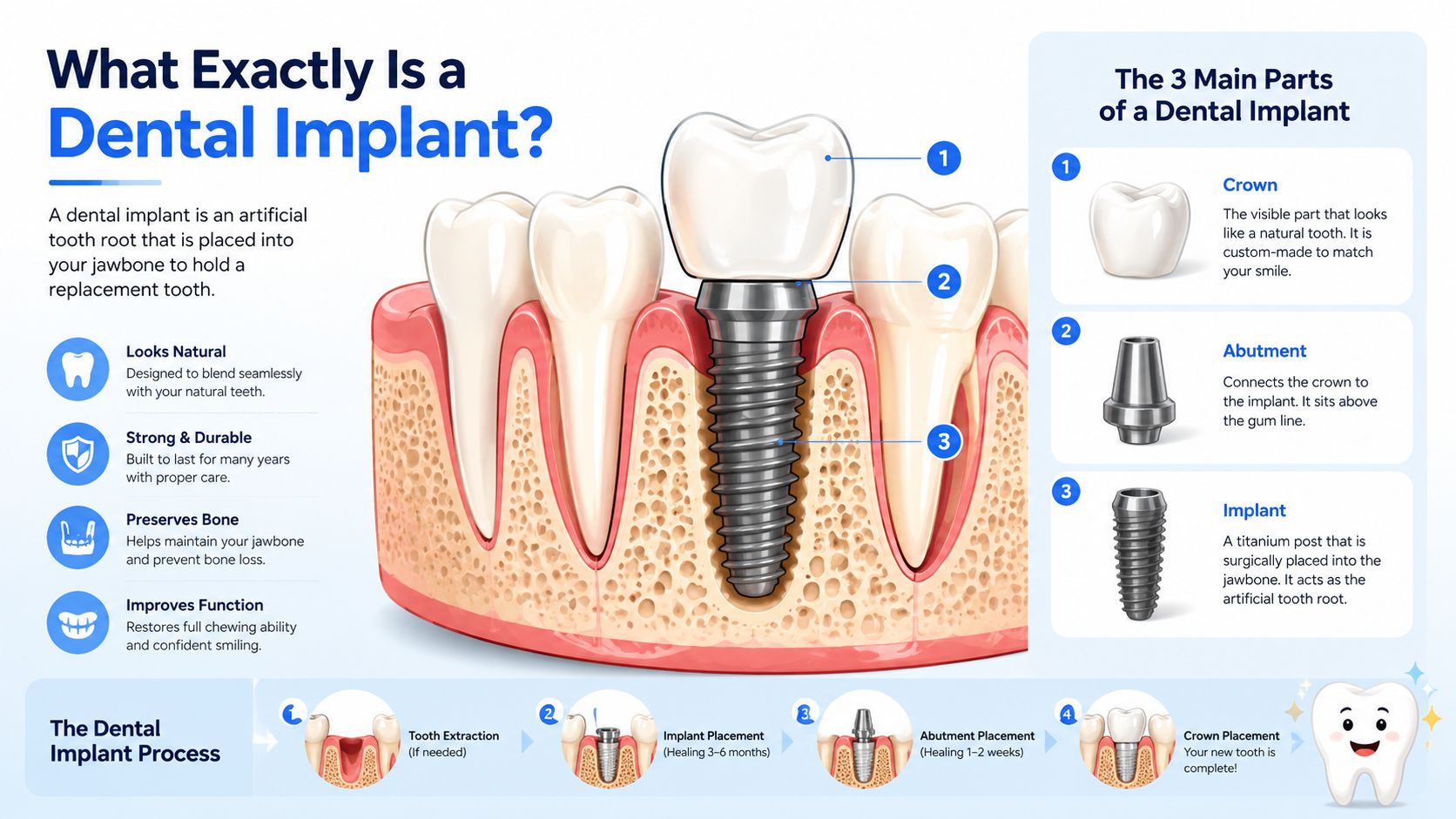
A dental implant is a small post placed in the jawbone to act like a replacement tooth root. Once it heals in place, it supports the visible part of the tooth that you chew with and see when you smile.
One easy way to picture it is to think of a wall anchor. If you hang something important, you need a secure base inside the wall, not just something attached on the surface. An implant works in a similar way. The stable support is underneath, and the replacement tooth is built on top of that support.
The three parts that matter
There are three main pieces in a standard implant restoration.
- The implant post: This is the part placed in the jawbone. It serves as the foundation.
- The abutment: This small connector joins the implant post to the final tooth.
- The crown: This is the custom-made visible tooth that's shaped and shaded to blend with your smile.
Patients often get confused because they hear the word “implant” used for the whole system. In everyday conversation, that's common. In practice, the implant is the foundation, and the final result includes all three parts working together.
Why titanium is used so often
Most implants are made from titanium. According to dental implant market data summarized here, titanium dental implants account for approximately 93% of the U.S. implant market share because of their biocompatibility and their ability to support osseointegration within the jawbone.
Osseointegration is the healing process where the bone bonds to the implant surface. You don't need to memorize that term. What matters is why it matters. This bond is a major reason implants can feel more secure than removable options.
Practical rule: If a treatment explanation feels overly technical, ask your dentist to point out which part goes in the bone, which part connects, and which part shows above the gums. That usually makes the whole process easier to understand.
For many Santa Ana patients, this is the moment implants stop sounding mysterious. They're not a vague “permanent tooth.” They're a carefully planned system designed to replace a missing tooth from the root up.
Are You a Candidate for Dental Implants
Many people assume they're either clearly eligible for implants or clearly not. Real life usually isn't that neat. Candidacy is more of a full-mouth assessment than a simple yes-or-no checklist.
That's important because tooth loss is common. This dental implant statistics overview notes that about 178 million Americans are missing at least one tooth. A large number of adults may at least be worth evaluating for implant treatment.
What dentists usually look for
A good implant candidate often has several of these traits:
- One or more missing teeth: Some patients need to replace a single tooth, while others need a broader restorative plan.
- Healthy gums: Gum health supports healing and long-term maintenance.
- Adequate bone support: The jaw needs enough structure to hold the implant securely, or a dentist may discuss ways to improve that foundation.
- A stable bite: The way your upper and lower teeth meet affects how force is distributed on an implant.
If you've been told years ago that you weren't a candidate, that still doesn't automatically settle the issue today. Treatment planning has become more precise, and a current exam with imaging gives much better information than guesswork.
Health factors that deserve a conversation
Some health issues don't always rule implants out, but they do affect planning. Smoking, uncontrolled gum disease, and certain medical conditions can influence healing and long-term success. The point isn't to scare you away. The point is to identify what needs attention before or during treatment.
For example, patients with bite wear may also be dealing with clenching during sleep. Others may want to align crowded teeth before restoring a missing one. In some cases, problems that seem unrelated at first, such as airway concerns or a history of emergency dental treatment, can matter because they affect timing, comfort, or how the final bite is designed.
A candidacy visit should feel like problem-solving, not gatekeeping.
At a consultation, Dr. Finley can evaluate the missing-tooth area, review your health history, study imaging, and explain whether implants, another restorative option, or preliminary treatment makes the most sense for your specific case.
Your Dental Implant Journey Step by Step
A lot of Santa Ana patients come in with the same concern. They are not only asking, "Can I get a dental implant?" They are also wondering how many visits it takes, what healing feels like, and how the whole process fits into daily life. That is why it helps to view treatment as a journey with clear stages, not one big unknown.
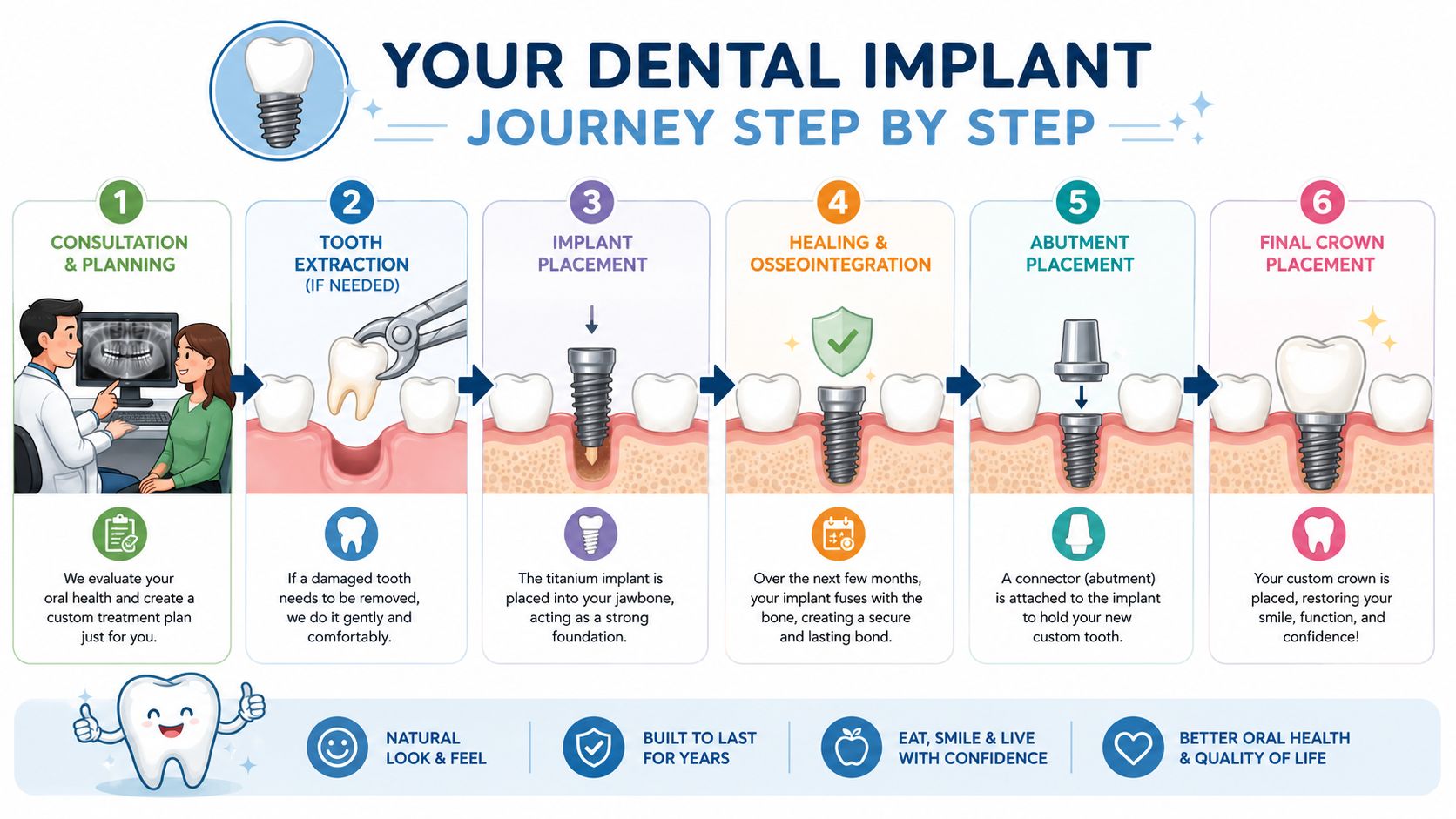
The four main stages
Consultation and planning
This visit is the roadmap stage. Dr. Finley examines the area, reviews imaging, checks how your bite comes together, and talks with you about your goals, timing, and health history. For some patients, the answer is "yes, you are ready." For others, the answer is "yes, with a little preparation first," such as improving gum health or planning space for the missing tooth.Implant placement
The implant post is placed into the jawbone in a carefully planned appointment. Many patients expect this to feel overwhelming, but the visit is usually more routine than they imagined. Local anesthesia is used, and comfort planning happens ahead of time so you know what to expect before you sit in the chair.Healing and integration
This stage is quiet but important. Over time, the bone heals around the implant and holds it in place, much like a fence post becoming stable once the ground firms up around it. You may not see much happening from the outside, but this healing period supports the long-term strength of the final tooth.Final restoration
After healing, the visible replacement tooth is attached. That usually includes the connector piece and a custom crown designed to fit your bite and match nearby teeth. The goal is not only a natural look, but also a result that feels balanced when you chew and speak.
What often feels confusing at first
The biggest source of stress is usually uncertainty. Patients want to know what it will feel like, how long it will take, and whether the implant is likely to last.
Here is the clearest way to think about those concerns:
- Comfort: Fear often comes from the unknown. A good treatment plan includes numbness during the procedure, clear aftercare instructions, and a discussion of what normal soreness looks like.
- Timing: Implant treatment has built-in waiting periods because healing matters. That can feel slow, but each phase has a job to do.
- Reliability: Long-term success depends on careful planning, healing, and home care, not luck.
A large meta-analysis in a peer-reviewed review article reported an overall implant survival rate of 97.79% across 158,824 implants, with smoking, shorter implants, and upper-jaw placement noted as risk factors for early failure.
That matters because implant decisions should be personal, not generic. Dr. Finley's job is to help you understand where you stand today, what may affect healing, and what the full journey looks like with a local Santa Ana practice from first exam to long-term maintenance.
Implants Compared to Bridges and Dentures
Not every patient chooses implants, and not every case should be approached the same way. Bridges and dentures still have an important role in dentistry. The right choice depends on your goals, the health of nearby teeth, how much stability you want, and how you feel about maintenance.
Tooth Replacement Options at a Glance
| Feature | Dental Implant | Fixed Bridge | Removable Denture |
|---|---|---|---|
| Support method | Anchored in the jawbone | Supported by neighboring teeth | Rests on gums |
| Effect on adjacent teeth | Usually doesn't require reshaping nearby teeth | Often requires preparation of adjacent teeth | Doesn't depend on adjacent teeth in the same way |
| Jawbone stimulation | Helps maintain bone through root-like support | Doesn't replace the root | Doesn't replace the root |
| Stability when chewing | Feels closer to a natural tooth for many patients | Fixed in place | May shift more during function |
| Daily care | Brushing, flossing, and professional maintenance | Brushing, flossing, and bridge-specific cleaning | Removal and cleaning outside the mouth |
| Best fit for | Patients seeking a fixed root-supported replacement | Patients who need a fixed option without surgery | Patients who need a removable replacement option |
How to think about the tradeoffs
An implant's biggest difference is where support comes from. It replaces the missing root area rather than relying on the teeth next to the gap or sitting on top of the gums. That can be especially helpful when the neighboring teeth are healthy and you'd prefer not to alter them.
A bridge may make sense when the surrounding teeth already need crowns or when implant placement isn't ideal. A removable denture can also be appropriate in certain situations, especially when multiple teeth are missing and a removable solution fits the patient's goals.
Clinical data discussed here reports that dental implants have a long-term success rate of over 95% in healthy populations, with early failure in only 1% to 3% of low-risk patients. That doesn't mean implants are automatic for everyone. It means they're a well-established option when the case is properly selected.
Choosing between implants, bridges, and dentures isn't only about replacing a tooth. It's about choosing where support should come from and what maintenance you're willing to manage over time.
For many patients in Santa Ana and Orange County, that comparison brings clarity. They stop asking which option sounds most advanced and start asking which option fits their mouth and habits best.
Investment Recovery and Long-Term Care
Implant treatment is a health decision, a function decision, and yes, a financial decision. Patients deserve clear expectations about all three.
Nationally, market information on dental implants states that the average cost for a single dental implant in the United States ranges from $3,000 to $6,000 per tooth, and that cost can increase depending on case complexity and location. That figure helps set context, but your own treatment plan depends on what your mouth needs, not on a broad national range.
Thinking beyond the upfront fee
A better question than “What does an implant cost?” is often “What does the full treatment need to include?” Some patients need only a straightforward replacement. Others need additional planning, supportive procedures, or work that improves the long-term result before the implant is restored.
That's also why comparing treatment options solely by the initial fee can be misleading. A lower upfront option may still be the right choice in some cases, but it may involve different maintenance needs, different compromises in stability, or future replacement considerations.
A thoughtful consultation should separate the parts of treatment clearly and explain what is medically necessary versus elective.
Caring for an implant after treatment
Recovery is usually less dramatic than many patients expect, but it still deserves respect. You'll want to follow home-care instructions carefully, keep pressure off the area as directed, and return for follow-up visits so healing can be checked.
Long-term care is straightforward:
- Brush thoroughly: Clean around the implant the way you care for natural teeth.
- Floss or use recommended cleaning aids: The area around the implant still needs daily plaque control.
- Keep regular dental visits: Professional exams help catch inflammation, bite changes, or wear before they become bigger problems.
- Protect the bite if needed: If you clench or grind, your dentist may recommend a protective appliance.
Key takeaway: An implant isn't “maintenance-free.” It's designed to function like part of your mouth, which means it needs the same consistent attention your natural teeth need.
Patients who understand that usually do well because their expectations are realistic from the start.
Your Consultation at Bristol Dental and Orthodontics
You may start this visit with one simple question: “Am I even a candidate for an implant?” By the end, you should have a much clearer picture of your mouth, your options, and the steps that make sense for your situation in Santa Ana.
That matters because an implant decision is rarely about one tooth alone. A missing tooth can affect how you chew, how your bite meets, how confident you feel when you smile, and how you plan other dental care. Some patients are also sorting through grinding, snoring, cosmetic concerns, or treatment they put off after a stressful dental experience. A good consultation puts those pieces in order, like laying out a map before a road trip.
What a local consultation should help you understand
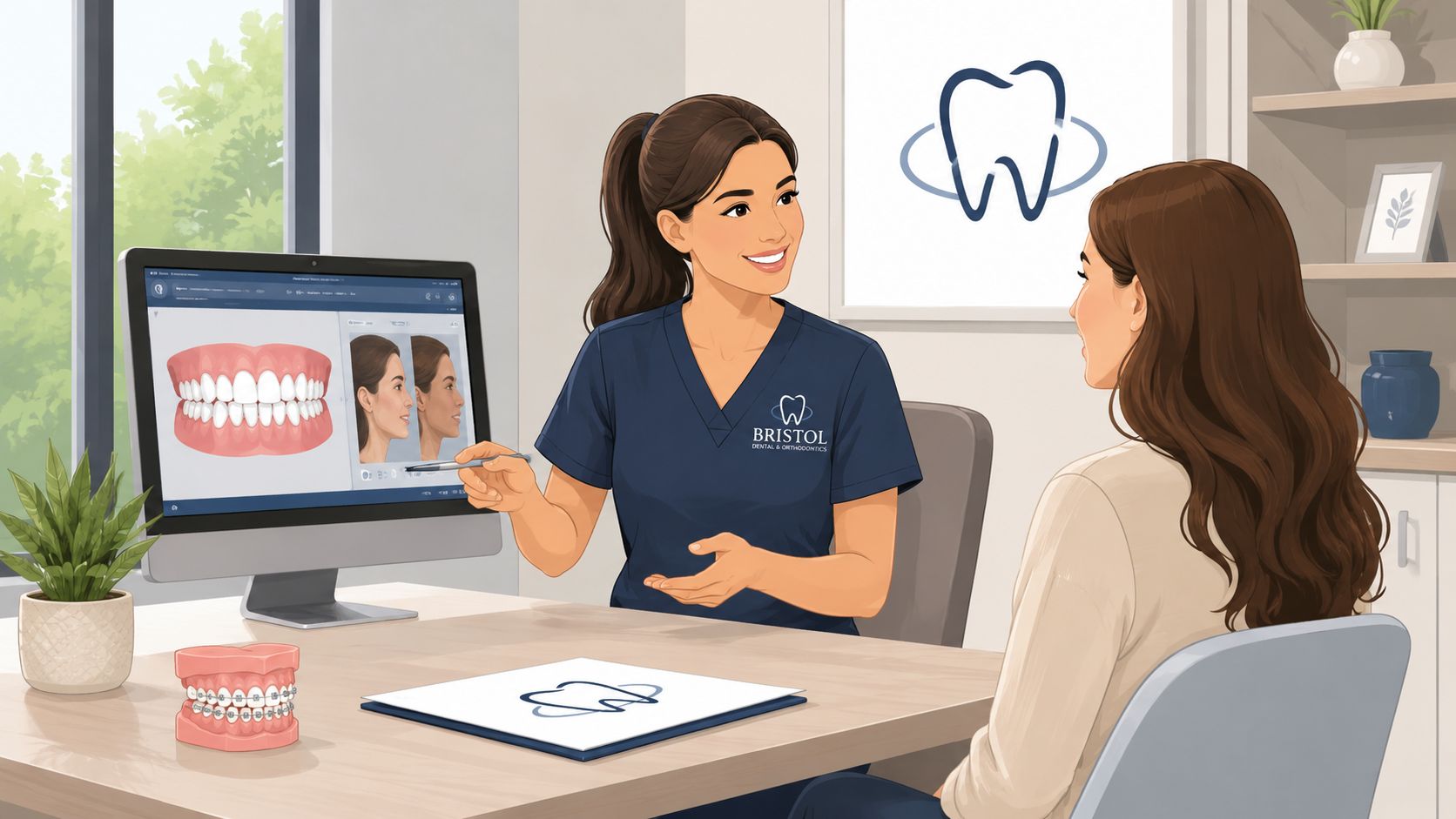
At Bristol Dental and Orthodontics, the goal of a consultation is not to rush you into treatment. It is to answer the practical questions patients usually have after searching for dental implants near me.
A helpful visit should clarify:
- Whether an implant fits your case right now: Some patients can move ahead after evaluation. Others need gum treatment, a tooth removal, bone support, or another step first.
- How an implant fits your bigger plan: If you are also considering smile improvements, bite correction, oral appliance options for sleep-related concerns, or follow-up after a dental emergency, the order of treatment matters.
- What the process may look like for you: Hearing the phases ahead of time often lowers anxiety because you know what happens first, what happens later, and where healing time fits in.
- How questions will be handled along the way: Clear communication makes a long treatment process easier to follow. The same idea applies in many professional settings, which is why Twizzlo's guide to client communication is a helpful reminder that clear expectations and timely updates reduce uncertainty.
Patients often feel relieved once they see the plan broken into parts. First the evaluation. Then any needed preparation. Then implant placement, healing, and the final tooth. It is much easier to understand when each step is explained in plain language instead of being presented as one big unknown.
Questions worth bringing to your visit
You do not need to show up using dental terms. In fact, the most useful questions are usually the plain ones:
- Am I a candidate for an implant now, or do I need preparatory treatment first?
- What is causing the delay if I am not ready yet?
- How long might healing take in my case?
- How will this change the way I chew, smile, and clean around the area?
- What other treatment options would reasonably work for me?
- What should I expect in terms of follow-up visits and home care?
If you live in Santa Ana or nearby communities such as Irvine, Tustin, Costa Mesa, or Garden Grove, the consultation is where the “what,” “why,” and “how” come together. Dr. Andrew Finley can examine your mouth directly, explain what he sees, and help you understand which path fits your health, comfort, and goals.
If you're ready to talk through missing teeth, implants, Invisalign, cosmetic concerns, sleep-related oral appliance options, or urgent dental needs, you can schedule a consultation with Bristol Dental and Orthodontics. Dr. Finley can review your specific situation, answer your questions, and help you decide on a treatment plan that fits your health, comfort, and goals.