
You may be at your bathroom mirror right now, tilting your chin a little and wondering whether it's finally time to fix the crowding, the spacing, or the bite that's bothered you for years. Or maybe you're a parent in Santa Ana trying to sort through options for a teen who wants straighter teeth but definitely has opinions about what they'll wear to school.
It's common to start with the same few questions. Will clear trays work as well as braces? Will braces be more reliable? Which one is easier to live with during work, school, meals, photos, and daily brushing? Those are smart questions, because clear aligners vs braces isn't just a clinical decision. It's also a lifestyle decision.
This guide is meant to feel like a calm consultation conversation, not a sales pitch. You'll see where each option tends to shine, where each can be frustrating, and why the “better” choice usually depends on your teeth, your habits, and your priorities. By the end, you should feel more prepared to talk through your own treatment goals with Dr. Finley.
Table of Contents
- Starting Your Journey to a Confident Smile
- The Two Main Paths to Straighter Teeth
- Which Dental Issues Can Aligners and Braces Treat
- Comparing the Daily Experience Comfort and Care
- Understanding Treatment Timelines and Appointments
- Investing in Your Smile Cost and Value Considerations
- How to Choose Your Best Path Forward
Starting Your Journey to a Confident Smile
A lot of patients walk in feeling torn between what they want and what they think they should choose. They want a straighter smile, but they also want to keep eating normally, speaking comfortably at work, smiling in photos, and brushing without turning the sink into a project.
That tension is real. A college student in Irvine may care most about having something discreet. A busy parent in Garden Grove may care more about reliability because they don't want treatment derailed by a packed schedule. A teen in Tustin may love the idea of removable trays until they realize “removable” also means “easy to forget.”
Clear aligners and braces can both move teeth well. The daily experience is where many patients discover what really fits their life.
At a practical level, the choice usually comes down to three things:
- What your teeth need: Some tooth movements are simpler and more predictable than others.
- How you live day to day: Meals, work meetings, sports, school, and social events all matter.
- How consistent you can be: Some treatment systems keep working whether you think about them or not. Others depend on your follow-through every day.
That's why a good consultation isn't about declaring one option the winner. It's about matching the treatment to the person wearing it.
The Two Main Paths to Straighter Teeth
A lot of patients in Santa Ana understand the goal right away. Straighter teeth. The part that takes more explaining is what daily life feels like once treatment starts.
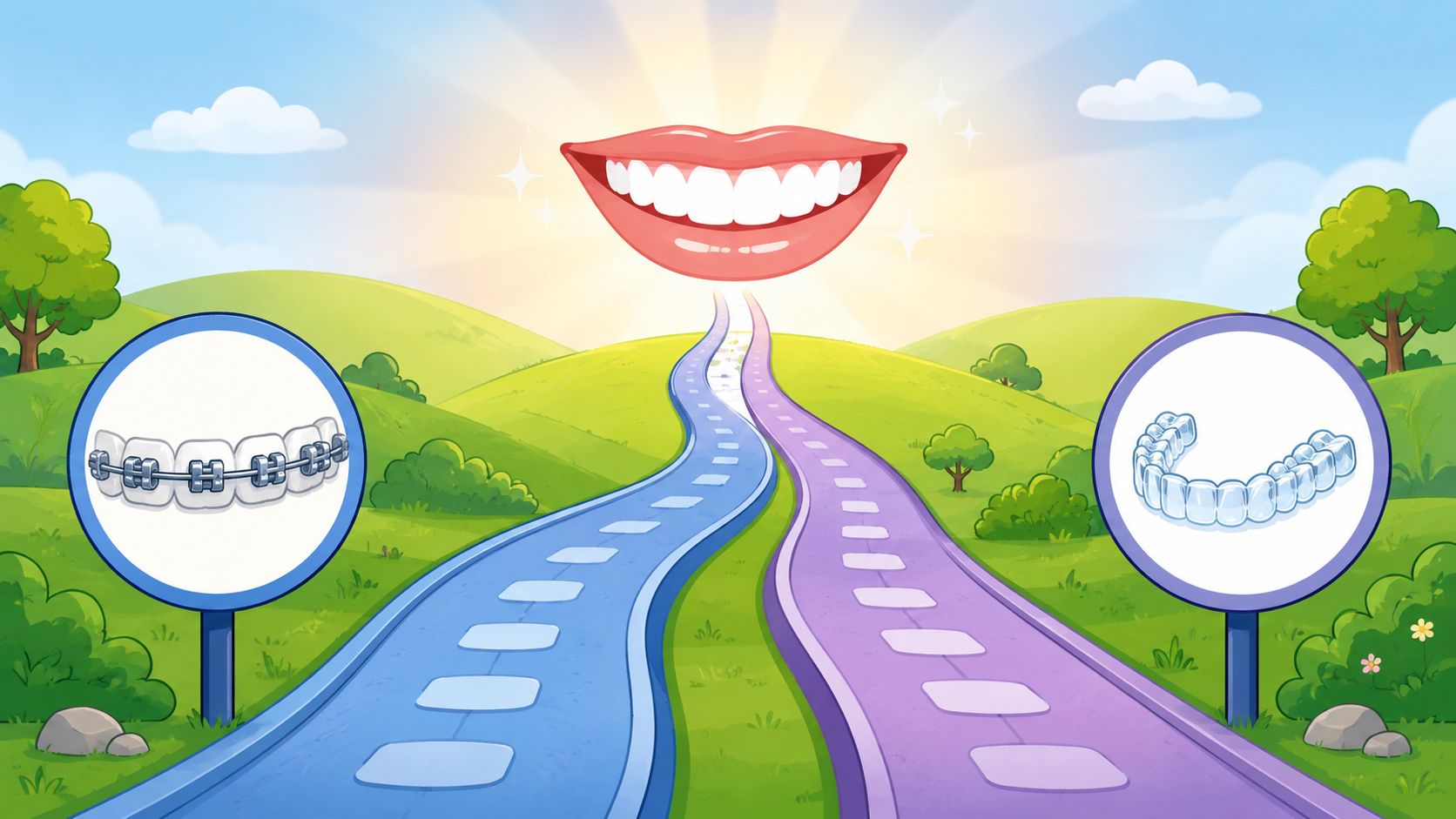
Braces and clear aligners both move teeth by applying gentle pressure over time. The big difference is how that pressure is delivered, and how much your routine has to change to keep treatment on track.
How braces move teeth
Braces use small brackets bonded to the teeth and connected by a wire. The wire works like a track that gradually guides teeth into better positions. Once braces are on, they keep working all day and all night.
That fixed design changes the treatment experience in an important way. You do not have to remember to put braces back in after coffee, lunch, baseball practice, or a late dinner on 17th Street. For patients with busy schedules, that built-in consistency can be a real advantage.
Braces also tend to feel more mechanical at first. You will notice the brackets. You will clean around them. You may need wax now and then while your cheeks adjust. But many patients like the fact that the system keeps doing its job even on hectic days.
How clear aligners move teeth
Clear aligners use a series of custom trays that fit snugly over the teeth. Each new tray is slightly different from the last, so teeth move in small planned stages instead of being guided by brackets and wires.
In everyday life, aligners often feel simpler in some ways and more demanding in others. They are smooth, removable, and far less noticeable in conversations, photos, and work settings. That matters to adults who speak with clients, college students on campus, and teens who feel self-conscious about metal on their teeth.
The tradeoff is responsibility. Aligners only work well if you wear them as directed, keep track of them, and put them back in after meals and drinks other than water. In a real week, that can mean rinsing trays in a restaurant bathroom, brushing after lunch at work, or realizing halfway through a family outing that the case was left at home.
Why both options still exist
Orthodontics is not about choosing the newer-looking option or the more familiar one. It is about choosing the system that fits your teeth and your habits.
Braces offer steady control with less day-to-day decision-making. Aligners offer flexibility and a lower-profile look, but they ask more of you every single day. One is a set-it-and-maintain-it appliance. The other is a removable system that works best for patients who are organized and consistent.
Practical rule: Aligners usually appeal to patients who want discretion and can stick to a routine. Braces often suit patients who want treatment working in the background, even on their busiest days.
At Bristol Dental and Orthodontics, this part of the conversation often clicks when patients stop thinking only about the end result and start picturing a normal Tuesday. How will you eat, clean your teeth, get through school or work, and handle social plans? The better choice is usually the one that fits your real life, not just your ideal plan.
Which Dental Issues Can Aligners and Braces Treat
The short answer is that both can treat many orthodontic problems. The more useful answer is that they don't always treat them in the same way, or with the same level of predictability.
Where clear aligners often fit well
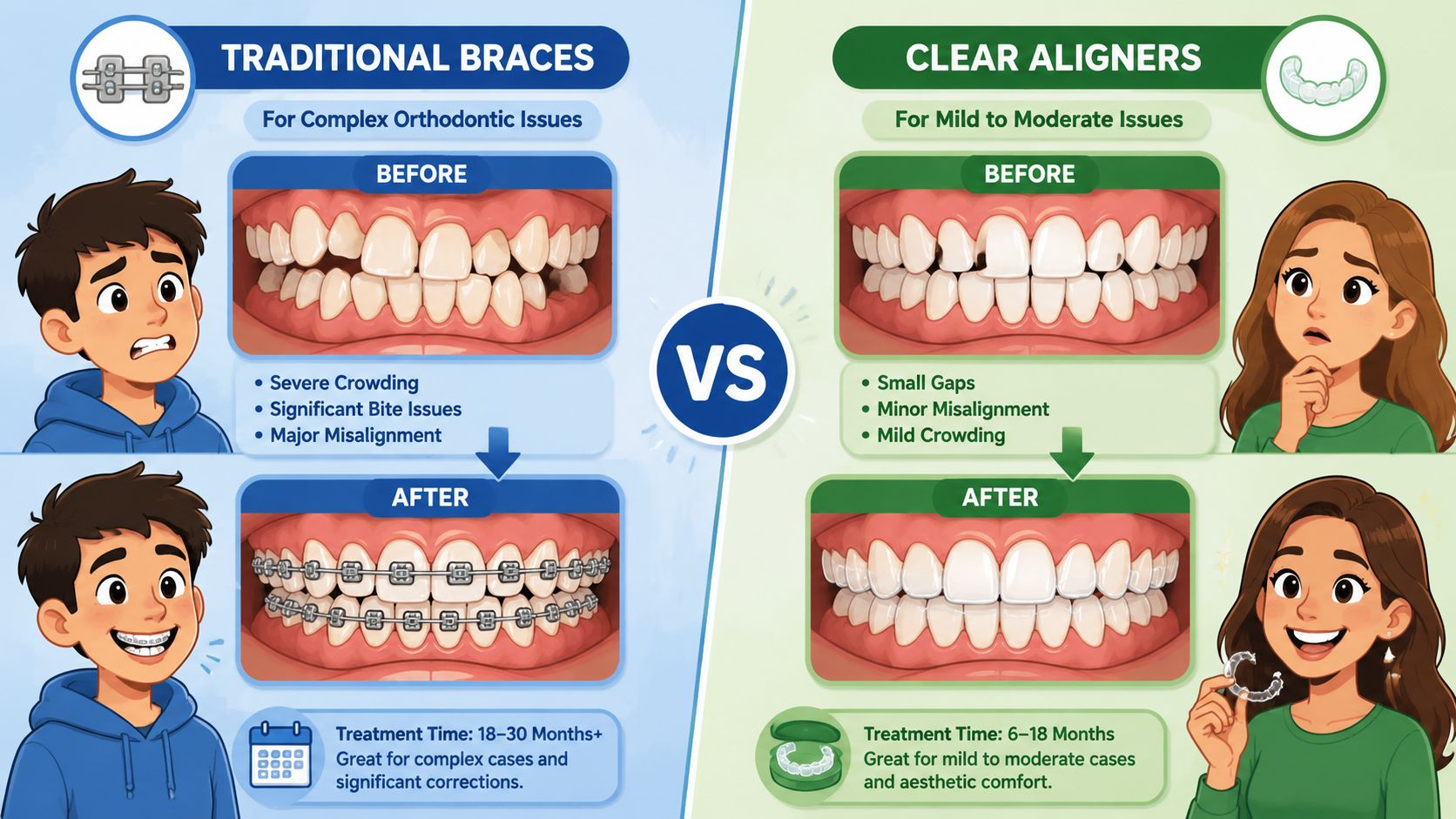
Clear aligners are often a strong option for mild to moderate crowding, small gaps, and certain bite corrections. They can be especially appealing when a patient wants a less noticeable appliance and is willing to wear trays as directed every day.
A systematic review found that clear aligners and braces had similar overall orthodontic effectiveness, while aligners showed advantages in segmented tooth movement and often shorter treatment duration in some cases, according to this review of eight studies.
“Segmented tooth movement” sounds technical, but the idea is simple. It means moving selected teeth in a planned sequence rather than relying on one wire to guide the whole arch at once. For some cases, that can be efficient and precise.
Where braces often have an edge
The same review found braces were more effective for occlusal contact quality, torque control, and transverse width increase. In plain language:
- Occlusal contact quality means how the upper and lower teeth meet when you bite.
- Torque control refers to controlling the angle and root position of a tooth, not just the visible crown.
- Transverse width increase means widening across the arch in a controlled way.
Those details matter in more complex cases. If a tooth needs strong rotation, vertical movement, or precise root control, braces often give the orthodontist a steadier mechanical advantage.
Why the “easy case versus hard case” idea can be misleading
Patients often hear that aligners are for simple cases and braces are for difficult ones. That's partly true, but it skips the underlying reason behind the recommendation. The issue isn't whether a case sounds simple. The issue is whether the needed tooth movements are predictable with a removable tray system.
A patient may have only mild crowding but still need very exact bite refinement. Another patient may have visible spacing that looks straightforward but hides a more complex bite issue. In such cases, photographs and selfies stop being useful, and a clinical exam starts mattering.
If the goal is not only straighter-looking teeth but also a stable bite, the treatment plan matters as much as the appliance.
That's also why two friends with “similar” smiles can leave a consultation with different recommendations.
Comparing the Daily Experience Comfort and Care
At this stage, many patients make up their minds. The clinical plan matters, but so does the question, “What will this feel like in my actual life?”
A quick side by side look
| Factor | Clear Aligners (e.g., Invisalign) | Traditional Braces |
|---|---|---|
| Appearance | Less noticeable during conversation and photos | More visible on the teeth |
| Eating | Removed for meals, so food choices are more flexible | Food restrictions help prevent broken brackets or wires |
| Brushing and flossing | Done normally after removing trays | Takes more time around brackets and wires |
| Daily responsibility | Requires consistent wear and tray care | Works continuously without needing to remember to put it back in |
| Social situations | Easier to remove briefly when appropriate, if advised | Always visible, but no need to manage removal |
| Sports and busy routines | Requires a habit system so trays don't get lost | Fewer daily decisions, but more care around impacts and breakage |
What a normal day feels like
With braces, breakfast is simple in one sense and inconvenient in another. You don't have to remember anything before eating because braces stay on. But certain foods become less practical. Sticky, hard, and crunchy choices can cause trouble, so many patients start scanning menus differently.
With aligners, meals are more flexible, but each one comes with a routine. You remove the trays, keep track of them, eat, brush if possible, and put them back in. That can feel easy for a very organized person. It can feel surprisingly annoying for someone who snacks often, works long shifts, or forgets things in napkins and lunch trays.
Socially, aligners usually win on discretion. Adults in Costa Mesa or Irvine who give presentations or meet clients often appreciate that. Teens may like them for photos and school events. But braces can be easier emotionally for some patients because there's nothing to manage. They're always on, all the time.
Oral health during treatment
Oral hygiene is one of the most important differences, and it's often underplayed in casual online comparisons.
A summary in Decisions in Dentistry reports that approximately 46% of patients treated with fixed appliances develop white spot lesions within the first year, while aligner patients showed a significantly lower percentage, along with a reduced prevalence of apical root resorption, according to this clinical summary comparing aligners and braces.
White spot lesions are the chalky marks that can develop when plaque sits around brackets and enamel begins to lose minerals. They don't happen because braces are “bad.” They happen because braces create more hiding places for plaque and make cleaning harder.
That doesn't mean aligners are maintenance-free. Trays still need cleaning, and teeth still need brushing before they go back in. But if you've ever tried to floss around wires after a long day, you can understand why some patients find aligners easier to maintain.
- If you're great with routines: Aligners may feel convenient and clean.
- If you struggle with follow-through: Braces may be more dependable, even if brushing takes more effort.
- If enamel health is a concern: The lower rate of white spot lesions with aligners is worth discussing during a consultation.
Understanding Treatment Timelines and Appointments
“How long will this take?” is one of the first questions patients ask. It's also one of the hardest to answer online, because treatment length depends on the person far more than most websites admit.
Why timelines vary so much
A mild spacing case in an adult with excellent compliance may move quite differently from a teenager with crowding, bite issues, and inconsistent wear habits. The appliance matters, but the case design and patient behavior matter just as much.
The American Association of Orthodontists notes that the best option depends on the specific malocclusion and patient compliance, and that real-world reliability and adherence to wear time are critical factors in aligner outcomes, as explained in the AAO discussion of braces and clear aligners.
That point is easy to miss. In ideal conditions, aligners can be very effective. In daily life, they only work when they're in your mouth. If trays sit in a case for long stretches, get lost, or aren't changed on schedule, treatment can stall.
Appointments and real world reliability
Braces and aligners often create different appointment rhythms.
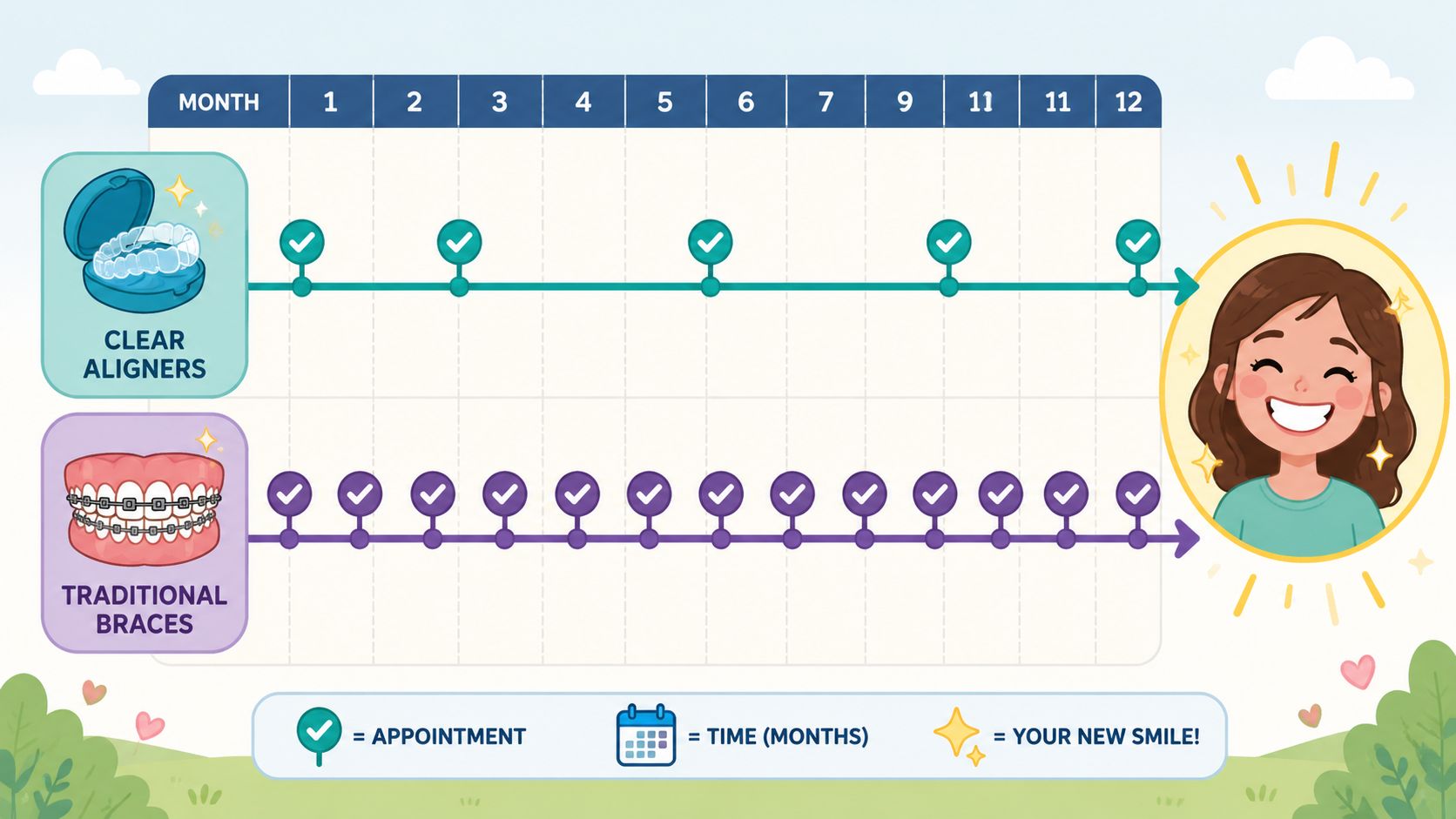
Braces usually involve regular adjustment visits. Aligners may involve fewer in-person checks for some patients, because several trays can be planned in advance. For a busy Orange County family, fewer office visits can sound appealing.
But fewer visits only help if the treatment is staying on track between visits. That's why reliability matters so much in the clear aligners vs braces conversation. A patient who wears aligners exactly as directed may enjoy that flexibility. A patient who knows they're forgetful may be happier with a system that keeps working without daily choices.
A shorter theoretical timeline isn't always a shorter real-life timeline.
If your schedule is packed, the best option may be the one you can follow consistently, not the one that sounds most convenient on paper.
Investing in Your Smile Cost and Value Considerations
Orthodontic treatment is an investment, and most patients want to understand what they're paying for before they commit. That's reasonable. The total cost usually reflects the complexity of your case, how long treatment is expected to take, the type of appliance used, and how much hands-on planning and follow-up your care requires.
What affects the overall investment
A simple alignment case is different from a case that also needs bite correction, attachment placement, refinements, or longer monitoring. That's one reason two patients choosing the same type of treatment may still receive different estimates.
There's also a value question behind the cost question. Some patients are less focused on the appliance itself and more focused on how treatment fits their life. A recent study reported higher patient satisfaction with clear aligners at 85% versus 65% for braces, along with lower discomfort, according to this comparative study on patient experience.
Value is more than the appliance itself
For many people, the main value of aligners isn't dramatically faster treatment. It's comfort, appearance, and convenience. If you're in public-facing work, attending school events, or just want a less noticeable option, that may matter a lot.
For others, braces may offer stronger value because they remove the burden of compliance. You don't have to remember to put them back in after coffee, lunch, or a late snack. That can protect the investment by reducing the chance that treatment drifts off course.
When you're reviewing options, it helps to ask about more than the starting fee.
- Ask what's included: Records, monitoring, refinements, and retainers can affect the full picture.
- Ask why the plan was recommended: A higher estimate may reflect a more involved clinical problem, not just the appliance type.
- Ask about payment logistics: Offices can explain financing options and help you understand available benefits without guessing.
A personalized consultation is the only reliable way to get a clear estimate for your own smile, because cost follows diagnosis, not marketing.
How to Choose Your Best Path Forward
You finish lunch in Santa Ana, head back to work, and realize your aligners are still wrapped in a napkin on the table. Or you make it through a long day with braces and wish you did not have to think so much about sore spots and food getting stuck. For many patients, the decision becomes clearer once they picture ordinary moments like these, not just the final smile.
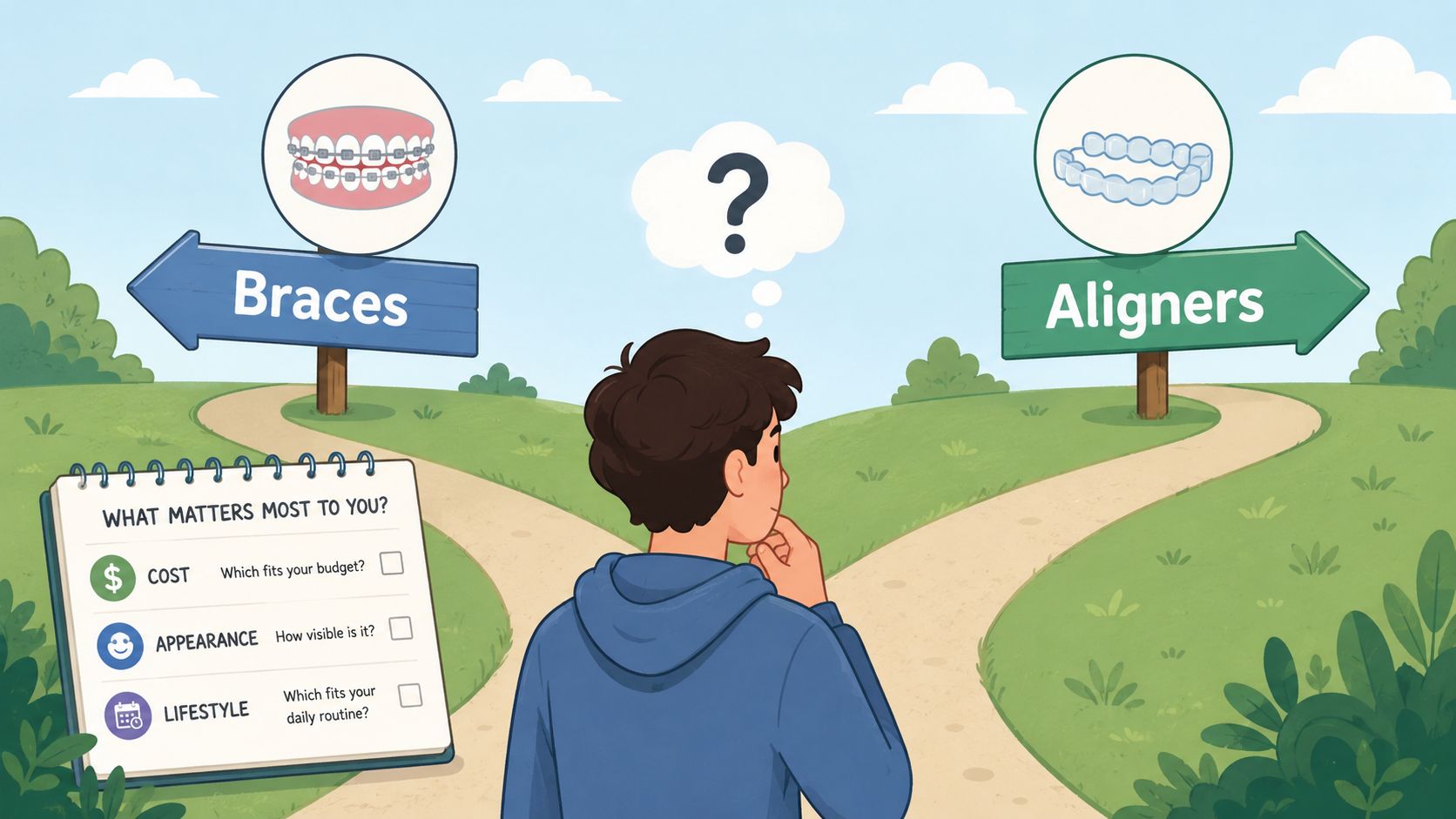
Questions worth asking yourself
A good choice usually matches the way you already live. Orthodontic treatment is a bit like choosing between glasses you can remove and contacts that need steady habits. One option asks more of your routine. The other stays in place and does more of the remembering for you.
These questions often help bring the answer into focus:
- How much does appearance matter during treatment? If you speak with clients, attend classes, or spend a lot of time in social settings around Orange County, a less noticeable option may matter more than you expected.
- How consistent am I with daily habits? Clear aligners work best for patients who can stick to wear time, keep trays clean, and remember them after meals, coffee, or snacks.
- Do I prefer simplicity over flexibility? Braces give you fewer daily choices. You do not remove them, misplace them, or leave them on a restaurant tray by accident.
- What parts of my schedule are hardest to control? Shift work, school lunches, sports, travel, and frequent snacking can all shape which treatment feels realistic.
- Does my bite need closer control? That part requires an exam. Teeth can look straightforward in the mirror but behave very differently once we study the bite and jaw relationship.
One simple rule helps many patients: the better option is the one you can follow on your busiest, most distracted day.
A few common questions
Do both treatments still require retainers afterward?
Yes. Straightening teeth is one phase. Keeping them there is the next phase. Retainers protect the result you worked for.
Are clear aligners a good fit for teens?
They can be. Teens who are motivated and organized often do very well with them. Teens who tend to forget water bottles, homework, or lunch containers may do better with braces because the appliance stays put.
Can adults choose braces?
Absolutely. Many adults do. Some want the reliability of a fixed option and would rather not manage trays during work meetings, meals out, or busy family schedules.
How do I know which one is right for me?
Photos and online quizzes cannot answer that. A real recommendation comes from an exam, imaging, and a conversation about your crowding, bite, goals, and day-to-day habits.
Ultimately, this choice is personal and practical. The best plan is not the one that sounds nicest on paper. It is the one that fits your teeth, your routine, and your life here in Santa Ana.
If you're weighing clear aligners vs braces and want guidance customized to your smile, schedule a consultation with Bristol Dental and Orthodontics. Patients from Santa Ana, Costa Mesa, Tustin, Irvine, and nearby Orange County communities can talk through treatment goals, daily lifestyle concerns, and the options that may fit best for their case.