
You're home after implant surgery, your mouth still feels numb, and the main question is usually the same: Is what I'm feeling normal? That anxiety is understandable. Patients aren't worried only about discomfort. They want to know whether healing is moving in the right direction.
Dental implant surgery recovery has two tracks happening at once. The first is the short-term recovery you can feel, such as soreness, swelling, bleeding, and getting back to eating and speaking comfortably. The second is the slower healing you can't see, as the implant bonds with the bone over time. Knowing the difference helps you stay calm, and it also helps you recognize when it's smart to call your dentist.
Table of Contents
- The First Few Hours After Your Surgery
- Your Recovery Timeline Day by Day Week by Week
- Managing Pain Swelling and Discomfort
- Eating and Oral Hygiene After Implant Surgery
- Knowing When to Call Your Santa Ana Dentist
- The Road to Full Recovery and Osseointegration
- Frequently Asked Questions About Implant Recovery
The First Few Hours After Your Surgery
The first few hours matter because this is when bleeding control, rest, and swelling management make the biggest difference. Keep steady pressure on the gauze exactly as your dentist instructed. A small amount of oozing or blood-tinged saliva can be expected early on, and that often looks worse than it is once it mixes with saliva.

Rest first
Go home and take it easy. Don't plan errands, workouts, or a packed evening. Your body heals better when you let it stay quiet for the rest of the day.
A few practical steps help right away:
- Keep your head raised: Sit upright or recline with your head supported instead of lying flat.
- Start hydrating carefully: Sip water once you're fully alert and able to swallow comfortably.
- Wait for numbness to wear off before chewing: It's easy to bite your cheek, lip, or tongue when the area is still numb.
- Take medication as directed: If your dentist gave you instructions for pain control, follow them on schedule rather than waiting until discomfort builds.
Practical rule: The calmer your first afternoon is, the easier the rest of the recovery usually feels.
Protect the surgical site
Leave the area alone. Don't poke it with your tongue, don't pull your lip to inspect it, and don't rinse forcefully right away unless your dentist gave you specific instructions to do so. A fresh surgical site is trying to stabilize.
Also avoid suction. That means no straws and no forceful spitting. Those habits can disturb the area and make bleeding harder to control.
If you feel soreness building as the anesthetic fades, that's expected. What helps most in these first hours is a simple routine: rest, cold pack on the outside of the face, fluids, and minimal activity. Patients who try to “power through” the day often feel more swollen and more uncomfortable by evening.
Your Recovery Timeline Day by Day Week by Week
Individuals often feel better when they know what pattern to look for. The question isn't whether you'll notice symptoms. You probably will. The more useful question is whether those symptoms are trending in a healthy direction.
A patient-perception study found that mouth opening, speech, and everyday activity often return to minimal-impact levels in about 2 days, while pain and analgesic use usually settle by about 3 days and swelling often falls to minimal levels by about 4 to 5 days. The same study noted that patients should generally expect recovery within 4 days, while women experienced delayed recovery and implants in the intercanine area could make eating difficult for nearly one week, according to this patient recovery study on implant placement.
The first day
The first day is mostly about protecting the site and staying ahead of discomfort. You may feel tired, puffy, tender, and a little off your routine. That's common.
Your main job is simple: reduce irritation. Rest, use cold therapy on the outside of the face, eat only what feels safe, and avoid anything that creates pressure or friction around the implant site.
Days two through seven
This is the stretch when people start checking themselves constantly and wondering whether healing looks “right.” What you want to see is gradual improvement, not perfection. Talking and opening your mouth usually become easier fairly early. Swelling may still be present before it starts to settle down.
If your discomfort is manageable and moving in the right direction, that generally fits a normal pattern. If chewing feels awkward for several days, especially near the front of the mouth, that can happen too.
| Timeframe | What to Expect | Key Actions |
|---|---|---|
| First several hours | Numbness, light oozing, tenderness, fatigue | Rest, keep pressure on gauze as instructed, use a cold pack, stay hydrated |
| Day 1 | Soreness and swelling begin to show up more clearly | Stick to soft foods, avoid disturbing the site, take medications as directed |
| Around Day 2 | Speaking and opening the mouth often feel easier | Continue a gentle routine, don't rush back into heavy activity |
| Around Day 3 | Pain should be settling rather than intensifying | Watch the trend. Improving is reassuring. Worse is not |
| Around Days 4 to 5 | Swelling should be easing for most patients | Keep following home care instructions and check in if symptoms are stalling or worsening |
| Later in the first week | Daily function usually feels much more normal | Return to normal activity gradually and protect the area while chewing |
Recovery usually isn't a straight line hour by hour. It's a broader trend. By this point, most people should be able to tell whether each day feels at least a little easier.
Weeks two and beyond
This stage is less dramatic but still important. Soft tissue healing continues, and the area should feel less reactive. Clinical guidance commonly describes initial soft-tissue healing at about 1 to 2 weeks, with the gums needing roughly 2 to 3 weeks to adapt around the healing collar or abutment area. The longer biologic process, called osseointegration, typically takes 3 to 6 months, and can extend to 12 months in cases involving added procedures such as bone grafting or a sinus lift, as outlined in this overview of implant healing and osseointegration.
That's why a patient can feel mostly fine well before the implant is ready for its final restoration. Comfort comes first. Full integration takes longer.
Managing Pain Swelling and Discomfort
Good recovery care is usually simple. The challenge is doing the simple things consistently. Most discomfort after implant placement responds better to a steady routine than to last-minute fixes.

What works best early on
Start with cold therapy on the outside of the face near the surgical area. Short, repeated intervals work better than leaving ice on continuously. Keep a cloth barrier between the cold pack and your skin so the area doesn't become irritated.
Comfort usually improves when patients combine several small habits:
- Use medication on schedule: Follow the instructions your dentist gave you. Waiting until pain is strong usually makes it harder to catch up.
- Sleep with your head raised: Extra elevation can help limit overnight throbbing and facial fullness.
- Choose low-effort foods: The less chewing and pressure near the site, the less irritated the area tends to feel.
- Hydrate often: A dry mouth and poor fluid intake can make everything feel worse.
A lot of people ask whether they should expect some swelling and soreness. Yes. That's part of normal tissue healing. What usually matters most isn't the presence of discomfort, but whether it's becoming more manageable.
What tends to make recovery harder
People often aggravate the site without realizing it. The common pattern is feeling a little better, then doing too much too soon.
These habits tend to backfire:
- Testing the area with your tongue: It can keep the site irritated all day.
- Sleeping flat: That can leave you feeling more swollen by morning.
- Returning to regular foods too fast: Even one crunchy or chewy meal can make the area angry again.
- Skipping prescribed instructions because you feel okay: Early improvement doesn't mean the tissues are ready for normal stress.
The best comfort plan is boring on purpose. Quiet evening, cold pack, fluids, soft food, rest, and patience.
If your dentist prescribed or recommended pain medicine, use it exactly as directed. Don't add anything on your own just because it seems familiar from a prior dental visit. Implant cases vary, and so do medication plans.
A final point that patients in Santa Ana, Costa Mesa, and across Orange County often appreciate once they've been through it: swelling can make the recovery feel worse than the actual pain does. When you keep swelling down early, the whole experience usually feels more manageable.
Eating and Oral Hygiene After Implant Surgery
The implant site needs protection from two things at once. The first is physical stress from chewing. The second is unnecessary bacteria and debris around a healing wound. Food choices and oral hygiene habits both matter.
What to eat while the area is tender
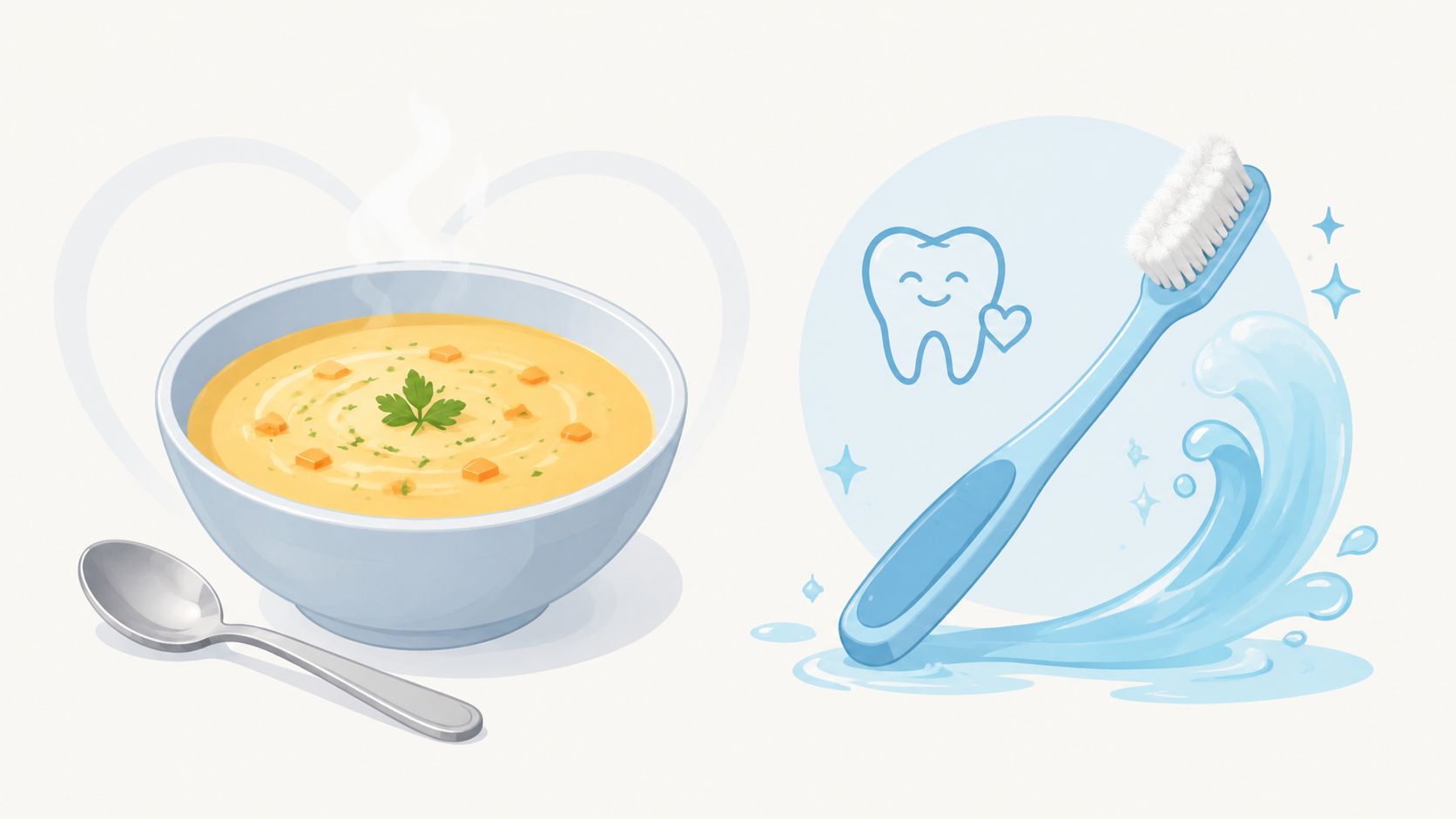
Think soft, cool to lukewarm, and easy to swallow. You want foods that don't require forceful chewing and don't break into sharp pieces.
Good options often include:
- Smooth foods: Yogurt, applesauce, pudding, and mashed vegetables are easy on the surgical area.
- Soft protein choices: Scrambled eggs, blended soups, and other gentle foods can help you stay nourished without overworking your mouth.
- Simple meals you can chew away from the site: If one side feels comfortable, use it carefully and slowly.
Some foods are more trouble than they're worth at this stage:
- Crunchy foods: Chips, crackers, nuts, and crusty bread can irritate the area or leave debris behind.
- Chewy foods: Tough meats, bagels, and sticky snacks put too much force on a healing site.
- Very spicy or very hot foods: These can sting and make a fresh surgical area feel worse.
- Anything through a straw: Suction is best avoided while the site is stabilizing.
If your implant was placed in the front part of the mouth, eating can feel especially awkward for a while. That doesn't automatically mean something is wrong. It often means the location is more noticeable during function.
How to keep your mouth clean without irritating the site
Clean doesn't mean aggressive. The goal is to reduce buildup while leaving the area undisturbed enough to heal.
A simple approach usually works best:
- Follow the exact first-day instructions you were given. Immediate aftercare can vary by procedure.
- Resume gentle cleaning around the rest of your mouth. Plaque left everywhere else still matters.
- Be cautious near the surgical site. Don't scrub over it or jab at it with bristles.
- Use gentle rinses only when your dentist says to start. Forceful swishing isn't helpful.
- Return to your normal brushing pattern gradually. The timeline depends on how the site looks and feels.
A clean mouth heals better, but a disturbed surgical site heals worse. Those two ideas have to stay in balance.
Patients sometimes worry that if they don't brush the implant area aggressively, they're “doing it wrong.” Usually the opposite is true. Early healing responds better to gentle, consistent care than to overcleaning.
Knowing When to Call Your Santa Ana Dentist
This is the part most patients want spelled out clearly. A normal recovery doesn't mean zero symptoms. It means the symptoms fit a pattern that makes sense and gradually improve.
One clinical education source emphasizes that mild soreness and swelling are expected, but pain that is severe enough to impair function, gets worse after the third day, or requires escalating medication is not typical. The same guidance notes that persistent or worsening symptoms should prompt contact with the clinician, along with concerns such as heavy bleeding, fever, or swelling that stops improving, based on this clinical discussion of normal recovery versus warning signs.
What usually fits normal healing
These signs often fall within a routine recovery pattern:
- Manageable soreness: You notice it, but it's controllable with the plan you were given.
- Swelling that peaks early and then starts easing: It may not disappear immediately, but it should stop trending upward.
- Minor bruising or light oozing: Early tissue healing can look messy without being dangerous.
- A mouth that feels stiff or cautious for a few days: That's different from a mouth that feels progressively worse.
A useful way to judge healing is to ask, “Am I heading in a better direction than yesterday?” Small improvement counts.
What deserves a phone call
Some changes don't fit a healthy pattern and shouldn't be watched casually at home.
Call your dentist if you notice:
- Pain that intensifies instead of improving: This matters especially if it's worse after the third day.
- Bleeding that seems heavy or won't settle down: Persistent bleeding needs direct guidance.
- Swelling that keeps increasing or stops improving: A healing site shouldn't stay stuck in the wrong direction.
- Fever, chills, pus, or a bad taste coming from the area: These can suggest a problem that needs evaluation.
- Any symptom that feels out of proportion to what you were told to expect: If eating, speaking, or resting becomes unusually difficult, it's worth checking.
When you're unsure, call. Patients rarely regret asking early. They often regret waiting too long because they didn't want to bother the office.
For patients in Santa Ana, Tustin, Irvine, and Garden Grove, the practical takeaway is simple. Don't try to diagnose the problem yourself if the trend looks wrong. Implant recovery should feel progressively calmer, not more intense.
The Road to Full Recovery and Osseointegration
The visible part of healing is only the beginning. Long after the soreness fades, the implant is still doing its most important work below the surface.
What the implant is doing under the gums
An implant succeeds because the surrounding bone gradually bonds to it through a process called osseointegration. That's what gives an implant its long-term stability. It's also why dentists are careful about timing before placing the final crown.
This process typically takes 3 to 6 months, and it can take longer when additional procedures such as bone grafting were part of treatment, as noted earlier in the linked clinical guidance. Early comfort doesn't mean the implant is ready for full load.
That distinction matters. Patients often feel much better within days or weeks and assume the entire job is finished. In reality, the body is still building the foundation that supports the final tooth.
Follow-up visits matter because your dentist checks healing at each stage, confirms the tissues look healthy, and decides when it's appropriate to move toward restoration. That timeline is individual. It depends on the site, your healing pattern, and whether any added procedures were involved.
Frequently Asked Questions About Implant Recovery
Can I go back to work quickly
Many patients can return to light daily activity fairly soon, but it depends on the procedure and how you feel. Desk work is different from physical labor. If your job involves lifting, bending, or nonstop talking, you may need a more cautious return.
Is it normal to have trouble chewing on the front teeth area
Yes, it can be. The earlier study noted that implants placed in the intercanine area may cause eating difficulty for nearly one week. Front-tooth areas are more noticeable during biting and speech than some back-tooth sites.
When should I worry that the implant is failing
Worry less about isolated sensations and more about the pattern. Increasing pain, swelling that doesn't improve, heavy bleeding, fever, or drainage are the kinds of changes that deserve a call. If something feels off, it's better to let your dentist decide whether it's routine or not.
How long until the implant is fully healed
Short-term comfort recovery and full healing are not the same thing. You may feel mostly back to normal well before the implant has fully integrated with bone. Your dentist will tell you when the site is ready for the next step based on healing, not just on how it feels.
If you have questions about dental implant surgery recovery, want a second opinion, or need a personalized treatment plan, Bristol Dental & Orthodontics is here to help patients in Santa Ana and nearby Orange County communities. You can schedule a consultation to discuss healing concerns, implant options, or the next step in your care. This article should be reviewed by Dr. Andrew Finley before publishing.