
Is a better-looking tooth the same decision as a missing tooth? Most comparisons of dental implants or veneers treat them as two cosmetic upgrades. They are not. One replaces a root that is gone. The other changes the front of a tooth that is still in your jaw.
That gap matters before shade, shape, or a photo of someone else's smile. If the tooth is present and mostly healthy, you are deciding how much enamel to give up. If the tooth is missing, you are deciding how to replace the root and whether the bone can support that plan.
Patients in Santa Ana, and in nearby Costa Mesa, Tustin, Irvine, and Garden Grove, often arrive with a picture they like. The more useful starting point is the tooth, the gums, and the bite. What follows is general information, not a promised result for any one mouth.
Table of Contents
- Dental Implants or Veneers at a Glance
- How Each Treatment Is Carried Out, Step by Step
- How Long Each Option Lasts and Why Results Vary
- Appearance, Tooth Structure and Reversibility
- Complications, Maintenance and Long-Term Care
- Cost and Timeline Factors to Discuss
- Which Option Fits Your Situation
- Book a Consultation to Choose Your Treatment
Dental Implants or Veneers at a Glance
The first question is simple. Is the tooth still there?
A veneer improves the visible surface of a tooth you still have. It is a thin, custom-made shell bonded to the front. It can address discoloration, chips, small gaps, or minor unevenness. Placing one usually removes some enamel so the shell does not look bulky. An implant does a different job. It replaces a missing tooth root and then supports a crown. The NHS guide to dental treatments describes an implant as a titanium screw placed in the jawbone to hold a crown, bridge, or denture, for one tooth or for several. After healing, a custom crown is attached to that post.
| Feature | Dental Implants | Porcelain Veneers |
|---|---|---|
| Problem it solves | Replaces a missing tooth root and supports a crown | Improves the look of a tooth that is still present |
| Procedure type | Surgical placement of a titanium post in the jawbone | Bonded custom shells, usually without surgery |
| Tooth structure | A single implant does not require reshaping neighboring teeth; it depends on healthy bone | Some enamel is typically removed before bonding |
| Healing before final restoration | A healing period while bone bonds to the implant | Minimal; bonding follows laboratory fabrication |
| Reversibility | Permanent addition that would need surgery to remove | Many veneers cannot be reversed once enamel is removed |
| Longevity reporting | Survival rates reported for implants and implant-supported prostheses | Survival rates reported for porcelain and glass-ceramic veneers |
| Day-to-day care | Brushing, interdental cleaning and professional checks around the implant | Soft-bristled brush, non-abrasive fluoride toothpaste and regular checks |
Read the rows as a filter, not as a scorecard. A dark, chipped, or slightly uneven tooth that is still firm belongs in the veneer column. A gap belongs in the implant column. A veneer cannot stand in for a missing root.
When each conversation starts
When the tooth can be restored, the visit usually starts with veneers, bonding, or whitening. Bonding places tooth-colored resin for chips, cracks, and minor gaps. Whitening changes color without covering the tooth. When a tooth is missing, implants and other replacements come into focus, including a single crown, a bridge, or a denture held by implants.
A specific plan depends on bone, gums, and bite. Dr. Andrew Finley at Bristol Dental & Orthodontics in Santa Ana evaluates each case in person. He has extensive training in implants and cosmetic dentistry. A friend's result cannot tell you whether your bone, enamel, and bite will support the same choice.
How Each Treatment Is Carried Out, Step by Step
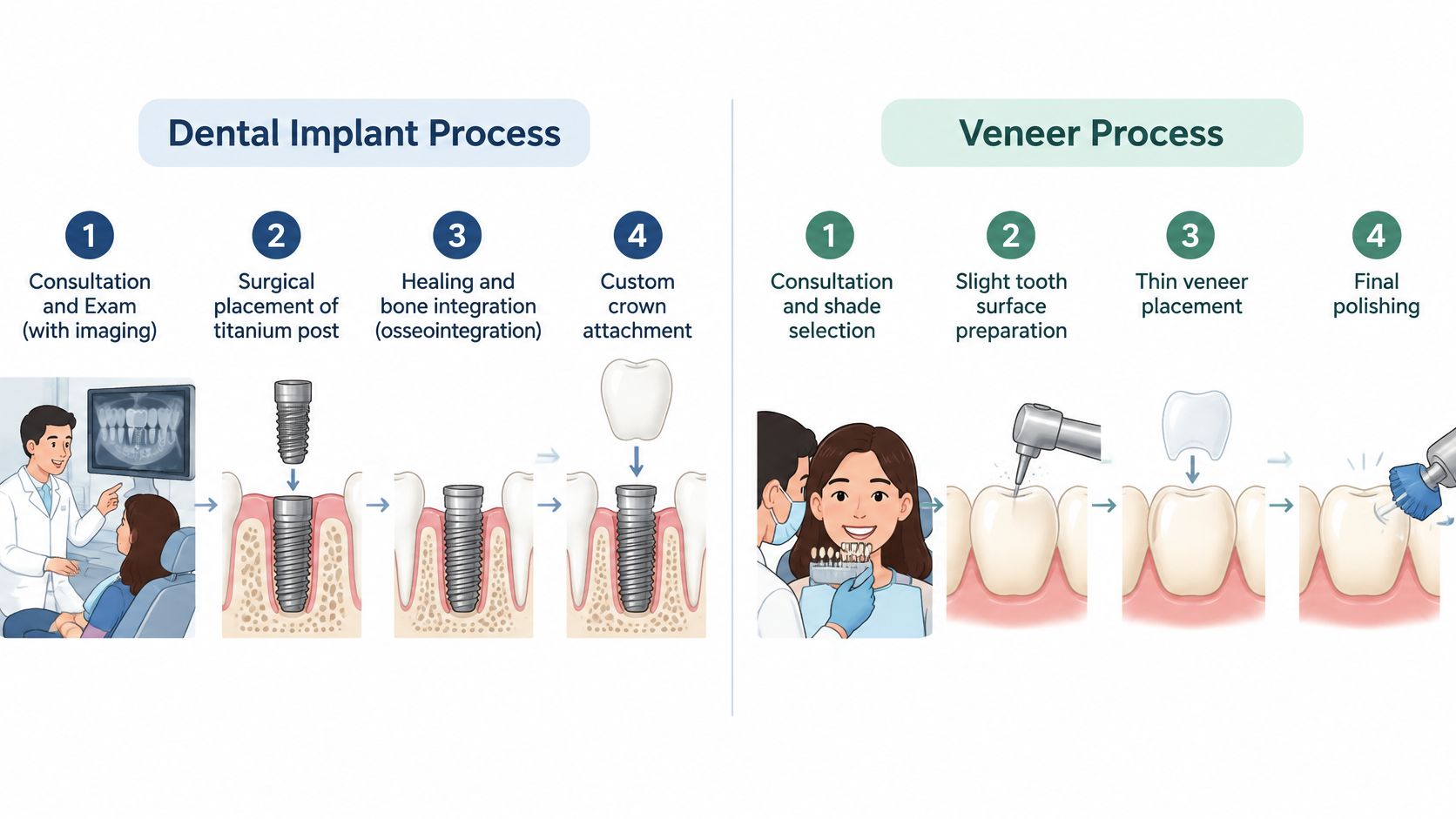
These paths do not share a middle step. One is surgery plus bone healing. The other is a light preparation, a laboratory shell, and a bond.
Implant placement
Consultation and imaging. The first step is an initial consultation with a full examination and imaging to evaluate jawbone density and structure. That record shows whether the site can hold a post or whether grafting has to come first. Without it, the rest of the plan is a guess.
Surgical placement. Implant placement is a surgical procedure in which the dental implant is placed into the jawbone. The post is a small titanium root replacement. You leave with the implant in the bone, not with the final tooth.
Healing and osseointegration. Bone has to bond to the titanium. That bond is called osseointegration. A Springer reference chapter on osseointegration recounts how Per-Ingvar Brånemark observed titanium fusing with bone in the 1950s, then in 1965 placed the first permanent osseointegrated implants in a human volunteer, with the clinical work later published in 1977 and 1981. Healing time is not one number. Bone quality and general health change how long this stage takes.
The final tooth. After the jawbone has healed and the implant is bonded to the bone, you receive a custom-made crown, bridge, or denture. The same logic applies when several teeth are missing. The final piece is built to your bite.
Veneer placement
Evaluation. Enamel thickness, bite, and gum health are checked before a tooth is prepared. Thin enamel or a heavy bite can make a shell a poor first choice.
Preparation. A thin layer of enamel is removed so the shell sits smoothly and the edge does not catch. This is the step that makes most veneers permanent.
Records and shade. Impressions or digital scans, plus a shade chosen with you, go to the laboratory so the shells match the teeth you are keeping.
Bonding and polish. The shells are bonded, polished, and checked against your bite. An uneven bite is a common reason a veneer chips.
At later visits, a sound result looks ordinary. Gums are quiet, the bite is comfortable, and you chew without favoring one side. Timing for either path is set at your consultation, not from a standard calendar.
How Long Each Option Lasts and Why Results Vary
A crown on an implant and a shell on a living tooth age on different clocks. One is held in bone. The other is bonded to enamel that is still yours. How long either lasts depends on what is holding it, and on the bite and gum habits that load that hold every day.
A meta-analysis of implant-supported prostheses found 5-year survival of approximately 96.4% for single crowns on implants, 94.5% for implant-supported fixed partial dentures, and 91.3% for prostheses that join implants to natural teeth. Cumulative failure rates per 100 prosthesis-years were 0.684, 0.881, and 1.514 for those three designs. The combined design sits lower because a natural tooth moves slightly in its socket and an implant does not, so the load is harder to share. That review also flagged implant lengths below 10 mm as potentially tied to higher failure. Jaw shape and any need for grafting remain individual decisions.
A systematic review of implants supporting fixed prostheses estimated survival at 95.6% after five years and 93.1% after ten years. The change between those two marks is small in the pooled figures. It reflects gum inflammation, bone changes around the post, and bite force that continues at night as well as at meals. With proper care, dental implants can last a lifetime. A published percentage describes people followed for a set number of years under that study's conditions. Your own span still turns on bone, gums, and how the bite is managed after the crown is seated.
What the veneer range is telling you
Feldspathic porcelain veneers had an estimated cumulative survival of 95.7% at 5 years (95% confidence interval 92.9% to 98.4%) in a systematic review published in the British Dental Journal. Across three studies, 10-year estimates ran from 64% to 95%, and a post-hoc meta-analysis in that review put a best-case 10-year figure near 95.6% (95% CI 93.8% to 97.5%). Same material name, a wide spread. Preparation, bonding, and how people were followed all sit inside that gap.
The five-year figure can look close to implant survival. The ten-year spread is the part to slow down for. A veneer has no root of its own. It stays only while the bond and the enamel under it stay sound. If preparation leaves little enamel, or the edge sits where you grind, a chip or a loosened shell shows up earlier in one group than in another. Studies that followed people differently, or included heavier bites, land at different ends of that 64% to 95% range.
Porcelain and glass-ceramic veneers have also been pooled in multi-year summaries, and they do not age as one product. Some ceramic groups have looked stronger over a shorter average follow-up, while some porcelain groups sit lower when people are watched longer. Material is only half of it. A veneer is available only while the tooth is still there and you accept changing some of its outer enamel. If the tooth is already gone, there is no enamel left to bond a shell to, and the replacement has to be built on an implant instead.
Why the same treatment ages differently
Oral hygiene, gum health, grinding and clenching, smoking, the material, and the quality of placement or bonding all move these results. Night clenching loads a veneer edge and an implant crown in different ways. On a veneer, the force meets a thin bonded margin, like prying at a sticker that is only as strong as the surface under it. On an implant crown, the same clench travels down a post that does not flex the way a natural root does, so the bone and the screw feel it.
An implant depends on the bone and gums around it. A veneer depends on the bond and the enamel beneath it.
Gums that bleed and stay inflamed can weaken the support around an implant in the years between a five-year visit and a ten-year one. Those same gums do not hold a veneer on, but decay or a failing bond at the edge can still end that shell. Smoking and skipped cleanings push both paths toward earlier repair. A high figure in a study group still leaves room for a chip, a loose screw, or a gum problem that needs a visit. Neither option retires your toothbrush or your checkup.
Appearance, Tooth Structure and Reversibility
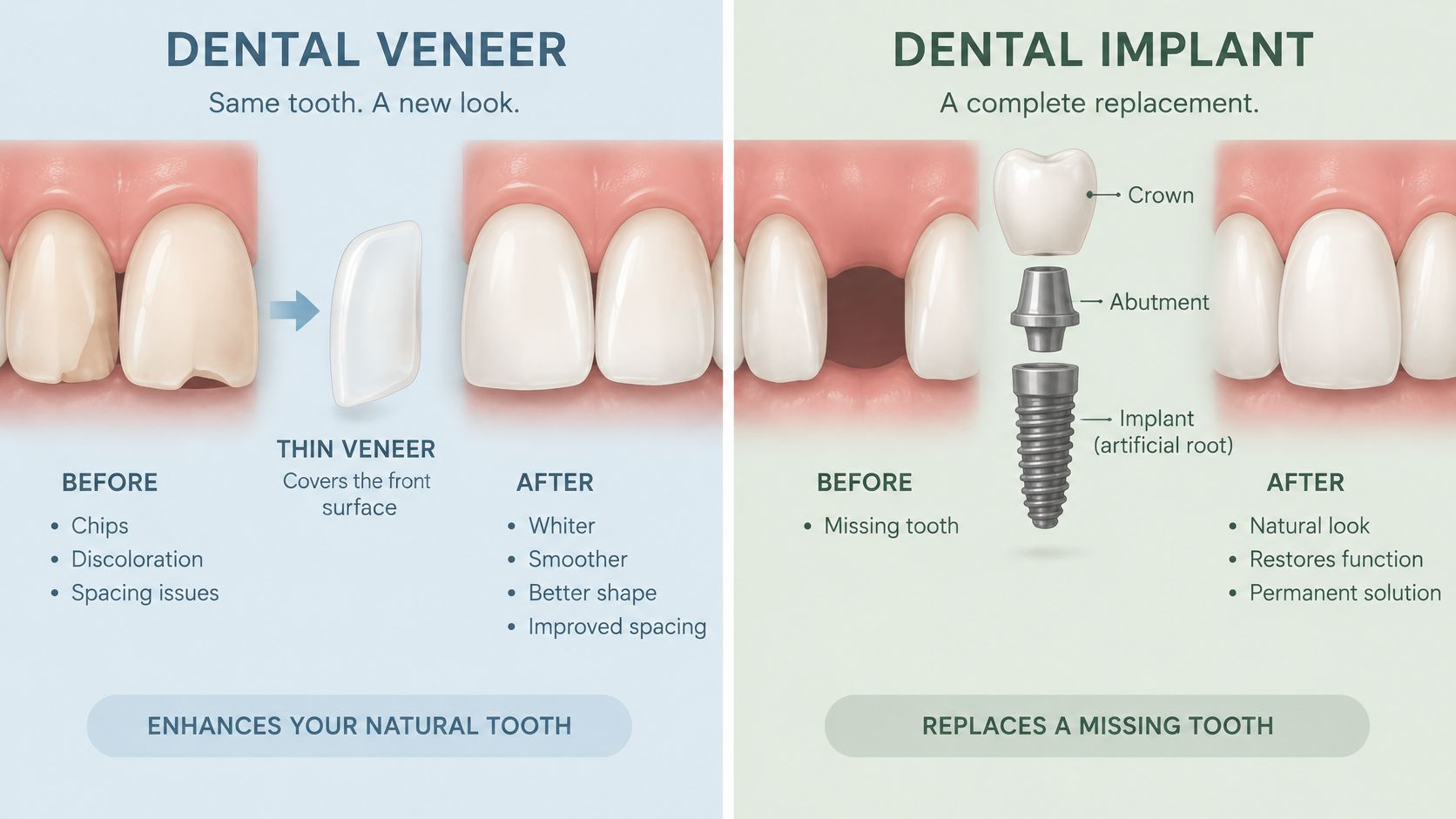
Veneers change color, shape, spacing, and surface while the tooth stays in place. The shade is chosen with the laboratory, and the bond needs enough enamel. If you want to keep as much natural tooth as possible, ask how much enamel the preparation will take before you agree to it.
An implant crown replaces the visible part of a tooth that is already gone, so the goal is a match in shape, shade, and gum line. Gum and bone contour around the post is what makes that crown look settled later, not only the porcelain on day one. Keeping the original tooth is not available here. The tooth is missing, and the question is how the replacement will meet the gum.
What you cannot undo
Cleveland Clinic's page on dental veneers notes that many veneers are not reversible, and that people may notice more sensitivity to heat or cold. A veneer can also become dislodged and need to be put back. Once enamel is removed, the tooth is permanently changed, even if a later shell replaces the first one. An implant is a permanent addition in the jaw. Removing it means another surgery. If preserving tooth structure is your priority, that difference should slow the decision.
Paths that change less
Bonding, professional whitening, orthodontic alignment, and care for bite or gum problems can come before any shell. Those steps leave more of the tooth in place than a preparation that cannot be undone.
Practical rule: If the tooth is still there and the enamel is sound, do not start with a smile photo. Start with what has to be removed.
Write these three questions down for the visit.
- Enamel: How much will be removed, and would bonding be enough?
- Match: How will shade and shape be set against the teeth you are keeping?
- Replacement: If this restoration needs replacing later, what happens to this tooth?
Complications, Maintenance and Long-Term Care
Is the tooth still in the jaw, or has the root already been lost? That question decides which problems you are more likely to face later. A veneer works like a shell bonded to a tooth that is still present, so most trouble is mechanical. An implant works like a new root in bone, so gums, bone, and the parts that hold the crown can each fail on their own.
A systematic review and meta-analysis of porcelain laminate veneers found fracture or chipping in about 4% of veneers (95% CI 3–6%), debonding in about 2% (95% CI 1–4%), and secondary caries or a root-canal complication in about 1–2% each. Chips and bonds that let go drive repair more often than decay or nerve problems. If a veneer chips or comes off, the usual path is to check the bite, then repair, rebond, or replace it. Which of those three is possible depends on how the bite loads that tooth and how much of the shell is left.
Implants, gums, and hardware
Peri-implantitis is inflammation around an implant that can lead to bone loss. NIDCR materials on dental implants note that excessive physical stress or a failure to integrate can contribute to implant failure, and a practice-based registry protocol cited with that guidance lists periodontitis, smoking, pathological oral microflora, uncontrolled diabetes, and missed maintenance as factors linked with peri-implantitis. Ask about those points before you choose surgery.
Treat gum inflammation and a broken part as separate problems with separate visits. Gum and bone problems may need cleaning or treatment. A loose screw or a fractured prosthesis may need repair or replacement.
If an implant never integrates, or later inflammation leads to bone loss, care may mean treating the site, removing the implant, and replanning with grafting or another prosthesis. Shorter fixtures call for a separate look at your anatomy and whether grafting belongs in the plan.
Home care is the part you control between those visits.
- Brush: Twice a day. On veneers, use a soft-bristled brush and non-abrasive fluoride toothpaste so the surface is not scratched.
- Clean between teeth: Once a day, including around an implant.
- Protect the bite: Skip ice and other hard objects. If grinding is diagnosed, wear the night guard you are given.
- Keep the visits: Follow the maintenance interval set for your mouth.
Cost and Timeline Factors to Discuss
No single fee or calendar fits every patient. Cost and time follow the planning steps, not the name of the treatment. Ask for a written, itemized estimate that lists each component, the follow-up visits, and the maintenance you should expect.
What changes an implant estimate
- How many implants: One tooth, several teeth in a row, or a full arch of custom teeth on several posts.
- The site: Grafting if bone volume is low, plus any extraction or sinus procedure that site needs.
- The tooth on top: Abutment and crown materials, or the attachment type if the plan is an implant-supported denture that should not slip.
- Visits after surgery: Healing checks before the final crown, bridge, or denture.
Surgery plus a healing period means the span is measured in months and several visits.
What changes a veneer estimate
- How many teeth are in the smile you want to change.
- Which ceramic the laboratory will use.
- Work that comes first: Bonding or orthodontic alignment before any shell, and whether a night guard is recommended.
- Laboratory time between preparation and bonding. There are usually fewer visits than with implant care, but most cases are not finished the day the tooth is prepared.
If you are in Santa Ana, Costa Mesa, Tustin, Irvine, or Garden Grove, bring those questions in so the estimate describes your mouth, not a sample case.
Which Option Fits Your Situation
Is the tooth still in your mouth, or is the space empty? That question sorts the choices faster than a wish for a certain smile. A veneer or bonding changes a tooth that is still there. An implant replaces a root that is gone. Between those two sits a quieter question: how much healthy tooth are you willing to change?
The visit people describe most often is one missing tooth with healthy neighbors. A single implant and crown is usually discussed first. The teeth beside the gap do not have to be reshaped to hold a bridge. Bone volume and gum health at that site decide whether the plan is realistic. Bristol Dental & Orthodontics provides dental implants for patients throughout Santa Ana and Orange County, and that exam is what makes the table personal.
| Situation | Option usually discussed first | Main consideration |
|---|---|---|
| One missing tooth with healthy neighbors | Single implant with crown | Bone volume and gum health at the site |
| Chipped, stained or uneven tooth with healthy enamel | Porcelain veneer or bonding | Enamel available for bonding and bite forces |
| Several teeth missing in a row | Implant-supported bridge | Number of teeth and implant placement |
| Most or all teeth missing in one arch | Implant-supported denture or full-arch option | Bone support, attachment type and maintenance |
| Heavy grinding or clenching | Bite evaluation before cosmetic work | Forces on implants and veneers alike |
| Active gum disease or smoking | Stabilize gums and habits first | Risk to both options from gum health |
A chipped front tooth with thin enamel
Take a front tooth that is still present. One corner is chipped, the color is patchy, and the enamel layer is thin. From across a table the repairs can look alike. They do not treat the tooth the same way.
Bonding works like patching a nick in paint. A tooth-colored resin is placed on the chip, shaped, and polished so it blends with the tooth beside it. You are not asked to thin the whole front surface first. When little enamel is left, that smaller change is often the place to start.
A porcelain veneer is a thin, durable, custom-designed shell. It can cover a chip, a discoloration, or a mild misalignment, and preparation is meant to alter the natural tooth only a little. The shell still needs enamel that can hold the bond. Thin enamel is a real limit. If that layer cannot support the bond, a veneer is a weak match even when a shell is the look you want. The tooth has not been lost, so the decision is how much of it to change, not how to replace a missing root.
Use that same test on any other row. If the tooth is gone, the plan replaces the root and does not borrow strength by cutting down healthy neighbors. If the tooth is still there, start with the option that changes the least sound structure and still solves the chip, the color, or the shape. Bone and gums then show whether that first idea can be carried out. No row promises a result on its own.
Book a Consultation to Choose Your Treatment
A veneer and an implant answer different questions. One asks how a tooth that is still in your mouth should look, and how much healthy tooth you are willing to change. The other asks what can stand in for a root that is gone. Dr. Andrew Finley has extensive training in implants and cosmetic dentistry. At Bristol Dental & Orthodontics in Santa Ana, he starts by sorting that difference, then examines bone, gums, bite, and the tooth structure you hope to keep.
When an implant is under discussion, the first step is a consultation with an examination and imaging. Those images show jawbone density and structure, the way a builder checks a foundation before setting a post. A veneer discussion stays on the tooth that is already there.
Bring a short list so the visit stays concrete.
- Records: Your medication list and earlier dental records, if you have them.
- Questions: How much enamel would be removed, how long healing takes, what daily care looks like, and what repair means if a restoration fails.
- Priorities: Which teeth bother you, and how much natural tooth you hope to keep.
- History: Smoking, grinding, and any past gum disease, so both options can be weighed in the same visit.
Patients throughout Santa Ana and Orange County use that visit to match one treatment to one mouth. Schedule a consultation to review your exam, bite, and goals, and leave with a written plan.
Bristol Dental & Orthodontics offers family and cosmetic care in Santa Ana, including dental implants when a tooth is missing and veneers when a sound tooth needs a change in shape or color. If you are comparing dental implants or veneers, a consultation is how that choice gets matched to your bone, enamel, and bite. Visit Bristol Dental and Orthodontics to schedule a visit and review your own exam.