
Your jaw clicks when you yawn. Should you book an appointment, buy a night guard online, or do nothing for a month and see what happens?
Most treatment menus don't help you answer that. They present mouthguards, medications, Botox, and surgery as if they sit on the same shelf, which leaves out the two things that decide your next step: order and reversibility.
Care for jaw pain generally moves from steps that are low-risk and undoable toward steps that aren't, and each step up is meant to be earned by a reassessment rather than a calendar date. That's the part patients most often miss. This guide walks through the sequence in plain language, stays candid about where the evidence is thin, and explains when a scan or a referral is the right move.
Table of Contents
- TMJ Disorder Treatment Options at a Glance
- Confirming the Diagnosis Before Choosing Treatment
- Why Conservative Care Comes First
- Physical Therapy, Exercises and Behavioral Care
- Night Guards, Bite Treatment and Medications
- When to Refer for Surgery or Urgent Evaluation
- Booking a TMJ Consultation With Dr. Finley
- Frequently Asked Questions About TMJ Treatment
TMJ Disorder Treatment Options at a Glance
Temporomandibular disorders are common enough that nearly everyone knows someone who has one. The U.S. National Institute of Dental and Craniofacial Research (NIDCR) reports that approximately 5% to 12% of the population experiences one, and that they're reported about twice as often in women as in men, with particularly high occurrence among women aged 35 to 44 (NIDCR facial pain treatment needs). The same source ranks them as the second most common musculoskeletal condition associated with pain and disability after chronic low-back pain, with estimated annual costs of approximately $4 billion.
That percentage range is wide on purpose. Estimates shift with the diagnostic criteria a study uses, how long symptoms have to last to count, and who was surveyed. Read them as a range rather than a single universal rate. Your question is narrower: are these symptoms passing, or do they involve persistent pain, limited function, or a joint and muscle problem that needs structured care?
Many people with jaw pain never need anything invasive. The NIDCR lists soft foods, heat or cold used with gentle jaw exercises, short-term over-the-counter pain medicine when it's medically appropriate, and cutting back on clenching, gum chewing and nail biting among the common nonsurgical measures (NIDCR overview of TMD). The table below sorts those and the other options by purpose, reversibility and usual place in care.
TMJ treatment options by purpose and reversibility
| Option | Main purpose | Reversible | Usual stage |
|---|---|---|---|
| Self-care: soft foods, heat or cold, gentle jaw movement | Reduce strain and short-term discomfort | Yes | First |
| Habit changes: reducing clenching, gum chewing, nail biting | Reduce loading on the jaw muscles and joints | Yes | First |
| Physical therapy and manual therapy | Restore movement and reduce muscle pain | Yes | Early, if symptoms persist |
| Cognitive behavioral therapy | Address pain beliefs, coping and stress | Yes | Early or alongside other care |
| Short-term pain medication | Relieve pain during flare-ups | Yes, when used short term | Early, as clinically appropriate |
| Night guard or occlusal splint | Reduce the impact of clenching and grinding | Yes, as a provisional device | Selected cases, time-limited |
| Orthodontic or bite treatment | Change tooth position or bite | Generally no | Not routine for most TMD |
| Botulinum toxin injections | Reduce muscle activity in selected cases | Temporary | Case by case, evidence limited |
| Surgery | Address structural joint problems | No | Referral after conservative care, selected cases |
Read the table from the top down and a pattern appears. The early rows are reversible and low-risk, and several cost nothing. The lower rows change something permanently, and they're reserved for specific situations rather than offered as an upgrade.
Two cautions. Appearing on this list doesn't mean an option is right for you, because the choice depends on the diagnosis, the symptom pattern and your medical history. And the rows aren't strictly sequential: a night guard can run alongside exercises rather than after them, and plenty of people never reach the bottom rows at all.
Before your consultation: mark the rows that resemble your symptoms, note what you've already tried and for how long, and bring that list with you. A specific history is far more useful to a clinician than a general description of jaw pain.
Dr. Andrew Finley at Bristol Dental & Orthodontics in Santa Ana can review that pattern with you and explain which options are worth considering for your situation, and which aren't.
Confirming the Diagnosis Before Choosing Treatment
Patients often arrive expecting one test to settle the question. Diagnosis doesn't work that way. TMD is identified mainly through a clinical exam, with imaging used as a supporting tool rather than the final word (American Family Physician review of TMD).
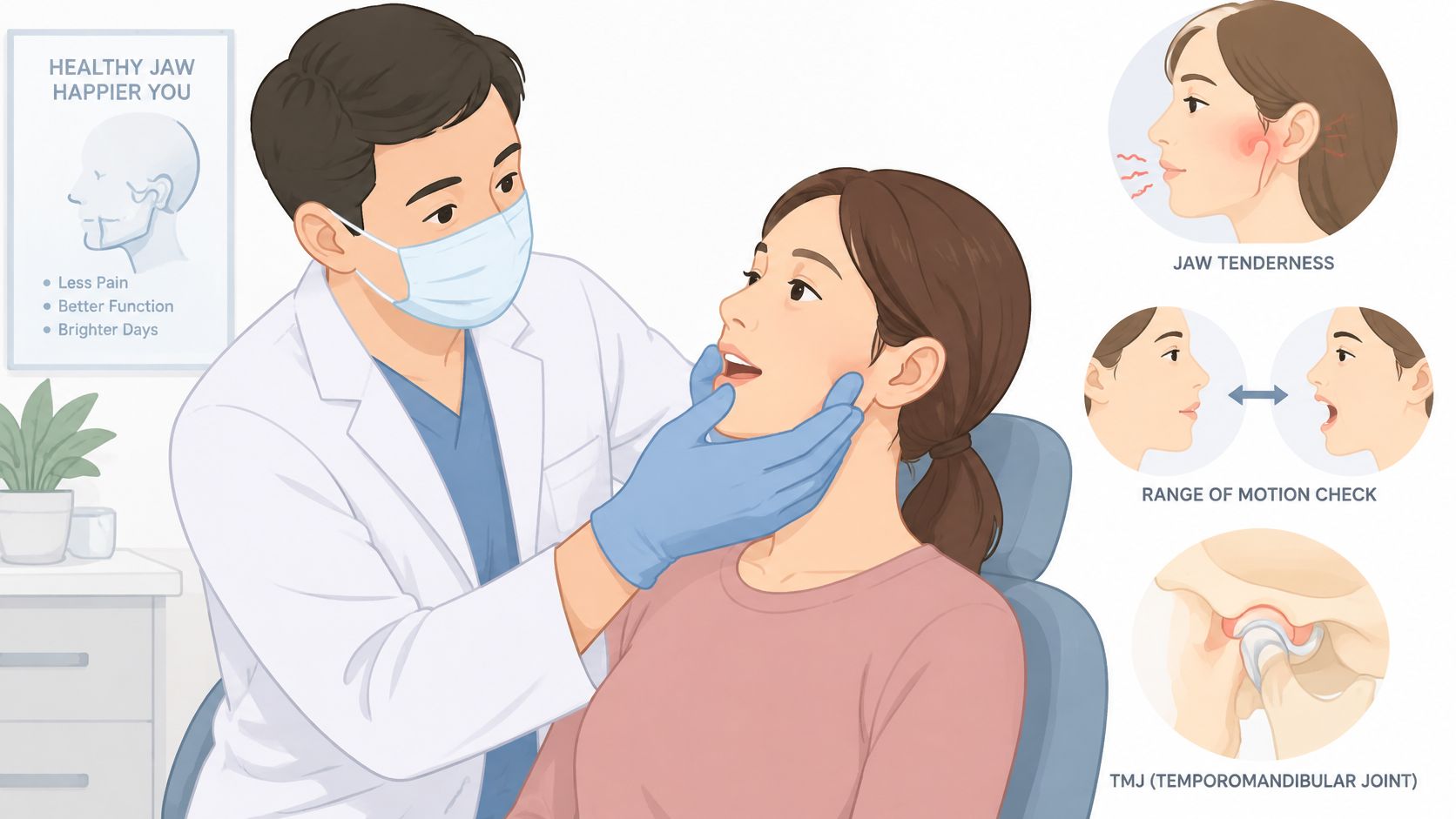
The exam is hands-on, and it usually answers more than a scan would.
What the Exam Is Actually Looking For
The clinician starts with your story: where the pain sits, when it started, whether an injury or a long dental appointment came before it, and which habits are present, including clenching, gum chewing and nail biting. Then comes the physical part, with the jaw moved, loaded and palpated while you report what you feel.
- Tenderness in the temporalis or masseter. These are the main chewing muscles, and soreness there points toward a muscle-driven problem.
- Pain when the jaw is loaded or moved. A jaw that hurts under gentle resistance is telling you something a resting jaw doesn't.
- Abnormal mandibular movement or reduced opening. The path and width of opening matter more than a single sound.
- Signs of clenching or grinding. Worn tooth surfaces and ridged cheeks help explain morning soreness.
Muscle or Joint, and Why the Split Matters
Two people can have identical clicking and completely different plans. When pain comes mostly from overloaded chewing muscles and clenching, the plan leans on habit change, exercise and stress. When it comes from the joint itself, disc position and joint health get more attention. The exam is what separates the two, and it decides whether a device, a therapy referral or a behavioral approach comes first.
When Imaging Earns Its Place
A CT or MRI isn't automatic, and asking for one at the first visit usually isn't the fastest route to relief. Imaging is considered when the diagnosis is uncertain, when symptoms follow trauma, when neurologic changes are present, or when conservative care doesn't resolve the concern.
A week or two of notes does more for your evaluation than an hour of trying to remember. Write down when the pain appears, what you were eating or doing beforehand, how you slept, and how stressful the day was. Patterns show up fast: soreness that's worst on Monday mornings, or pain that spikes with crunchy foods, points the assessment in a direction.
Bristol Dental & Orthodontics evaluates the pattern and source of jaw symptoms for patients in Santa Ana, Costa Mesa and Tustin, and explains whether additional assessment or a referral is appropriate. Your situation deserves an answer built around your case rather than a general one.
Why Conservative Care Comes First
Jaw pain care works better as a sequence than as a menu. Current guideline-based management for chronic TMD pain favors reversible, conservative care before anything invasive, and it names the components: education and self-management, cognitive behavioral therapy, supervised exercise or manual therapy, and selected medication for pain (BMJ clinical guideline on TMD).
The four stages below are what most patients should expect to work through.
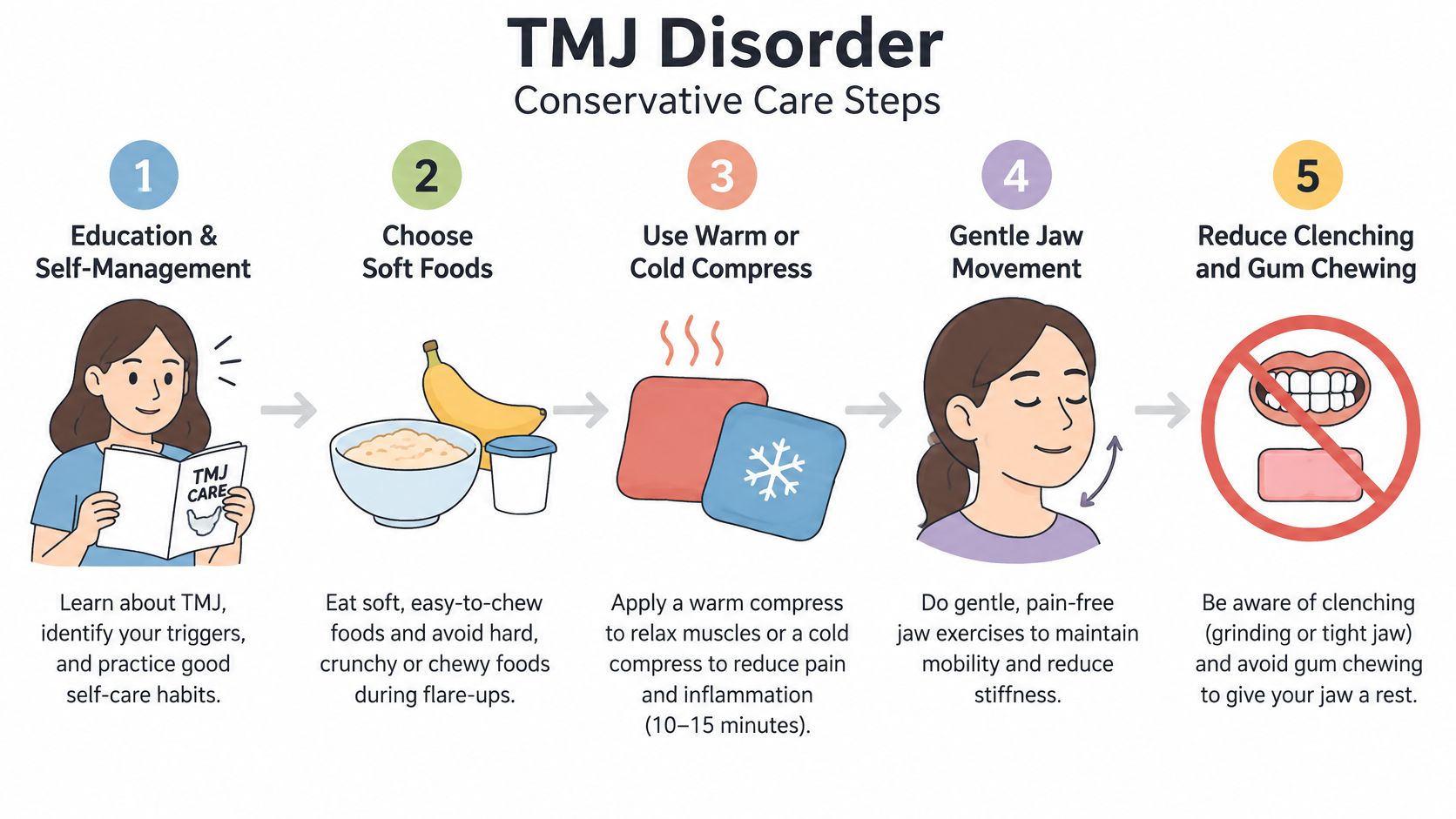
- Education and self-management. Understand what's driving the pain, then reduce the load: softer foods for a stretch, heat or cold for comfort, gentle jaw movement rather than aggressive stretching, and less clenching, gum chewing and nail biting. This stage is free, and it's the one most often skipped.
- Active and psychological care. Add supervised exercise or manual therapy, and cognitive behavioral therapy when pain-related stress, worry or disrupted sleep is part of the picture. Short-term pain medication can bridge a flare so you can do the exercises.
- A reversible, time-limited device. A night guard is considered when grinding or clenching is a clear contributor, and it's paired with the first two stages rather than used alone. The guideline conditionally recommends against reversible occlusal splints as a routine stand-alone treatment, and strongly recommends against irreversible oral splints, discectomy, and opioid and NSAID combinations.
- Specialist referral. Move up when symptoms persist, worsen, or involve any of the warning signs covered further on in this guide.
Why the Sequence Runs This Way
TMD pain can involve masticatory muscle overload, joint inflammation, central sensitization, parafunctional clenching, and psychosocial amplification, often several at once in the same person. When multiple factors are active, permanently changing the bite targets one of them and leaves the rest running. Irreversibility is the key issue: a permanent change to teeth or joints cannot be undone if it does not help.
Say you clench through a stretch of deadline weeks. The pain is genuine, but the drivers are muscle overload, short sleep and stress rather than a bite that moved overnight. A plan built around function and pain habits addresses what is running. A plan that reshapes the bite does not.
How Long Before a Step Up
A 2025 clinical review found that more than 85% to 90% of patients in three studies experienced symptom relief with conservative treatment, with improvement generally stabilizing within six to 12 months (review of conservative TMD outcomes). Those are encouraging numbers and a wide window at the same time, which is why the calendar alone shouldn't drive the decision.
Reassessment decides when to escalate. At each visit, record pain location, range of motion, joint sounds, locking and functional limits, then compare them with the previous visit. If those measures aren't moving, change the plan. If they are, keep going.
No fixed schedule fits every patient. What you can reasonably expect is that each stage gets judged against your own recorded function, not against someone else's recovery story.
Physical Therapy, Exercises and Behavioral Care
The active parts of care ask the most of you and carry the most support. Rehabilitation for TMD works best as a combination: active jaw exercises, manual mobilization, posture-focused training, relaxation, and biofeedback where appropriate, rather than a single passive treatment on its own (systematic review of TMD rehabilitation).
Exercises You Do Yourself
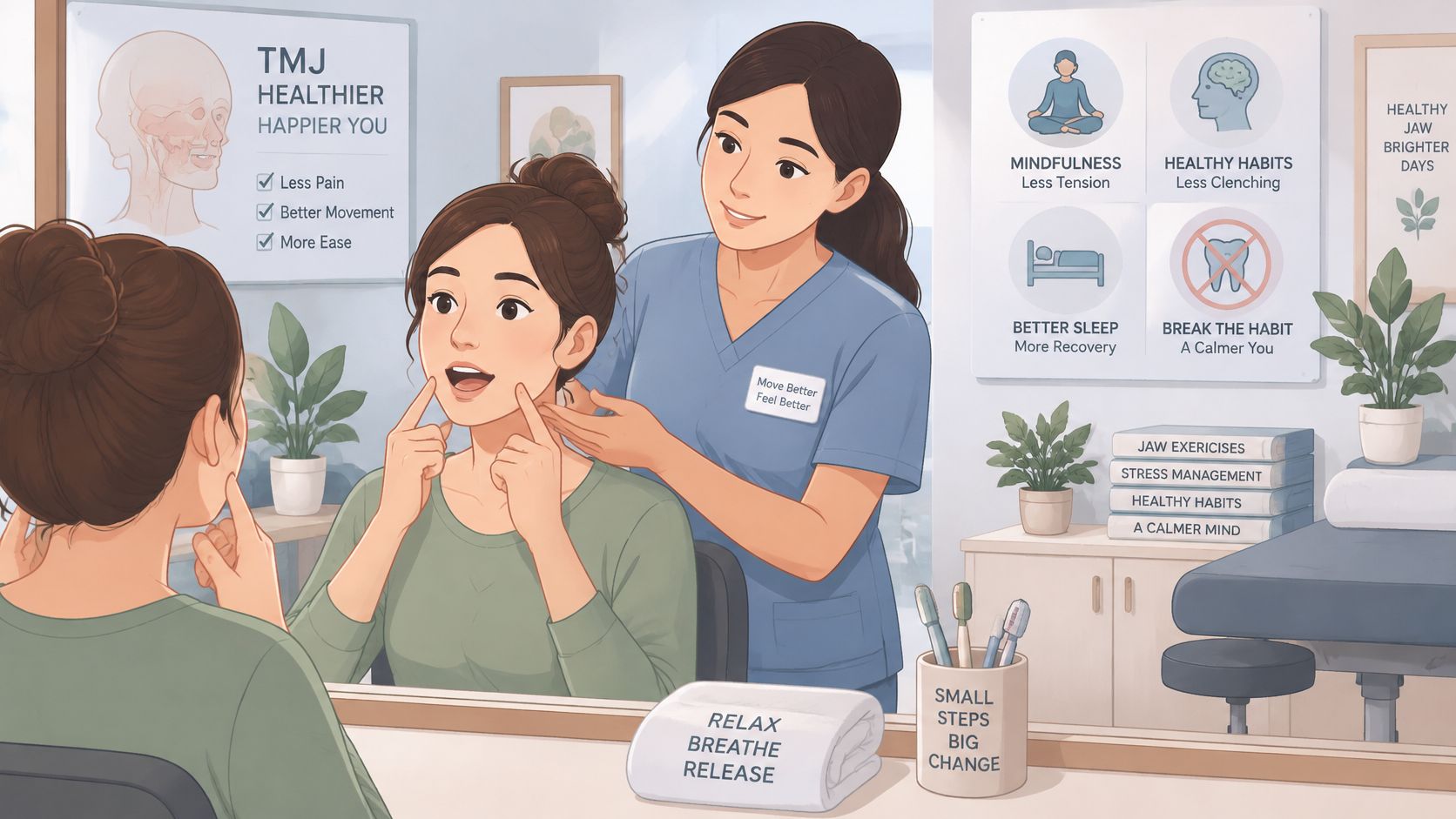
Active exercise is the core. That means slow, controlled opening within a comfortable range, gentle isometric holds against your own hand, and relaxed practice of the movement you've been guarding against. The point isn't to stretch through pain. It's to retrain movement and reduce the bracing that keeps muscles sore. A review of 30 studies reported that active exercises and manual mobilizations may improve TMD symptoms, and that combining exercise, manual therapy, postural correction and relaxation may work better than isolated care or placebo. The independent value of posture training on its own remains uncertain.
Hands-On Help and the Neck Connection
Manual therapy helps the joint and surrounding muscles move more easily, and it should support your active work rather than replace it. The neck matters more than many expect. A 2024 systematic review found that cervical rehabilitation reduced pain in adults with myogenous TMD across five studies involving 223 participants, with a standardized mean difference of -0.98 (2024 review of cervical rehabilitation for TMD). In practice, treatment aimed at the neck and upper back can change jaw pain when the muscles are the main driver.
Certainty is the honest caveat. Physiotherapy can improve pain and jaw function, but the certainty of the evidence stays low to very low, because studies use different treatments, small samples and inconsistent outcomes (review of patient experiences and treatment evidence). That doesn't make exercise useless. It means the direction is sound and the fine print is still being written.
The Behavioral Side of Pain
Pain that lasts changes how you think about your jaw. That same review of patient experiences identified physical and psychological impact, difficulty understanding the condition, healthcare interactions, treatment access and behavioral adaptation as major themes, and it called for better explanations and support. Cognitive behavioral therapy earns its place there: it targets pain beliefs, worry about damage, catastrophizing, coping and the functional limits that follow. Reviews describe it as promising for painful or chronic TMD while noting that larger, longer trials are still needed.
Consider a patient who wakes with a sore jaw after stressful workdays and clenches through most of the afternoon. A sensible plan combines jaw exercises, a wind-down routine before bed and a look at sleep position, rather than a device on its own.
What Progress Should Look Like
What a therapist tracks tells you what to expect: pain intensity, maximum comfortable opening, chewing tolerance and disability. Those measures matter more than the click. Occlusal splints may be considered selectively, but the evidence doesn't establish a specific splint design or consistent superiority over exercise-based care.
Set the goal as better function and less disability, measured against your baseline, rather than the disappearance of every symptom. Few people lose every click, and most don't need to.
Night Guards, Bite Treatment and Medications
Devices and medicines sit in the middle of the pathway. Each has a defined job, a limit, and a review point.
Night Guards and Occlusal Splints
A custom guard is a fitted appliance, usually worn at night, that cushions the joint and puts a barrier between upper and lower teeth so grinding forces land on plastic instead of enamel. That's its job: reduce the impact of clenching and grinding, and protect teeth and existing dental work. What it can't do is retrain the muscles or remove the reason you clench.
Practical decisions matter here. Ask how many nights a week to wear it, how to clean it without warping it, and when it will be checked. A guard still in use a year later with no review has stopped being a treatment plan and become a habit.
Bite Treatment and Orthodontics
Adjusting the bite, whether by reshaping tooth surfaces or moving teeth, is generally irreversible in its effect and is not routine care for most TMD. Careful case selection is the rule. Changing tooth position or surfaces to chase a jaw symptom is a real commitment for a condition that often improves without it.
If you have a separate orthodontic reason to straighten teeth, that can be planned on its own merits. It shouldn't be sold to you as a guaranteed cure for jaw pain, because the evidence doesn't support that promise.
Medications
Short-term over-the-counter pain relief has a place during a flare, when it's medically appropriate, so you can do the exercises and sleep. Prescribed options should be reviewed with the physician who knows your other conditions and medications. Medication eases pain. It doesn't change loading patterns, clenching or sleep, which is why it's a bridge rather than a plan.
Not every promising medicine holds up. A 2025 randomized, double-blind pilot study published in the Journal of Oral & Facial Pain and Headache found no significant benefit from erenumab for TMD at 24 weeks, with a between-group difference in pain interference of -0.19 points (95% confidence interval, -1.94 to 1.56) (Journal of Oral & Facial Pain and Headache). It's a small pilot with a wide interval, so it doesn't prove the drug can never help anyone. It does show that a plausible mechanism isn't the same as a demonstrated benefit.
Laser Therapy and Injections
A 2025 meta-analysis of 44 randomized clinical trials involving 1,816 participants reported that low-level laser therapy was associated with a 60% to 70% reduction in pain intensity and a 10% to 20% increase in maximum mouth opening (2025 meta-analysis of low-level laser therapy for TMD). Pooled results like these come from trials that differ in dose, protocol and population, so treat them as a study finding to discuss rather than a promised outcome.
Botulinum toxin injections are used in selected cases to quiet overactive muscles. The effect is temporary and wears off, repeat treatments become a recurring commitment, and the evidence base is limited. That puts it in the case-by-case column rather than the routine one.
Three questions worth asking before you accept a device or injection: How long will I use this before we judge whether it worked? Which measure will we compare? And what would make you change the plan?
Ask them at the fitting, not six months into a routine nobody has revisited.
When to Refer for Surgery or Urgent Evaluation
Surgery sits at the far end of a long ladder, past every reversible step, and few patients ever need to climb that far.
What Changed the Thinking
The NIDCR describes treatment options that run from self-care, heat or cold, jaw exercises, behavior modification, pain medication and physical therapy through to injections or surgery, while noting that evidence for many interventions remains limited and that treatments permanently altering the teeth, bite or jaw joints should generally be avoided when possible (NIDCR 2025 report on temporomandibular disorders).
Two findings shaped that order. A randomized clinical trial in patients with acute TMD found that an early biopsychosocial intervention was associated with lower long-term treatment costs over one year than no intervention. A large matched case-control study found the same pattern from the other direction: people with TMD used considerably more outpatient visits, pharmacy fills and dental care than matched controls without the condition.
Those results pushed care toward early assessment, multidisciplinary pain management and minimally invasive treatment. They also reset expectations, because a bigger intervention is not automatically a better answer.
The practical question becomes simpler: what is the least invasive step that changes your symptoms?
Everything before the surgical step, exercises, splints, medication, can be stopped or undone if it fails. Surgery cannot. The NIDCR notes that long-term research evidence is lacking on both the safety and the symptom-relief effectiveness of open TMD surgery. That gap is why informed consent and careful patient selection matter before an irreversible procedure, and it is a fair reason to ask for a second opinion when surgery is proposed early.
Referral to oral and maxillofacial surgery exists for refractory cases, meaning symptoms that persist despite a genuine trial of conservative treatment (NHS guide to temporomandibular disorder).
The Warning Signs That Change the Plan
Some symptoms should not wait for the next routine visit. The distinction matters because conservative care assumes the joint and surrounding tissue are intact. The signs below suggest something self-care cannot reach.
Warning signs and suggested next step
| Sign | Why it matters | Suggested next step |
|---|---|---|
| Jaw or joint pain after an injury | Possible injury needing examination | Seek prompt evaluation |
| Swelling, fever or suspected abscess | Possible infection | Seek urgent dental or medical care |
| Numbness, weakness or other neurologic change | Possible nerve involvement | Seek prompt medical evaluation |
| Progressive limited opening or jaw locking | Possible joint or disc problem | Book an evaluation soon |
| Pain persisting or worsening despite self-care | Needs reassessment or referral | Schedule a consultation |
| Clicking or popping without pain or limitation | Common and often not urgent | Monitor and mention at the next visit |
Infection and neurologic change do not wait for a routine appointment. If an urgent sign on that table appears, contact a dentist or physician promptly rather than starting another round of home care.
Booking a TMJ Consultation With Dr. Finley
The practical step is smaller than the worry around it.
A consultation at Bristol Dental & Orthodontics in Santa Ana usually begins with your history: what the pain does, when it started, what makes it better or worse, and what you've already tried. Then comes an exam of the jaw, the bite and the chewing muscles, a review of the symptom diary you've kept, and a plain explanation of whether conservative care, a custom night guard or a referral makes the most sense. TMJ disorder treatment options here include physical therapy, nightguards or other appliances to relieve symptoms, and custom nightguards protect against damage from grinding while helping relieve jaw discomfort.
You leave with a written plan and a date to review it. A device is one option among several and not a guaranteed fix, so the review point matters as much as the recommendation.
Worth bringing with you:
- A short timeline. When symptoms started, what changed around that time, and whether they're improving, stable or worse.
- A current medication and supplement list. Including anything prescribed by another clinician.
- Notes on clenching, sleep and stress. Morning soreness, night waking and busy weeks all feed the assessment.
- Any prior imaging or treatment records. They save time and repeat appointments.
The practice serves teens and adults in Santa Ana, Costa Mesa, Tustin and the surrounding Orange County area. To schedule an appointment, call 714-874-8579.
If your symptoms are persistent, worsening or limiting what you can eat and say, talk through your individual situation with Dr. Andrew Finley rather than waiting for it to resolve on its own.
Frequently Asked Questions About TMJ Treatment
Does TMJ pain go away on its own? Sometimes symptoms settle with self-care and time, but there's no guarantee, and persistent or worsening pain deserves an evaluation rather than patience alone.
Is surgery usually needed? No. Surgery is considered only for selected cases after conservative care has been tried, and the long-term evidence on open surgery is limited.
Will a night guard fix my jaw? A guard can protect teeth from grinding forces and ease strain. It's a provisional option that works alongside habit changes and exercise, not a guaranteed fix.
How long does treatment take? There's no fixed timeline that fits every patient. Progress is judged by reassessment at each stage, using measures like pain, comfortable opening and chewing tolerance.
Timing, Referrals and Preparation
Which comes first, a dentist or a physician? A dentist is a sensible first contact for bite, tooth and jaw joint concerns. A physician is the right call for medication questions and for any numbness, weakness or other neurologic symptom.
Can clicking in the jaw be ignored? Clicking without pain or limitation is common. Monitoring it and mentioning it at your next visit is usually reasonable, while new pain, locking or reduced opening changes the plan.
What if the first step doesn't work? That's what the review point is for. If the measures haven't moved, the plan changes: a different mix of exercise and behavioral care, a time-limited device, or a referral. Escalating isn't failure. It's the sequence working as designed.
What should I do before my visit? Start a short symptom diary covering pain timing, foods, sleep and stress, and gather any prior imaging or treatment records.
Bristol Dental and Orthodontics sees Santa Ana patients for jaw pain, clicking, morning soreness and bite concerns, and can walk you through the conservative steps before anything irreversible is on the table. A visit includes an exam of your jaw, bite and chewing muscles, a conversation about what you've already tried, and a written plan with a clear review point. If your symptoms keep returning or are limiting how you eat, schedule a consultation at Bristol Dental and Orthodontics.