
It is 9:40 p.m. in Santa Ana. Your cheek has throbbed for two days. Then a sudden rush of salty, foul fluid hits your tongue, and the pounding eases. You spit, rinse once, and the tooth feels almost quiet. A parent in Costa Mesa or Irvine may look at a child's calmer face and decide morning is soon enough.
That pause is the risky part. An abscess tooth rupture can drop the pressure that was driving the pain. It does not clear infected pulp, a root tip, or a gum pocket that is still releasing bacteria. Feeling better is not the same as being well.
This page from Bristol Dental & Orthodontics is general education, not a diagnosis for your tooth. Only an exam can say whether that tooth can be saved. If you cannot breathe, swallow, or open your mouth, go to an emergency department now.
Table of Contents
- Why Less Pain After a Burst Abscess Is Not a Cure
- What to Do in the First Hour After Rupture
- How Dentists Remove the Source After Drainage
- When Antibiotics Help and When They Do Not
- Home Care While You Wait for the Appointment
- Call for Same-Day Care in Santa Ana
Why Less Pain After a Burst Abscess Is Not a Cure
An abscess throbs because pus builds inside a sealed pocket with nowhere to go. Once that pocket tears and drains into the mouth, the pressure drops within minutes, and the pounding drops with it. Mayo Clinic describes this sudden rush of foul-smelling or foul-tasting, salty fluid, sometimes followed by reduced pain, as a possible sign that an abscess has ruptured. Many people recognize an abscess tooth rupture by exactly that sequence.
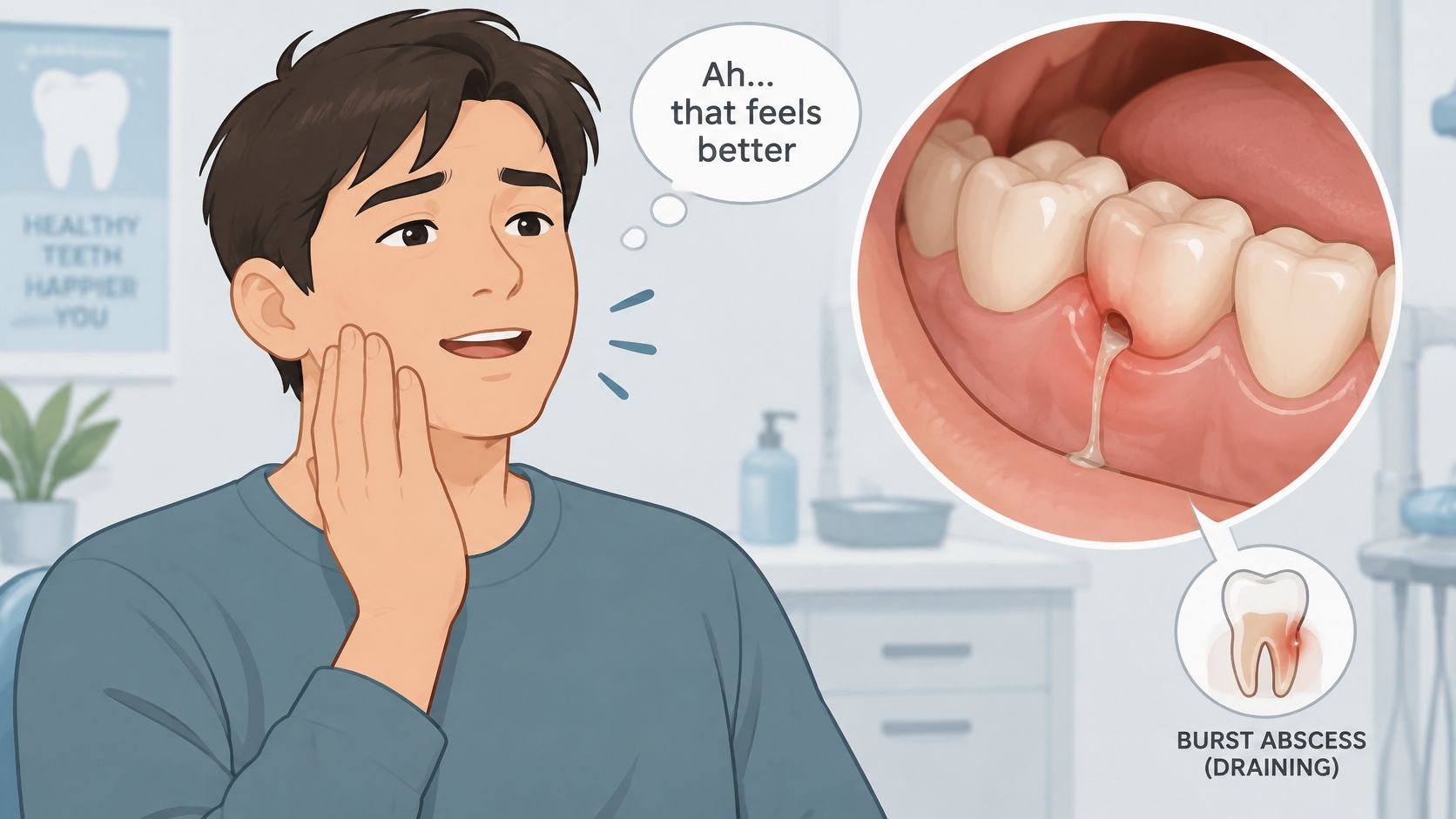
Here is the part that fools people. The pus was a product, made by infected tissue that stays behind after the fluid leaves. Dead pulp inside the tooth, inflamed bone at the root tip, or a periodontal pocket along the gum can keep releasing bacteria while the cheek looks flatter. Draining the pocket cleared the symptom. The factory that produced it is still running.
Pressure relief is not infection control
Mayo Clinic notes that the improvement may be temporary, because drainage does not necessarily mean the infection has been eliminated. If the small opening seals over, the pocket can refill and the cycle of swelling and pain can start again. Meanwhile, bacteria sitting at the root tip or in a gum pocket can keep spreading into surrounding bone and soft tissue even while the tooth feels quiet.
Practical rule: A foul taste followed by less pain means the pocket found an exit. Treat the quiet tooth as a drained symptom, with the source still active underneath.
Depending on the tooth, care can include professional drainage, root canal treatment to remove infected pulp and seal the canals, or extraction when the tooth cannot be predictably restored. Dr. Andrew Finley can explain which emergency or restorative option fits after an exam, since no description over the phone can settle that.
If pus, a bad taste, or sudden pressure relief shows up after swelling, contact Bristol Dental & Orthodontics rather than assuming the problem resolved. Same-day care gives the source a chance to be removed while the infection is still localized.
What to Do in the First Hour After Rupture
The first hour after an abscess bursts has one job: get you to the right door without making anything worse. Treat the next sixty minutes as triage. The American Dental Association describes the clinical sequence as checking the airway and how sick the person feels, examining the tooth and nearby tissues, taking appropriate images, draining anything still collected, then removing the source. For an immunocompetent adult with a localized acute apical abscess, that guidance favors definitive dental treatment, such as incision and drainage, root canal therapy, or extraction, rather than routine systemic antibiotics.
Five actions before you leave the bathroom
- Stop chewing on that side. Keep fingers, tongue, and anything sharp away from the opening. A self-puncture is not professional drainage. It can push bacteria into nearby tissue and delay real source control. The ADA warns that patients shouldn't puncture, squeeze, or irrigate an abscess themselves, because that can traumatize tissue.
- Rinse gently once. Stir about half a teaspoon of salt into a cup of warm water, swish softly, and spit. The goal is to clear the fluid already in your mouth, not to drive water into the gum.
- Write down what you see. Note the time, which tooth hurts, and whether swelling stays near one tooth or is moving into the cheek, neck, eye area, or floor of the mouth. A photo with a timestamp gives the dentist a useful before picture.
- Use only pain medicine already cleared for that person. Ibuprofen or acetaminophen can be reasonable when a clinician has said it is safe for them. Don't start a leftover antibiotic from the cabinet, and don't share someone else's prescription.
- Choose the right door the same day. Call a dentist when the rupture stays local. Go to an emergency department now if breathing, swallowing, or opening the mouth is failing.
Feeling better can be the trap. Less pain after the salty taste does not move you off the same-day exam path: a localized adult infection still needs an exam, imaging when indicated, drainage of anything still collected, and removal of the source. Whether your symptoms call for antibiotics is a clinical judgment, covered in the section on when they help.
Treating a spontaneous burst as finished drainage is a common miss. The opening can seal over the way a small cut scabs, while the tooth or gum pocket underneath keeps producing pus. Pressure then builds until the swelling returns.
Match the situation to the right place
| Situation | What it suggests | Where to go now |
|---|---|---|
| Foul or salty taste and less pain, no fever, swelling stays near one tooth | Pressure released; the source inside the tooth or gum may remain | Same-day dental exam; don't wait for the weekend |
| Fever, feeling ill, or swelling spreading across the cheek or jaw | Infection may be leaving the tooth | Urgent dental care the same day; a clinician decides whether antibiotics belong |
| Trouble breathing or swallowing, voice change, neck swelling, eye involvement, confusion, or the jaw nearly locked shut | Possible deep-space or airway threat | Emergency department immediately |
| Child, pregnancy, immune-suppressing illness, or a drug allergy | A localized infection may still need a clinician's plan | Urgent professional evaluation; no leftover or shared antibiotics |
Read the table from the bottom up when symptoms overlap: each lower row outranks the ones above it. If you are unsure which row fits, use the more urgent one.
How Dentists Remove the Source After Drainage
A burst at the kitchen sink is not the same procedure as controlled care in a dental chair. One releases pressure wherever the tissue gave way. The other is planned, watched, and followed by treatment of whatever is still infected.
What a planned opening actually does
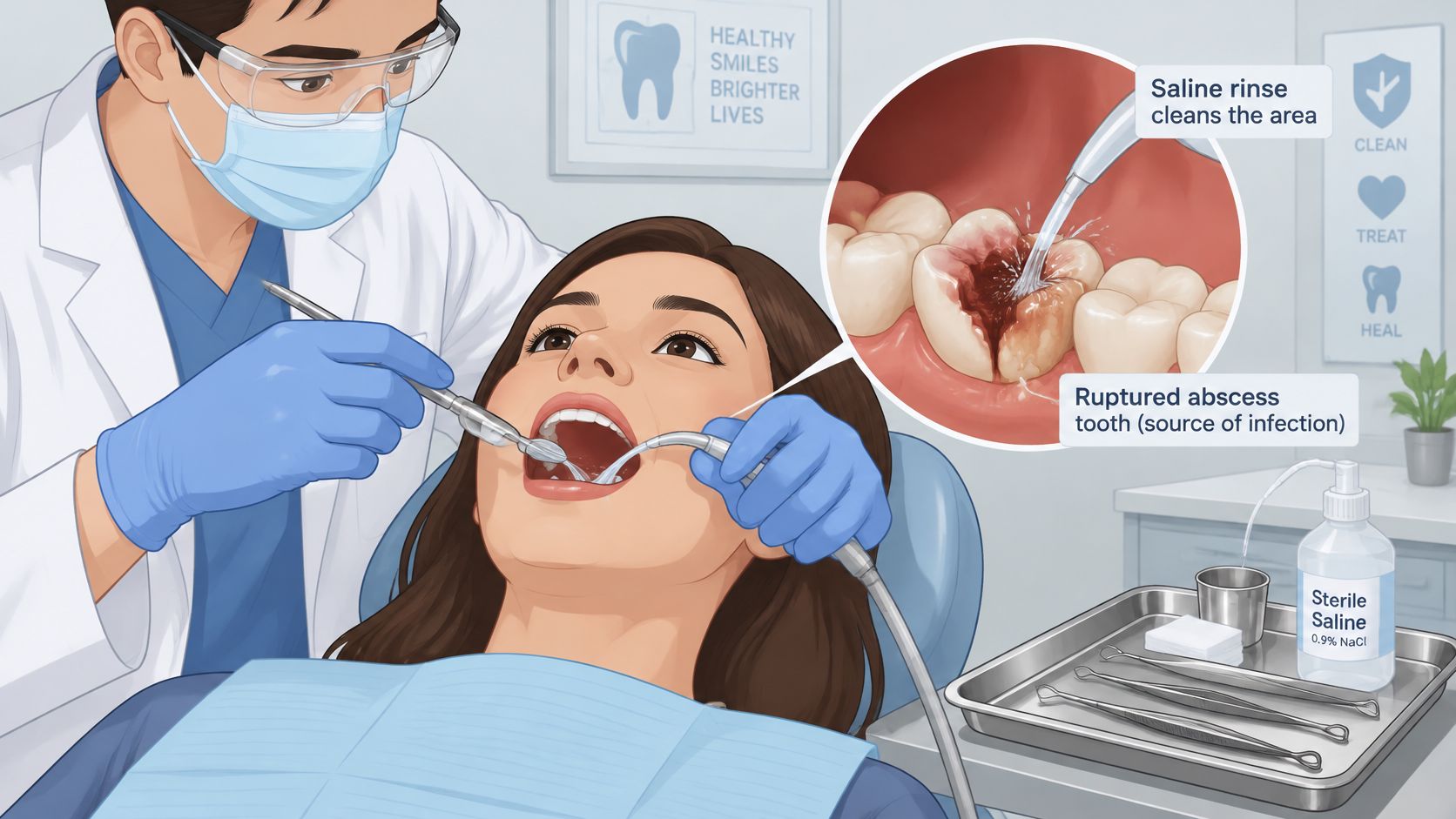
Mayo Clinic describes incision and drainage as making a small opening so pus can leave, then washing the area with saline. Occasionally a small rubber drain stays in place for a short time while swelling decreases. That drain is a temporary exit, not a cure by itself.
The order of care is practical. The dentist checks breathing and how sick you feel, examines the tooth and gums, and takes images when they will change the plan. Anything still collected is drained. Then the source is removed. Closing the area too soon, or relying on medicine alone, can let pus collect again.
Root canal, a later crown, or removal
When infection starts inside the tooth, a root canal may remove diseased pulp, drain the abscess, and fill and seal the pulp chamber and root canals. A crown is sometimes discussed later to strengthen a treated back tooth. That is a restorative step after the emergency, not a promise made on the day the abscess opens.
Extraction is the other way to remove the source when the tooth cannot be predictably restored. A later implant, if one is appropriate, is a separate plan after infection is controlled and the bone has healed. It is not a same-day fix for a draining abscess.
These steps address both the collection of pus and the underlying source. A spontaneous rupture may only release pressure. Outcomes vary by the tooth, how far infection has spread, and overall health. At Bristol Dental & Orthodontics, Dr. Andrew Finley explains tooth-preserving or removal options after the exam. This explanation does not decide root canal versus removal for you.
A small opening plus a saline wash treats the pocket you can see. The tooth still needs a plan for the tissue that produced the pus.
When Antibiotics Help and When They Do Not
The call comes in often: the abscess burst overnight, the pressure eased, and the question is whether the office can phone in a prescription. The request sounds reasonable. Antibiotics treat infection, and an abscess is an infection.
The catch is where the medicine can reach. An antibiotic travels through blood and tissue, clearing bacteria that have spread outward. It cannot drain a pocket, and it cannot reach the sheltered bacteria inside a dead tooth. An antibiotic works like a mop on a flooded floor: it helps with the water that has already spread, while the leaking pipe still needs a hand on the valve.
Signs the infection has outgrown one tooth
For a localized abscess in an otherwise healthy adult, treatment of the source comes first. A 2025 European pediatric dentistry policy states that antibiotics are not recommended for pulpitis or localized periapical periodontitis, reserving them for systemic spread, fever, lymph-node involvement, extra-oral swelling, cellulitis, or cases where adequate drainage cannot be achieved.
Each item on that list describes infection moving beyond the pocket. A fever means the whole body is responding. Cellulitis means bacteria are tracking through soft tissue. Swelling outside the mouth means the problem no longer sits at one root. When one of those signs appears, or when the dentist cannot drain the collection that day, medicine joins the procedure rather than replacing it.
Two misses that keep people sick
- A prescription with no drainage. The pills quiet what circulates while the pocket refills. If swelling remains after the bad taste fades, the tooth still needs a hands-on plan.
- No recheck when the cheek grows. A quiet hour can be followed by firmer, wider swelling. That change deserves a same-day call to the dental office instead of a wait-and-see evening.
Some situations always need a clinician's choice rather than a leftover bottle. Children, pregnancy, a penicillin allergy, and immune-suppressing illness each change the drug, the dose, or both. The prescriber weighs allergy history, pregnancy, other illnesses, and local resistance patterns. The same rule holds for the bottle already in the cabinet: do not self-start, share, or adjust a course on your own.
Feeling better is not the same as being well. A quiet evening after a burst abscess is a reason to keep the appointment.
Home Care While You Wait for the Appointment
The hours between the rupture and the exam are for comfort and watching, not fixing. Book the exam even if the throbbing eases, because the drain spot can close over while the pocket beneath it stays full.

What helps while you wait
Keep the gentle rinses going. Continue the soft salt-water swishes you started right after the rupture, especially after meals. The motion stays soft because forceful swishing can push fluid into sore tissue.
Raise your head a little at night. An extra pillow can ease throbbing in the cheek. Lying flat often makes the pulse in that area feel louder.
Brush nearby teeth with a soft brush. Clean what you can without scrubbing the drainage spot. Skipping the whole mouth lets plaque build on the teeth next door.
Choose cool, soft foods. Yogurt, eggs, or lukewarm soup are easier than a crunchy or very hot meal. Sugary snacks tend to irritate the area and are not worth it for one evening.
Use cold only on the outside. A cloth-wrapped cold compress, in short intervals, may calm swelling. Ice does not go inside the mouth, and it does not go on bare skin.
Check whether the swelling is growing. Look in a mirror every few hours and compare the two sides of your face. A cheek that feels firmer, wider, or warmer than it did this morning is moving the wrong way. Also test how wide your mouth opens; shrinking movement matters even when pain stays quiet.
Write a short log. Note temperature and whether swelling is drifting toward the eye, the neck, or under the tongue. That note saves time at the visit.
Habits that make the wait less safe
Aspirin held on the gum can burn tissue. Alcohol used as a rinse stings the open spot and dries already-irritated tissue. Cotton, wax, or gum packed over the spot can trap pus.
Pain that returns after a quiet hour is common. Keep the appointment anyway. A fading ache says nothing about what remains inside the tooth.
A nightguard or sports mouth guard that presses the swollen tooth should stay out until the dentist says it is safe to wear. Custom nightguards protect against grinding, and custom-fitted sports mouth guards are made to fit precisely, but neither belongs on a tooth that is still draining.
If breathing, swallowing, or opening gets worse while you wait, home care is over. Go to an emergency department.
Call for Same-Day Care in Santa Ana
If breathing and swallowing feel normal and swelling stays near one tooth, the next step is a same-day exam. Call Bristol Dental & Orthodontics at 714-874-8579 and say that an abscess tooth rupture just happened. That one detail helps the team judge how quickly you need to be seen.
What to have ready before you call
Have a few facts in front of you. When the bad taste or swelling started. Whether you have a fever. Any medicines already taken. Drug allergies. Whether you are pregnant. Those details shape a safer visit, especially for a child or someone with a complex medical history.
Emergency dentistry at the practice covers toothaches, broken teeth, and other urgent problems, so a ruptured abscess fits squarely in a same-day slot. The exam determines whether the tooth can be saved and which treatment comes next. The practice serves Santa Ana and surrounding Orange County communities, including Costa Mesa, Tustin, Irvine, and Garden Grove.
After the infection is under control, Dr. Andrew Finley can discuss whether the tooth needs root canal treatment and a later crown, removal, or, once the area has healed, a plan to replace a missing tooth. That conversation follows the exam.
Why a fading taste is still a reason to be seen
A clinical review on the National Library of Medicine site describes a Trieste dental-emergency-unit study in which more than 24,000 patients were evaluated and 688 were diagnosed with dental abscess. Spontaneous drainage, meaning an abscess that ruptured on its own, was specifically associated with longer healing time, alongside fever, restricted mouth opening, and infection involving more than one anatomical space.
Dental abscesses can extend from the tooth or periodontal tissues into facial and neck spaces. Untreated infection may progress to lymph-node involvement, sepsis, airway obstruction, mediastinitis, orbital or cerebral abscess, and osteomyelitis. Those outcomes remain uncommon for a localized rupture, and they explain why a fading foul taste still calls for a prompt exam rather than a wait-and-see weekend. Any of the warning signs in the section 2 table moves the situation to emergency care. Otherwise, definitive care such as root canal therapy or extraction still has to follow the drainage event.
Once the emergency is handled, prevention lowers the chance of a repeat. Treat decay before it reaches the pulp, have a lingering toothache examined, and keep gum disease under care.
If breathing trouble, swallowing trouble, or rapidly spreading neck swelling appears before the appointment, go to an emergency department. A dental visit can wait for a morning slot; an airway problem cannot.
Bristol Dental & Orthodontics offers emergency dentistry in Santa Ana for toothaches, broken teeth, and other urgent problems, including an exam after an abscess tooth rupture. Dr. Andrew Finley can review your tooth and explain the next step for your case, without promising a specific result. Visit Bristol Dental and Orthodontics to schedule a consultation, or call 714-874-8579 if swelling is still local and breathing and swallowing are normal.