
If full-mouth implants stay in place, does that mean they'll need less care than removable teeth? Not necessarily. How your teeth attach, how you'll clean them, and what may need repair are separate questions, and all deserve attention before you choose treatment.
For patients in Santa Ana and Orange County, comparing full-mouth dental implants means looking beyond appearance or the word fixed. A useful decision starts with understanding the implant posts, the replacement teeth they support, and the long-term care each option requires.
Table of Contents
- Full-Mouth Implant Options Side by Side
- How Fixed and Removable Designs Attach to the Jaw
- Who Is a Candidate and How Many Implants Are Placed
- How to Move from Consultation to Final Teeth
- Survival Rates and What Can Go Wrong
- Maintenance and Repairs Over the Years
- Recovery and What Shapes Cost
- Choosing the Full-Mouth Option That Fits Your Life
Full-Mouth Implant Options Side by Side
Full-mouth implant treatment replaces an entire arch, upper, lower, or both, by anchoring replacement teeth to titanium posts placed in the jawbone. You don't necessarily need an implant for every missing tooth.
Full-mouth implant options compared
| Option | Implants per arch | Removable by patient? | Main upkeep | Often suits |
|---|---|---|---|---|
| Fixed full-arch bridge, All-on-4 or All-on-6 style | Commonly four to six; some plans use eight or more | No | Professional visits, careful cleaning under the teeth, possible prosthetic repairs | Patients who want non-removable teeth and can clean beneath them |
| Implant-supported overdenture, snap-in | Two to four | Yes, removed nightly | Daily denture cleaning, periodic adjustments, replacement of worn parts | Patients who want removable teeth with fewer implants |
| Individual implants | One per missing tooth | No | Crown care, gum checks, regular cleanings | Patients who want each tooth replaced separately |
These counts describe treatment configurations, not a prescription for your mouth. The central distinction is whether implants support a shared restoration or separate crowns.
What each option means in daily life
A fixed full-arch bridge joins replacement teeth into a restoration secured to implants. It can appeal to someone who doesn't want to take teeth out at home, but the design must leave practical access for cleaning underneath.
An implant-supported overdenture combines implant retention with patient removal. Taking it out gives access to the appliance and tissues, although its attachment components and denture teeth still need attention over time.
Individual implants replace missing teeth separately rather than connecting a complete arch to a shared bridge. For extensive tooth loss, that means more separate implant sites and crowns to plan, clean, and maintain, so it isn't automatically the most practical full-mouth approach.
Why an entire arch can share support
The principle has a long clinical history. A historical review of implant dentistry describes how Per-Ingvar Brånemark treated Gösta Larsson in 1965 with four titanium implants supporting a fixed complete-arch prosthesis that remained functional for approximately 40 years.
That influential case demonstrated the possibility of supporting an arch without replacing every tooth root individually. It doesn't establish an expected lifespan for someone starting treatment today.
Use the comparison to build a shortlist rather than choose by implant count alone. Fixed describes how teeth are held, not whether they need less care.
How Fixed and Removable Designs Attach to the Jaw
The attachment determines what you can remove at home and where your cleaning tools must reach. The implant sits within the jawbone, while connecting components join it to the replacement teeth.
Fixed teeth require access underneath
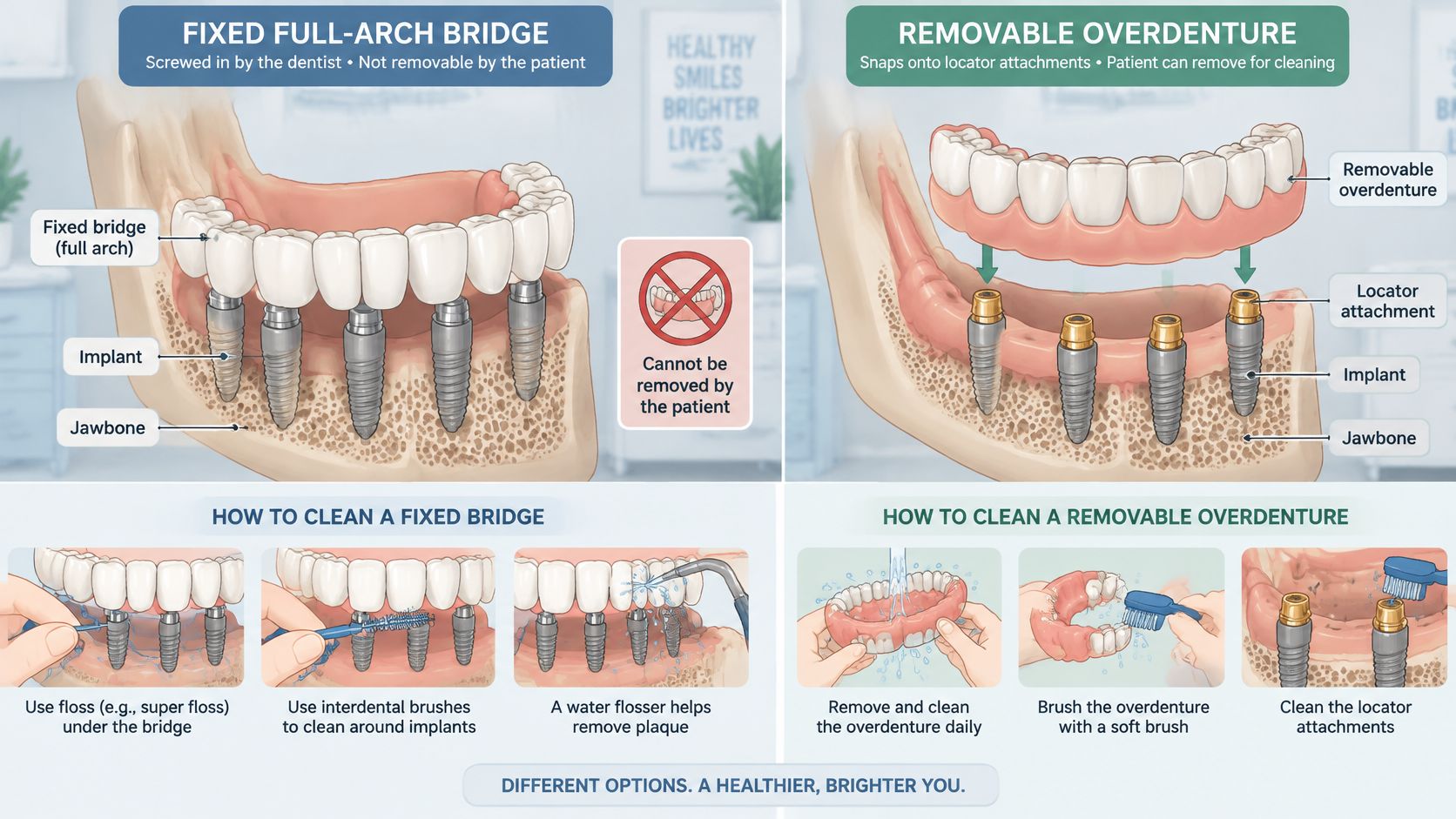
A fixed full-arch prosthesis is secured to implants, often through screw-retained connections. You can't remove it yourself, although a dental professional may remove it when clinically necessary.
Brushing the visible teeth isn't enough. Food and plaque can collect near the gumline and beneath the bridge, so the dental team should demonstrate tools suited to the available space:
- Floss threaders help guide suitable floss beneath accessible areas.
- Interdental brushes clean spaces when their size and shape fit the restoration.
- A water flosser may help flush debris, alongside the mechanical cleaning your dentist recommends.
A tool should fit without being forced. If you can't reach an area comfortably, that's a design or hygiene question to raise, not something to solve by scrubbing harder.
Removable teeth use accessible attachments
A snap-in overdenture engages attachments connected to implants. These attachments improve retention, but they don't make every removable design completely motionless.
The WebMD guide to snap-in dentures describes removable designs commonly using two to four implants, while some fixed plans may require eight or more; it also explains daily cleaning and usual nightly removal so gum tissues can recover.
There's an important middle category: implant-assisted designs may share chewing support with the gum tissue. The American College of Prosthodontists' definitions of implant prostheses explain why retention, support, and movement aren't interchangeable terms.
Bone volume, implant position, arch shape, bite forces, and the planned restoration determine which attachment system is viable. The number of missing teeth alone doesn't settle that decision.
Practical rule: Ask to see how you would clean the proposed restoration before you agree to it.
At a consultation with Bristol Dental & Orthodontics, ask:
- Removal: Can I remove this prosthesis myself?
- Cleaning: Which tools will reach every area I need to clean?
- Repairs: What should I do if an attachment or component loosens?
Who Is a Candidate and How Many Implants Are Placed
More implants don't automatically mean better survival. A systematic review and meta-analysis of fixed full-arch prostheses found no statistically significant survival difference between fewer than five implants per arch and five or more, across one to fifteen years of follow-up.
That finding doesn't mean every configuration is equally suitable for every patient. It means implant count must be interpreted within the whole treatment plan.
Planning factors that shape a full-mouth plan
| Planning factor | Why it matters | How planning responds |
|---|---|---|
| Jawbone volume and density | Implants need sufficient bone for support and integration | Imaging measures bone; grafting is considered in some cases |
| Gum health and periodontitis history | Gum disease is linked to peri-implantitis | Gum evaluation and treatment before placement |
| Smoking | Listed as a peri-implantitis risk factor | Open discussion of cessation and closer monitoring |
| Diabetes control | Uncontrolled diabetes is a listed risk factor | Coordination with the patient's physician |
| Bite forces and grinding | Adds load to implants and the prosthesis | Bite assessment and protective planning where needed |
| Hand dexterity and vision | Affects cleaning under fixed teeth | Removable design or closer hygiene support considered |
| Opposing teeth and appearance goals | Shapes restorative design and risk | Design planned around the opposing bite and aesthetic goals |
Position matters as much as quantity
Prosthetically driven planning starts with where the replacement teeth should be, then works backward to suitable implant positions. Placing implants wherever bone is easiest to access may not produce the most cleanable or mechanically appropriate restoration.
Front-to-back distribution also matters. If replacement teeth extend beyond their supporting implants, that unsupported extension, called a cantilever, creates additional force during chewing.
The dentist evaluates how biting forces will travel through the teeth, connectors, implants, and bone. Grinding, the opposing teeth, and the chosen restorative material can change that calculation.
Health and home care belong in the plan
Smoking, uncontrolled diabetes, periodontitis, and inadequate maintenance are recognized peri-implantitis risk factors. Medical and periodontal assessment therefore belong alongside imaging and bite evaluation, rather than being treated as paperwork before surgery.
Limited vision or hand movement also deserves a direct conversation. A restoration that looks suitable on a scan may still be a poor practical fit if the patient can't maintain it or access reliable help.
Four implants aren't appropriate for every patient. Dr. Andrew Finley at Bristol Dental & Orthodontics evaluates anatomy, health, restorative goals, and maintenance feasibility in person; this article is general information, not individualized medical advice.
How to Move from Consultation to Final Teeth
How does a treatment plan become a finished set of teeth? The process moves through assessment, implant placement, healing, and fitting. Some stages may overlap, while gum treatment, extractions, or bone preparation can add steps.
The treatment sequence
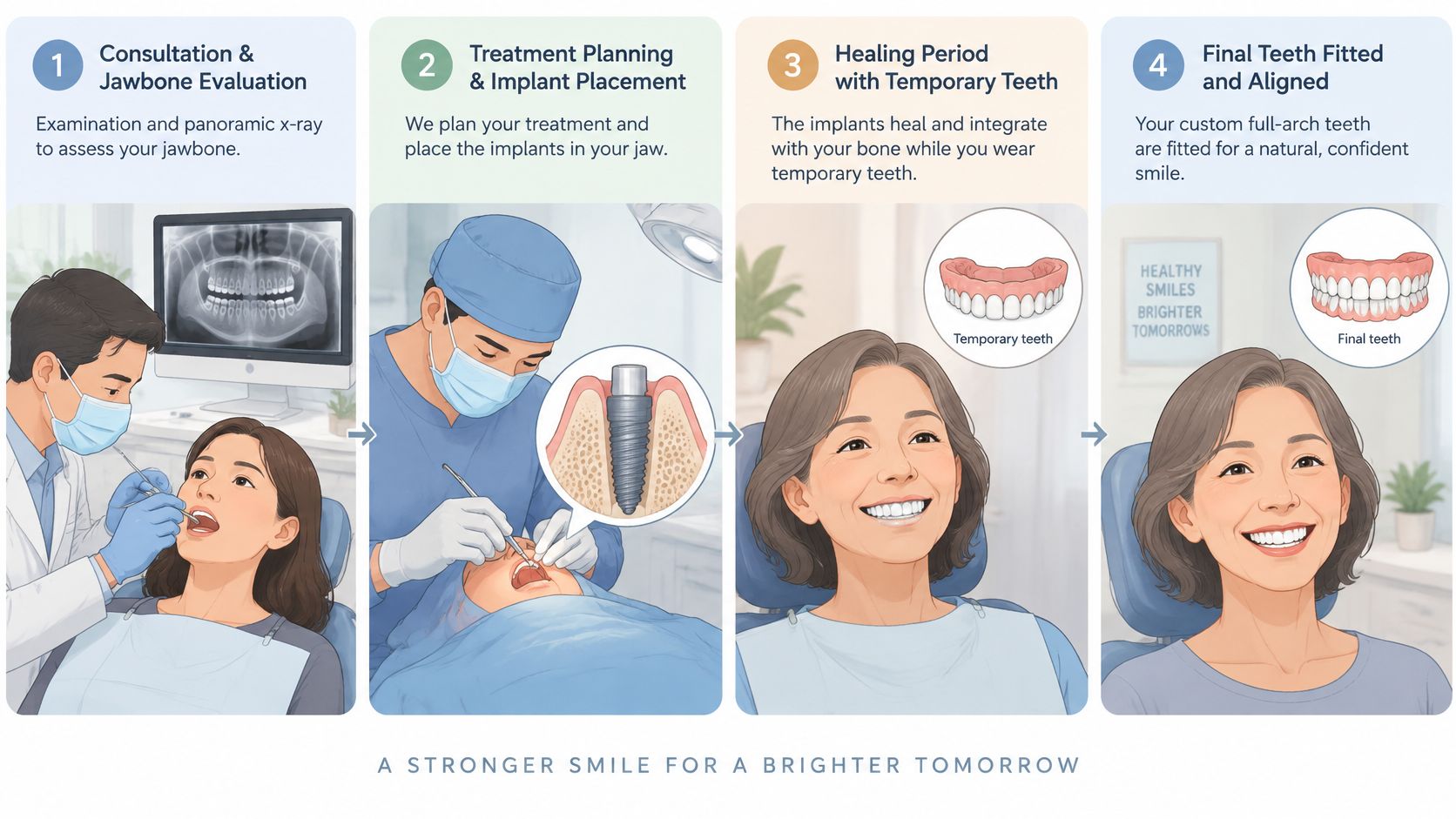
Initial consultation and imaging. The first appointment includes an examination and imaging to evaluate jawbone density and structure, along with the remaining teeth, gums, and bite. If you're wondering whether there is enough bone, these findings help determine whether additional preparation may be needed.
Agreeing on the treatment plan. Before surgery, clarify the proposed restoration, implant arrangement, treatment sequence, and care during healing. Ask whether temporary teeth are appropriate in your case and what limits they may have.
Implant placement. This is the surgical stage, when implants are placed into the jawbone. The team provides case-specific instructions for preparation, comfort measures, transportation when relevant, and care afterward.
Healing and bone integration. After placement, an implant fuses with the jawbone over a healing period that typically takes three to six months. This process, called osseointegration, is the connection between living bone and the implant surface. Your team will explain what you can eat and how to use any temporary restoration.
Final impressions and fabrication. When healing and tissue conditions allow, impressions or digital records capture the details needed to make the custom crown, bridge, or denture. You might ask, “How will we choose a tooth shape that suits me?” Your preferences can be considered alongside bite, speech, and access for cleaning.
Attachment of the final prosthesis. After the jawbone has healed and the implant has bonded to the bone, the custom restoration is attached using the planned connections. The team checks how it fits and how the teeth meet, then explains how to resume chewing in a way that suits your case.
Adjustments and follow-up. Follow-up visits let the dentist assess comfort, speech, tissue health, and cleaning technique. If the restoration feels high, rubs, or moves unexpectedly, contact the team rather than trying to adjust it yourself.
Preparing for the first visit
Bring a current medication list, relevant medical information, and recent dental records if available. Include an accurate summary of smoking and diabetes status, since these details can affect preparation and follow-up.
Write down practical questions about work, meals, appearance during healing, or arranging help at home. These concerns can shape the treatment conversation.
Survival Rates and What Can Go Wrong
Implant survival, prosthesis survival, and complication-free survival answer different questions. An implant can remain integrated in the jaw while the bridge above it needs a repair, and a surviving prosthesis may have required servicing.
Implant survival concerns the supporting implant. Prosthesis survival concerns the restoration remaining in service, while complication-free survival asks whether treatment has continued without biological or technical problems.
Reading the figures accurately
The figures below describe different patient groups and follow-up periods. They shouldn't be combined into a single personal success estimate.
Reported survival and complication figures
| Measure | Follow-up period | Reported figure |
|---|---|---|
| Implant survival, fixed hybrid prostheses | 5 to 10 years | 87.89% to 100% |
| Implant survival, fixed hybrid prostheses | Over 10 years | 78.3% to 98.9% |
| Implant survival, mandibular three-implant full-arch | At least 1 year | 95.9% mean, 95% CI 94.6% to 97.3% |
| Prosthesis survival, mandibular three-implant full-arch | At least 1 year | 97.0% mean, 95% CI 95.7% to 98.3% |
| Osseointegrated implant survival, published evidence summarized in a registry protocol | 5 years | 90% to 96.2% |
| Full-arch prosthesis survival, clinical review | 10 to 15 years | Roughly 90% to 98% |
| Peri-implant mucositis, clinical review | About 10 years | 30% to 50% of cases |
| Peri-implantitis, clinical review | About 10 years | 10% to 20% of cases |
The fixed-hybrid and mandibular findings, including their confidence intervals, are summarized in the systematic-review evidence on full-arch survival. The broader osseointegrated-implant range comes from published evidence summarized in the National Dental Practice-Based Research Network registry protocol, while the longer-term prosthesis and inflammation figures appear in a clinical review of full-arch rehabilitation.
What complications mean
Peri-implant mucositis involves inflammation in the soft tissues around an implant. Peri-implantitis also involves loss of supporting bone and requires professional assessment.
Mechanical problems are different: screws may loosen, veneering material may chip, or the prosthesis may fracture. A repairable problem isn't necessarily implant failure, but it still affects convenience and long-term expense.
Studies differ in patient selection, health, implant location, restoration design, follow-up duration, and how many participants remain available for later evaluation. These are population-level findings, not guarantees, and high survival doesn't mean complication-free service.
Maintenance and Repairs Over the Years
Full-arch treatment is a long-term care relationship rather than a one-time installation. Keeping the supporting tissues healthy and the replacement teeth serviceable requires a plan for both prevention and repair.
In a long-term cohort summarized by Evidence-Based Dentistry, implant survival was 99.4% and prosthesis survival 98.2% at approximately five years, yet biological complications affected 47.1% of prostheses and technical complications 42%. Peri-implantitis was the most frequent major biological problem, and porcelain fracture was the most common technical problem.
A calendar you can maintain
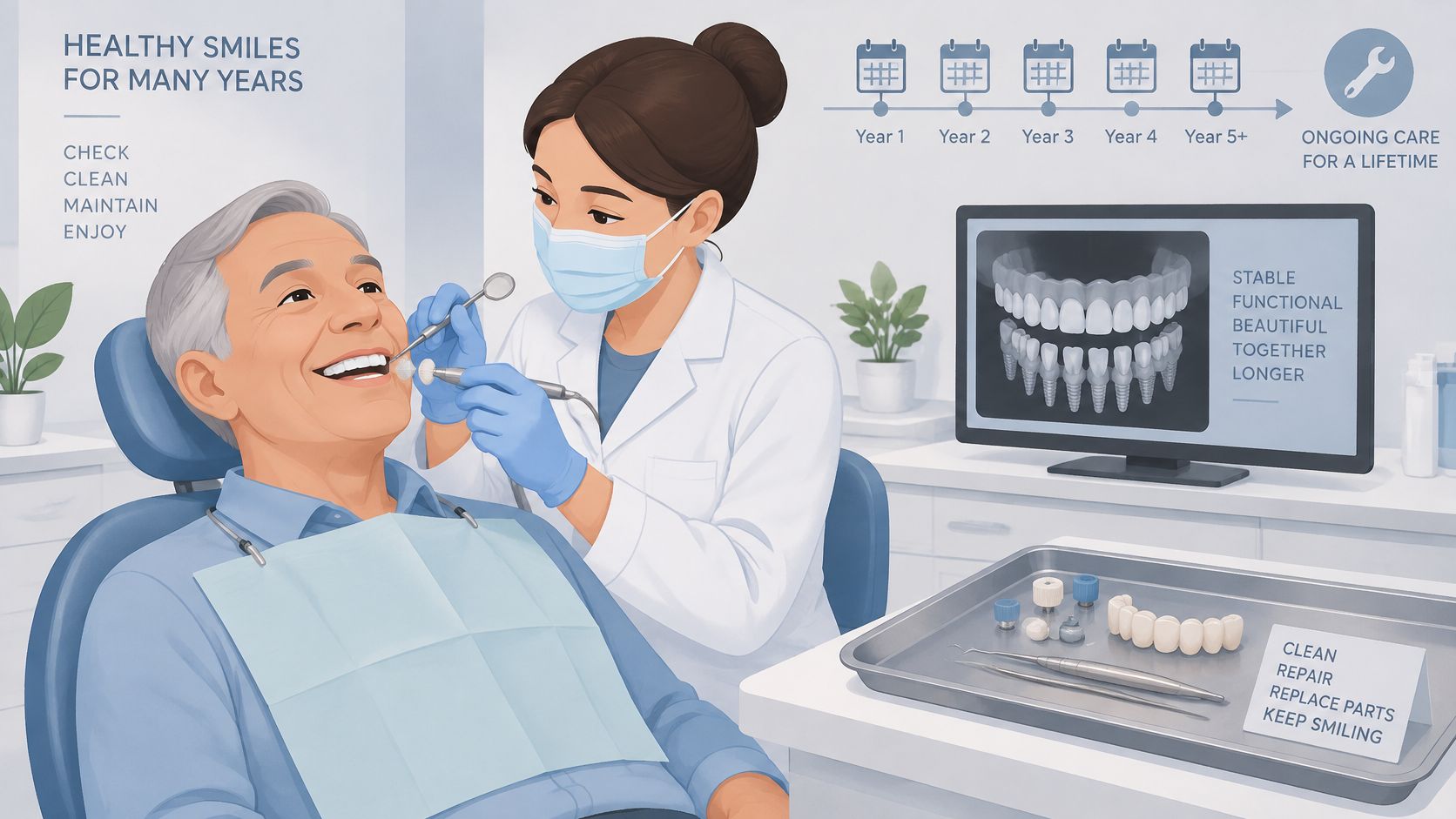
The American College of Prosthodontists' patient-care publication recommends professional examinations and cleanings every six months. It also reports a prosthodontic review in which acrylic denture teeth in fixed implant-supported prostheses reached replacement-level wear after an average of approximately seven years, not a universal replacement deadline.
Maintenance calendar for full-mouth implants
| Task | Typical timing | Purpose |
|---|---|---|
| Daily home cleaning | Every day | Remove food particles and plaque with tools suited to the design |
| Professional exams and cleanings | Every six months, per ACP patient brochure | Check gum tissue, implants, and the prosthesis |
| Periodic radiographs | As the dentist directs | Monitor marginal bone levels |
| Risk-based visits | More frequent, set by the dentist | Support patients who smoke, have prior periodontitis, systemic disease, or limited vision or dexterity |
| Prosthesis review | At each visit | Check screws, chipping, opposing-tooth wear, and speech comfort |
Materials, bite forces, habits, and hygiene affect wear. Someone with acrylic replacement teeth may face different servicing needs from someone with a ceramic restoration.
Agree on the repair pathway early
Report new movement, chipping, persistent food trapping, speech changes, or discomfort when biting. Don't tighten components yourself or use household adhesive on a damaged restoration.
A useful maintenance plan explains not just when you'll return, but whom you'll contact and what happens if your teeth need repair.
Ask whether a problem would require an adjustment, component replacement, laboratory repair, or a new prosthesis. Also discuss whether you might be without the restoration during service, because that can affect meals, work, and travel.
Dr. Andrew Finley at Bristol Dental & Orthodontics can tailor follow-up to your health, restoration, and ability to manage home care. A workable schedule is more useful than an optimistic lifespan estimate without a service plan.
Recovery and What Shapes Cost
Recovery after full-mouth implant surgery happens in stages. In the first few days, soreness and swelling are common. Follow the dental team's instructions for cleaning and medication, and call the office if symptoms worsen or you are unsure whether a change is expected.
For the first week, meals may include yogurt, scrambled eggs, mashed potatoes, oatmeal, and soup that has cooled enough to eat comfortably. Avoid putting hard or chewy foods against a temporary restoration until your dental team says it can handle more force. Temporary teeth can look ready for normal chewing before the tissues underneath have healed.
Healing continues after the initial soreness settles. Keep follow-up appointments, avoid smoking, and check with the dental team before changing prescribed medication. Once the final restoration is attached, report a bite that feels uneven or discomfort that is increasing.
Compare the whole treatment plan
Full-mouth dental implants, also called All-on-4, typically cost $20,000 to $30,000 per arch. The total depends on the treatment needed and the restoration being made. A written plan should show which services make up the price, rather than presenting one figure without explaining what it includes.
Preparatory procedures, imaging, implant placement, and the custom-made teeth may each appear as separate line items. For example, the plan should clarify whether the quoted arch price includes the final restoration or only part of the treatment. It should also distinguish initial treatment costs from future maintenance or repair expenses.
Review the plan alongside the timeline: implant placement is surgery, and the implant needs time to bond with the jawbone before the custom-made restoration is provided. Bristol Dental & Orthodontics provides dental implants for patients throughout Santa Ana and Orange County. Make sure the written estimate explains the expected stages, recovery restrictions, and which future services are charged separately.
Choosing the Full-Mouth Option That Fits Your Life
Which full-mouth design fits your daily routine as well as your treatment goals? Consider how you manage detailed cleaning, whether you can remove and reinsert a restoration, and how comfortable you feel with regular appointments. Speech, chewing comfort, anatomy, appearance, and the long-term care involved also matter.
A systematic review comparing fixed and removable implant restorations describes complications in both categories, though the types differ. Compare each option by what it asks of you day to day, as well as the care and repairs it may need over time.
Match the design to your priorities
- Limited dexterity or vision: Ask whether a removable design would make cleaning and repairs more manageable, and whether you would need help removing and reinserting it.
- A strong preference for teeth that stay in place: Consider whether you can manage the cleaning routine for a fixed design or arrange reliable hygiene support.
- Scattered missing teeth: Compare individual implants or smaller implant-supported restorations. Full-arch treatment may not be the only option.
- Family or caregiver involvement: Include cleaning assistance, transportation, and repair arrangements in the discussion, alongside the appearance of the final teeth.
For example, someone who has difficulty cleaning beneath a fixed restoration may prefer to explore a removable design. Someone who values a restoration that stays in place may focus on whether its cleaning demands are manageable. The right choice depends on how the design fits your needs, not on its label.
Bristol Dental & Orthodontics provides dental implants for patients throughout Santa Ana and Orange County. To discuss your situation with Dr. Andrew Finley, consider the priorities and questions that matter most to you. A clinical examination is needed before an option can be recommended.
Bristol Dental & Orthodontics offers dental implant care for patients considering replacement of a complete dental arch, with attention to both the restoration and its ongoing care. Visit Bristol Dental and Orthodontics to schedule a consultation with Dr. Andrew Finley and discuss which approach fits your health, daily routine, and long-term priorities.