
You finished dinner, ran your tongue over a back tooth, and the crown still feels a little different from the tooth beside it. Maybe it was placed recently in Santa Ana, or it has been quiet for years until something sticky tugged. Learning how to care for dental crowns means looking after the crown, the tooth under it, the gum edge, and the way your teeth meet.
A crown can look finished and still fail at the margin, from grinding at night, or from a habit you barely notice. The steps here are general home care, not a plan written for your tooth. Dr. Andrew Finley can match them to your case at Bristol Dental & Orthodontics.
Table of Contents
- Daily Cleaning Routine for Crowned Teeth
- Everyday Habits That Protect a Crown
- Grinding and Clenching Around Crowns
- Warning Signs That Need a Dental Visit
- Caring for Crowns on Children's Primary Teeth
- Book a Crown Check-Up Before Problems Start
Daily Cleaning Routine for Crowned Teeth
A crown covers the part of the tooth you see. It does not cover the story underneath. Plaque still settles where the crown meets the tooth and the gum, and that junction is where new decay often starts.
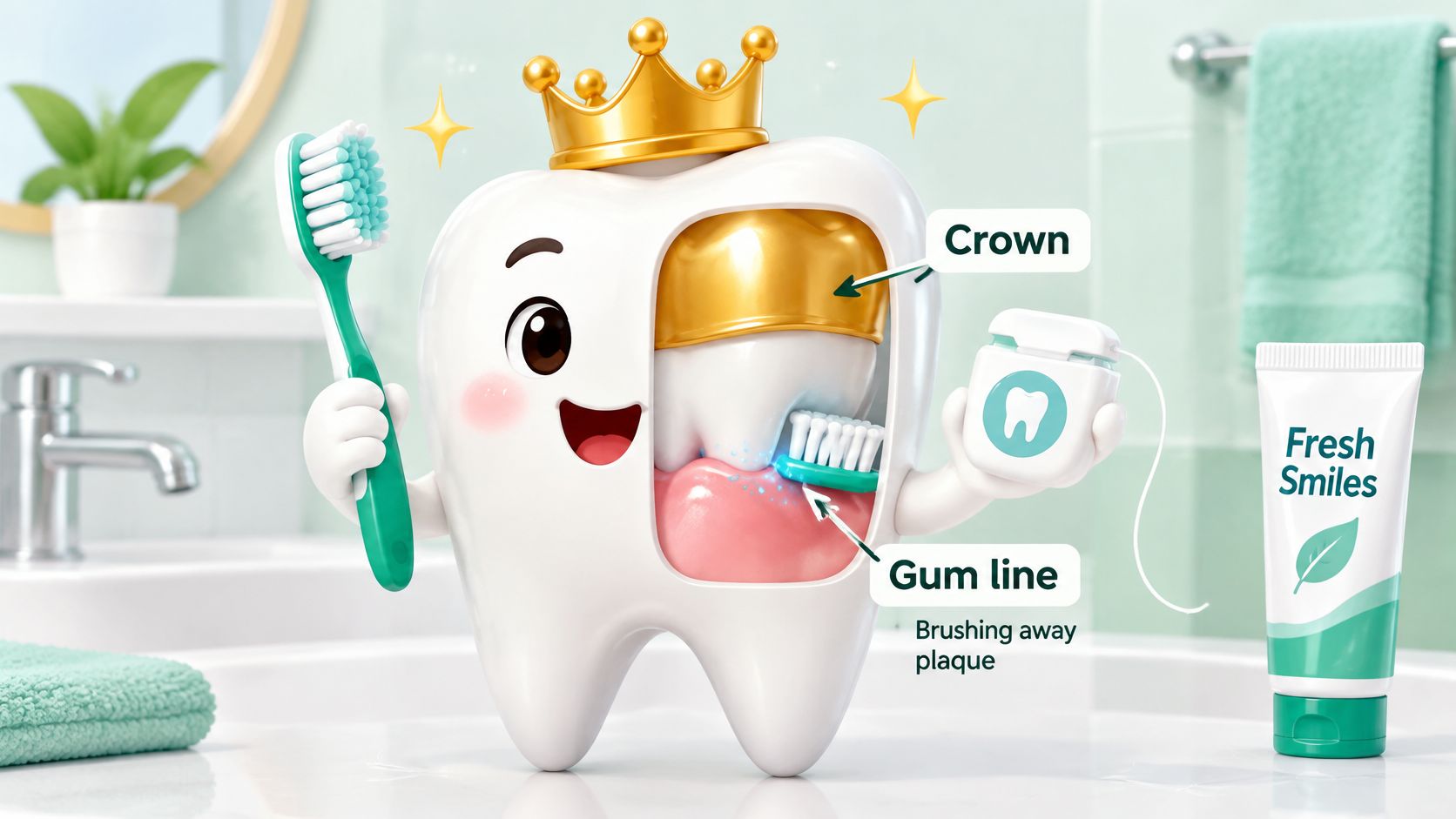
A prosthodontic maintenance review describes a two-stage clean: brush the natural teeth and the restoration twice a day with fluoride toothpaste, then clean the crown's sides and the neck of the tooth with floss, an interdental brush, or a water flosser. The American College of Prosthodontists recognizes floss, water flossers, air flossers, interdental cleaners, and electric toothbrushes as suitable aids. Patients with extensive restorations may need prescription 5,000-ppm fluoride toothpaste when it is clinically indicated.
Five steps you can start tonight
- Brush for two minutes, twice a day. Use a soft-bristled brush and fluoride toothpaste. Angle the bristles toward the gumline on the crown and on the teeth next to it, so the margin gets contact and not only the shiny top.
- Clean beside the crown once a day. Floss, an interdental brush, or a water flosser all work. Slide floss out sideways instead of snapping it up through the contact, so you don't nick the margin.
- Add an antibacterial mouthwash only if Dr. Finley recommends one. A rinse does not replace the brush or the between-teeth step. If you wear Invisalign, take the aligners out before you brush and clean between teeth, then put them back on clean teeth.
- Ask whether prescription 5,000-ppm fluoride toothpaste fits you. It is for mouths where the amount of restoration and the decay risk make a stronger paste appropriate. Don't start a prescription paste on your own.
- Once a week, run your tongue along the crown edge. Note roughness, a new zing, or a shift, and write the date so the next visit starts with facts.
Common miss: Treating the crown as if it can't decay. Recurrent caries forms at the crown–tooth margin, and plaque there can inflame the gum and compromise the tooth that holds the restoration.
People with uneven self-care, dry mouth, grinding, several restorations, or earlier biological or mechanical problems may need exams more often than every six months. The recall is set for the person, not copied from a calendar.
One-minute nightly check: brush the gumline, clean one contact on each side of the crown, look for bleeding, and notice whether the bite feels even. If something changed from last night, call rather than waiting it out.
Everyday Habits That Protect a Crown
The habit that surprises people most is not a dramatic crack from one hard bite. It is the ordinary one, ice after lunch, a package torn with a molar, caramel on the drive through Garden Grove. A crown is durable, and it is not indestructible. Most of the damage we see comes from repeated small forces.
The Cleveland Clinic reports that crowns commonly last about 5 to 15 years with proper care, and that some remain functional for more than 30 years when they are protected from decay, fracture, grinding, and heavy chewing. That range is a population expectation, not a replacement date, and it shifts with material, location, bite force, hygiene, and the tooth underneath. Extremely hard, crunchy, or sticky foods can fracture ceramic or dislodge a restoration. The crowned tooth is not a tool.
| Habit | Why It Matters | Better Choice |
|---|---|---|
| Chewing ice or hard candy | Can chip ceramic or crack the restoration | Let ice melt and choose softer snacks |
| Opening packages with your teeth | Sudden force can fracture the crown | Use scissors or a package opener |
| Chewy caramel, taffy, or sticky candy | Can pull at a loosely cemented crown | Eat in small bites and check the crown afterward |
| Frequent sugary snacks between meals | Raises decay risk at the crown margin | Keep sweets to mealtimes and rinse with water |
| Biting nails, pens, or pen caps | Concentrated force can damage the crown and the tooth | Use a different object or stop the habit |
Pick two habits to change this week. Keep scissors or a package opener in the kitchen drawer you use. After sticky food, rinse with water and run your tongue over the crown before you leave the table. A habit change is the most direct protection you have between visits, whether you live in Santa Ana, Costa Mesa, Tustin, Irvine, or Garden Grove.
A crown that survives the office visit can still fail in the car if it becomes a bottle opener.
Grinding and Clenching Around Crowns
You wake with a tight jaw. Breakfast feels normal, and the mirror shows no chip. The load can still be happening every night, when you cannot feel it and cannot stop it on purpose.
Bruxism is clenching or grinding, often during sleep. Each cycle loads the crown, the cement, the gum margin, and the tooth under it. A crown can feel comfortable in the daytime and still take more force than the ceramic or the root was planned for. A hard material still depends on the bite and on how the crown meets the tooth beside it.
A 2025 review of crown failure identified bruxism, improper occlusal adjustment, loss of tooth vitality, and poor margin design as important factors tied to failure. The same review points to occlusal management, preventive splints, and regular follow-up as ways to support longevity. Short-term results for zirconia and lithium disilicate crowns in people who grind can look favorable, but high-quality long-term evidence remains limited. I would not tell a patient that either material removes the risk.
Mention these signs to Dr. Finley:
- Morning jaw soreness or headaches near the temples.
- Flattened or chipped natural teeth, including teeth that oppose the crown.
- A sleep partner who hears grinding.
- A bite that feels different, or a crown that rocks even slightly.
A night guard should be professionally fitted, cleaned daily, and checked at visits. A guard bought without an evaluation can shift the bite in the wrong direction. Custom nightguards from our office are made to the teeth, protect against grinding damage, and can ease jaw discomfort and TMD. If you already use an oral appliance for sleep apnea, bring it so we can see how it meets the crown.
The crown that feels fine at noon can still be the one taking the night shift.
Ask for a bite and grinding review at the next visit. That review matters for a single crown, a cosmetic restoration matched to neighboring teeth, and a crown on an implant, where a mechanical problem is costly to undo.
Warning Signs That Need a Dental Visit
You bite into toast and the crowned molar twinges, then settles. By afternoon the gum at the edge looks a little red, and a shred of food sits in the same spot again. A crown sits on a living tooth, against a gum margin, and inside a bite. A change in any one of those three can be the first sign that the restoration is no longer doing its job.
Some changes can wait for a planned check. Others should not. The table is a signal list, not a diagnosis. The cause still depends on the tooth under the crown, the cement, the gum edge, and how the bite loads that tooth.
| Symptom | What It Can Signal | How Soon to Call |
|---|---|---|
| Crown feels loose or moves | Cement failure or decay under the crown | Call soon, do not wait for a routine visit |
| Pain when biting down | Bite change, crack, or irritated tooth | Call soon |
| Sensitivity to hot or cold that persists | Possible decay or nerve irritation | Schedule a visit soon |
| Bleeding around the crown margin | Gum inflammation or plaque at the margin | Schedule an evaluation |
| Chipped surface or sharp edge | Ceramic chipping or fracture | Call soon to have it checked |
| Bad taste or odor near the crown | Leakage or decay at the margin | Schedule an evaluation |
| Food repeatedly trapped at the crown | Gap or poor contact at the margin | Schedule an evaluation |
| Bite suddenly feels high | Crown shift or bite interference | Call soon |
| Severe pain, facial swelling, or fever | Possible infection | Seek urgent care right away |
A loose crown, pain on biting, a sharp chip, or a bite that suddenly feels high belongs on the phone this week, not on a list for the next routine cleaning. Persistent hot or cold sensitivity, bleeding at the margin, a bad taste, or food that traps in the same spot still needs an evaluation, even when you can chew. None of these rows tells you the repair. They tell you the tooth, the margin, and the bite should be seen together.
A review of mechanical crown failure found loss of retention was the most frequently reported mechanical failure category at 26.5%, with tooth fracture at 12.6%. Risk rose with bruxism, post-and-core restorations in non-vital teeth, bonding problems, and unresolved bite interference. Separate pooled data on all-ceramic crowns show higher failure among posterior crowns than anterior ones over multi-year follow-up. Read those group rates against the tooth in front of you: a back tooth, heavy grinding, a post in a non-vital tooth, or a bite that still hits high makes a small symptom more likely to be mechanical failure than a passing sensitivity. I would rather see that tooth early than wait for the crown to come off in a meal.
When quiet is not the same as fine
Plaque and gum inflammation can travel along a margin without a dramatic symptom. A comfortable crown can still hide a gap, a high spot, or early decay at the edge, which is why periodic checks cover the bite, the margin, the nerve, and the gums, not only whether it hurts today.
Severe pain, facial swelling, fever, or trouble swallowing or breathing needs urgent care right away. Emergency dentistry at our practice covers toothaches, broken teeth, and other urgent problems. Before you call, note when each symptom started and what set it off, such as chewing, cold water, or waking up.
Caring for Crowns on Children's Primary Teeth
A child bites a whole apple and the crown on a back baby tooth takes the force at the gum edge. A primary crown protects that baby tooth until the tooth loosens naturally. Daily care still matters while the crown, the tooth, the gum margin, and the bite share that job.
A 2025 systematic review and meta-analysis of 13 randomized trials and five clinical studies, covering 454 children with 1,172 crowns in the trials and 810 children with 2,667 crowns in the clinical studies, reported pooled five-year retention of 97.88% for stainless-steel crowns, 92.18% for composite resin, 90.30% for resin-modified glass ionomer, and 88.90% for compomer crowns. Follow-up, tooth condition, behavior, cementation, and study design all change the result for any one child.
Cleaning beside a small crown is a parent job at first. Brush with fluoride toothpaste, and clean between the crowned tooth and its neighbor once a day. Slide floss gently along the side of the crown. Do not force it under the edge, where the margin meets the gum. If the child fights the floss or you cannot see that edge, ask Dr. Finley to show the motion at the visit. I recommend staying with the child until the stroke is steady.
The crown is planned around normal loss of the baby tooth. A little mobility near the age that tooth should loosen can be expected. Mobility with pain or swelling, or a crown that comes off early, is a different problem. Ask when the next check should be, rather than copying a sibling's schedule.
Snack habits for kids are about supervision and portion shape. Cut apples and firm fruit into small pieces so the child chews them instead of levering a whole piece against the crowned side. Watch sticky sweets at the table, and check the crown and the gum line after those snacks. A short family routine covers the rest: brush morning and night, keep sticky sweets at mealtimes, and keep the recall visit even when the crown looks unchanged.
At Bristol Dental and Orthodontics, every family member receives personalized dental care suited to their age and needs, from children to adults.
Book a Crown Check-Up Before Problems Start
A crown can look unchanged in the mirror and still be collecting plaque where it meets the tooth and the gum, or sitting slightly off the bite. Book a routine check if it has not been reviewed in a while, and come in with notes so the appointment is about your mouth rather than a default schedule.
The Cleveland Clinic recommends brushing at least twice daily with fluoride toothpaste and a soft-bristled toothbrush, cleaning between teeth once daily, considering an antibacterial mouthwash, and keeping regular cleanings and exams, because plaque can collect where the crown meets the tooth and gums. Tell the team if you also wear aligners, have an implant, or are being treated for gum disease. Cleaning and how often you return should fit that mix.
What to bring to the visit
- Write each symptom and the date it started, including what you were eating or whether it began after sleep.
- List habits such as grinding, ice chewing, or sticky snacks, even if they feel minor.
- Describe your brushing and between-teeth routine so Dr. Finley can check the technique. That review matters most if you also have aligners, an implant, or gum disease.
- Ask whether a night-guard evaluation and a personal recall interval make sense for your mouth. Visit spacing should match your risk, not one timetable for every patient.
At the visit, the crown's contours and margins are inspected, deposits are removed with instruments suited to the restoration, and home cleaning is refined where the margin is hard to reach. Mention a crown that looks or feels different, even if it does not hurt. Dr. Finley makes sure the final restoration matches your natural teeth in color and shape, and that same check helps when an older crown no longer blends or no longer meets the bite cleanly.
Bristol Dental and Orthodontics provides family and cosmetic dentistry in Santa Ana, including crowns, dental implants, Invisalign, sleep apnea treatment, and emergency care when a restoration breaks. If your crown, your child's crown, or your bite needs a closer look, bring the notes above. Visit Bristol Dental and Orthodontics to schedule a time with Dr. Andrew Finley.