

Is sedation dentistry safe? For most patients, yes, when the team plans the sedation around the person's health and keeps watch from the first dose through recovery. The caveat that matters most is that sedation is a continuum, so a patient planned for a light level can drift deeper than anyone intended.
That changes the useful question. The more useful question is whether the practice is equipped for the deepest level a patient could reach, with trained eyes on them, rescue equipment close by, and a clear plan for the hours afterward. In many dental consultations, the talk centers on which drug is used, whether that's nitrous, a tablet or an IV line. How the team would respond if a patient slid deeper gets less attention, yet the safety margin lives in exactly that response.
Table of Contents
- Is Sedation Dentistry Safe? The Short Answer
- Sedation Options Compared for Safety and Comfort
- How Your Health Is Screened Before Sedation
- How You Are Monitored During During and After Sedation
- Risks and Side Effects Worth Knowing
- Questions to Ask Before You Agree to Sedation
- Your Next Step Toward Safer Sedation
Is Sedation Dentistry Safe? The Short Answer
Yes, for most patients. The honest version of that answer has one condition: the team and the room need to be ready for the deepest level of sedation you could reach, which is sometimes deeper than anyone planned.
Sedation depth sits on a sliding range, and it can move during the appointment. The same drug at the same dose can land two people at different levels, and a patient who starts light can drift deeper. The most common pushes are ordinary ones: a poor night's sleep, untreated sleep apnea, or a sedative taken at home that nobody asked about. This is why your team asks what you took before you arrived, before the first dose is ever given.
In the chair, the drift is quiet. A patient answering questions clearly one minute may only mumble the next. The jaw relaxes, the airway starts to snore or obstruct, and breathing turns shallow while oxygen saturation dips. Nothing about it looks dramatic from across the room, which is why a trained observer is watching for exactly that.
Where safety actually lives. In the assessment before the drug, the dose control during it, the person watching, the equipment in the room, and the documented recovery afterward.
Professional dental guidelines, including the American Dental Association's, require continuous observation during active treatment and until recovery criteria are met. The requirement exists because depth can change faster than a schedule can.
Some patients deserve a longer, slower conversation before any sedation plan is written: children, people with sleep apnea or obesity, anyone with heart or lung disease, pregnant patients, and people taking opioids, sleep medicines, benzodiazepines, alcohol or other sedating drugs. Age and airway anatomy change how a drug lands, and stacking sedatives compounds the effect on breathing.
So is sedation dentistry safe? For most patients, yes, when the screening, the monitoring and the recovery plan are built for the deepest moment you could have.
Sedation Options Compared for Safety and Comfort
Three options cover nearly every sedation appointment: nitrous oxide, oral conscious sedation and IV sedation. Which one fits you belongs in a consultation rather than a decision made from a webpage, because anxiety, health history, procedure length and how much you'd like to remember all pull on the answer.
| Option | How it is given | Level of sedation | Best suited for | Memory of procedure | Recovery and driving |
|---|---|---|---|---|---|
| Nitrous oxide | Inhaled through a small nasal mask | Mild, awake and responsive | Mild anxiety, shorter visits, adults and children | Usually remembers most of the visit | Wears off quickly; patients can usually drive home |
| Oral conscious sedation | Prescribed tablet taken at the office before treatment | Moderate, awake but drowsy | Moderate anxiety, longer procedures | Often little memory of the procedure | Drowsiness may linger; escort required, no driving |
| IV sedation | Medication delivered into the bloodstream by a trained professional | Deepest level offered, deeply relaxed | Significant anxiety, complex or multiple procedures | Little to no memory for most patients | Escort required, no driving; rest for the day |
Nitrous oxide is the lightest option and the quickest to recover from. It's breathed through a small, comfortable nasal mask, you stay awake and responsive throughout, and you can answer questions and swallow normally. Because the effects wear off quickly, you can often drive yourself home afterward. Picture a nervous teenager who needs two fillings and wants to be back at school the next morning: that's a nitrous case.
Oral conscious sedation begins with a prescribed tablet taken at the office before treatment. You stay awake but drowsy, and many patients remember very little of the appointment, which helps people who find the sounds and smells of dentistry harder than the discomfort. It suits moderate anxiety and longer procedures, and it can be combined with nitrous oxide for extra comfort. An adult who needs a crown and a couple of fillings in one long visit is a reasonable candidate.
IV sedation is the deepest option we offer, delivered into the bloodstream by a trained professional, with little to no memory of treatment for most patients. It fits significant anxiety or several procedures combined into fewer visits, which matters if time off work is hard to arrange.
Timing and predictability vary, which is why the conversation matters. The NHS patient guide on sedation explains that oral midazolam generally leaves you conscious, may cause drowsiness and temporary amnesia lasting about an hour, and can take 30 minutes or more to begin working. It also notes the effect can be unpredictable and may be ineffective for some patients. The same guide states that oral and intravenous sedation can slow breathing, which is why close monitoring is used and supplemental oxygen can be provided if needed. Recovery is slower with some forms of oral sedation.
Memory is worth naming separately, especially for parents. A 2025 study in the Journal of the American Dental Association of 109 children treated with oral conscious sedation at Nationwide Children's Hospital found amnesia in 53.9% of patients aged 6 years or younger, per the published findings indexed on PubMed. Children may not recall the visit afterward, which is different from having a calm experience at the time.
Deeper isn't automatically better. The right level balances your anxiety, the length of the work, your health history and how quickly you need to be back to normal.
Plan transportation with oral or IV sedation rather than assuming you can drive, and follow the office's aftercare instructions instead of heading straight back to work. Bristol Dental & Orthodontics can review these details with patients considering treatment in Santa Ana, Tustin, Irvine, Costa Mesa or Garden Grove.
How Your Health Is Screened Before Sedation
The majority of the safety decisions in sedation dentistry happen before the first dose, at the screening stage. The ADA's sedation policy statement frames it plainly: safety rests on preoperative risk stratification and medication control, the system built around the drug. It advises a medical and dental history, a focused clinical examination, medical consultation for higher-risk patients, drugs and techniques within the provider's training, emergency equipment and drugs, trained support personnel, and complete documentation of doses, vital signs, adverse reactions, recovery and any emergency procedures.
Screening is a conversation about your health, and it answers a deeper question than whether sedation can proceed. A patient can settle one level deeper than the plan called for. The exam's job is to learn whether your airway, heart and lungs have the reserve for that deeper level, so the team can plan, equip and staff for it in advance rather than hoping the intended depth holds.
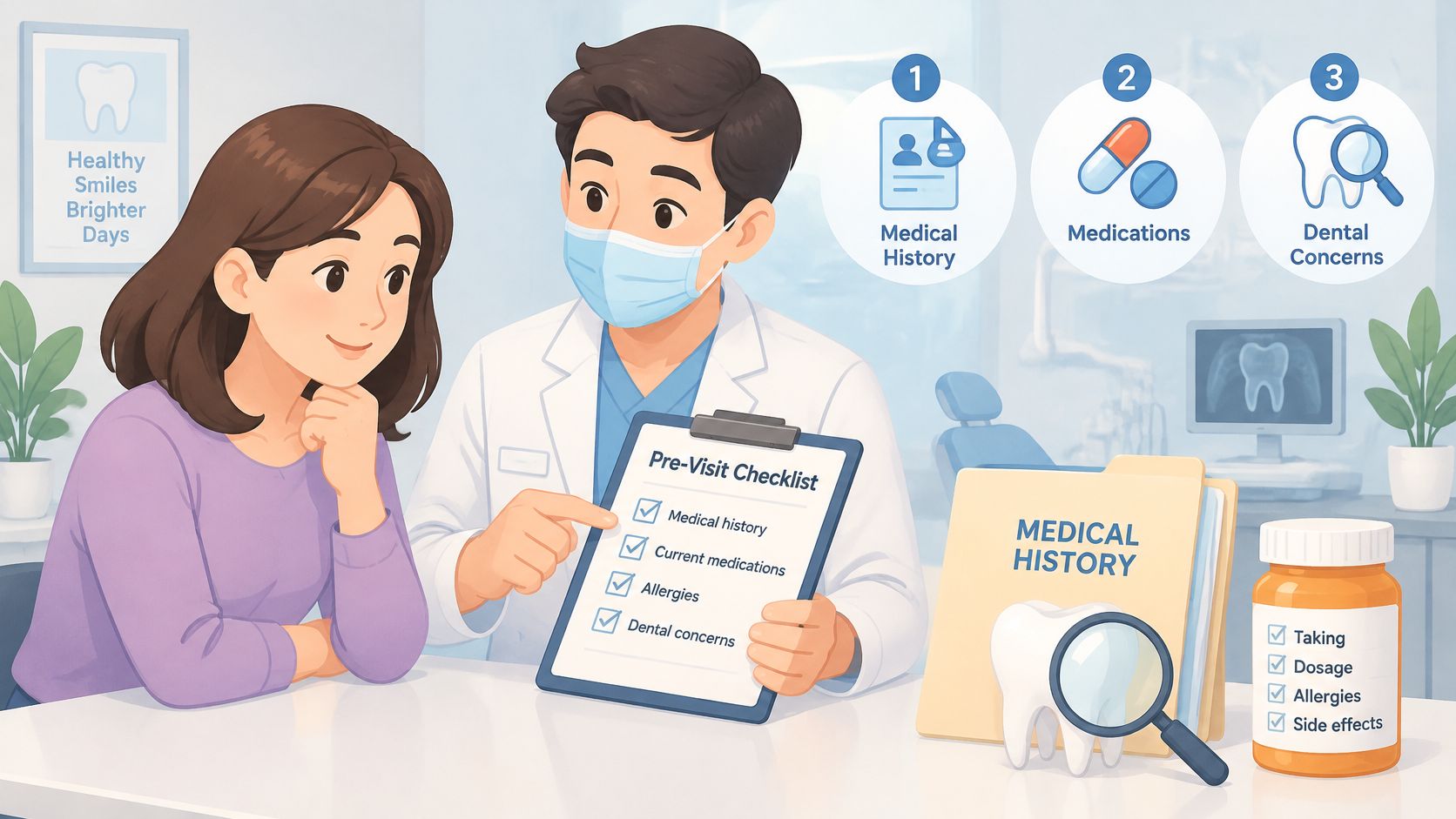
A careful practice runs this sequence before sedation is confirmed.
- A full medical and dental history. Diagnoses, surgeries, hospitalizations, and any previous sedation or anesthesia with a note on how it went.
- A focused clinical examination. Airway, mouth opening, tonsil size, nasal patency, weight, and blood pressure where relevant.
- A medication review. Prescriptions, over-the-counter drugs, supplements, alcohol and recreational substances. Respiratory depression can be amplified by combinations of sedatives, opioids, alcohol, sleep medications or other central nervous system depressants.
- Medical consultation when risk is higher. Uncontrolled heart or lung disease, a recent cardiac event, poorly controlled diabetes, or pregnancy may call for a physician's input first.
- Written pre-visit instructions. Fasting, an escort, comfortable clothing, and transportation arranged in advance.
Disclosure is the part patients control, and it changes decisions. Tell the team about:
- Sleep apnea and obesity. Both narrow an airway that relaxes further under sedation.
- Pregnancy. It changes which medications are appropriate and how you're positioned in the chair.
- Heart or lung disease. Less reserve if breathing or blood pressure shifts mid-appointment.
- Prior reactions to anesthesia or sedation. A previous difficult experience reshapes the plan.
- Recent alcohol or recreational drug use. Tolerance and compounding effects are real, and honest answers lead to a dose adjustment.
- Everything you take, including supplements. Local anesthetic doses also need weight- and condition-appropriate limits, because large doses can add to central nervous system depression when combined with sedation.
A practice that declines sedation for a higher-risk patient without medical support, or refers that patient to a hospital setting, is exercising clinical judgment. Sedation becomes safer through assessment, dose control and documentation before anyone sits in the chair.
How You Are Monitored During During and After Sedation
Monitoring starts with the first dose and continues past the end of the procedure. The ADA sedation use guidelines describe what continuous observation means in practice, and why a check at the beginning and the end cannot stand in for it.
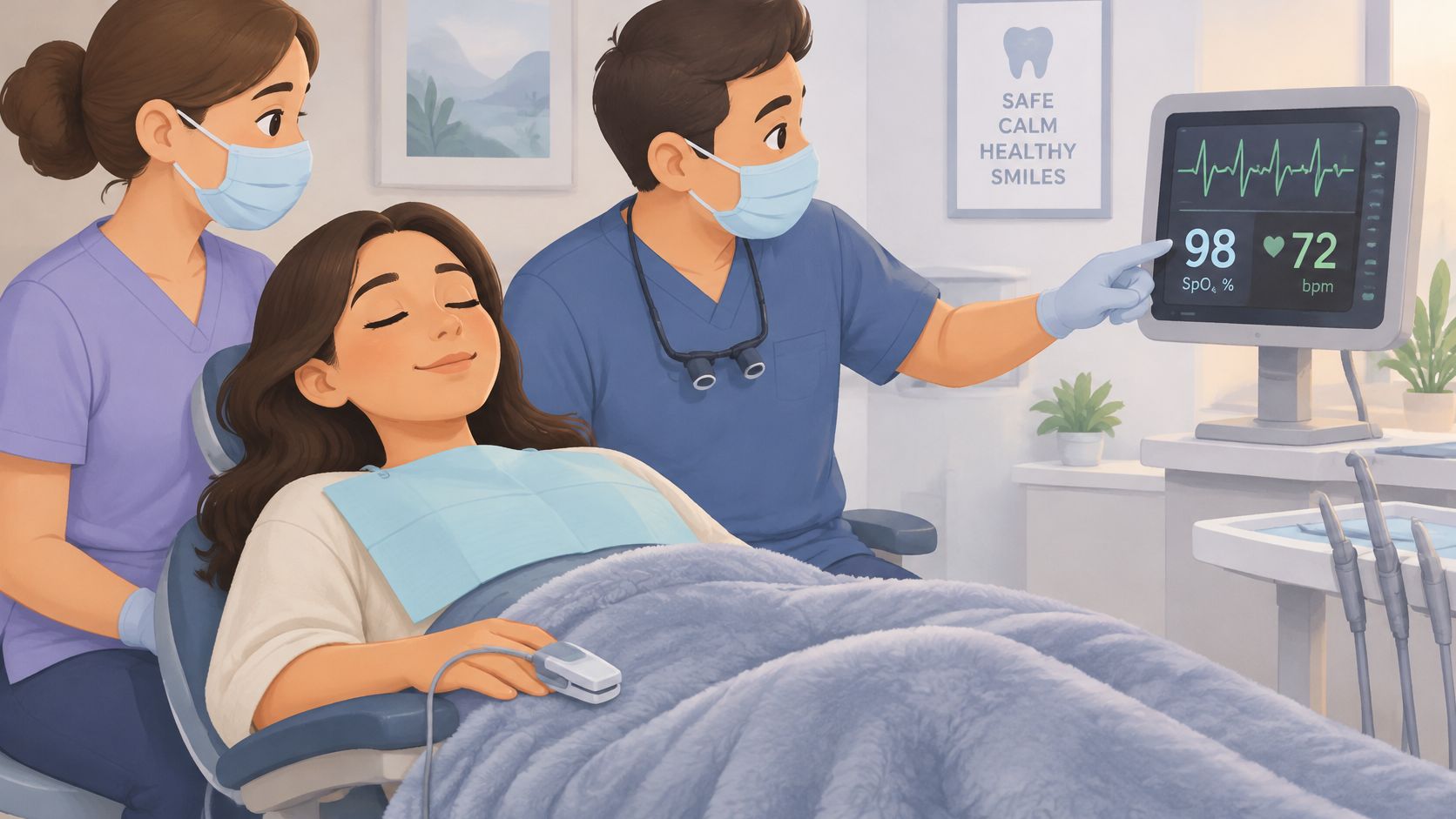
Sedation depth is a moving target. A patient can drift deeper than the level planned for the appointment, so the team watches where you are and stays ready to respond at the deepest level you could reach. Four things get watched, each for a different reason.
- Consciousness and responsiveness. How easily you rouse and answer tells the team the depth you have reached.
- Oxygenation with pulse oximetry. A sensor on your finger tracks blood oxygen saturation.
- Chest movement and respiration. Direct observation of how you're breathing, how often, and how it sounds.
- Blood pressure and heart rate. Circulation under sedation, assessed at appropriate intervals.
Each measure answers a different question, and timing is what separates them. Pulse oximetry shows oxygen levels after they have started to fall. Watching chest movement and ventilation catches changes in breathing earlier, which is why the guidelines call for continuous oxygen saturation at deeper levels of sedation and general anesthesia, with ventilation monitoring that may include end-tidal carbon dioxide. Supplemental oxygen is available if breathing slows.
The written record belongs to the same system. The American Academy of Pediatric Dentistry's monitoring guidance calls for a competent individual to observe the patient continuously, and for heart rate, respiratory rate, blood pressure, oxygen saturation and expired carbon dioxide to be recorded at least every five minutes in a time-based record.
A calm team writes things down while nothing is wrong, because that's the habit that holds when something is.
Recovery follows the same logic. Observation continues after treatment ends until predetermined discharge criteria are met: stable vital signs, protected airway reflexes, a patient who responds appropriately and can tolerate fluids. You leave with a responsible adult and printed instructions.
You are allowed to ask to hear that routine before you agree. A prepared team will name its monitors, its discharge criteria and who supervises recovery, in plain language.
Risks and Side Effects Worth Knowing
Risk in sedation is less a property of the drug than of the system around it. The serious events cluster around breathing, respiratory depression and airway obstruction, which is precisely why screening, monitoring and rescue readiness run through everything above. Honest counseling separates the everyday effects from the rare ones.
Common and usually mild: drowsiness that lingers into the afternoon, temporary amnesia, dry mouth, nausea, headache, and a slower return to normal after some oral medications. Most patients experience little more than this.
Less expected, and rarely explained in advance: paradoxical agitation, especially in children, and incomplete sedation that leaves a patient aware enough that treatment has to pause. That distinction matters. Sedation can be physiologically safe and still fail to deliver a completed appointment.
Four pediatric studies sketch what goes wrong.
| Study context | Patients studied | Key finding | What it means for patients |
|---|---|---|---|
| Pediatric outpatient deep-sedation chart review | 175 cases | Adverse events in 8.57% of cases; 36.84% involved airway or breathing, 47.37% sedation quality, 15.79% drug allergy | Events were uncommon and mostly manageable under monitoring |
| Pediatric dental sedation review | Several hundred pediatric sedations | Agitation was the most frequent event, and a share of agitated episodes forced treatment to end early | Calm cooperation is not guaranteed; procedures sometimes pause |
| Propofol-assisted deep sedation study, 2025 | 504 children | Hypoxemia in 10.3%, bradycardia in 1.8%, tachycardia in 2.0% | Breathing and heart-rate changes are the events monitors watch for |
| Post-discharge follow-up study, 2025 | Pediatric patients followed after discharge | Some families reported events at home, mostly behavioral or dental rather than breathing emergencies | Recovery instructions and supervision matter after the visit too |
Read those numbers in context. Children are the most closely studied sedation group because so much pediatric dentistry depends on it, and even there, true emergencies are unusual. The typical entry in these studies is a patient who stays drowsy longer than expected, or a child who cries, squirms and cannot settle enough for the work to finish. The events monitors watch hardest for, falling oxygen levels and a slowing heart rate, appear far less often than agitation or incomplete sedation.
Drug selection shifts the figures without removing the need for the same safeguards. A 2025 comparative study in Cureus reported adverse-event rates of 4% with dexmedetomidine, 10% with midazolam and 15% with a midazolam-ketamine combination among pediatric dental patients.
Discharge does not end the risk window. A 2025 post-discharge follow-up study tracked 1,079 sedation records and found that 35.2% of families reported at least one event after getting home, including behavioral issues in 19.5% and dental complications in 17.6%, rather than a breathing emergency. Supervision during the first hours, and a phone number to call, are part of treatment.
Your own risk is not an average. It rises with deeper planned sedation, younger age, airway anatomy shaped by obesity or sleep-disordered breathing, existing medical conditions, and combinations of sedating drugs. That is the argument for a real health history rather than a quick signature.
Questions to Ask Before You Agree to Sedation
The practical safety question is whether screening, monitoring depth and rescue readiness match the most profound level you could reasonably reach during treatment. The 2026 conscious sedation guidance from SAAD makes the same point: plan for the deepest sedation that could reasonably occur, because a patient can unintentionally become more sedated than planned. Minimal, moderate and deep sedation are distinct risk categories. A setting on a dial is a plan; the safety system has to cover the highest point the dial can reach.
That reframes your job in the consultation. You are checking whether the team can respond if sedation becomes deeper than expected.
- Who stays with me the entire time, and what training do they have? Continuous observation works when one person owns it and can keep full attention on you rather than on passing instruments.
- Will you monitor my breathing directly as sedation deepens? Pulse oximetry measures oxygen level. Capnography or another ventilation assessment becomes relevant when deeper sedation or airway risk makes breathing itself the thing to watch.
- What rescue equipment is in the room? For deep sedation, ask whether airway-rescue and positive-pressure ventilation capability are immediately available, along with appropriately trained and credentialed personnel.
- How often does the team rehearse emergencies? Respiratory depression, airway obstruction, delayed recovery and anaphylaxis should be drilled, not improvised.
- Who administers IV sedation, and what are their credentials? Ask directly. The answer should be specific.
- What has to be true before I'm discharged, and who supervises recovery? Vague discharge language is a warning sign.
- Which level fits my health history, and what would make you advise against sedation? A practice with no threshold for saying no is a warning sign.
A good answer names a monitor, a person and a threshold. A weak answer reassures you without naming anything.
Confidence sounds like specific monitors by name, a described emergency routine, written discharge criteria, an escort requirement enforced rather than mentioned, and a willingness to refer when your history warrants it. "We do this all the time" does not answer a question about a breathing emergency.
These questions carry the most weight for children, for patients with obesity or sleep-disordered breathing, and for anyone taking opioids, benzodiazepines, alcohol or other sedating medicines.
Your Next Step Toward Safer Sedation
Sedation dentistry is generally safe when the right patient, the right level and the right monitoring come together, and that match is worked out during a consultation. The aim is a plan where screening, monitoring depth and recovery arrangements are scaled to the deepest level of sedation you might reach, rather than the lightest one anyone hopes for. That is what the appointment is for.
Bring a complete health history and your current medication list, including supplements and anything you take only occasionally, to a consultation with Dr. Andrew Finley at Bristol Dental & Orthodontics. Come ready to describe your anxiety level and the care you are planning, whether that is routine treatment, dental implants, wisdom teeth or urgent work. If you need several procedures, sedation can allow more to be completed in fewer visits, and if a strong gag reflex has made past appointments difficult, mention it, because it shapes which option fits.
We offer nitrous oxide, oral conscious sedation and IV sedation, matched to each patient's comfort and needs, and we serve Santa Ana and the surrounding Orange County communities. Sedation plans are built from your exam and health history. One practical detail: nitrous oxide wears off quickly enough that patients can drive themselves home afterward, while deeper levels mean a monitored recovery before you leave.
If sedation has been the reason you have postponed care, or the reason you are unsure whether to start, schedule a consultation and let the plan come from your health rather than your fear.
At Bristol Dental and Orthodontics, Dr. Andrew Finley and his team offer nitrous oxide, oral conscious sedation and IV sedation, matched to each patient's comfort, health history and the work being planned. If anxiety, a strong gag reflex or a long treatment list has kept you out of the chair, a consultation is the place to review which level fits and what monitoring, recovery and aftercare will look like. Schedule a visit with Bristol Dental and Orthodontics in Santa Ana to get a sedation plan built around your health.