
If the tooth comes out on a Tuesday, does that mean the implant goes in the same day, and the crown follows a week later? That is the gap most calendar-style answers leave open. The extraction date is only one input. Placement, bonding to bone, and the final tooth each run on their own clock, and none of them is set until someone looks at your socket.
At Bristol Dental & Orthodontics in Santa Ana, we walk patients through those milestones in plain language before anyone picks a date. The ranges below are typical, not a promise for your mouth.
Table of Contents
- Dental Implant Timeline After Extraction at a Glance
- Why Placement and Restoration Follow Separate Clocks
- Immediate, Early and Delayed Placement Explained
- Matching Timing to Your Extraction Site
- What Happens in the Jaw While You Wait
- Factors That Lengthen or Shorten the Schedule
- How the Implant Timeline Unfolds Step by Step
- Book a Consultation to Confirm Your Timeline
Dental Implant Timeline After Extraction at a Glance
The timing categories used in implant dentistry sort cases by how the socket has healed, not by one calendar count. The table below maps the five stages you will hear about at a consultation. Read the third column carefully, because it shows which clock each row runs on, and that is where most confusion starts.
| Stage | Typical timing | The date this row counts from | What must be true |
|---|---|---|---|
| Immediate placement | Same appointment as extraction | Extraction day itself | Intact socket, strong initial stability, no active infection |
| Early placement | About 4 to 8 weeks after extraction, or 12 to 16 weeks if bone is partly healed | The extraction date | Soft tissue closed over the socket and bone healing underway |
| Delayed placement | More than 6 months after extraction | The extraction date | Site completely healed, or bone rebuilt with grafting |
| Healing after implant placement | Typically 3 to 6 months | The implant placement date, not the extraction date | Implant stable and left undisturbed while it fuses with the jawbone |
| Final crown, bridge or denture | After healing, once the implant is bonded to bone | The end of the healing period | Gums and bone healthy and the restoration matched to natural teeth |
Two clocks run through this table. The first three rows count forward from the day the tooth comes out. The last two count forward from the day the implant goes in, and that day depends on which of the first three rows applies to you. The ITI consensus on implants in postextraction sites places delayed placement at more than 6 months after extraction, once the site is fully healed or a graft has rebuilt the ridge.
Here is what that means in practice. If your implant goes in 8 weeks after the extraction and then takes 4 months to bond with the bone, your final tooth arrives roughly 6 months after the tooth came out, even though no single stage lasted that long. The extraction date started the count, but it never described the whole schedule.
Once the implant has fused with the jawbone, a custom crown, bridge, or denture is attached and matched to your natural teeth in color and shape. These are typical ranges, not a schedule for any one patient in Santa Ana or elsewhere in Orange County. Your exam decides which row you are on.
Why Placement and Restoration Follow Separate Clocks
The question we hear most is not "which protocol is this?" It is "When can I chew, when will I have a temporary tooth, and when does the permanent crown go on?"
Those are three different milestones. Extraction healing, implant placement, osseointegration (bone locking onto the implant), and attachment of the final crown are separate events. Many online timelines squash them into one number, which is why two neighbors can both say "six months" and mean completely different things.
A fence post set in wet concrete explains the logic. Digging the hole takes minutes, but you cannot hang the gate the same afternoon because the concrete has to cure first. The implant works on the same principle. Placement starts the clock; the implant still needs months before it can carry a tooth. This is the distinction patients most often miss, because the surgical visit feels like the finish line when it is really the starting line.
What the survival numbers actually say
A 2022 systematic review and meta-analysis reported approximately 97% survival for immediate implants and found broadly similar survival to delayed protocols, with a risk ratio of 0.99 and a 95% confidence interval of 0.96–1.02 in its comparison meta-analysis, though immediate placement showed more early and delayed complications in the pooled analysis.
Strong survival, though, does not mean a short calendar. A long-term review of 29 studies involving 965 maxillary single-tooth implants found no meaningful differences in outcomes based on placement or loading timing, and it also noted insufficient evidence for every combination of protocols. Placement timing and loading timing are independent decisions. You can receive an implant soon after extraction and still need a longer wait before it carries a crown. You can also wait for placement and wear a temporary replacement in the meantime.
Two patients can share an extraction date and end up months apart on everything that follows. One has a socket that accepts an implant the same day; the other needs the site to close first. Both then wait through the same bonding period, but because they started that period on different dates, their final crowns arrive in different months. The extraction date is one input among several, never the whole schedule.
A date only helps if you know which milestone it belongs to: the extraction, the implant, the bonding period, or the final tooth.
Whether a temporary tooth is realistic depends on the site, the bite, and how steady the implant is. That call is made at the consultation, not by counting weeks on a calendar. Dr. Andrew Finley reviews the site with you so the date you hear is tied to a specific step.
Immediate, Early and Delayed Placement Explained
Immediate, early and delayed placement describe the condition of the extraction site when the implant is inserted. The ITI consensus on implant placement and loading protocols distinguishes these approaches by the healing that has occurred. Each label refers to implant surgery, rather than the date you receive your final tooth.
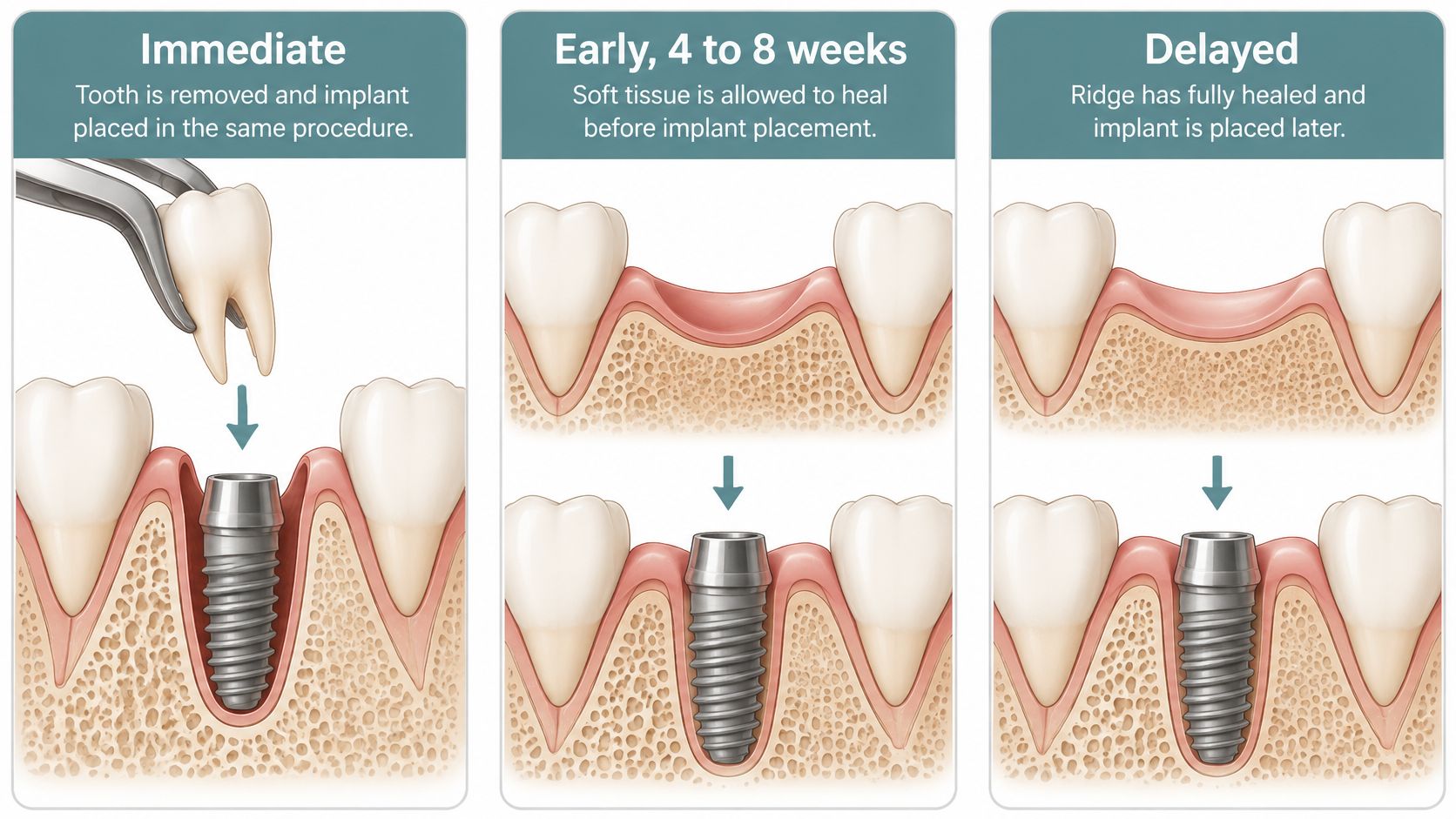
Immediate placement means inserting the implant during the extraction procedure. Combining those steps can reduce surgical visits, provided the socket can support the planned placement. The dentist needs enough initial stability, an intact or rebuildable socket, and infection under control. Removing the tooth creates an opening, but that opening alone does not establish whether an implant can be secured.
Early placement allows initial healing before implant surgery. It can follow soft-tissue closure or a later stage when bone has partly healed. These are different starting conditions within the same category: the gum may have closed while the bone underneath is still developing. The purpose of waiting is to let the site reach a suitable healing stage before placement.
Delayed placement follows complete healing of the extraction site. By then, the ridge has already undergone changes in shape. A healed site still needs assessment to establish whether enough bone remains for the intended implant position.
Why the site matters more than the label
The extraction socket changes as it heals: new bone fills the space while the outer walls remodel. Waiting allows healing, but the ridge can also narrow. Ridge preservation may help limit that change; without it, grafting may become more likely.
Imaging helps assess the available bone and socket walls. The implant needs to sit where the replacement tooth belongs, with enough support to hold it there.
At Bristol Dental & Orthodontics, the initial consultation includes an examination and imaging to evaluate jawbone density and structure. Those findings help determine placement timing for your site, with the extraction date serving as one part of the decision.
Matching Timing to Your Extraction Site
A 2019 systematic review and meta-analysis reported a 3% increased risk of implant failure with the immediate-placement protocol compared with the alternatives evaluated. The same analysis found no statistically significant difference in pink esthetic scores between immediate and delayed approaches.
Location mattered inside that review. In a subgroup analysis, immediate placement showed better results in the anterior region, while delayed placement showed better results at molar sites. That does not make immediate implants unsuitable, and it does not make delayed implants always better. It means the socket in front of you matters more than the label on the protocol.
What usually tips the choice
| Factor | Often supports immediate placement | Often supports early or delayed placement |
|---|---|---|
| Socket walls | Intact outer walls | Damaged or missing walls, where grafting may be needed |
| Initial stability | Firm implant stability at placement | Low stability, where waiting for bone healing helps |
| Infection | Infection controlled before surgery | Active infection treated and resolved first |
| Tooth position | Front teeth with favourable bone and careful planning | Molar sites, where delayed placement looked better in one subgroup analysis |
| Gum tissue | Thick, healthy soft tissue | Thin tissue or tissue that needs repair first |
| Aesthetic demand | Visible site with enough bone and tissue to support the crown | Limited bone or high aesthetic risk that needs extra procedures |
Stability is measured, not assumed. A 2025 prospective controlled clinical trial reported mean primary stability values of 73.98 ± 5.40 in maxillary molar sockets and 73.59 ± 6.74 in mandibular molar sockets immediately after extraction. Those figures describe that study's molar sites. They show why a clinician checks the reading in your jaw instead of guessing from the tooth's name.
Say a front tooth in Costa Mesa has thick gum, a solid outer wall, and no infection. The table leans toward a same-day discussion. Say a molar in Irvine has a cracked wall. The same table leans toward healing or a graft first. Bring the tooth's position, your gum health, and any past infections or grafts to the visit so those factors get weighed together.
What Happens in the Jaw While You Wait
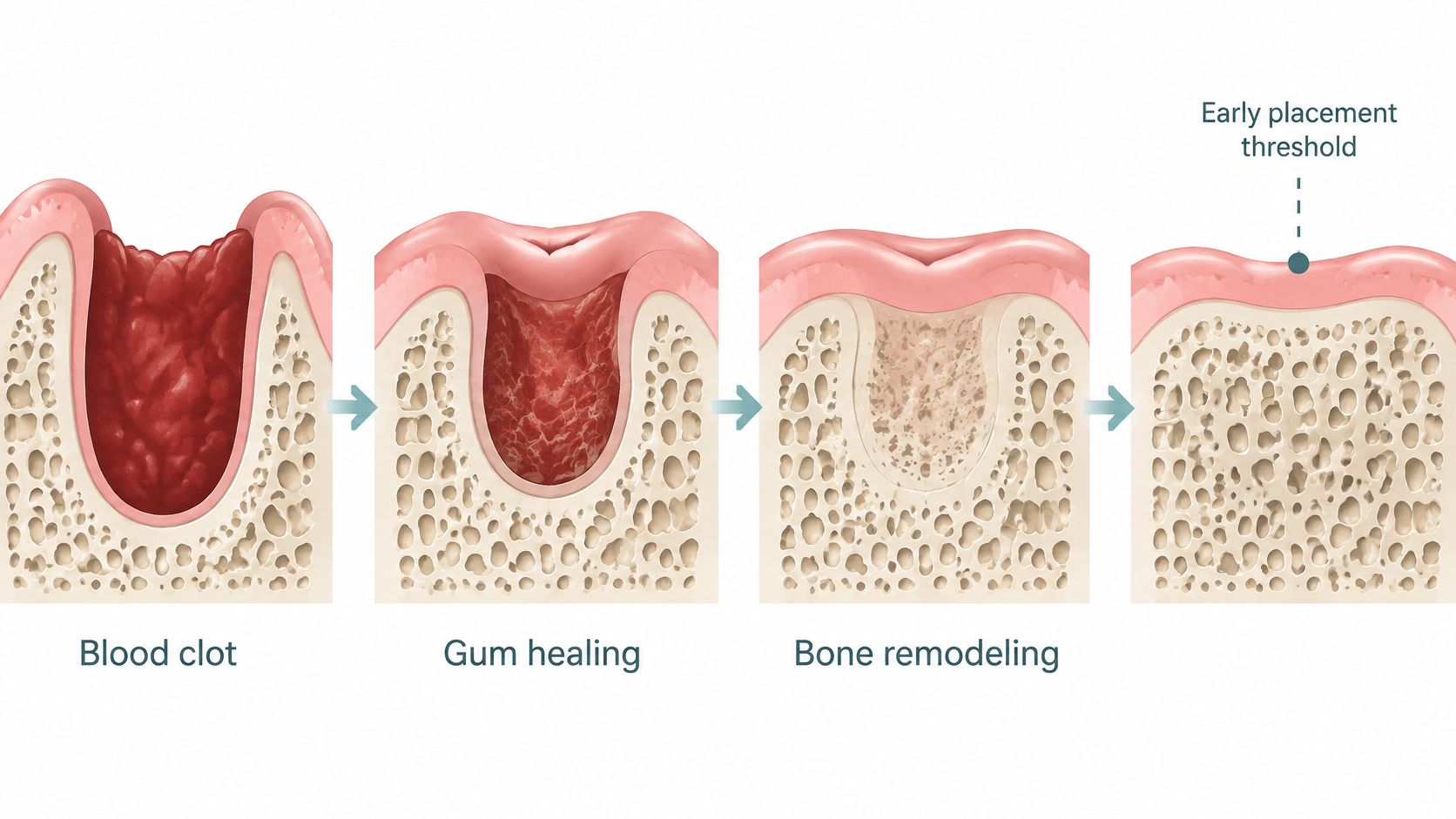
Right after a tooth leaves, a blood clot fills the socket. Over the next days the gum starts to creep across that clot. Tenderness that fades, and swelling that peaks and then settles, is the usual pattern. The site is not "empty bone" the whole time you are waiting.
One systematic review of early versus delayed placement defined early placement as insertion after complete soft-tissue coverage, typically within 3–8 weeks, and delayed placement as 12 weeks or more after extraction. Those cutoffs sit a little apart from the 4 to 8 week range used in many planning tables. The gap comes from different studies and protocols, not from two opposing sets of advice.
Bone fills in while the walls change
In the later months, new bone fills the socket while the outer walls remodel. That is why the ridge can look narrower at placement than it did on extraction day. The same review found early placement had a similar failure risk to immediate and delayed protocols, and better peri-implant hard-tissue stability than immediate placement in the evidence it analyzed. It does not set one schedule for every patient. The evidence has limits, and the cases were not identical.
If placement will wait, ridge preservation places graft material in the socket to help hold width and height. Grafting can add months before the implant goes in. That extra time is often what keeps a later implant possible.
Call us if pain grows instead of fading, bleeding will not stop, swelling keeps increasing, or you notice fever or drainage.
The extraction date alone cannot set the schedule. Healing, bone, soft tissue, and whether the implant can be positioned and held all have to be checked. Dr. Andrew Finley can confirm that at a follow-up and talk through whether bone or gum procedures are needed before a tooth goes on.
Factors That Lengthen or Shorten the Schedule
A fixed calendar is less useful than the biology of the site. Case selection often matters more than the date printed on the extraction note.
What commonly adds time
- Bone grafting or ridge preservation: The graft has to become solid enough before an implant can be planned.
- Active gum disease or infection: The area is treated and allowed to settle before surgery.
- Smoking: Healing is slower, and the plan may build in more time.
- Poorly controlled diabetes: Blood sugar that is not steady can stretch recovery.
- Poor daily cleaning: Plaque around a fresh site works against the schedule.
- A long gap after extraction: More remodeling can mean less bone when you return.
- Medications that affect healing: Always tell us what you take, including supplements.
What you can influence
- Cut back or quit smoking before surgery if that is part of your plan.
- Keep the area clean exactly as you are shown, not harder and not less.
- Come to follow-up visits so a slow spot is caught early.
- Follow the food and activity guidance for the first days, when the clot is fragile.
Bite forces and grinding may also be reviewed during planning, because a heavy bite on a fresh site can disturb it. These are general considerations, not a diagnosis. Dr. Andrew Finley sets timing only after your health history, the exam, and the images are in front of him.
How the Implant Timeline Unfolds Step by Step
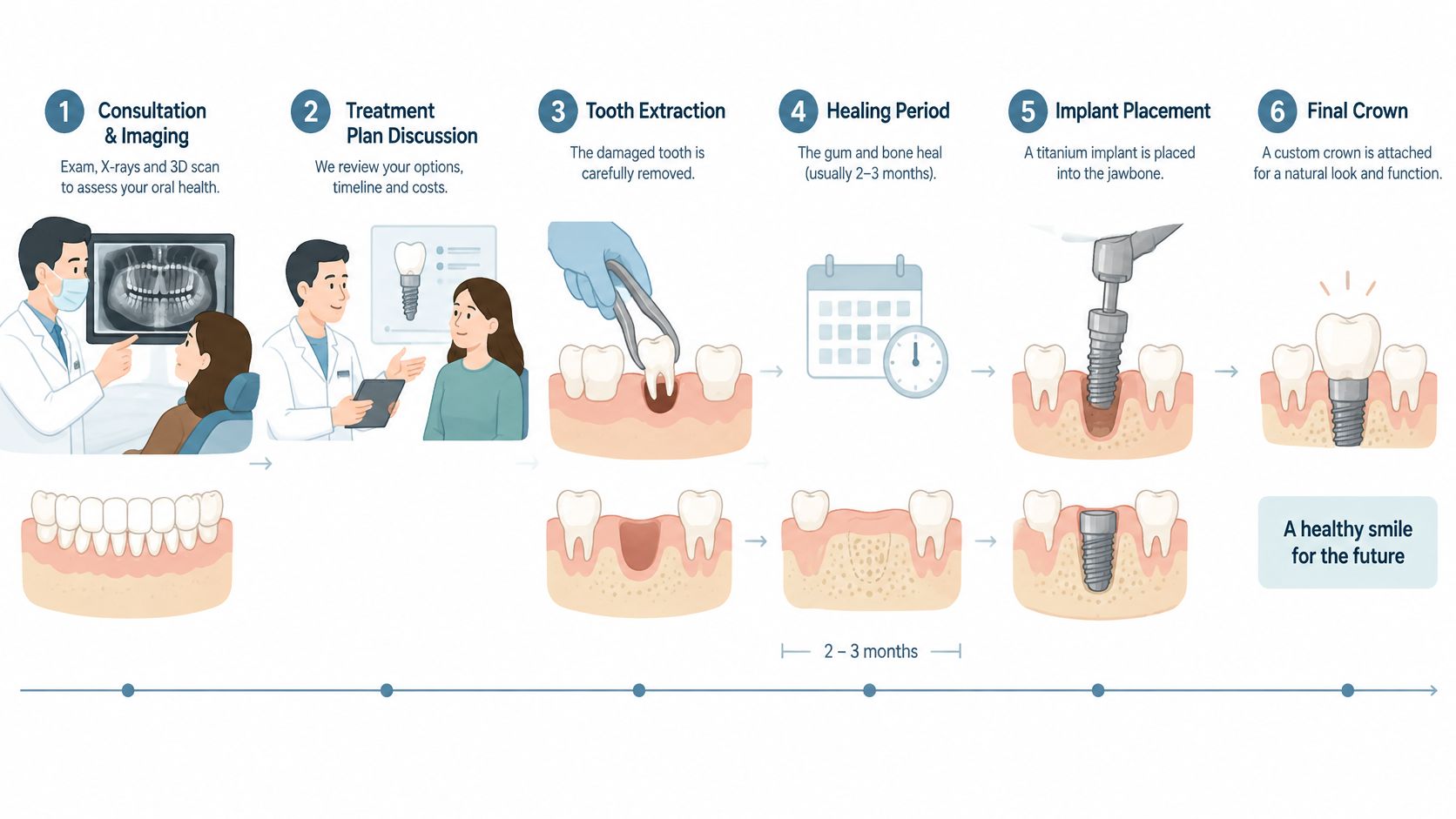
Consultation and imaging. The first step is a thorough exam and imaging to evaluate jawbone density and structure. At this stage, the timing category is first discussed, because the pictures show height, width, and nearby anatomy that a mirror cannot.
Treatment plan. Immediate, early, or delayed placement is confirmed here, along with any graft. The most common delay at this step is a site that needs infection control or more bone before a date is honest.
Implant placement. A small titanium post is placed into the jawbone as a replacement tooth root. The reason for the chosen timing is explained in the chair, so you know why this visit is happening now rather than later. Placement itself is a surgical procedure.
Healing. The implant fuses with the jawbone over a period that typically takes 3 to 6 months. You keep the site clean and come in for checks. If a healing check needs more time, the crown waits. Rushing that fusion is how a stable-looking post becomes a loose one.
Abutment and impressions. Once healing is confirmed, the connector piece is placed and impressions are taken so the lab can build the tooth. Gums sometimes need a short extra period to shape around that connector.
Final restoration. After the jawbone has healed and the implant is bonded to the bone, you receive a custom-made crown, bridge, or denture. Color and shape are matched to your natural teeth. Ask whether a temporary tooth is an option during healing. That depends on the site and the plan, not on a standard add-on.
What you leave with
By the end you have a fitted tooth on an implant that has already bonded, not a date that was guessed on extraction day. With proper care, implants can last a lifetime, though no one can guarantee a result for every case. If a step runs long, it is usually because a check found the bone or the gum was not ready, and waiting then protects the work already done.
Book a Consultation to Confirm Your Timeline
A consultation is where the calendar becomes specific. The extraction date matters, but it is only one input. Dr. Finley examines the site and uses imaging to check jawbone density and structure before any placement timing is chosen. That exam separates two questions patients often combine: when the implant can be placed, and when it can be loaded with the final tooth.
Dr. Finley has advanced training in implants from the California Implant Institute. Our office provides dental implants for patients throughout Santa Ana and Orange County.
Bring a short packet so the visit stays focused:
- The extraction date, even if it is approximate.
- Your current medical history and a list of medications.
- Any previous X-rays from another office.
- Your questions about healing, a temporary tooth, and the final crown.
This article is general information and does not replace individual advice. Your timeline is set after an examination, because bone healing and gum readiness differ from one site to another. Think of the consultation as a map: extraction marks the starting point, placement is one stop, and the final restoration comes after healing is confirmed.
Bristol Dental & Orthodontics plans dental implant care around your extraction site, your healing, and the tooth you will use, not a one-size calendar. If you are in Santa Ana or nearby Orange County and want that sequence mapped for your case, visit Bristol Dental and Orthodontics and schedule a consultation with Dr. Andrew Finley.