

If two orthodontic estimates cover different parts of treatment, does the lower headline fee mean you'll pay less? That's the gap a national average can't resolve. To understand typical orthodontic cost, you need to know what care is planned, what the written estimate includes, and which expenses remain your household's responsibility.
A useful estimate follows treatment from diagnosis through retainers, rather than stopping at the braces or aligners themselves. For families and adults in Santa Ana, that approach makes it easier to compare options without mistaking an advertised payment for the full financial commitment.
Table of Contents
- What Sets the Total Cost of Treatment
- Braces and Clear Aligners Compared on Total Cost
- How Insurance Changes What You Pay
- Monthly Payment Plans and What They Add
- How to Compare Two Estimates Line by Line
- Cost Scenarios for Families and Adults in Orange County
- Book a Consultation to Get Your Own Estimate
What Sets the Total Cost of Treatment
One patient needs a few months of minor alignment. Another needs both arches treated, a bite corrected, and far longer monitoring. Both might wear similar brackets, yet their totals will sit far apart.
Orthodontic treatment uses braces, aligners, and other appliances to move teeth into the desired position, and the appliance itself is only one line in a longer plan. The work around it, from records and planning to adjustments and retention, is where most of the difference between two totals lives.
National fee surveys consistently point to the same drivers: how complex the case is, how long treatment runs, which appliance is used, and where the practice is located. Those figures give a family context for budgeting, and they stop short of predicting any one patient's written estimate.
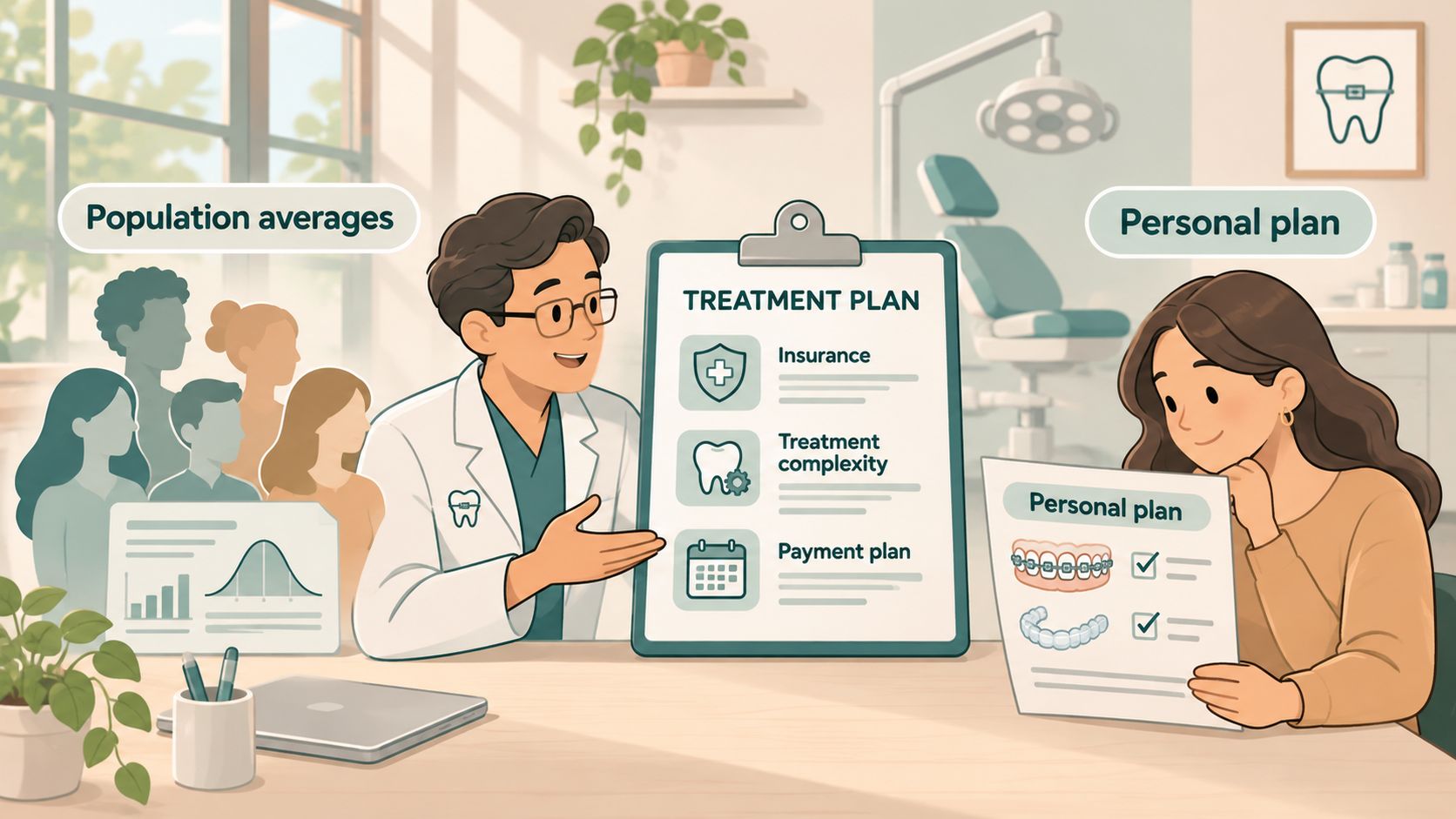
The work behind the appliance
Teeth that look similarly crowded in a photograph can require very different treatment. A consultation weighs how the upper and lower teeth fit together, not just whether the front teeth look straight. Bite problems such as overbites, underbites, crossbites, and open bites add mechanics, appointments, and clinical oversight that a straightforward spacing case never needs.
Two plans can also differ on services that never touch the brackets: diagnostic imaging, extra visits when teeth respond slowly, a lost aligner that must be replaced, and the retainers that hold the result afterward. Each line in this table shifts the total in a specific way, and the same list applies when you compare two written estimates line by line.
Cost factors and how each changes the total
| Cost factor | How it changes the total |
|---|---|
| Case complexity | Crowding, bite problems, or treatment of both arches can add mechanics and visits. |
| Treatment duration | Longer treatment means more visits and monitoring. |
| Appliance type | Braces, aligners, and other systems differ in materials, laboratory work, and appointments. |
| Arches treated | Treating the upper, lower, or both arches changes the scope of care. |
| Diagnostic records | X-rays, photos, and scans may be included in the fee or billed separately. |
| Refinements and adjustments | Extra visits or appliances may be needed if teeth move differently than planned. |
| Emergency visits | Broken brackets or lost aligners may add charges under the treatment agreement. |
| Retainers and retention | Retainers, follow-up care, and replacement retainers can add cost. |
| Location | Practice overhead and local fee levels differ by region. |
Keep separate treatments separate
Fee levels in Santa Ana and the wider Orange County area can sit above or below national figures, so a local quote will rarely match an online benchmark. The table serves better as a scope check on your written estimate: does it cover records, every scheduled visit, mid-course corrections, and the retainers at the end?
At Bristol Dental & Orthodontics in Santa Ana, Dr. Andrew Finley reviews these factors case by case, and every patient receives a personalized treatment estimate after consultation. Unrelated care stays out of that comparison. Dental implants and cosmetic dentistry each carry their own estimate, and the same principle holds for appliance-based care elsewhere in dentistry: the American Dental Association's materials on obstructive sleep apnea describe a custom appliance as assessment, fabrication, fitting, adjustment, and follow-up rather than a simple device purchase. If that kind of care is on your list, request its own evaluation and written estimate so the scope stays clear.
Braces and Clear Aligners Compared on Total Cost
In the survey behind the Invisalign cost and affordability guide, 53.5% of more than 300 U.S. orthodontists and general dentists reported Invisalign cases costing the same as or less than traditional braces. The same guide cites a recent practice survey in which average bracket-and-wire and clear-aligner fees came in very close.
What separates two real quotes is everything around the appliance: which services the fee covers, how many visits the plan assumes, and what happens when teeth move differently than expected. Two estimates for the same patient can diverge on those lines even when the headline fees look similar.
A written example shows why. A braces quote that bundles records, adjustment visits, and the first set of retainers can total less than a lower-priced aligner quote that bills refinement trays and lost-tray replacements separately. Flip the inclusions and the order reverses. The total follows the line items, so the fair comparison is each estimate's full treatment pathway.
Braces and clear aligners on the same criteria
| Comparison point | Traditional braces | Clear aligners |
|---|---|---|
| Fee pattern in surveys | Close to aligner averages in a recent practice survey | Same as or less than braces in over half of surveyed clinicians' responses |
| Best suited for | Patients of all ages, across a wide range of needs including complex bite correction | Mild to moderate crowding, spacing, overbites, underbites, and crossbites in teens and adults |
| Appearance | High-grade stainless steel brackets, with colored bands for personalization | Clear, removable trays |
| Adjustments | Periodic visits to adjust wires and brackets | Periodic tray changes, with refinements possible |
| Monthly payments | Ask which payment arrangements apply to the proposed treatment | Customized monthly payment options offered directly through our practice |
| Retention | Retainers and follow-up guidelines set after treatment | Retainers and follow-up guidelines set after treatment |
Suitability comes before a price comparison
Traditional braces work for patients of all ages and can address a wide range of orthodontic needs, from crowded or spaced teeth to overbites, underbites, crossbites, and open bites. Patients can personalize their braces with different colored bands, which can make the metal appearance more appealing to children and teens.
Invisalign treats mild to moderate crowding, spacing, overbites, underbites, and crossbites in teens and adults, and it can handle cases ranging from minor adjustments to more complex needs. Adults who want straighter teeth without the look of metal braces can receive a custom Invisalign treatment plan based on their evaluation.
The practical questions differ by appliance. With braces, ask how adjustment and repair visits are billed. With aligners, ask about additional trays, lost-tray charges, and refinements if planned movements need further attention. After either treatment ends, the orthodontist provides specific guidelines to keep teeth in their new positions, so confirm which retainers that plan includes.
Dr. Andrew Finley evaluates each case at our Santa Ana office and provides a personalized treatment estimate after consultation, so both options can be priced against the same clinical goals.
How Insurance Changes What You Pay
A plan described as covering half of orthodontic care won't necessarily pay half of your full bill. The percentage may apply only to eligible care, and the plan may stop paying when its benefit limit is reached.
Orthodontic benefits commonly use a percentage or fixed benefit subject to a lifetime maximum, while adult coverage may be limited or unavailable, according to a consumer explanation citing the American Association of Orthodontists. The same explanation identifies deductibles, waiting periods, age restrictions, and exclusions as factors that can change patient responsibility.
Plan terms that change your share
| Plan feature | What it means | Effect on your share |
|---|---|---|
| Percentage benefit | The plan pays a set share of covered orthodontic care. | The remaining share is the family's responsibility. |
| Lifetime maximum | A cap on what the plan pays over the patient's lifetime. | Costs above the cap fall to the family. |
| Deductible | The amount paid before benefits begin. | Adds to what the family pays first. |
| Waiting period | Time after enrollment before orthodontic coverage starts. | Treatment may need to wait, if clinically appropriate, or be paid without that benefit. |
| Age restriction | Some plans cover orthodontics only for children. | Adult treatment may be fully out of pocket. |
| Exclusion | The plan doesn't cover orthodontic treatment. | The family remains responsible for the treatment fee. |
| Shared family maximum | A benefit may cover several children if the policy specifies a shared cap. | Siblings treated together may reach the cap sooner. |
Translate the policy into a household obligation
Say your policy pays a percentage of eligible care. If some proposed services aren't eligible, the percentage won't apply to those items; if a deductible remains, you may need to meet it before benefits begin.
A waiting period creates a different issue. Enrollment doesn't necessarily mean coverage is available immediately, so ask whether records, appliance placement, and ongoing care have different eligibility dates.
For siblings, don't assume every child receives a separate benefit. Ask whether the maximum is individual or shared, and whether earlier orthodontic payments have already reduced the amount available.
Before budgeting: Ask the insurer what it expects to pay, when it expects to pay, and which assumptions could change that estimate.
We can explain what your treatment agreement includes, while your insurer determines your benefits. Verify the policy directly with the insurer, including adult eligibility and any remaining lifetime benefit, before treating an estimated contribution as money already paid.
A coverage percentage becomes useful only after you know the full treatment fee and the policy's limits. Keep the treatment agreement and insurance estimate separate so you can see both clearly.
Monthly Payment Plans and What They Add
A lower monthly installment can still carry a higher total cost. Spreading the fee across more months shrinks each payment, while interest or account fees raise the amount you ultimately pay.
The arithmetic is easy to check in the office. Say the treatment fee is $4,500, inside the typical Invisalign range of $3,500 to $5,500 at this practice. A $500 down payment plus 20 installments of $200 comes back to $4,500. Run the same arrangement with financing charges and the total climbs above the cash price, even though the headline $200 figure never changes. The installment only becomes meaningful after you multiply it by the number of months and add the down payment.
Orthodontic financing commonly combines a down payment with monthly installments, and the American Association of Orthodontists economics survey distinguishes financed payments from the total treatment commitment. The payment schedule and the treatment schedule are separate timelines, so ask directly whether the financial agreement ends when active treatment ends.
Questions to take into the office
- What is the total cash price? Use this figure as the baseline for judging whether financing changes the amount paid.
- How many installments apply? Confirm the down payment, the installment schedule, the final payment, and whether payments continue after active treatment.
- Is the plan interest-free? Get a direct answer on whether the arrangement spreads the fee at no added cost or carries financing charges.
- What is the annual percentage rate? Ask about interest, account charges, and late-payment fees, including what happens after a missed payment.
We offer customized monthly payment options directly through the practice for Invisalign treatment. You can ask about the terms before beginning care so the arrangement fits your household budget.
Do the addition before signing: down payment, plus the monthly installment times the number of months, plus any stated fees. Compare that total, not the installment.
Insurance timing matters here too. A practice payment may come due before an insurer sends reimbursement, so ask who is responsible during that gap and how later payments will be credited. A reimbursement arriving mid-plan reduces your share, but only once it posts.
Keep a copy of the payment schedule alongside the treatment agreement. Together, they should show what you owe, when it is due, and which events could change the balance.
How to Compare Two Estimates Line by Line
Two estimates for the same patient can show different totals. The gap usually comes from which services each document includes. Put the estimates side by side and compare the treatment commitments before deciding which one offers the lower expected total.
Follow the treatment from start to finish
The steps below walk the treatment pathway in order, from the first record to the last retainer check. They apply the cost components listed in the opening section's table to an actual document.
Request the full treatment cash price in writing. Establish the baseline before insurance contributions or financing charges. This prevents an advertised installment from being mistaken for the treatment fee.
Confirm which arches are treated. Check whether the proposal covers the upper teeth, the lower teeth, or both. A limited correction and a coordinated bite plan can use the same appliance and still be very different commitments.
Find the records and active-treatment provisions. Look for diagnostic records, appliances, scheduled adjustments, refinements, and emergency repairs. Ask whether each is included, excluded, or subject to a stated condition, since a broad label leaves unanswered questions.
Confirm the retention terms in one line. Retainers, replacement policies, and retention visits should each be marked as included or priced separately. After treatment is completed, the orthodontist provides guidelines for keeping teeth in their new positions, so the estimate should show which part of that stage is already covered.
Ask about expected duration and office visits. These are estimates rather than promises, but they help you plan transportation, time away from work, and school schedules. Ask what happens financially if monitoring continues longer than initially expected.
Note the insurance assumptions behind the projected share. Write down the eligibility status, remaining benefit, and payment timing the estimate used, so you can confirm each one with the insurer before relying on the projected household cost.
Compare the expected totals. Account for known exclusions and financing terms instead of choosing by monthly payment or appliance name. If something lacks documentation, request clarification before signing.
Look for a usable agreement
At our practice, every patient receives a personalized treatment estimate after consultation. You can apply these same checks to our estimate and to any other proposal you're considering.
A complete estimate identifies the planned care, what is included, what might generate an additional charge, and how payments are scheduled. It also keeps the clinical plan separate from insurance projections, with clear conditions for repairs, refinements, and retention.
Before signing, write down five things: the total cash price, the included services, the events that trigger extra charges, the insurance assumptions, and the payment schedule. Keep that summary with the estimate itself, so any later question starts from the same numbers rather than from memory.
Cost Scenarios for Families and Adults in Orange County
A written estimate changes shape the moment a fee, a benefit, and a plan limit sit side by side. Three worked examples show how households revised their budgets once those numbers were on the same page.
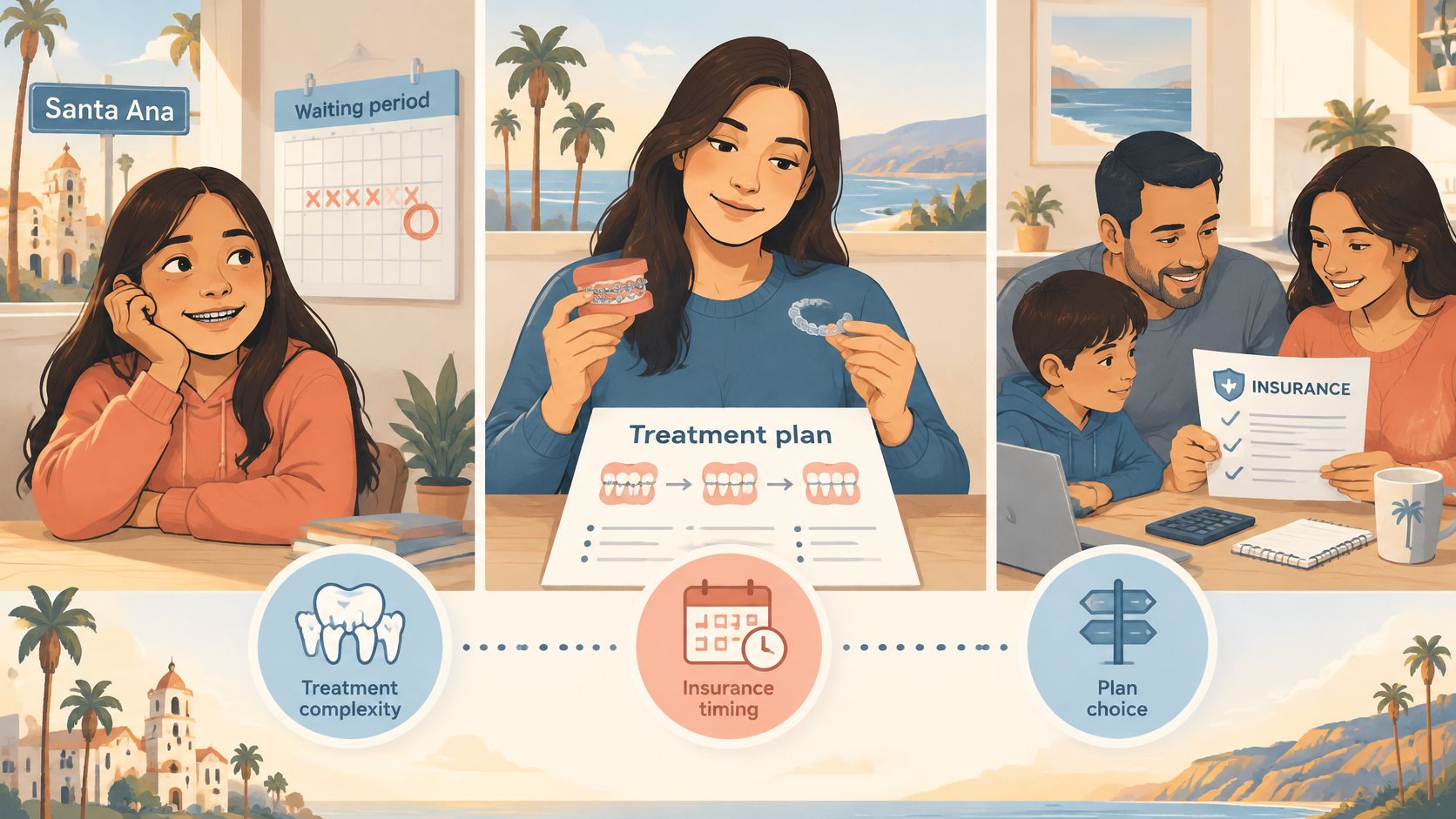
A child in Santa Ana with a waiting period
"Will the new plan help right away?" That is the question a family asks when they bring their twelve-year-old in for a crowding evaluation. The estimate prices treatment at $4,500, and the new policy lists a $1,500 orthodontic benefit that activates only after a waiting period.
The family asks the insurer two things: whether diagnostic records collected during the waiting period still qualify, and when appliance placement becomes eligible. They split their budget in two, setting aside the evaluation costs they will pay now and the benefit they expect later, and they discuss timing with Dr. Finley rather than postponing recommended care just to satisfy an insurance date.
An adult in Tustin comparing appliances
An adult with mild crowding and no orthodontic benefit asks whether Invisalign must cost more than braces. Her Invisalign proposal totals $4,800, inside the practice's typical $3,500 to $5,500 range, and with no insurance contribution her share equals the full fee on any appliance she picks.
That moves the question from labels to inclusions: which suitable plan already covers the anticipated refinements and the retention guidance that keeps teeth in their new positions? She weighs the clinical recommendation, her preference for straightening without the look of metal braces, and what each written plan includes.
Siblings in Costa Mesa sharing a benefit
The insurer answers before anyone asks about appliances: the policy carries a $3,000 orthodontic maximum for the whole family, not per child. Each sibling's estimate sits near $4,200, so the first claim filed directly shrinks what remains for the second.
If the older child's treatment draws $1,800 of the maximum, $1,200 is left for the younger one. Their parents rebuild the household budget around that gap and request separate monthly payment schedules for each child.
Our Santa Ana office provides orthodontic care for patients of all ages, and each of these budget questions gets resolved the same way: with a personalized treatment estimate written after a consultation.
Book a Consultation to Get Your Own Estimate
National averages describe a range, not your household's share. A written estimate turns that range into specific numbers: the appliance recommended for your case, which refinements and retention care the fee includes, how your plan's limits apply, and what a monthly payment schedule adds over time.
Bristol Dental & Orthodontics is a family and cosmetic dental practice led by Dr. Andrew Finley. At a consultation, we can review your concerns, discuss appropriate orthodontic options such as traditional braces or a custom Invisalign plan, and provide a personalized treatment estimate.
Our office on South Bristol Street serves Santa Ana and surrounding Orange County communities. This guide is general information; your estimate depends on an individual exam.
If you'd like help understanding your own options, contact the practice to schedule an orthodontic consultation at 714-874-8579.
Bristol Dental & Orthodontics offers traditional braces, custom Invisalign treatment plans, and personalized estimates after consultation. Visit Bristol Dental and Orthodontics to learn about our care and arrange a conversation about the treatment and payment considerations that apply to you.