
When you lose a tooth, people often jump straight to a single question: should I get an implant? That skips a far more useful question about how to replace a missing tooth in a way that fits your mouth, your health, and your life.
Treating an implant as the automatic finish line overlooks what really separates one replacement from another: total treatment burden. Every option asks something different of you. One involves minor surgery and months of healing, another reshapes healthy neighboring teeth, and a third trades permanence for simpler upkeep and lower upfront disruption.
In a systematic review of 23,702 participants across 16 countries, patients commonly preferred dental implants and fixed bridges, yet high cost stood out as a leading reason people declined treatment altogether. Choosing well means weighing bone volume, adjacent teeth, medical history, timeline, and budget together rather than assuming one method fits everyone.
Table of Contents
- Why a Missing Tooth Deserves a Plan
- Comparing Replacement Options by Missing Teeth and Support
- What Your Dentist Checks Before Choosing
- How the Implant Process Unfolds Step by Step
- Managing Cost, Timing and Urgent Problems
- Schedule a Consultation to Choose Your Replacement
Why a Missing Tooth Deserves a Plan
Tooth loss is an everyday health issue, not just a gap in a photograph. According to the World Health Organization, about 6.8% of adults aged 20 and older worldwide (nearly 1 in 15) and 22.7% of those aged 60 and older (roughly 1 in 4) had complete tooth loss in 2019, with rates in the WHO European Region reaching 12.4% for adults 20 and older and 31.3% for those 60 and older.
Even a single missing tooth sets off quiet physical shifts in your mouth. Neighboring teeth tend to tilt or drift into the open space, while the opposing tooth on the opposite jaw can gradually grow downward or upward toward the gap. Over time, the jawbone and gum ridge where the root used to sit also change shape, which can alter how your bite meets, how comfortably you chew, and even how clearly you pronounce certain sounds.
A missing tooth rarely becomes an overnight crisis, but waiting without a plan can quietly reshape the bone and neighboring teeth, narrowing your options later.
The right replacement depends on your age, gum and bone condition, medical history, and how many teeth are missing and where they sit. A gap by itself isn't an emergency unless you're dealing with pain, swelling, infection, or dental trauma. Whether you live in Santa Ana, Costa Mesa, Tustin, Irvine, or Garden Grove, understanding your options early gives you room to make a calm, informed decision with a dentist you trust.
Comparing Replacement Options by Missing Teeth and Support
Seeing every replacement side by side makes it easier to compare how each one stays in place and what it asks from your mouth. Use the table below to narrow the field before an examination.
| Option | Missing teeth it suits | How it is supported | Surgery needed | Removable |
|---|---|---|---|---|
| Single implant with crown | One tooth | Titanium post in the jawbone with a crown on top | Yes | No |
| Conventional fixed bridge | One or more teeth in a row | Anchored to the teeth on each side | No implant surgery | No |
| Maryland bridge | One tooth | Bonded to the back of adjacent teeth | No | No |
| Implant-supported bridge | Several teeth in a row | Anchored to two or more implants | Yes | No |
| Removable partial denture | Several teeth | Clasps onto remaining natural teeth | No | Yes |
| Complete denture | All teeth in one arch | Rests on the gums | No | Yes |
| Implant-supported denture | Several or all teeth | Anchored to dental implants | Yes | Yes for snap-on designs; no for fixed designs |
| Full-arch implant restoration | Entire arch | Several implants support a full set of teeth | Yes | No (typically fixed) |
| Orthodontic space closure | One tooth, when the gap allows | Adjacent teeth moved to close the space | No | No |
Fixed Options Anchored to Bone or Neighboring Teeth
Replacement methods differ mainly in how they carry chewing forces. As University Hospitals of North Midlands explains, dental implants are titanium posts surgically placed into the jawbone that can support a single crown, a fixed bridge, or a removable acrylic denture depending on the mouth. At our practice, a dental implant is a small titanium post placed in the jawbone that acts as a replacement tooth root. Because it stands independently, neighboring teeth aren't reshaped, though you do take on a surgical visit, a healing window, and lifelong gum care around the post.
A conventional fixed bridge takes a non-surgical route. As Havering Family Services Hub notes, a bridge is fixed onto the neighboring teeth so it stays in place rather than coming out like a partial denture. That saves surgical healing time and works well when the teeth on either side already need crowns, but healthy adjacent teeth have to be shaped down to anchor it, and you'll need to floss underneath the pontic every day.
A Maryland bridge bonds a replacement tooth to the back of adjacent teeth using small wings. It usually preserves far more natural enamel than a traditional bridge, though it still relies on healthy neighboring teeth and a bite that won't pop the bond loose.
For multiple missing teeth in a row, implant-supported bridges are anchored to dental implants placed in the jawbone rather than leaning on natural teeth. Patients who need to replace an entire arch may consider full-mouth dental implants, which involve placing several implants in the jawbone to support a full set of custom-made teeth. Both fixed implant solutions demand surgical planning and careful daily cleaning under the bridge, yet they avoid the movement of traditional dentures.
Removable Appliances and Orthodontic Closure
A removable partial denture clips onto remaining teeth to fill several gaps without surgery, while a complete denture rests directly on the gums when all teeth in an arch are missing. You can take both out for brushing and soaking, which makes cleaning straightforward. The trade-off is adaptation: removable appliances can feel bulkier while chewing or speaking, and they need periodic adjustments as the gums and jawbone change shape.
An implant-supported denture adds stability by anchoring the denture to implants. In practice, this doesn't mean one implant for every missing tooth; a few strategically placed implants can support a much larger restoration. Depending on the design, it can snap off for cleaning or stay fixed in place, trading surgical healing time for a steadier bite.
Orthodontic space closure uses braces or clear aligners to gently shift neighboring teeth together so no artificial tooth is needed at all. It avoids surgery and prosthetic upkeep entirely, but it only works when the spacing, bite alignment, and tooth positions allow the gap to close cleanly.
Three Questions to Narrow Your Choices
Before your appointment, three practical questions help sort which options are realistic for you:
- How many teeth are missing, and are they side by side? A single gap opens the door to an implant crown, a bridge, or sometimes orthodontic closure, whereas several missing teeth in a row point toward an implant-supported bridge or partial denture.
- What condition are the neighboring teeth in? Healthy, untouched teeth often make people hesitant to reshape them for a conventional bridge, while heavily filled neighbors that already need crowns can make a bridge a sensible two-in-one fix.
- How do you feel about minor oral surgery and healing time? If you'd rather avoid surgery or want a faster finish, a fixed bridge or removable partial denture may fit your priorities better than an implant.
This comparison narrows the possibilities, but no table can see beneath your gums. The final match always depends on a hands-on examination and dental imaging at Bristol Dental & Orthodontics.
What Your Dentist Checks Before Choosing
Two patients can arrive with the same missing molar and leave with very different plans. The difference lies in what the examination finds, because how to replace a missing tooth depends as much on the mouth doing the holding as on the tooth filling the gap. At Bristol Dental & Orthodontics, implant planning begins with a consultation that pairs a hands-on exam of your teeth, gums, and bite with imaging that measures jawbone density and structure. It works like the survey a builder orders before drawing up plans: the site decides what construction makes sense.
- Medical history and current medications. Certain health conditions and prescriptions slow bone or tissue healing, so your dentist reviews your full health picture before recommending surgery.
- Active infection and gum health. Gums need to be healthy and the mouth free of active infection before implant planning moves forward, because untreated gum disease undermines the bone supporting any replacement.
- Smoking and daily habits. Tobacco restricts blood flow to healing gums and bone, which raises the chance of complications and steers the plan toward whichever replacement carries the lowest risk for you.
- Two-dimensional and 3D imaging. Periapical X-rays inspect the roots and surrounding bone, while three-dimensional CBCT scans come in when bone width, height, or nearby nerve and sinus anatomy needs a clearer view.
- Neighboring teeth and your bite. How your upper and lower teeth meet, and whether adjacent teeth already need crowns, reveals whether a bridge solves two problems at once or an implant leaves healthy enamel alone.
- Bone volume and site readiness. The scans show whether the site can hold an implant now, needs socket preservation after an extraction, or calls for staged bone grafting first.
- Timeline and personal priorities. When grafting is not practical or you need a quicker finish, a conventional fixed bridge or removable partial denture can be the more sensible clinical path.
Pitfalls a Careful Exam Prevents
According to the American College of Prosthodontists, dental implants and bridges are leading non-removable options, with properly placed implants showing roughly 98% success. The same guidance stresses that survival does not mean an implant is free of disease or upkeep. Long-term reviews draw a clear line between an implant staying in place and the tissue around it staying healthy, and peri-implantitis, the inflammatory bone loss that can develop around an implant, appears often enough that cleaning and regular check-ups remain part of the plan for as long as the implant serves you.
Most avoidable failures trace back to rushed planning. Placing an implant while gum disease is still active, positioning the post without mapping out the final crown first, overlooking tight chewing space, or shaping an overcontoured crown that traps plaque all create problems that are much harder to fix after the fact.
The exam also weighs the upkeep each option asks of you. A removable denture comes out nightly for cleaning, a bridge needs floss threaded beneath it, and an implant needs the same steady hygiene a natural tooth gets.
Bring these to your consultation: a complete list of current medications, any recent dental X-rays or records you have on hand, and a written list of your top questions so nothing gets forgotten in the chair.
At Bristol Dental & Orthodontics, this examination shapes the plan around your exact bone structure, bite, and comfort level, so the recommendation fits your mouth, your healing capacity, and your priorities.
How the Implant Process Unfolds Step by Step
An implant replaces a missing tooth in stages, with healing checks between surgery and the finished restoration. A single tooth implant involves placing a titanium post in the jawbone as a replacement root and attaching a custom-made crown. Understanding that sequence helps you weigh the full treatment burden, including surgery, follow-up visits, cleaning access, and ongoing maintenance.
The post works like a foundation. The crown is the visible tooth, and a connector joins the two. Each part has a different job, so readiness for the final crown depends on more than how comfortable your gum feels.
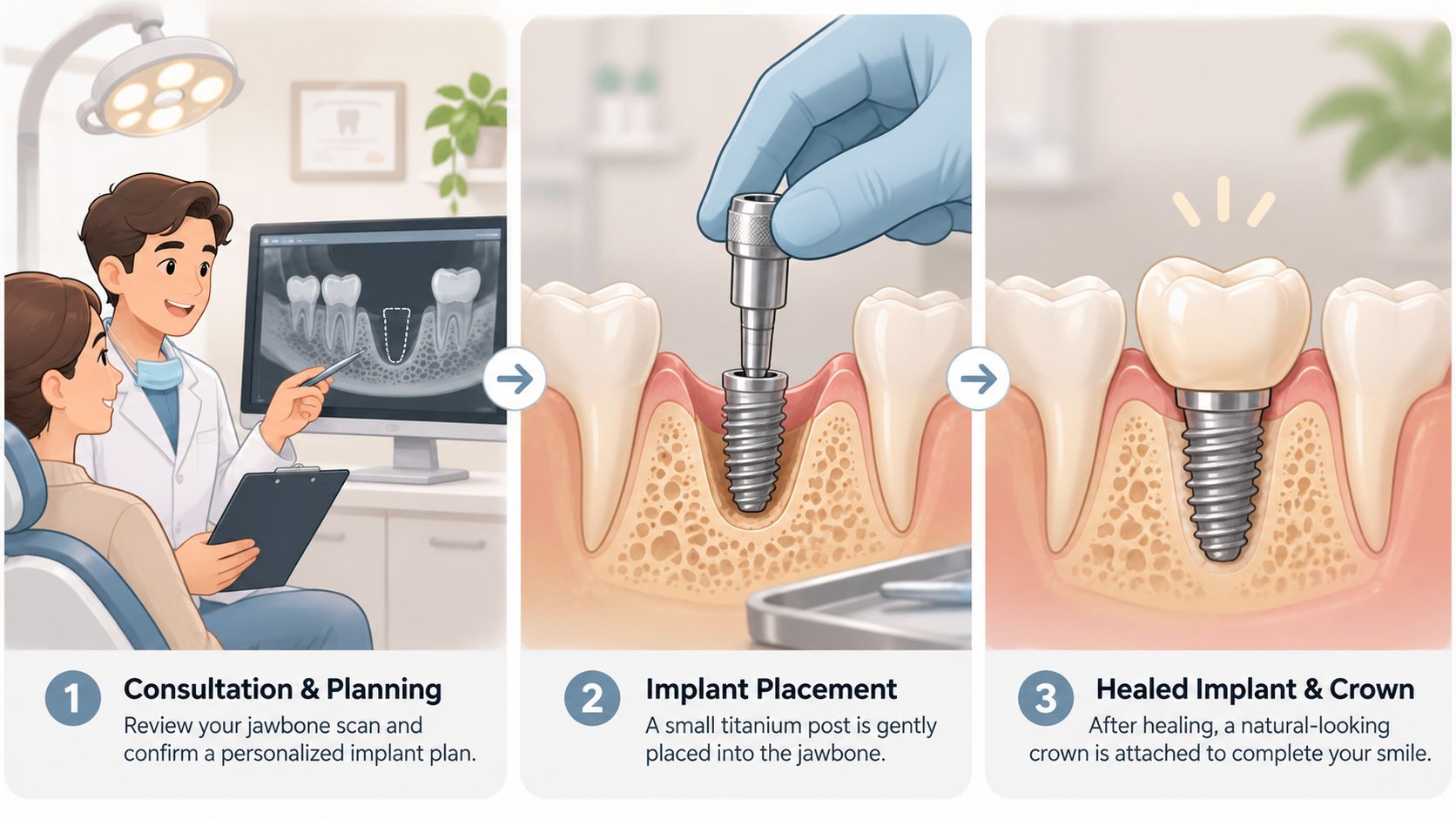
The illustration groups treatment into broad phases. The table separates the planning, healing, and restoration checkpoints within those phases.
| Stage | What happens | Typical timing |
|---|---|---|
| Consultation and imaging | Examination and imaging assess jawbone density and structure and help plan the final crown's position | Before surgery |
| Implant placement | A titanium post is surgically placed into the jawbone | Surgical visit, followed by initial healing |
| Osseointegration | Bone bonds to the implant surface, creating support for the replacement tooth | Typically 3 to 6 months after placement |
| Gum healing | Surrounding tissue matures, with follow-up checks to assess healing | Overlaps with bone healing; readiness is assessed individually |
| Abutment and final crown | The connector and custom-made crown are fitted after stable bonding and healthy gums are confirmed | After healing checks, rather than on a fixed calendar date |
Why Healing Determines the Schedule
The gum surface and the bone underneath heal on different schedules. The American Association of Oral and Maxillofacial Surgeons explains that initial soft-tissue healing begins within days to weeks, while bone-to-implant bonding develops over several months. Guidance from NHS Grampian describes gum healing around an implant as taking roughly two to three months, with broader bone healing and full treatment taking longer.
During osseointegration, bone grows onto the implant surface. Follow-up visits help the dentist assess that bond and the surrounding gums before proceeding with the restoration. A comfortable-looking site alone does not establish that the implant is ready.
Once healing is confirmed, an abutment connects the implant to the replacement tooth. After the jawbone has healed and the implant has bonded to it, the final restoration may be a custom-made crown, bridge, or denture, depending on the teeth being replaced. Its shape must accommodate both your bite and daily cleaning. Dr. Finley also makes sure the final restoration matches your natural teeth in color and shape.
What Long-Term Survival Numbers Mean
Research distinguishes the implant post from the crown it supports: a systematic review and meta-analysis of 34 studies cites single-crown evidence showing implant survival of 97.2% at 5 years and 95.2% at 10 years, crown survival of 96.3% and 89.4% at those intervals, and 5-year rates of 7.1% for soft-tissue complications and 5.2% for bone loss exceeding 2 millimeters.
These are population averages, not personal guarantees.
“Survival” means a component remains in place; it does not mean every part remains free from complications. The titanium fixture, abutment screw, ceramic crown, gums, and supporting bone can develop separate problems. A chipped crown, for example, may need repair or replacement while the implant beneath it remains sound. That distinction matters when considering future appointments and maintenance alongside the initial surgery.
Protecting Your Implant After Placement
An implant cannot get a cavity, but plaque can inflame the surrounding tissues. PubMed's clinical risk synthesis discusses smoking, poor bone quality, and a history of gum disease as risk factors. These are not all preventable: bone quality and past disease require individual assessment. Early inflammation, called peri-implant mucositis, can progress to bone loss without effective plaque control.
Daily brushing and interdental brushes or floss suited to the space help keep the restoration clean. Personalized maintenance visits allow your dentist to assess gum probing depths and bone levels on X-rays. Before proceeding, ask how you will reach around the finished tooth and what follow-up care your examination suggests. An implant's suitability includes your ability to maintain it comfortably.
Managing Cost, Timing and Urgent Problems
Not everyone is ready to start definitive tooth replacement the week a tooth comes out. Budget constraints, busy family schedules, and medical timing are real considerations, and separating an urgent problem from an elective replacement keeps you safe while you plan.
Seek prompt care if you notice any of these warning signs:
- Persistent or worsening pain: Throbbing discomfort or pain that wakes you up points to irritation or infection that shouldn't wait.
- Facial or gum swelling: Puffiness near the jaw, cheek, or extraction site signals inflammation that needs prompt evaluation.
- Signs of infection: Fever, a bad taste, or drainage near the gums requires timely treatment to protect surrounding tissue.
- Trauma or sharp broken fragments: A cracked tooth or jagged edge cutting your tongue or cheek should be smoothed or stabilized quickly.
Emergency dentistry at Bristol Dental & Orthodontics covers issues such as toothaches, broken teeth, and other urgent problems. Once the mouth is comfortable and infection-free, replacing the empty space becomes a planned, elective decision rather than a race against the clock.
Practical Ways to Pace Elective Replacement
If you can't move straight into your final restoration right away, your dentist can walk through several structured interim approaches:
- A temporary removable appliance. A lightweight interim partial restores your smile and light chewing function while you save or finalize plans, though it won't feel as steady as a fixed tooth and doesn't stimulate the jawbone.
- Phased treatment. When several teeth are missing, tackling the most functional chewing teeth or visible front teeth first spreads appointments and expenses over time, at the trade-off of a longer overall calendar.
- Extraction-site preservation. If a tooth is being removed now and you may want an implant later, preserving the socket at the time of extraction helps maintain bone volume, though it adds an early step before the final tooth is made.
- A monitored delay. Waiting while your dentist tracks the space at routine check-ups can be clinically acceptable in selected cases, as long as you understand that bone resorption and shifting teeth can gradually alter what's possible later.
Planning Around Coverage Gaps
Insurance often surprises patients who assume tooth replacement is automatically included. A 2025 Colorado adult dental-coverage analysis found that only 50% of analyzed plans covered dentures, bridges, or implants in each category. Because benefits vary so widely from plan to plan, asking the front office to verify how your specific plan treats each option saves frustration before treatment starts.
During your visit, ask clear practical questions: what payment plan options are available, whether your insurer requires pre-authorization before treatment, if third-party healthcare financing is accepted, whether any step needs a specialist referral, and how many trips to the office the schedule will take. A missing tooth doesn't automatically demand immediate implant surgery, and setting the right pace belongs inside your consultation.
Schedule a Consultation to Choose Your Replacement
Sorting out how to replace a missing tooth becomes much simpler once you put the steps in the right order. An examination and imaging come first, followed by an honest look at how many teeth are missing, how healthy the neighboring teeth are, how you feel about surgery, and what timeline and upkeep fit your life.
A sound tooth-replacement plan is built on an individual examination of your mouth, not on defaulting to a single option.
Patients across Santa Ana, Costa Mesa, Tustin, Irvine, and Garden Grove can sit down with Dr. Andrew Finley and our team at Bristol Dental & Orthodontics on South Bristol Street to review their options in plain language. We look closely at your health history, gums, bone structure, and bite, explain the trade-offs between dental implants, bridges, dentures, and orthodontic care, and never push a one-size-fits-all answer. When it's time for the final tooth, Dr. Finley makes sure the final restoration matches your natural teeth in color and shape so it blends comfortably into your smile.
Bring a short checklist to your appointment to get the clearest answers:
- Best-fit options for my mouth: Which replacement choices work with my bone volume and neighboring teeth?
- Expected visits and schedule: How many appointments will this take from start to finish?
- Healing expectations: What will recovery look like between stages, and will I have a temporary tooth in the meantime?
- Long-term upkeep: What daily tools and professional cleanings will keep this restoration healthy?
You don't have to commit to a procedure just to learn where you stand. Starting with a relaxed conversation and clear imaging lets you move forward at a pace that makes sense for you.
Bristol Dental & Orthodontics provides family, restorative, cosmetic, and dental implant care on South Bristol Street in Santa Ana, serving patients across Orange County with clear, individualized treatment planning. Whether you're weighing an implant, bridge, denture, or an interim step after losing a tooth, Dr. Andrew Finley and our team are here to answer your questions and review your options without pressure. Schedule your consultation today at Bristol Dental and Orthodontics.