
Does less surgery really mean less risk? That's the question hiding under most searches for mini implants vs regular implants, and it deserves a straight answer rather than a brochure.
Mini implants and regular implants aren't two sizes of the same decision. They're different tools judged against different demands: how much bone you have, how hard you bite, and what has to be held in place afterward. A narrow one-piece implant steadying a lower denture in dense front-jaw bone is a well-supported choice. The same implant under a back molar taking heavy, angled chewing force is a gamble.
Here's how we walk through the comparison with patients in Santa Ana: what the specifications mean, who each design suits, how the procedures differ, what the survival numbers do and don't promise, what drives the overall plan, and what happens if an implant fails.
Table of Contents
- Mini and Regular Implants Side by Side
- Who Each Implant Option Suits
- How the Procedure and Healing Differ
- Stability, Bite Force and Survival Data
- Cost Factors Beyond the Implant Itself
- Expected Outcomes and What Happens if an Implant Fails
- Confirm the Right Implant Type at Your Consultation
Mini and Regular Implants Side by Side
The one-sentence version: mini implants are generally defined as implants less than 3 millimeters across, while regular implants are typically wider than 3 millimeters and commonly 3.5 millimeters or more, as a comparative review of mini and conventional implant evidence sets out. Both are posts placed in the jawbone to act as a replacement tooth root, and both are usually made from biocompatible titanium. Read the table as a map, not a scorecard.
| Feature | Mini implant | Regular implant |
|---|---|---|
| Diameter | Generally less than 3 mm | Typically wider than 3 mm, commonly 3.5 mm or more |
| Typical length | Often shorter | Varies by site and bone height |
| Common material | Biocompatible, often titanium | Biocompatible, often titanium |
| Typical design | Often one-piece | Often two-piece, accepting more abutment types |
| Bone width needed | Less; may suit narrow ridges | More; grafting may be needed when bone is thin |
| Load tolerance | Lower; higher stress on surrounding bone | Higher, with more structural reserve |
| Healing period | Varies; depends on placement and loading | Commonly 3 to 6 months for bone to bond |
| Evidence base | Shorter track record in most indications | Used for more than four decades |
The two designs don't share the same history. Conventional root-form implants received U.S. Food and Drug Administration clearance in 1976, and by 2010 millions had been placed across more than four decades of use. Mini-implant use expanded in the early 1990s for patients with limited bone, and long-term intrabony use received clearance in 1997. That shorter runway is why mini implants carry narrower evidence, not because they're experimental.
What changes when the post gets narrower
Bone grips an implant along its threaded surface, so a wider post presents more surface for the same length and spreads chewing force across a broader footprint. A narrow post concentrates that same force into less bone and, in one-piece designs, into a thin neck at the gum line.
Design follows from that. Most mini implants are one-piece, with the head machined into the body, so the angle you place is the angle you get. Most regular implants are two-piece, with a separate abutment that can be angled or swapped later, which widens the range of crowns, bridges and attachments the implant can carry.
Practical rule: if the tooth being replaced is a back molar or the plan is a fixed bridge, the question comes second to whether a regular implant can be made to fit, with grafting if the ridge is thin.
Three rows of that table decide most cases: bone width, bite strength, and what sits on top (a single crown, a bridge, or a denture that clips on and off). Answer those three and the diameter usually picks itself.
Who Each Implant Option Suits
Diameter alone doesn't decide candidacy. Bone quality, bite forces, hygiene ability, health history and the planned restoration all shape the answer, and a peer-reviewed clinical review of mini dental implants makes the same point: the comparison isn't small versus large, it's whether the available bone, bite forces, restoration and location support the chosen design.
Mini implants are most established in carefully selected cases, such as retaining a lower overdenture or placing an implant where ridge width blocks a standard fixture. Regular implants are the usual starting point for single crowns, bridges and back teeth under heavy load. No implant type suits every patient, which is exactly why the assessment comes first.
| Situation | Mini implant | Regular implant |
|---|---|---|
| Narrow ridge, limited bone width | Often considered when standard placement isn't possible | May require bone grafting first |
| Retaining a lower overdenture | Commonly used, sometimes four implants | Often two wider implants |
| Single front tooth | Limited evidence; used in tight front gaps | Commonly used with a custom crown |
| Back teeth under heavy bite | Greater caution needed; not the standard choice | Preferred for high-load areas |
| Upper jaw with softer bone | Lower reported survival in studies | Higher reported survival in studies |
| Tobacco use or uncontrolled diabetes | Long-term outcomes insufficiently studied | Also requires careful screening |
A 2019 evidence review drew a firmer line than most marketing does. It recommended conventional implants, described there as approximately 3.75 millimeters or wider, as the preferred option for definitive prosthetic rehabilitation in general, and advised that small implants of 3.0 to 3.25 millimeters and narrow implants of 3.3 to 3.5 millimeters be used primarily in non-load-bearing regions, as summarized in this review of implant diameter and prosthetic indication. The reasoning is mechanical: heavier chewing forces place greater demands on the implant and the bone around it.
Walking the table row by row, the pattern is consistent. Where space is tight and forces are modest, a narrow post has a defensible place. Where forces are high and the restoration is fixed, a wider two-piece fixture is the more established route, and a graft may be the price of getting there.
Every plan at Bristol Dental & Orthodontics begins with an initial consultation that includes a thorough examination and imaging to evaluate jawbone density and structure, so the recommendation rests on your scan rather than on a general rule. Patients from Santa Ana, Costa Mesa, Tustin, Irvine and Garden Grove can have that evaluation done in one visit.
How the Procedure and Healing Differ
Regular implant treatment follows a sequence that has changed little in decades. The mini version compresses parts of it. Knowing which steps exist, and why, makes the timelines you hear from friends and family easier to interpret.
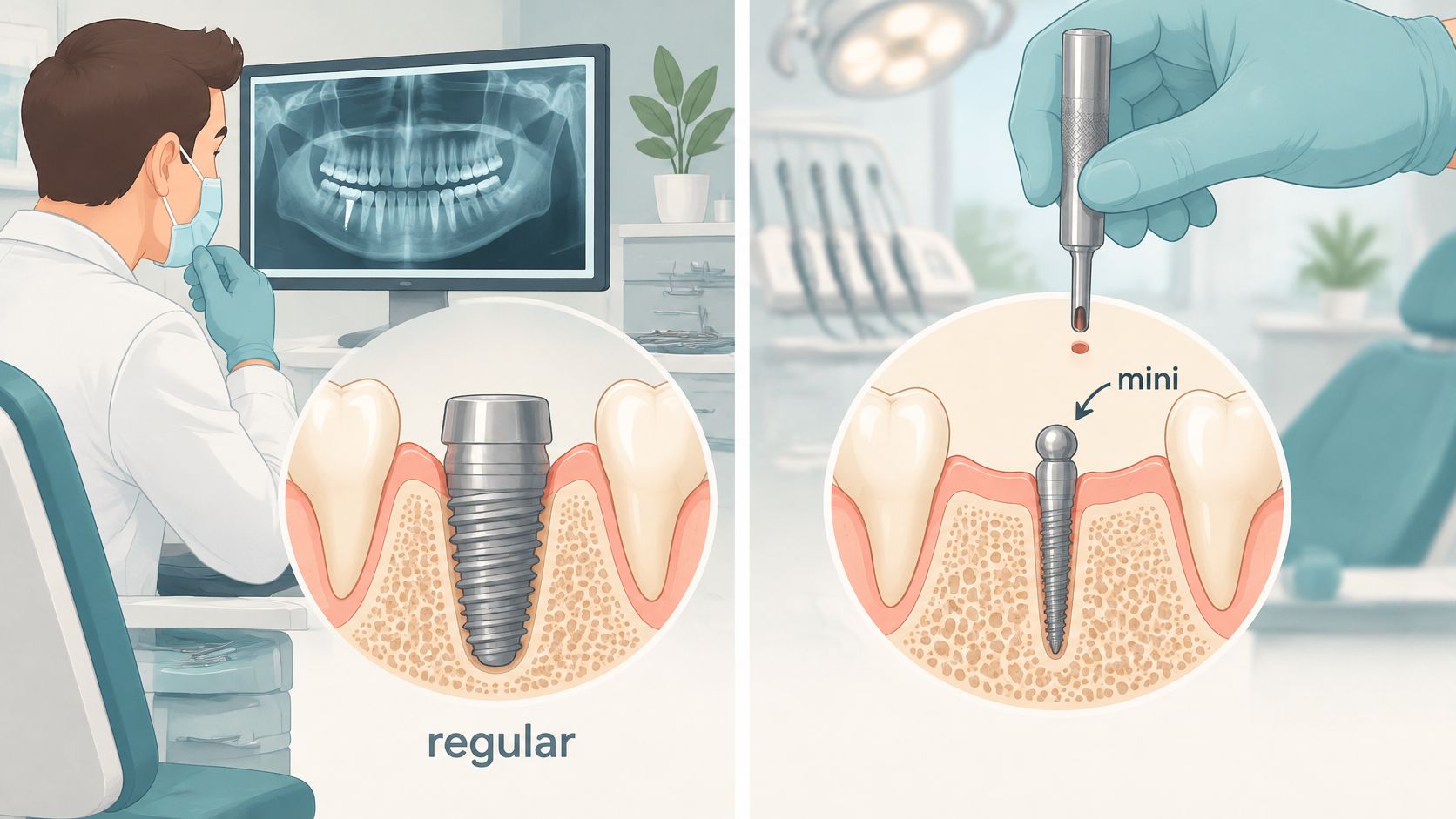
The four steps of a regular implant
- Consultation and imaging. A detailed examination and imaging assess jawbone density and structure, along with nerve position, sinus proximity and the health of neighboring teeth. A narrow ridge or an infection gets found before anyone picks up a drill.
- Surgical placement. The implant is placed into the jawbone as a replacement tooth root, under local anesthetic and, when it helps, with sedation.
- Healing. The implant fuses with the jawbone over a period that typically takes 3 to 6 months. Bone grows directly onto the titanium surface, and that bond is what lets the fixture carry load.
- Restoration. Once the bone has healed and the implant is bonded to it, a custom-made crown, bridge or denture is attached, using an abutment that sets the angle and height.
Where mini implant placement is different
A mini implant is usually placed as a single small fixture in a less extensive procedure. Because the post is narrow, it's often seated through a small pilot opening rather than a lifted flap of gum, and in some denture cases the retaining component can be attached sooner, sometimes the same day.
That speed isn't automatic. Whether a freshly placed implant can carry force depends on how firmly it seats, the quality of the bone and how the bite distributes load.
Timing is a clinical decision made at the chair, not a package feature. Ask what your specific bone and bite will allow.
The days after surgery
Patients often describe soreness and swelling that settle over the following days, and a smaller procedure usually means less of both, though that's an expectation rather than a promise. Soft food, gentle rinsing and leaving the site alone are the standard instructions for either design.
Call the office if pain worsens after the first few days rather than easing, if bleeding restarts heavily, if swelling keeps growing, or if numbness in the lip, chin or tongue outlasts the anesthetic. Those signals matter more than any timeline.
Ask Dr. Andrew Finley for a written sequence with your own dates on it, including when the temporary comes out and when the final restoration is expected.
Stability, Bite Force and Survival Data
Start with the numbers, because they're the part promotional summaries tend to leave out. The figures below come from a review comparing mini and standard implants for overdentures and a pooled analysis of overdenture outcomes in both jaws. Every one describes a study population, not a promise to an individual patient.
| Context | Reported survival | Context note |
|---|---|---|
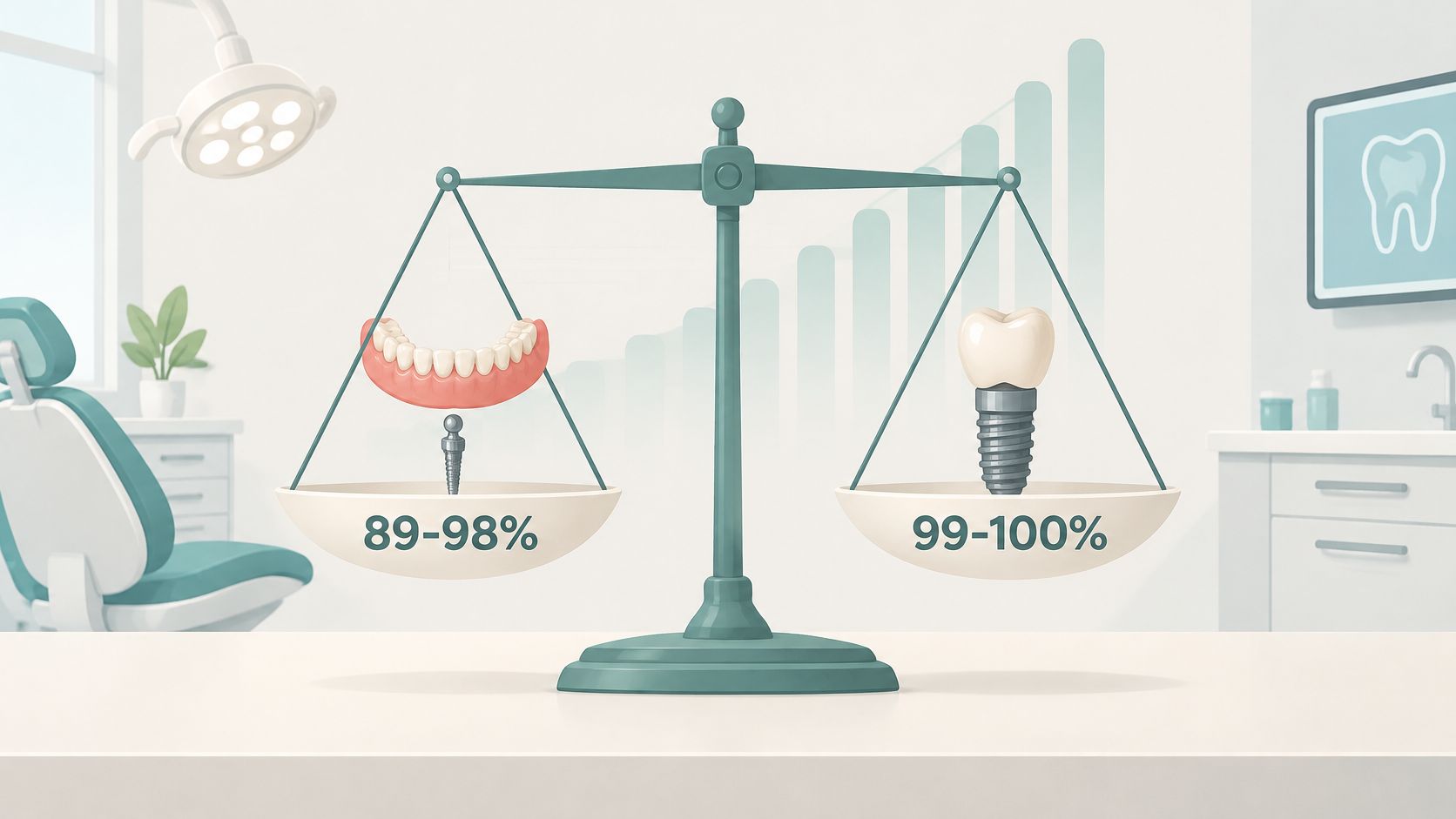
| Mini implants, lower overdentures | 89% to 98% in randomized trials | Versus 99% to 100% for standard implants |
| Mini implants, general reported range | 91% to 97% | Depends on location, loading, design and patient selection |
| Mini implants, upper overdentures | 77.1% (95% CI 64.7% to 89.5%) | Mean follow-up 1.79 years |
| Traditional implants, upper jaw | 98.1% | Figure cited in the relevant literature |
| Conventional implants, cumulative | About 95% | Reported across more than four decades |
| Narrow 3.3 to 3.5 mm implants | No significant difference (odds ratio 1.16) | 95% CI 0.70 to 1.69, meta-analysis |
The pooled mandibular review covered 24 studies, 1,273 patients, 2,494 mini implants and 386 standard implants, with an average patient age of 65.93 years, and reported mini-implant survival of 92.32% after roughly 30 months. That's an encouraging figure for a lower overdenture, in the right mouth.
Why the upper jaw numbers are lower
Upper-jaw bone is softer, less dense and closer to the sinus, and the biomechanics are more demanding: the same load lands on a less forgiving foundation. That's why the maxillary figures drop so sharply in the table, and why a clinician who is comfortable placing minis in a lower ridge may steer away from them under an upper denture.
A separate review of two conventional implants versus four mini implants illustrates the trade in architecture rather than materials. Four narrow fixtures spread retention across more contact points and can avoid substantial bone augmentation, while two wider fixtures use fewer posts with greater structural reserve and longer-established prosthetic components.
What bite force does to a narrow post
Narrow posts don't just offer less surface. They transmit about twice the load to the supporting bone, according to a mini-review of load transmission in mini implants, which makes control of occlusal loading, meaning how and where teeth meet during biting, unusually important.
That mechanics explains a set of findings from a systematic review and meta-analysis of overdenture maintenance. Compared with standard implants, mini implants were associated with fewer reported abutment adjustments (risk ratio 0.23), fewer replacements of retentive elements (risk ratio 0.41), fewer occlusal adjustments (risk ratio 0.53) and fewer overdenture fractures (risk ratio 0.46) in the analyzed studies. Those are relative findings in specific overdenture populations and don't generalize to single teeth or fixed full-arch work.
Immediate loading and bruxism add mechanical risk for small-diameter implants, so insertion torque, bone quality, occlusal design and hygiene access deserve to be assessed explicitly. The FDA's advice, echoed in that review, is to discuss potential benefits, risks and candidacy with a dental provider before choosing any implant.
Cost Factors Beyond the Implant Itself
The implant is one line item in a plan, and often not the largest. Judging two options by a per-implant number is like comparing cars by the price of one tire.
What shapes the total:
- How many fixtures are needed. A single tooth, a three-unit bridge and a full arch are three different projects with different component counts.
- Site preparation. A ridge that's too thin for a standard fixture may need grafting, and a graft adds a procedure plus months of healing before an implant can go in at all.
- The restoration on top. A single crown, a bridge and a denture with attachments are priced and maintained differently, and the attachment hardware inside a denture wears and gets replaced.
- The components. Abutments, healing caps, impression parts and the final crown or denture teeth all belong in the plan.
- What happens later. Adjustments, hygiene visits and repairs continue across the years.
A mini implant can reduce the need for grafting in a narrow ridge, which changes the shape of the whole plan rather than just one line of it. It can also loosen, fracture or lose bone later, and repairs, replacement or conversion to a different treatment add time and expense that a lower opening number doesn't show.
Compare complete plans, not labels. Ask what each option includes, what happens if a repair is needed, and which parts are likely to need replacing first.
Ask before you decide: which parts of this plan are permanent, which are expected to wear, and what does maintenance look like at year five?
Every patient at Bristol Dental & Orthodontics receives a personalized treatment estimate after consultation, itemized so the comparison is between complete plans rather than headline figures.
Expected Outcomes and What Happens if an Implant Fails
A good outcome looks unremarkable. The implant stays stable, the bite feels even, the gums stay quiet, and the crown or denture keeps doing its job. Results vary, and the honest version of this conversation includes the failure data.
Here's the number that should sit alongside every survival chart. A five-year study of maxillary mini implants supporting overdentures, described in a clinical review of mini dental implant complications, found an absolute implant failure rate of 22.5% and a cumulative failure rate of 23.2%, with prosthetic success of 80.0%. That is a substantially more cautionary picture than the high survival figures quoted in promotional summaries, and it belongs in the room.
Known complications in that same review include implant fracture during placement, screw loosening, prosthetic problems, peri-implant disease, progressive bone loss and sensory complications. The review also flags limited evidence on long-term survival.
Two groups deserve specific caution. Long-term mini-implant outcomes remain insufficiently studied in tobacco users and in people with metabolic conditions such as diabetes, which means the confidence interval around any recommendation for those patients is wider.
The pathway if an implant loosens or fractures
Failure isn't the end of the plan, but it isn't trivial either. A failed implant of any width leaves a defect that may need to heal or be grafted before another attempt.
- Assessment. Imaging identifies whether the implant is mobile, fractured or surrounded by bone loss, and whether infection is involved.
- Prosthesis repair. The crown or denture is adjusted or repaired so it doesn't load the compromised site.
- Removal. A fractured one-piece mini usually comes out entirely, whereas a two-piece system sometimes allows the connector to be replaced while the fixture stays put.
- Healing and re-planning. After the site heals, the options are another implant of the same design, a conventional implant, or a graft followed by a conventional implant.
Less invasive surgery means a lower surgical burden. It doesn't mean low risk and it doesn't mean maintenance-free. Anyone who tells you otherwise is selling something.
Confirm the Right Implant Type at Your Consultation
Use the situations below as a starting checklist rather than a diagnosis. Regular implants are generally the starting point for a single crown in a visible tooth with adequate bone, for bridges, for back teeth, and for heavy or uneven bites. Mini implants are worth discussing when ridge width blocks a standard fixture or when steadying a lower denture is the goal, alongside alternatives such as grafting and a conventional fixture.
Bring these questions written down:
- Which option fits my bone, my bite and the restoration I need, and why that one rather than the other?
- What happens if the implant loosens or fractures, and how is that handled in each design?
- What maintenance does this need, and how often?
- How is my bone density being measured, and what did the scan show?
- Would a graft and a standard implant be the stronger long-term choice for me?
Dr. Andrew Finley has advanced training in implants from the California Implant Institute and extensive training in implants and cosmetic dentistry, and he reviews every plan before treatment begins.
Bristol Dental & Orthodontics on South Bristol Street in Santa Ana provides dental implants for patients throughout Santa Ana and Orange County, within a practice that also covers cosmetic dentistry, orthodontics and sedation options, including nitrous oxide for adults and children. If you've been weighing mini implants vs regular implants, the next step is a conversation about your bone, your bite and what you want the implant to hold.
Bristol Dental & Orthodontics evaluates both mini and conventional implant options in one consultation, using imaging to measure the bone, the bite forces and the restoration each implant would carry, so the choice follows your anatomy instead of a marketing trend. Dr. Andrew Finley reviews every treatment plan personally and explains what maintenance and repair look like years down the road. Schedule a consultation at Bristol Dental and Orthodontics to find out which implant design fits your mouth.