
You've lost a tooth, searched “affordable dental implants near me,” and found several local offers that seem impossible to compare. One quote may mention an implant, another may describe a complete tooth, and a third may leave important steps for later. If you're in Santa Ana or nearby Orange County communities such as Costa Mesa, Tustin, Irvine, or Garden Grove, that uncertainty can make an important decision feel like a shopping exercise instead of healthcare.
Affordability deserves a broader definition. The lowest advertised number isn't always the lowest total cost if it excludes imaging, grafting, the abutment, crown, sedation, or follow-up care. A sound comparison looks at the complete treatment pathway, the quality of planning, and the care needed to protect the result over time.
This guide explains what dental implants are, why local estimates vary, how implants compare with dentures and mini-implants, and which questions can help you compare providers fairly. Bristol Dental & Orthodontics is a family and cosmetic dental practice in Santa Ana led by Dr. Andrew Finley. A consultation can help you understand whether an implant, bridge, denture, or another option fits your oral health, goals, and budget.
Table of Contents
- Introduction to Affordable Dental Implants Near You
- Understanding What Dental Implants Are and How They Work
- What Makes Dental Implant Costs Vary So Much Locally
- Comparing Implants With Dentures and Mini Implants
- Your Dental Implant Journey From Consultation to Final Smile
- How to Evaluate Affordable Providers Near Santa Ana
- Taking the Next Step With Bristol Dental & Orthodontics
Introduction to Affordable Dental Implants Near You
A Santa Ana patient might begin with a very practical question: “What will I pay to replace this tooth?” They may have seen a headline price online, called another office, and received a very different estimate. Both figures may be accurate for the services listed, yet neither may represent the same completed treatment.
That's why the phrase affordable dental implants near me needs careful interpretation. Affordability isn't only about the first number you see. It also includes whether the plan is designed properly, whether the components fit together as intended, how much additional treatment is needed, and what maintenance the restoration may require.
A useful rule: Compare complete treatment plans, not isolated line items.
Dental implants have become a mainstream restorative option through decades of clinical development. Per-Ingvar Brånemark discovered osseointegration in the 1950s, and the first human patient received osseointegrated dental implants in 1965, a milestone documented by the Foundation for Oral Rehabilitation's history of osseointegration. That history doesn't mean every case is identical or that treatment is guaranteed, but it helps explain why implant dentistry now follows more established protocols than it did in its early years.
A local consultation matters because the same missing tooth can require different planning for different patients. Bone volume, the location of the gap, the condition of neighboring teeth, bite forces, gum health, and the type of restoration all affect the recommended pathway. Dr. Finley can assess those factors and explain the choices in language you can use to make a considered decision.
The sections ahead focus on value rather than hype. You'll learn what belongs in an itemized estimate, which alternatives may be reasonable to discuss, and how to prepare for a conversation with Bristol Dental & Orthodontics.
Understanding What Dental Implants Are and How They Work
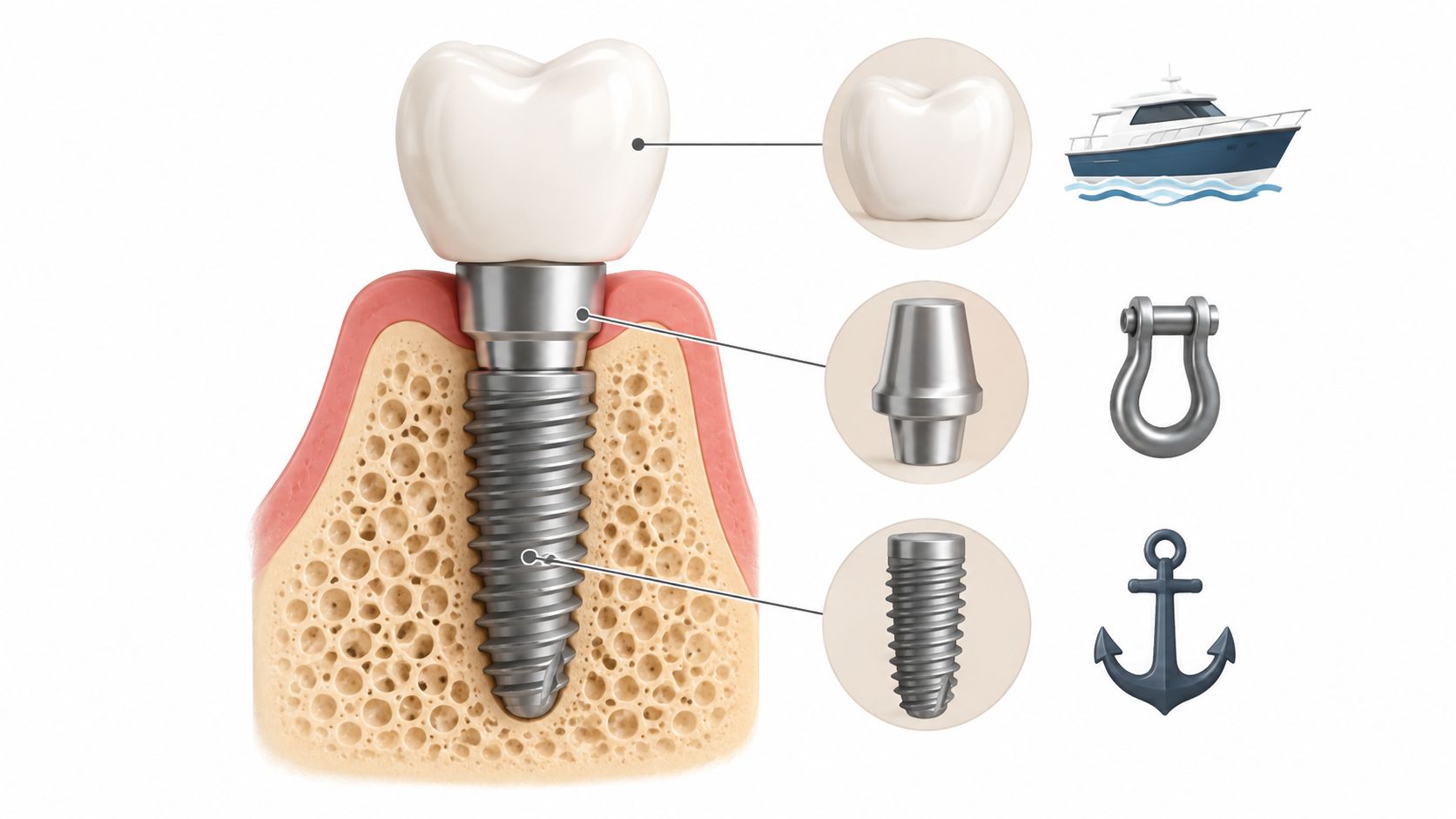
Think of a dental implant as an anchor system. The part below the gum acts like an artificial tooth root, the connector joins that anchor to the visible replacement tooth, and the restoration fills the space you see when you smile or chew.
The three main parts are:
- Implant post: A small component placed in the jawbone. Titanium remains the dominant implant material in contemporary practice because it can support the bone-to-implant integration that makes the system stable.
- Abutment: The connector attached to the implant post after the appropriate healing and planning stages.
- Crown or prosthesis: The visible replacement tooth, bridge, denture, or full-arch restoration supported by the implant system.
The biological process is called osseointegration. During healing, bone grows into close contact with the implant surface. That process provides the foundation for a restoration that is supported by the jaw rather than resting only on the gums.
Matching the implant design to the missing teeth
A single-tooth implant replaces one missing tooth without requiring a removable appliance. An implant-supported bridge can replace several neighboring teeth while using implants as support. A full-arch restoration uses multiple implants to support a broader set of replacement teeth.
The right design depends on the anatomy and the condition of the surrounding mouth. A dentist must consider the available bone, the bite, the position of the replacement teeth, cleaning access, and the way forces will reach the implant components.
Clinical literature reflects why planning and maintenance matter. A systematic review reported survival of single-crown implant restorations at 96.3% after five years and 89.4% after ten years, while another long-term review reported a 10-year implant-level survival estimate of 96.4%, with a confidence interval of 95.2% to 97.5%, in the review published through Wiley Online Library. These figures describe study populations and shouldn't be treated as a personal prediction.
The practical lesson is simple. An implant isn't just a screw placed in the jaw. It's a coordinated restorative system, and the post, abutment, crown, bite, and maintenance plan all contribute to its long-term value. Ask Dr. Finley which components are proposed for your case and why.
What Makes Dental Implant Costs Vary So Much Locally
Two people living near each other in Santa Ana may receive different dental implant estimates because their treatment needs differ. One person may need a straightforward single-tooth replacement. Another may need bone reconstruction, a different restoration design, or more appointments before the final tooth is placed.
The main cost drivers usually include:
- Surgical complexity: Placement can require more careful planning when the site is difficult to access or close to nearby anatomy.
- Bone availability: Limited bone volume may require grafting or staged treatment before implant placement.
- Prosthetic design: A single crown, implant-supported bridge, implant-supported denture, and full-arch restoration involve different materials and laboratory work.
- Diagnostic planning: Imaging and treatment planning help the provider assess the site and coordinate the restoration.
- Sedation and comfort care: If sedation is recommended or chosen, it may appear as a separate charge.
- Follow-up care: Healing checks, adjustments, temporary restorations, and maintenance should be identified in the written estimate.
Read the estimate as a treatment map
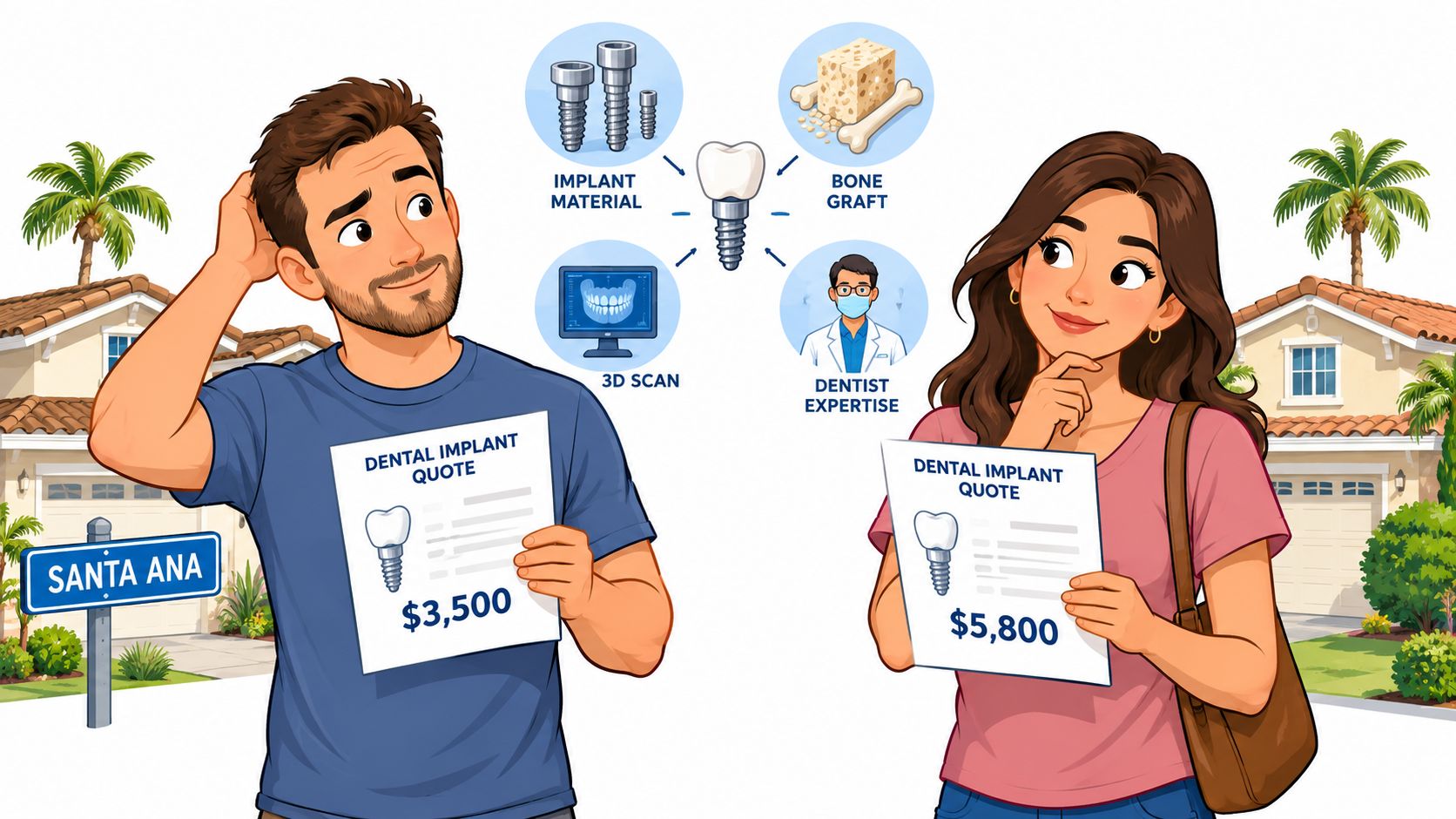
A low advertised figure may cover only the implant post. Another office may provide a broader estimate that includes the post, abutment, crown, imaging, and planned follow-up. Comparing those figures directly can mislead you until you know what each one covers.
Research on dental implant economics identifies implant type, surgical complexity, and geography as factors that can affect costs, as discussed in research on dental implant economics and insurance coverage. A cost-conscious plan aims to avoid unnecessary procedures while still providing the support needed for the planned restoration. A lower total does not justify skipping treatment that your oral health requires. Your provider should explain the purpose of each step and what could happen if it is omitted.
Request these details in writing:
- Which parts are included, such as the post, abutment, crown, temporary tooth, and laboratory work?
- Are imaging and treatment planning included?
- Is bone grafting or a sinus-related procedure anticipated?
- Are sedation and follow-up visits billed separately?
- What could change the estimate after treatment begins?
- Does the plan explain maintenance after the restoration is delivered?
Affordable care is easier to judge when estimates describe the same treatment components. Choose the provider who explains the plan clearly, not the one showing the lowest headline price.
Comparing Implants With Dentures and Mini Implants
A missing tooth can be replaced in several ways. Conventional dentures, implant-supported dentures, bridges, standard dental implants, and mini-implants each suit different anatomy, health needs, comfort preferences, and budgets. The affordable choice is the one that provides appropriate function and care over time, not automatically the option with the smallest first payment.
A conventional denture is removable and can replace several teeth or a full arch. It rests on the gums, so it may move while you speak or chew. An implant-supported denture remains removable in many designs but uses implants to improve retention. That can change the balance between stability, cleaning, appointments, and total cost.
Mini-implants are narrower than conventional implants and may suit selected situations. They are not interchangeable with standard implants in every case. Available bone, chewing forces, the proposed restoration, and the clinician's assessment all affect suitability.
| Option | Best For | Stability and Feel | Maintenance Considerations |
|---|---|---|---|
| Traditional dental implant | Replacing a single tooth or supporting a bridge | Designed to provide fixed support through bone integration | Requires daily home care and professional monitoring |
| Mini-implant | Selected cases where a narrower implant may be appropriate | Can offer support in specific restorative designs, but suitability varies | Cleaning access and component care must be discussed |
| Conventional denture | Patients seeking a removable replacement for several or all teeth | Rests on the gums and may move during function | Must be removed and cleaned as directed, with periodic evaluation |
| Implant-supported denture | Patients seeking more support than a conventional denture provides | Uses implants to improve retention and reduce movement | Requires care around implant attachments and regular maintenance |
Look beyond the first payment
Implants have strong durability benchmarks, but their long-term value depends on planning, component fit, oral hygiene, bite management, and follow-up care. A systematic review of implant restoration survival helps explain why a lower starting price does not automatically make an option more affordable over time.
A cheaper plan may lose its advantage if components are poorly matched, prosthetic planning is limited, or maintenance is unclear. A removable option may be a sound choice when it fits your health, preferences, and financial limits. The comparison should work like an apples-to-apples quote: review the treatment included, not just the headline figure.
Ask Dr. Finley:
- Can you eat the foods you want with the proposed option?
- How will the replacement stay in place while speaking?
- Can you clean around it easily?
- Will neighboring teeth need preparation?
- What future adjustments or replacements could be part of ownership?
- Does the option preserve flexibility if your needs change?
The aim is a design that balances function, health, comfort, maintenance, and total value for your situation. A clear explanation of those trade-offs is more useful than a promise of the lowest price.
Your Dental Implant Journey From Consultation to Final Smile
If you are comparing affordable dental implants near you, the first appointment should feel like the start of a plan, not a sales pitch. The process includes several decisions, and each one affects the treatment scope, timeline, and total value. A clear plan helps you compare quotes on equal terms.
The evaluation and planning phase
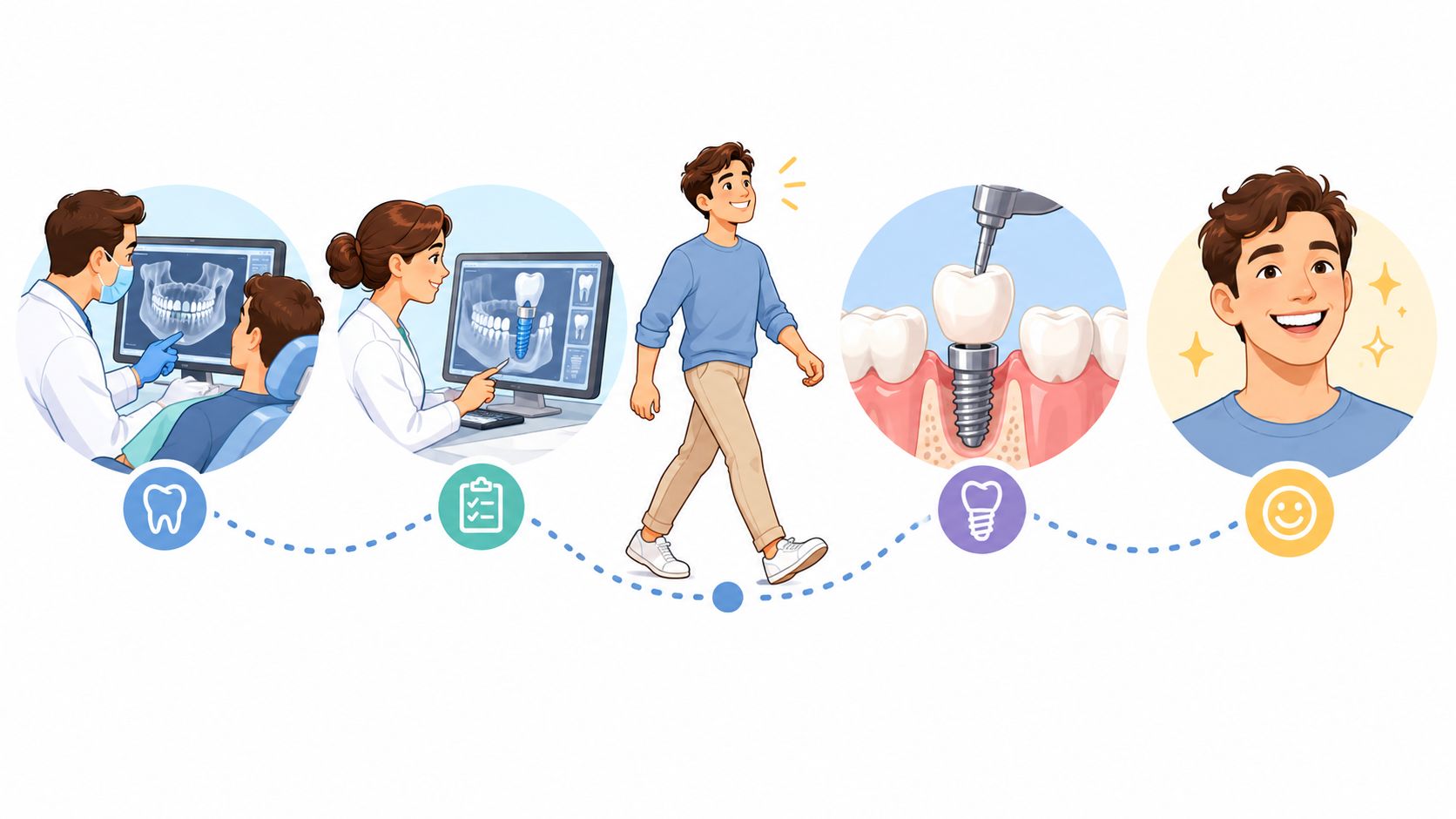
At the consultation, the dentist reviews your medical and dental history, examines the missing-tooth area, and uses appropriate imaging to assess bone and nearby structures. You can also discuss your goals, bite, neighboring teeth, and whether an implant-supported bridge or another design suits your situation.
Bone availability can affect the materials, appointments, and order of treatment. If the site needs more support, grafting or staged placement may be considered. These steps can change the total estimate, so they should appear clearly in the treatment plan rather than emerge as unexpected additions later.
Placement, healing, and restoration
During placement, the implant post is positioned in the planned site. Healing then allows the implant to bond with the surrounding bone. The timeline differs between patients because bone quality, surgical approach, restoration design, and preparatory care are not the same.
After the dentist confirms that the site is ready, the abutment and final restoration are designed and fitted. The team checks the bite, appearance, contact with neighboring teeth, and access for cleaning. Follow-up visits help monitor healing and address fit or comfort concerns.
Use these questions at your consultation:
- Which treatment choices are reasonable for this missing tooth?
- Which steps and components are included in the estimate?
- What preparatory treatment might be needed?
- What will I wear or use while the site heals?
- How will the final crown or prosthesis be designed?
- What daily care and follow-up will help protect it?
Bristol Dental & Orthodontics can explain your possible pathway, but an examination is needed to determine whether implant treatment is appropriate. A written, itemized plan makes it easier to compare the full treatment value, not just the lowest starting price.
How to Evaluate Affordable Providers Near Santa Ana
A good local search includes more than typing a phrase into a map. Whether you're comparing practices in Santa Ana, Costa Mesa, Tustin, Irvine, or Garden Grove, evaluate the treatment plan and the communication around it.
Start by asking for an itemized estimate. Independent guidance on implant insurance coverage and common billing components notes that charges may be separated into the implant post, abutment, crown, and related care. Insurance may cover only part of treatment or exclude implants, and annual benefit limits can be much lower than the cost of a complete restoration.
Questions that reveal the real scope
Use this checklist during a consultation:
- Included components: Does the quote include the post, abutment, crown, temporary tooth, and laboratory work?
- Imaging: Is the scan included, or is it billed separately?
- Preparatory care: Are grafting, sinus lifts, extractions, or treatment for gum disease included if needed?
- Sedation: Is sedation available, and does it carry a separate charge?
- Follow-up: How many healing checks and adjustment visits are included?
- Possible changes: What findings could alter the plan or estimate?
- Insurance details: Which portions may be eligible for benefits, and what annual limits or exclusions should you verify?
- Payment arrangements: Are financing options available, and what terms, approval requirements, or fees apply?
Recent guidance also emphasizes asking about scans, grafting, sedation, laboratory work, and follow-up because these items can materially change the completed treatment cost. The independent discussion of finding lower-cost implant treatment makes the same practical point: the cheapest advertised offer may not be the cheapest finished treatment.
Notice how the practice communicates
A provider should explain why a procedure is recommended, not only place it on an estimate. You should feel comfortable asking what happens if bone support is limited, how the final restoration will be maintained, and which alternatives could meet your needs.
Bristol Dental & Orthodontics provides dental implant consultations alongside family, cosmetic, orthodontic, sleep apnea, sedation, and emergency dental care in Santa Ana. Patients can bring their itemized questions to a consultation with Dr. Andrew Finley and discuss whether the proposed pathway fits their situation.
Taking the Next Step With Bristol Dental & Orthodontics
Searching for affordable dental implants near me becomes more manageable when you separate the decision into clear questions. First, understand the implant system and the role of osseointegration. Then identify the factors that shape the treatment pathway, compare implants with removable and other supported options, and review estimates line by line.
The final decision should be personal. A single missing tooth, several missing teeth, and a full-arch concern can require very different designs. Bone availability, gum health, bite forces, medical history, cleaning habits, appearance goals, and budget all belong in the conversation. No online article can determine candidacy or promise how your treatment will proceed.
Bristol Dental & Orthodontics is located on South Bristol Street and serves patients in Santa Ana and surrounding Orange County communities. The practice offers patient-focused care for dental implants and related needs, and each treatment plan is reviewed by Dr. Andrew Finley. You can also discuss alternatives such as implant-supported bridges, implant-supported dentures, Invisalign, cosmetic dentistry, sleep apnea and oral appliance therapy, or emergency dental care when those concerns overlap with your restorative needs.
Schedule a consultation with a written list of questions and ask for a complete estimate. A calm, transparent conversation can help you choose based on total value instead of a headline number.
Bristol Dental & Orthodontics offers dental implant consultations, restorative options, and coordinated family and cosmetic dental care for Santa Ana patients. Visit Bristol Dental and Orthodontics to learn more and request a consultation with Dr. Andrew Finley about your missing-tooth treatment options.