
You've been thinking about your smile for a while. Maybe it's a chipped front tooth you've learned to photograph around, or color that whitening toothpaste never touched, or a gap you notice on every video call. So you searched for cosmetic dentistry cost and got back numbers that ranged from a nice dinner to a used car.
That spread isn't the internet being careless. It's what happens when a fee for one tooth gets published next to a fee for an entire smile, with nothing in between to explain the distance.
In a dental office, the number comes last. First comes the problem, then the plan, then the cost of that plan. Reading a price list backwards, from sticker to smile, is how people end up surprised by a bill that doesn't match the website.
Table of Contents
- Why Cosmetic Dentistry Cost Is Never One Number
- What Changes the Cost of Each Cosmetic Treatment
- What a Written Estimate Is Built From
- How Coverage and Timing Change the Amount You Pay
- Santa Ana Cases That Look Similar but Are Not
- When Urgent Dental Problems Come Before Cosmetics
- Book a Consultation to Price Your Own Plan
Why Cosmetic Dentistry Cost Is Never One Number
Two neighbors on the same street in Santa Ana can want the identical thing, a brighter smile before a family wedding, and leave two offices with two different plans. One hears that her gums are healthy and her enamel is intact, and that a round of professional whitening will handle the staining. The other has crowding on the lower arch and a front tooth that's already been rebuilt twice. Her plan starts with alignment and only then decides how to restore that tooth once it sits in the right position.
Neither plan is wrong. They answer different questions.
That variation isn't hypothetical. A 2024 field study sent one standardized patient with a cosmetic complaint to 47 general dentists and collected what each one recommended. The proposals ranged from a single composite veneer to 10 ceramic laminates or orthodontics, and many plans didn't match a standard plan at all (field study on cosmetic treatment plan variation). One person, one goal, forty-seven professional judgments about how to reach it.
So the useful question isn't what veneers cost. It's what the least invasive, durable option is for your particular problem, and why one dentist proposes more treatment than another.
Dental care is also funded differently from most medical care. Out-of-pocket payments represented 45.1% of dental spending in 2013, far above the patient-payment share typical of medical care, and dental spending rose about 4% after inflation from 2023 to 2024 while out-of-pocket spending grew 3.3% across the same period (American Dental Association Health Policy Institute). A cosmetic plan lands on a household budget, not on an insurer's ledger.
Separate three things before you compare any advertised fee. The wish is what you want to see in the mirror. The diagnosis is what's actually happening in your mouth. The payment path is who pays, when, and in what order.
Hold those three apart and the numbers start making sense. Mix them together and every quote looks arbitrary.
What Changes the Cost of Each Cosmetic Treatment
Comparison only works once you know which category of work your problem belongs to. Treat the table below as a scope map. It shows what makes a case grow, before any exam and before any fee. Nothing in it is a quote, and nothing in it guarantees a treatment fits you.
| Treatment | What usually drives the fee | Relative case size |
|---|---|---|
| Professional whitening | Stain type and number of visits, no tooth reshaping | Smallest |
| Bonding | Teeth treated, size of chips or gaps, shade match | Small to moderate |
| Porcelain veneers | Number of teeth, lab work, temporaries, bite checks | Moderate to large |
| Crowns or bridges | Damage, materials, number of units | Moderate to large |
| Invisalign or braces | Complexity, monitoring, refinements, retainers | Moderate |
| Single implant restoration | Imaging, placement, healing, abutment, crown, possible grafting | Large |
| Implant bridge or implant denture | Number of implants and attachment design | Larger |
| Full-arch implant restoration | Bone, provisional teeth, final prosthesis, timeline | Largest |
| Custom sleep oral appliance | Physician diagnosis, custom fabrication, adjustments, follow-up | Its own path |
"Relative case size" means the number of moving parts, not a ranking of importance. Whitening has almost none: it removes stains and discoloration without altering tooth structure. A full-arch reconstruction has dozens, spread across surgery, healing, provisional teeth, and a final prosthesis.
Where scope accumulates quietly
Two things multiply faster than patients expect. The first is how many teeth enter the plan. Whitening covers the whole mouth in one pass, while bonding and veneers are priced and built tooth by tooth, so a six-tooth smile zone is six small projects wearing one name.
The second is laboratory and clinical time. Veneers involve minimal alteration of natural teeth when that approach is appropriate, but the fee reflects smile design, preparation, temporaries, lab fabrication, try-in, bonding under isolation, and bite verification. In a 2017 survey of cosmetic-dentistry practices, average prices for most individual procedures were broadly similar to 2015, while veneer and inlay/onlay costs each increased by more than 10% (2017 State of the Cosmetic Dentistry Industry Report). Materials and lab time move; the procedure name alone doesn't explain a total.
Treatments that carry their own sequence
An implant is the clearest example of a label hiding a project. The implant itself is one component of a multi-stage restoration that may also involve examination and imaging, an extraction when a tooth can't be saved, bone or gum procedures when findings call for them, placement, healing and follow-up, an abutment, and the final crown, bridge, or denture. A single implant restoration is priced as one case with several parts, and an implant bridge or full-arch case multiplies those parts again.
A custom appliance for obstructive sleep apnea belongs in a different column entirely. It isn't cosmetic dentistry and it isn't a drugstore mouthguard. It's a prescription device with its own clinical pathway, which is why it doesn't sit on the same scale as a whitening visit.
What a Written Estimate Is Built From
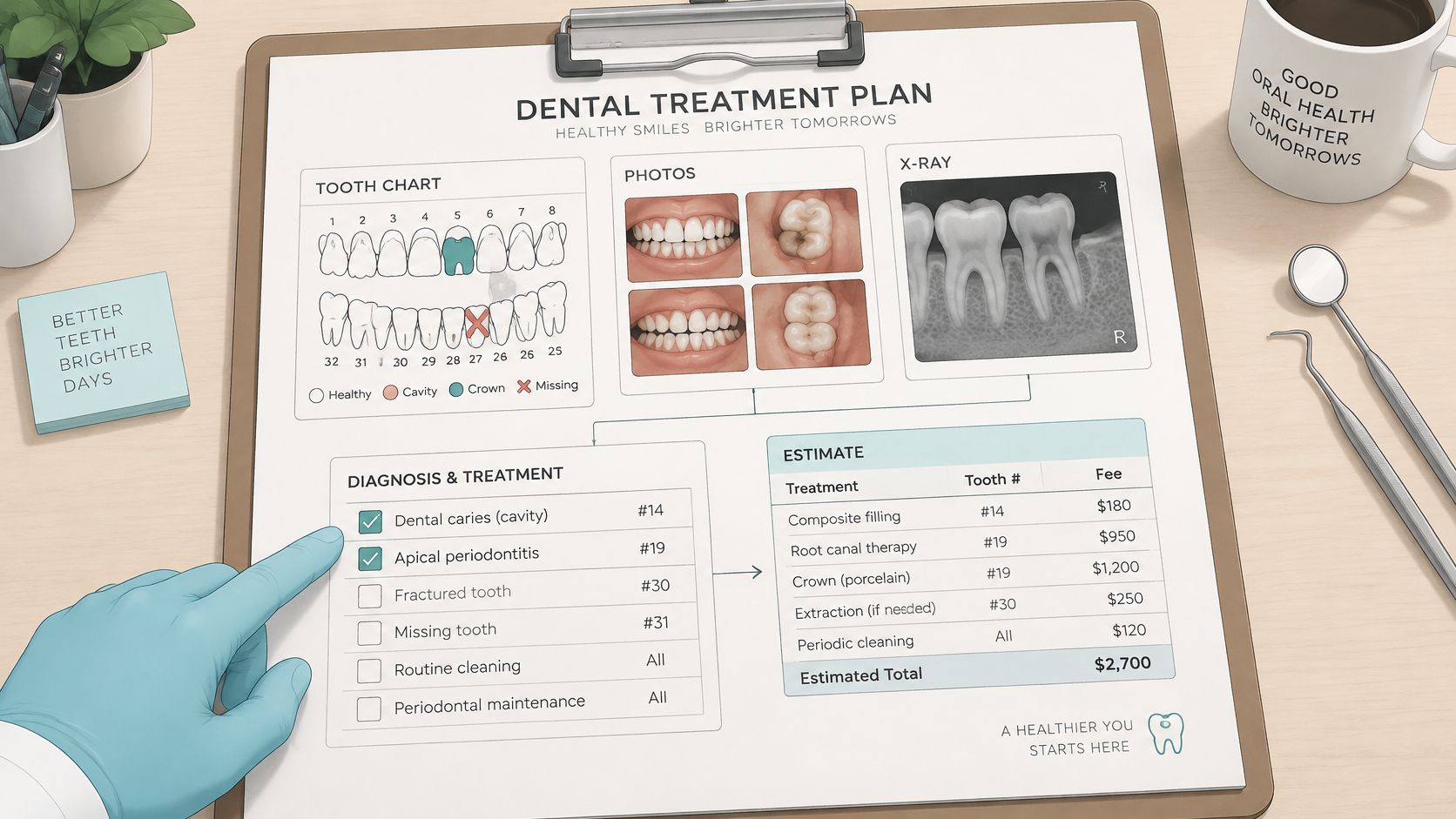
A written estimate is a parts list. It reads like a contractor's quote because it is one: materials, labor, and stages, priced for a specific address. The distance between a quote for paint and a quote for rebuilding a wall is the same distance between whitening and a full veneer case. Same room. Different work.
That parts list looks like this on paper when it's done properly.
Records and diagnosis come first
Every plan starts with information, not with a procedure. That means an exam, photographs, and imaging when roots, bone, or the bite have to be seen. The diagnosis is where surprises live: a cavity under an old filling, gum inflammation, a cracked tooth, a bite that overloads the front teeth. Any of those can require treatment before elective work, because bonding a chip onto an inflamed gum or covering a cracked tooth with porcelain doesn't solve the problem underneath.
This is the part patients skip when they price a case from a website. A plan built on a photograph of your smile is a guess. A plan built on records is an estimate.
The steps inside each treatment, in order
For veneers, a typical sequence runs through smile planning, a decision about how much natural tooth is altered, temporary restorations, laboratory fabrication, a try-in, bonding under isolation, and a bite check. For clear aligners, the list includes diagnostic records, a staged movement plan, a series of trays worn as instructed, progress visits, possible refinements when teeth don't track as planned, and retainers at the end, because teeth shift after active movement stops. Skip the retainer phase and the movement you paid for partially reverses.
An implant splits into three separate parts: the fixture placed in the jaw, the connector, and the visible tooth. An extraction or a bone or gum procedure is added only when the clinical findings support it, which is why two people missing the same tooth can receive different plans.
At Bristol Dental & Orthodontics, every patient receives a personalized treatment estimate after consultation. Dr. Finley works closely with each cosmetic patient to develop a treatment plan that meets that patient's specific cosmetic goals, and he plans the final restoration to match the neighboring teeth in color and shape. That match is a goal built into the plan, not a promised outcome.
Read the exclusions before the total. An estimate that doesn't say what happens if the exam finds decay is only half an estimate.
Ask which stages are required, which are optional, and what would change the plan if the exam turns up something new. A practice that can answer all three has thought about your case. A practice that can't has quoted a category.
How Coverage and Timing Change the Amount You Pay
The procedure list answers what the work is. This question is different: what does your household pay, and over how long? Coverage and calendar shape that answer as much as the clinical plan does.
The CareQuest Institute's 2025 State of Oral Health Equity in America survey found that 26% of adults, roughly 69 million people, lack dental coverage, and 39% report either delaying treatment until insurance benefits renew or paying full price after reaching a maximum benefit. The same survey reported that dental-care increases negatively affected the budgets of 27% of respondents who experienced rising out-of-pocket or premium costs.
The mechanic behind those numbers is simple and rarely explained. Plans commonly treat work done only for appearance as elective and outside coverage, though where each plan draws that line varies. The medically necessary portion of the same plan, such as treating decay or replacing a broken tooth, may be reviewed on different terms. Annual maximums, deductibles, and coinsurance can push a large case across two benefit years, which is why phasing exists and why phasing has clinical limits.
Plan the year, not the visit. If a case spans two benefit years, decide which stage belongs in each year before anything is scheduled.
| Situation | How benefits often behave | Household planning point |
|---|---|---|
| Whitening only | Usually elective and patient-paid | Often one short stage |
| Bonding a few teeth | Often elective unless it repairs breakage | Can sometimes be staged tooth by tooth |
| Veneers across the smile | Commonly excluded as cosmetic | Phasing still needs a matched shade and bite |
| Aligners plus whitening | Orthodontic benefits may be capped and separate from whitening | Movement, retention, then color are different phases |
| Implant plus a cosmetic finish | Restorative portions may be reviewed apart from elective veneers | Healing spreads the timeline |
| Custom sleep appliance | Needs a physician diagnosis first | Evaluation, device, adjustments, and follow-up are separate |
| Choosing to wait | Reasonable for elective color changes | Infection, pain, or a failing tooth should not wait on a new benefit year |
Waiting deserves its own note, because not all delays are equal. Postponing whitening until next year costs you a shade. Postponing an infected tooth until a benefit renews costs you tooth structure. One delay is a preference, the other is a clinical risk, and the table is only honest if you read it that way.
Financing changes the timing question, not the clinical one. Read the estimate and the financing terms side by side, because spreading payments can raise the total paid over time compared with paying a case fee at once. At Bristol Dental & Orthodontics, Invisalign financing is available through CareCredit, Sunbit, and Cherry, with pre-approval in minutes and no impact to your credit, and the practice also offers customized monthly payment options directly. Most PPO dental insurance plans the office works with typically cover $1,000 to $3,000 of orthodontic treatment toward Invisalign. Whatever the route, ask what happens if treatment stops midway, and ask it before the first appointment rather than after the third.
Bring your benefit summary to a consultation and ask which lines are elective and which are reviewed as restorative.
Santa Ana Cases That Look Similar but Are Not
Four people, four goals that sound alike on paper, four different sequences. The differences are what a fee is really measuring.
A patient from Costa Mesa wants a brighter smile. Her gums are healthy, her enamel is intact, and the staining is superficial. Her case stays small: a whitening plan and a conversation about what caused the staining so it doesn't return in six months.
A patient from Tustin chips one front tooth on a cracker. Bonding repairs chips, cracks, and minor gaps by applying a tooth-colored resin that is shaped and polished to blend with the natural teeth. One tooth, one visit, no coverage of the whole smile. The skill is in the shade match and the edge contour, not in the amount of material.
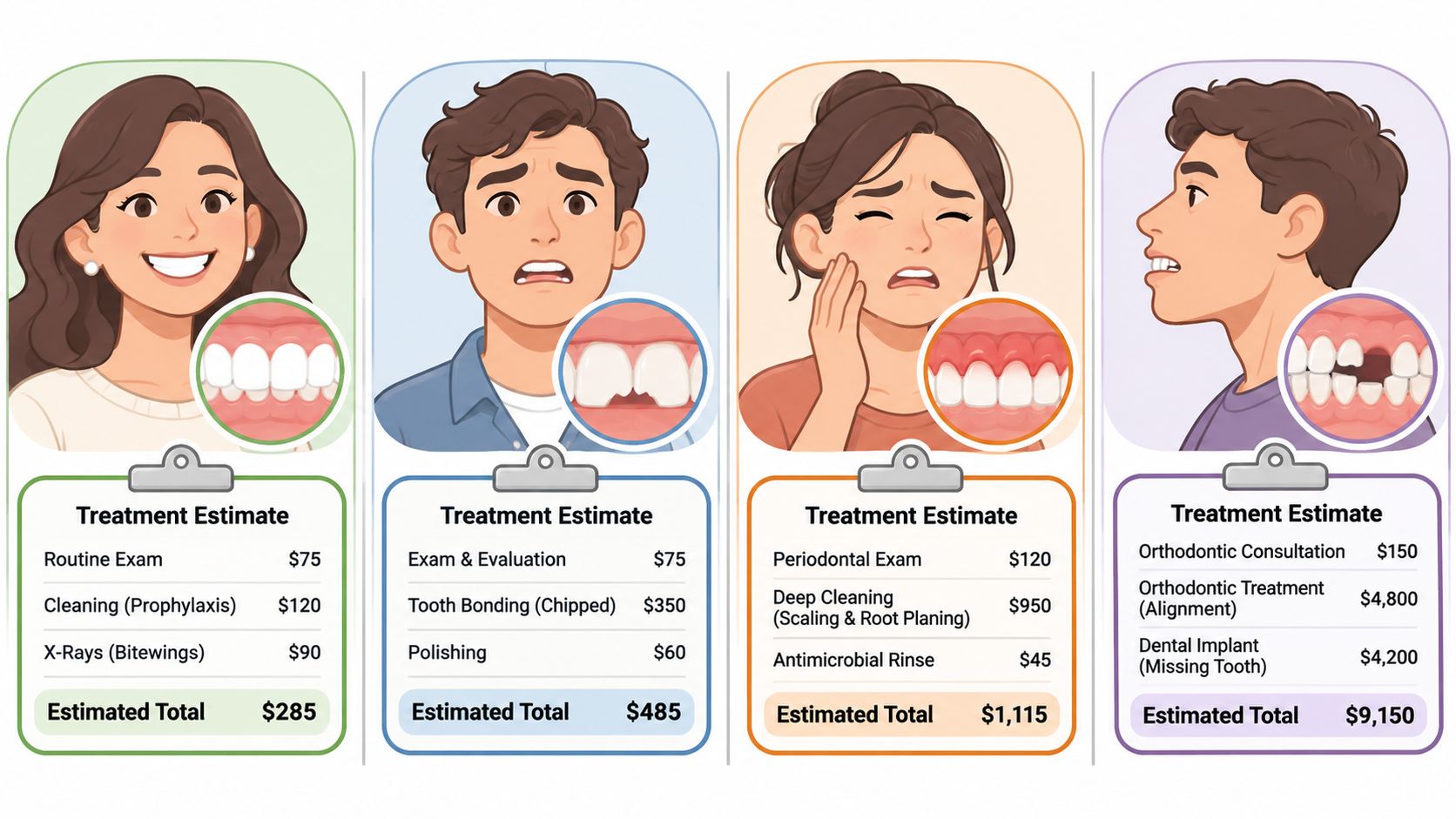
An Irvine patient wants straight, white teeth and has visible crowding. Alignment comes first, with monitoring and a retainer at the end, and whitening waits until movement is complete so the color lands evenly across teeth that have finished moving. Doing it the other way around means whitening teeth that are about to shift into new positions.
A Garden Grove patient lost a back tooth and also dislikes the color of the front teeth. The missing tooth may need an implant pathway, while veneers are a separate elective decision, and neither should be planned before decay and gum health are addressed. Two problems, two clocks.
Then there's the Santa Ana adult who snores and was told by a partner that breathing stops at night. That isn't a cosmetic case at all. The FDA describes mandibular-advancement appliances as prescription, custom-fabricated, reusable devices intended for use during sleep. They work by positioning the lower jaw forward, which can increase space in the throat and improve airflow, and they're intended for patients who have first received a physician's diagnosis of obstructive sleep apnea (FDA clearance record for a mandibular advancement appliance). The same documentation notes that no method predicts with certainty which patients will respond, which is why evaluation, fitting, adjustment, and follow-up are separate parts of care.
A store-bought guard and a prescription appliance are not the same product. One protects teeth from grinding. The other is a medical device made for your jaw from a physician's diagnosis.
Dr. Finley has to examine each person before any of this becomes a plan. These sketches illustrate sequencing only. They aren't diagnoses, timelines, or promises about how treatment will look or feel.
When Urgent Dental Problems Come Before Cosmetics
Some visits aren't about appearance at all, and pretending otherwise wastes time and money. Emergency dentistry covers issues such as toothaches, broken teeth, and other urgent problems, and those come first.
NHS guidance separates two kinds of urgency, and the split is useful. It identifies severe tooth or mouth pain that affects sleep or daily activities and isn't relieved by common painkillers as a reason to seek an urgent dental appointment. The same guidance lists knocked-out teeth, significant dental injury, persistent swelling or a growing mouth lump, uncontrolled bleeding after an extraction, and broken or loose crowns, bridges, fillings, dentures, or veneers among the situations needing urgent dental advice (NHS guidance on urgent dental care).
Call our Santa Ana office promptly for severe pain that disturbs sleep, a knocked-out or injured tooth, swelling that persists, bleeding that continues after an extraction, or a broken or loose crown, bridge, filling, denture, or veneer.
Call emergency services for serious facial or jaw injury, heavy bleeding that won't stop, or swelling of the mouth, lips, throat, or neck with trouble breathing or an eye that won't open.
The distinction matters for cost because the first visit has a different job. It stabilizes the mouth: controlling pain, managing infection, stopping bleeding, protecting a damaged tooth. A replacement veneer, a new crown, or implant planning is discussed once the mouth is stable, so the urgent visit and the definitive cosmetic or restorative work are separate stages. They may land on different days and arrive as different estimates.
Don't book a cosmetic consultation while you're swollen or bleeding. Stabilize first. The smile plan will still be there next week.
Patients in Santa Ana, Costa Mesa, Tustin, Irvine, and Garden Grove can reach out for guidance on toothaches, broken teeth, and similar problems. Dr. Andrew Finley decides what's needed case by case; this is general information, not individual advice.
Book a Consultation to Price Your Own Plan
Your mouth, examined in person, is the only source of a real plan. Everything above is a map of the terrain. The route is yours.
Dr. Finley offers a blend of cosmetic and general dentistry, with extensive training in implants and cosmetic dentistry. He works closely with each cosmetic patient to develop a treatment plan that meets that patient's specific cosmetic goals, and he makes sure the final restoration matches your natural teeth in color and shape. Bring three things: a list of what bothers you, photos of the look you're drawn to, and any benefit summary you'd like explained in plain terms.
Come with questions that move the conversation forward. Ask which problem should be treated first and why that one, how many teeth would change and whether fewer could reach the goal, and whether bonding, an aligner, a veneer, or an implant is the least invasive answer for your case. Ask what healing, maintenance, or retention follows the treatment, and which parts of the plan are elective or could grow or shrink once imaging is reviewed. If other concerns sit on your list, raise them in the same visit so the plan accounts for everything at once.
Expect a personalized estimate once the findings are clear, shaped by your imaging, your goals, and your coverage rather than a national chart.
Bristol Dental & Orthodontics is a family and cosmetic dental practice in Santa Ana, led by Dr. Andrew Finley, caring for patients across Costa Mesa, Tustin, Irvine, and Garden Grove. If you're weighing several ways to reach the same smile goal, a consultation is where the wish, the diagnosis, and the payment path finally get sorted into one plan. Visit Bristol Dental and Orthodontics to schedule your visit and talk through your specific case with Dr. Finley.