

If two dental offices quote a filling, are they quoting the same treatment, or just using the same name? A filling fee might cover the restoration alone, while the complete visit includes an examination, X-rays, or other care. Insurance can introduce another difference between the quoted fee and what you owe.
When you ask, “How much are fillings?”, the useful answer starts with the tooth, the material, and the work involved. For families in Santa Ana, comparing those details is more helpful than choosing the lowest headline figure. A written estimate should let you see both the proposed treatment and your expected share.
Table of Contents
- Filling Cost Tiers by Material at a Glance
- What Changes the Price of a Filling
- How Insurance Changes Your Share
- What to Ask for in a Written Estimate
- Paying for Care When Your Budget Is Tight
- Filling Costs Across Santa Ana and Orange County
- Confirm Your Filling Estimate with Dr. Finley
Filling Cost Tiers by Material at a Glance
How much are fillings? The material helps shape the fee, but each option has a different role. These relative tiers show how common filling materials compare; they are not a price schedule.
| Material | Relative cost tier | Appearance | Typical longevity | Common placement |
|---|---|---|---|---|
| Amalgam (silver) | Lower to moderate | Silver-colored | Long track record; service life reflects wear | Back teeth under heavy chewing |
| Composite resin | Higher than amalgam | Tooth-colored | Service life reflects restoration size and wear | Visible teeth and selected back teeth |
| Glass ionomer | Lower to moderate | Tooth-colored | Shorter-term than many options | Small, low-stress areas |
| Gold (lab-made inlay) | Highest tier | Gold-colored | Very long-lasting | Large back-tooth restorations |
| Porcelain ceramic (lab-made inlay) | Highest tier | Tooth-colored | Long-lasting; affected by bite and wear | Large restorations where appearance matters |
Amalgam has a long clinical track record and is commonly used on back teeth that handle substantial chewing pressure. Its silver color may be noticeable when you smile.
Composite resin blends with natural teeth and generally costs more than amalgam. A tooth's chewing load and the amount of healthy structure remaining also help determine whether it fits the case.
Small fillings and lab-made restorations serve different needs
Glass ionomer suits small, low-stress areas. It wears faster than composite, so it is a poor choice for a molar that takes heavy bite force.
Gold and porcelain ceramic inlays are made in a lab rather than placed directly into a cavity. Gold offers durability, while porcelain provides a tooth-colored appearance. Their fabrication helps explain their higher cost tier.
The National Institute of Dental and Craniofacial Research's overview of dental fillings explains that fillings replace damaged tooth tissue with restorative material, and identifies composite and amalgam as common options. Fillings don't last forever, so ask what the quoted fee covers and whether it includes any planned follow-up care.
Think beyond the first visit: The material's suitability and future maintenance belong in your comparison of the complete treatment cost.
What Changes the Price of a Filling
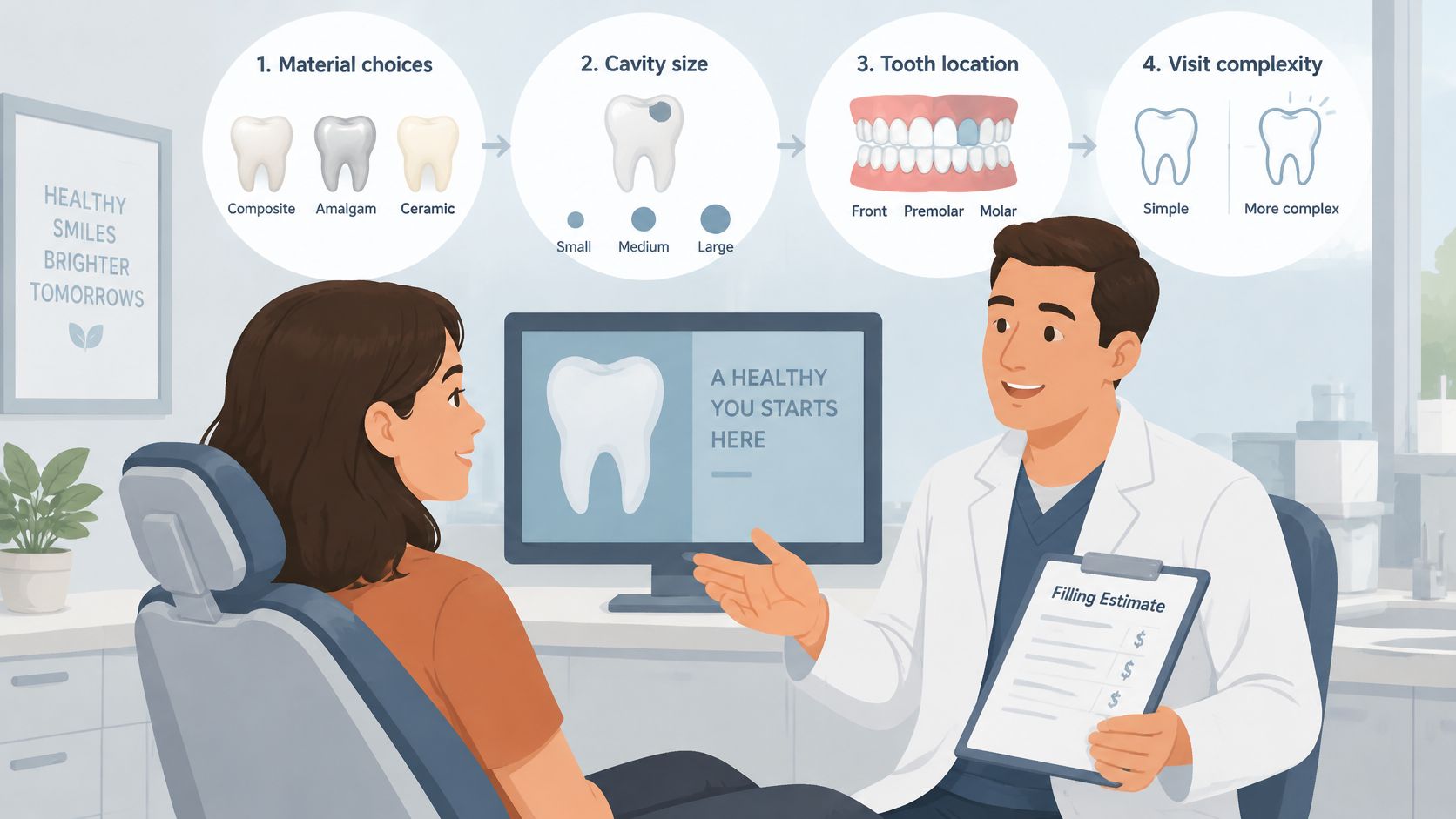
A dentist needs to identify what the tooth requires before giving a meaningful estimate. These are the main factors to discuss during that examination.
Material and placement conditions
The American Dental Association identifies cost, longevity, sensitivity after placement, appearance, and placement conditions as considerations when choosing restorative materials. Composite placement requires careful moisture control, so the ability to keep the tooth dry can affect the treatment approach.
A higher-cost material isn't automatically the right choice. The dentist should consider chewing demands, access to the tooth, and how much healthy structure remains, alongside your appearance preferences.
Surfaces, tooth size, and replacement work
A surface is a side or chewing area of a tooth, not a separate tooth. Restoring decay that crosses several surfaces generally requires more preparation, shaping, and finishing than treating a small, contained area, as explained in Aflac's filling-cost guide.
Other work can change the estimate:
- Tooth location: Front teeth and molars differ in access, shape, and the forces they handle.
- Cavity size: A broader or deeper area of decay may require a more involved restoration.
- Existing restorations: Replacing an old filling requires removing it and assessing the tooth underneath.
- Laboratory fabrication: Gold or ceramic inlays involve fabrication work beyond direct filling placement.
Consider a small front-tooth composite restoration compared with a molar restoration that crosses several surfaces and replaces an old filling. Both may be called fillings, but the second involves a different scope of work.
Dr. Finley evaluates the entire oral structure, including the shape, size, and color of the teeth. For tooth-colored restorative work, matching the natural teeth's color and shape is part of his process. That individualized assessment, rather than a fixed menu, establishes the proposed treatment.
How Insurance Changes Your Share
Your out-of-pocket cost depends on how your plan calculates its payment, not just the percentage listed for fillings.
| Plan term | What it means | Effect on your bill |
|---|---|---|
| Deductible | Amount you pay before applicable benefits start | Can add to your share early in the plan year |
| Basic restorative coverage | Fillings are often classed as basic care and paid at a set percentage | You pay the remaining percentage of the allowed amount |
| Annual maximum | Yearly cap on what the plan pays | Later fillings may become entirely your responsibility |
| Waiting period | Time after enrollment before some services are covered | Can delay coverage on a new plan |
| Network status | Whether the office has a contract with your plan | Can change the allowed amount and your share |
| Alternate benefit | Plan bases payment on a lower-cost material | You may pay the difference for a higher-cost option |
| Frequency limit | How often a service is covered | May affect replacement fillings |
Plan rules determine how these terms apply. FAIR Health's dental-plan guide explains how basic-service benefits and alternate-benefit provisions can affect a patient's responsibility.
Your percentage applies to the allowed amount
A plan's stated percentage generally applies to its allowed amount, subject to plan rules. That amount may differ from the office's charge, and the calculation can also depend on an unmet deductible or annual maximum.
For example, suppose a filling has a plan-allowed amount of $200, your plan pays 80% after the deductible, and you have $50 of deductible remaining. You pay the $50 deductible first. The plan then pays 80% of the remaining $150, or $120, leaving you with $30. Your estimated share is $80: the deductible plus the unpaid portion. This illustration shows the arithmetic; your plan's terms determine the actual amounts.
An alternate-benefit rule can change the calculation. For certain back teeth, a plan may base payment on an amalgam allowance even when you choose composite. You may owe your usual share plus the difference between the plan's allowance and the composite charge.
Ask for your expected responsibility, not just confirmation that the procedure is a covered benefit.
Family treatment adds another layer. A family deductible, each person's remaining maximum, and any shared limits can affect how much coverage remains for later appointments. Each family member may have different benefits available.
Ask the plan or office to estimate the payment using the allowed amount, your deductible remaining, and the maximum still available. Then ask whether a material restriction applies and what you would owe if the plan pays at its estimate. The estimate helps you compare the filling quote with the likely final bill, though claim processing may change the payment.
What to Ask for in a Written Estimate
A filling estimate is easier to compare when it spells out the work, related charges, and how insurance affects the total. Use this checklist to see whether two quotes cover the same care.
- Procedure and tooth: Request the CDT procedure code, tooth identification, and surfaces being restored. These details define the filling being priced.
- Recommended material: Ask why the material suits the tooth and whether a clinically appropriate alternative would change the estimate.
- Examination and imaging: Check whether the examination and diagnostic X-rays are included or charged separately.
- Anesthesia and laboratory work: Ask whether local anesthesia and any inlay fabrication fee are included.
- Visit scope: Confirm whether the estimate covers the filling alone, the full appointment, or all recommended restorations.
- Possible changes: Ask how the office will explain and seek authorization for additional treatment if it finds more extensive decay.
Identify whose figure you're reading
The Bureau of Labor Statistics medical-care guide explains how dental-service prices are tracked within its medical-care framework. A Bureau of Labor Statistics price index describes averages across many payers, so it cannot tell you what one estimate will cost.
An estimate may show the dentist's submitted fee, the insurer's allowed amount, or your expected out-of-pocket responsibility. These are different figures, like separate lines in a bill. Check that the document identifies which amounts are included and whether its total reflects expected insurance benefits.
Keep a copy and note any assumptions about benefits. Ask how long the estimate remains applicable and what findings could change the proposed treatment. Comparing estimates with the checklist helps you see whether the totals cover equivalent care.
Paying for Care When Your Budget Is Tight
If you can't pay for every recommended restoration at once, ask Dr. Finley which teeth need care sooner and which may be safe to schedule later. Share any pain, sensitivity, swelling, or other changes so he can assess the urgency. A tooth without symptoms can still need treatment; set priorities by clinical urgency.
Waiting can affect the treatment a tooth needs. A small cavity may grow, and deeper decay may require a crown or, in some cases, root canal treatment. Earlier treatment may help avoid more involved care, though no clinician can promise what will happen if treatment is delayed.
Start the budget plan with the teeth that can safely wait, and schedule the rest by clinical urgency.
Discuss timing and payment together
Ask whether staged treatment is clinically reasonable. The dentist can identify which teeth to treat first and whether other appointments can be separated without an unacceptable risk.
Payment arrangements are a separate discussion. Ask whether the office offers payment plans or third-party healthcare financing, then review any interest, fees, repayment dates, and the total repayment obligation. Check that the arrangement fits your budget.
If your benefits renew at the start of a new plan year, scheduling nonurgent work after renewal may help you use available coverage. Let clinical timing guide the decision; postponing needed care solely for insurance could lead to a more difficult problem.
Before deciding, ask:
- Urgency: Which tooth needs treatment first?
- Delay: What might happen if this waits six months?
- Material: Is a lower-cost option clinically suitable for this tooth?
- Payment: Which payment approach fits this estimate and my budget?
Dr. Finley's examination determines whether a proposed treatment sequence is reasonable for your teeth.
Filling Costs Across Santa Ana and Orange County
Patients comparing estimates in Santa Ana, Costa Mesa, Tustin, Irvine, and Garden Grove can ask each office to show the same CDT codes and surface count before comparing totals. A code identifies the procedure, while the surface count indicates how many areas of the tooth the filling covers.
Fees may also reflect office overhead, staffing, laboratory charges, and dental-plan fee arrangements. A lower total can reflect a different proposed restoration or a different calculation of insurance benefits, so compare estimates on the same terms.
Compare the treatment, not the ZIP code
Use the written-estimate checklist from the previous section to compare what each quote includes and how the patient's share is calculated. Then ask each office directly whether it participates with your specific dental plan. A familiar insurance name alone does not confirm participation.
Bristol Dental & Orthodontics is on South Bristol Street in Santa Ana and serves patients from surrounding Orange County communities. Dr. Andrew Finley evaluates each patient's teeth before recommending treatment.
A useful local consultation should leave you able to explain why the restoration is recommended and what the estimate includes. If a total is lower, ask whether the difference comes from the proposed restoration or the benefit calculation.
Confirm Your Filling Estimate with Dr. Finley
A filling estimate can change if an X-ray shows decay extending farther than expected. Ask the office how it handles a re-estimate in that situation, and whether you'll be contacted before any additional work begins.
At Bristol Dental & Orthodontics, Dr. Andrew Finley evaluates each patient's teeth before recommending treatment. That assessment helps connect the proposed filling to the condition of the tooth. If the plan is staged around insurance benefits, confirm with the office that the timing remains clinically appropriate.
Prevention can help protect back teeth
For a child, sealants may be applied to the grooves of back teeth, where food particles can get trapped. The protective surface can help prevent cavities for several years. Cleanings remove plaque and tartar, while exams check for cavities, gum disease, and other potential concerns early.
Regular visits cannot guarantee that a filling won't be needed, but they give the dental team a chance to identify problems. Ask whether sealants are suitable for your child's teeth.
Bristol Dental & Orthodontics provides family and cosmetic dental care in Santa Ana. Visit Bristol Dental and Orthodontics to schedule a consultation with Dr. Finley and discuss your filling options.