
A teen needs one stubborn canine rotated into line, and the appliance choice can change the outcome. Invisalign handles many straightforward movements well, while braces give the orthodontist finer control over rotations, torque, and vertical shifts that aligners can struggle to deliver.
That gap is why comparing Invisalign vs braces starts with the specific movements your teeth need. Each goal asks for something different: straight-looking teeth call for cosmetic alignment, a well-fitting bite calls for precise control, and a manageable routine calls for an appliance you can live with daily. Which of those matters most to you? Comfort, timing, hygiene, and cost belong in the comparison too, and they make more sense once the diagnosis is clear.
Table of Contents
- Invisalign vs Braces at a Glance
- How Each Treatment Unfolds From First Visit to Retainer
- How Predictable Each Option Is for Different Tooth Movements
- Which Cases and Ages Suit Aligners or Braces
- Comfort, Eating and Daily Routine Compared
- Treatment Time, Hygiene and What Shapes Cost
- Book a Consultation to Confirm Your Best Fit
Invisalign vs Braces at a Glance
Both appliances move teeth, and neither suits every case. A 2025 systematic review of 21 randomized trials involving 970 participants found no statistically significant overall effectiveness advantage for clear aligners in straightforward cases treated without extractions.
That finding covers simpler cases. The same review associated aligners with better pain management, fewer orthodontic visits, and potentially shorter treatment, yet the researchers rated the overall evidence low certainty, so treat those advantages as possible rather than guaranteed. One more nuance: treatment length in an individual case is shaped less by the appliance than by the plan itself, including whether extractions are planned and how much the arches need to widen or roots need to be repositioned.
A few differences are visible before treatment begins:
| Criterion | Invisalign (clear aligners) | Traditional braces |
|---|---|---|
| Appearance | Clear trays; small tooth-colored attachments may show up close | Metal or ceramic brackets connected by an archwire |
| Fixed or removable | Trays come out for meals and cleaning | Brackets stay bonded to teeth until treatment ends |
| Office visits | Periodic check-ins; the review reported fewer visits overall | Regular visits for wire changes and adjustments |
| If something goes wrong | A lost or damaged tray can usually be replaced against the plan | A loose bracket or poking wire typically needs a repair visit |
What a feature table can't settle is the difference between a preference and a clinical requirement. A working adult may rank appearance first; a parent may weigh whether a teenager will keep trays in for the prescribed hours. Those are real priorities. Whether aligners can reliably produce a particular rotation or bite correction is a separate question, and it gets answered by examining your teeth rather than by comparing products.
How Each Treatment Unfolds From First Visit to Retainer
The first appointment is mostly shared: records, a diagnosis, and a plan you can question before anything is bonded or printed. The plan is the route map; the appliance is the vehicle. From there, aligners move much of the job to your home routine, while braces keep more of the work in the chair.
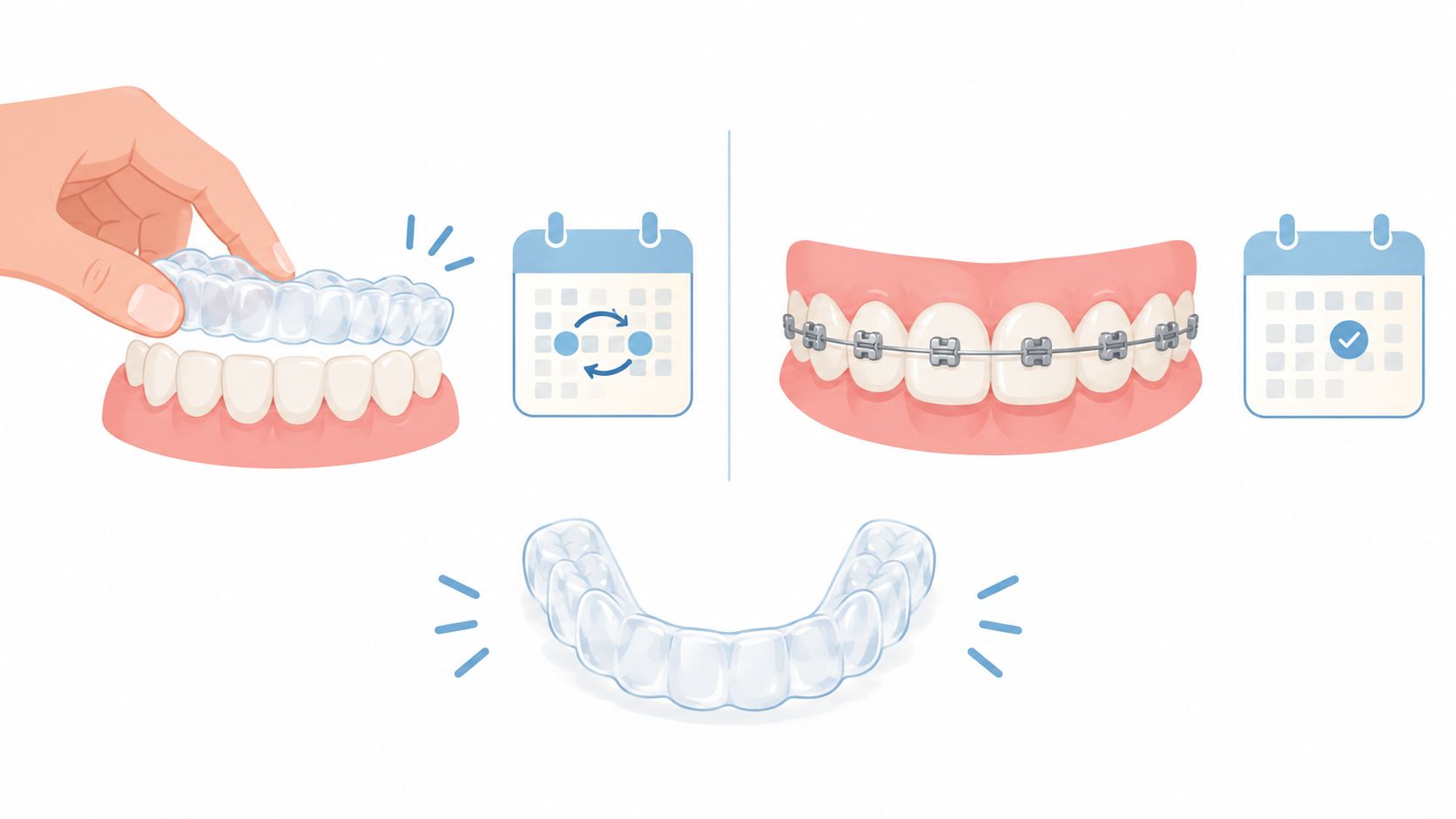
The clear-aligner sequence
- Records and staging. A scan or impressions are used to stage each planned movement and preview the sequence.
- Attachments when needed. Small tooth-colored bumps are bonded when a tray needs better grip for rotation, extrusion, or root control.
- Daily wear on the prescribed schedule. The aligner only works while it is seated, so the hours it is worn are the engine of treatment.
- Tray changes at home. You advance to the next set on the schedule you are given, rather than when a tray merely feels loose.
- Mid-course decisions. If a tooth is not tracking, the clinician chooses a specific fix: add an attachment, extend the current tray, rescan, or order refinement trays.
- Retention. Once positions are reached, retainers hold them while the bone and gums stabilize.
Where fixed braces take a different path
With braces, the early records are similar, but the appliance is installed once and then tuned. Brackets are bonded, an archwire is tied in, and the wire sequence does much of the guiding. Instead of changing trays at home, you return for adjustment visits where wires, ties, springs, or elastics are changed to match the next stage. The daily burden shifts too: less responsibility for inserting a device, more for cleaning around hardware and avoiding hard or sticky foods that can break a bracket. Removal is a single appointment, then retention begins.
A useful question for either path is concrete: “If my teeth fall behind the plan, what is the next adjustment, and who triggers it?” For aligners that can mean a new scan and attachments; for braces it can mean a different wire or added elastic wear.
How Predictable Each Option Is for Different Tooth Movements
Alignment and bite correction are separate goals, and each can succeed or fail independently. Teeth can look straighter from the front while the roots still sit at the wrong angle, or while the upper and lower teeth meet unevenly. An appliance that produces a good-looking result in the mirror may still leave mechanical work unfinished underneath.
A systematic review of eight studies, including two randomized trials and six cohort studies found both aligners and braces effective for correcting malocclusion, meaning an imperfect tooth or bite relationship. Aligners were less predictable for complete biting contacts, root torque, widening the dental arch, and retention.
Predictability by tooth movement
The differences come down to how each appliance delivers force. A tray pushes on the crown through smooth plastic, while a bracket and wire can grip, twist and pull in ways a removable shell cannot.
| Tooth movement | Clear aligners | Fixed braces |
|---|---|---|
| Simple alignment, mild crowding or spacing, no extractions | Tray shape guides crowns toward planned positions; outcomes broadly comparable | Wires deliver the same guidance; outcomes broadly comparable |
| Rotated teeth | A rounded tooth gives smooth plastic little grip, so attachments are often bonded on to create a purchase point | The bracket acts as a handle, letting the wire apply a twisting force directly |
| Vertical movement, including intrusion and extrusion | Trays push teeth inward more readily than they pull them outward; extrusion often needs attachments or elastics | Wires and auxiliaries can apply continuous force in either direction |
| Widening the arch | Trays tend to tip crowns outward rather than expand the bone housing around the roots | Progressively wider archwires drive expansion at each adjustment |
| Root torque and inclination | Flexible plastic can move the crown without the root following; findings vary by study and movement | A rectangular wire seated in the bracket slot applies torque to the root directly |
| Extraction and space closure | Spaces can close by tipping crowns while roots stay unparallel; a comparative review reported less favorable extraction results | Teeth can slide along the wire with roots held upright; better treatment quality in extraction cases |
| Final bite contacts | Plastic between the teeth means contacts may settle differently once trays stop being worn | Finishing bends set the contacts with nothing covering the biting surfaces |
Torque describes control over how a tooth and its root tilt. Vertical movement means moving a tooth farther into or out of its supporting position, while final bite contacts describe how opposing teeth meet.
These distinctions explain why a small-looking problem can hide a demanding movement. Correcting a visible rotation may require more than making the front surface look straight.
Why faster doesn't automatically mean better
In the same eight-study systematic review, aligner treatment finished 6.31 months shorter on average, with a 95% confidence interval of 4.24 to 8.37 months and a P value below 0.001. Those figures describe the studies included in that review, not a time saving an individual patient can expect.
A shorter course also doesn't prove that the final bite or root positions are better. Treatment duration and treatment quality measure different things, so both deserve discussion.
Other research reinforces the need for caution. A 2025 review addressing treatment and smile outcomes reported differences in study designs and measurements that prevented pooled conclusions, despite some advantages for aligners.
Ask which movement is most likely to need extra work, rather than asking only which appliance finishes sooner.
An aligner plan may require attachments, refinement trays, or occasionally a switch to braces. Predictability should be assessed movement by movement, not inferred from the appliance's name or appearance.
Which Cases and Ages Suit Aligners or Braces
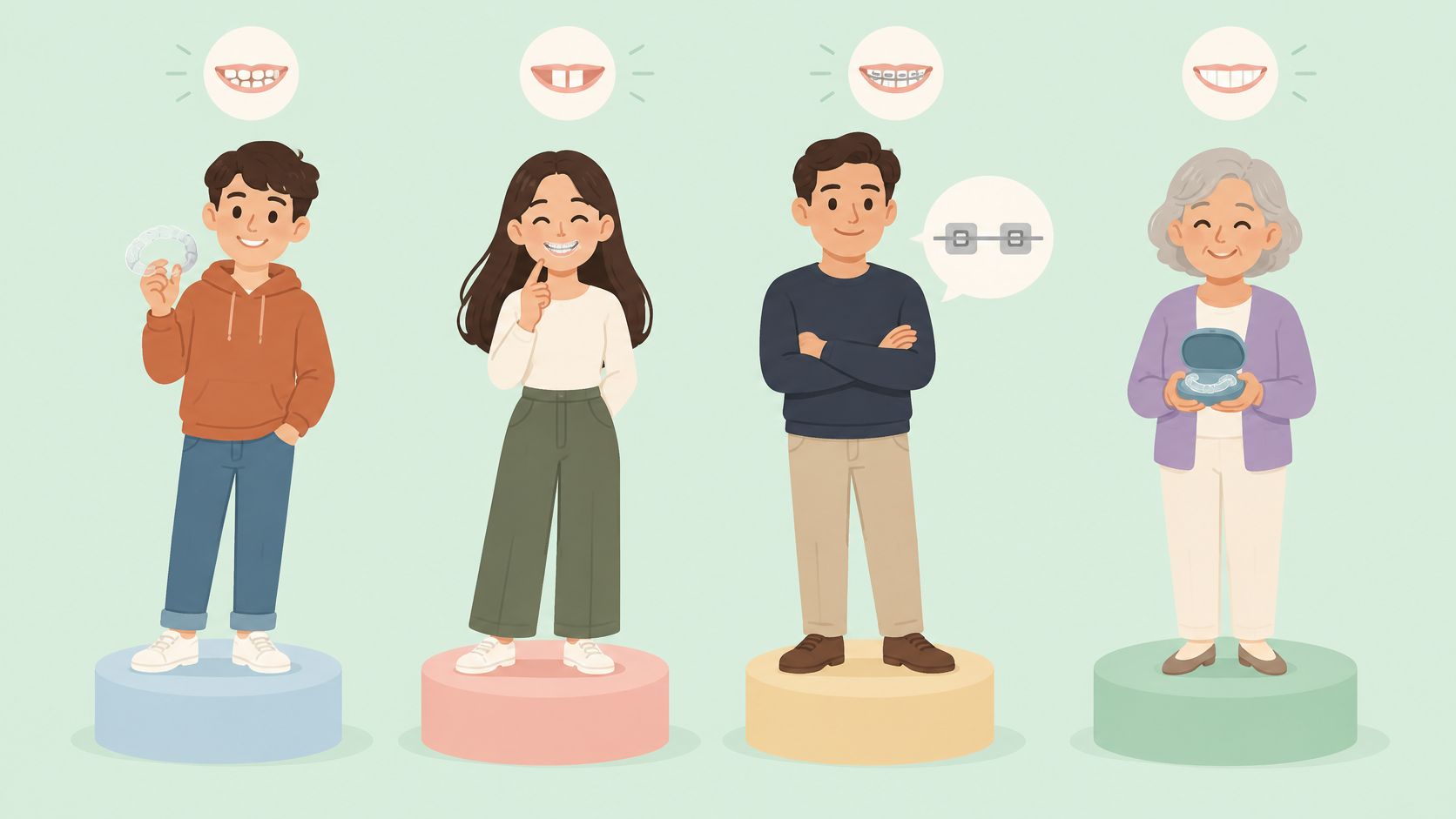
Age alone doesn't answer the question. The decision has to weigh the movements required, the patient's oral health, and whether the routine around the appliance is realistic.
When the correction is relatively straightforward
Mild-to-moderate crowding or spacing, with no extractions planned, is the clearest aligner territory when discretion and removability matter. The complication is that a smile can look simple in the mirror while the bite behind it tells a different story. A small gap between the front teeth says nothing about how the molars meet or whether the roots sit upright. Only the examination confirms the case is simple.
For an adult worried about visible hardware at work, the practical question is whether trays can stay in as prescribed through meetings, meals, and shifting hours. A discreet appliance still demands daily management.
When the roots and bite need more control
Start with a premolar extraction. The space left behind has to close, and the teeth beside it tend to tip into the gap unless the appliance controls the roots along with the crowns. A bracket works like a handle fixed to the tooth, letting the orthodontist keep roots parallel while the space closes. The same logic applies to torque control on the front teeth and vertical bite correction, where the direction of force matters as much as the amount.
A review of complicated orthodontic cases reported better inclination and biting contacts with fixed appliances in premolar-extraction treatment; the same review described adult evidence in which aligner outcomes scored 9.9 points worse on average on an objective grading system, with a 1.6 relative risk of an unacceptable result, and a retrospective comparison finding 1.7 years of treatment for Invisalign versus 1.3 years for braces. Study designs and case selection varied across that evidence, so those figures do not predict a poor aligner outcome for any individual adult. They do explain why blanket claims that aligners are always faster deserve skepticism.
When the patient is a teenager or growing child
For younger patients, judge the plan against the school day. Removable trays sound appealing until lunch, sports, storage, and cleaning all have to fit around classes.
- Ask the patient directly. Does the teenager want removable trays, or would fewer device-management tasks each day feel easier?
- Discuss family support. Decide who will monitor instructions and contact the office if problems develop.
- Review growth and development. Ask how the examination findings shape appliance choice and timing.
Appearance, comfort, and scheduling often compete in the same decision, and a straightforward-looking smile can still call for a different approach once examined. The rule stays conditional: aligners suit simpler corrections, and braces take priority when precise root and bite control matter most.
Comfort, Eating and Daily Routine Compared
The first day doesn't tell you what the entire treatment will feel like. A 2025 comparative study of pain and chewing function found the greatest discomfort and chewing difficulty around 24 hours in both groups.
The same 2025 comparative study reported that pain returned to pretreatment levels after about two weeks with aligners, compared with about one month with fixed appliances. In that study, chewing function improved sooner with braces, at roughly one week, versus about two weeks with aligners.
Read those timelines as group averages, not a recovery schedule you should expect to follow exactly. An individual patient's soreness depends on the movements planned, the adjustment schedule, and how their mouth responds.
What a first-week lunch actually looks like
Pain and chewing are separate experiences, and you may notice that gap yourself. A patient can stop feeling sore yet still hesitate before biting into something firm, or chew comfortably while the gums remain tender around the brackets.
Here is a concrete example of how the two appliances shape the same meal. An aligner patient takes the trays out, puts them in a case, eats, cleans the trays and their mouth as instructed, and wears them again promptly. That cycle repeats at every meal and snack. A braces patient skips the removal routine but rethinks the menu: softer choices in the tender days after an adjustment, and care with sticky or hard foods.
One appliance adds steps around the meal. The other changes what goes on the plate.
A useful family question: Would removability make treatment easier to manage, or create more opportunities to forget the appliance?
Before choosing trays, think through the practical details:
- School meals. Where will the case go, and how will cleaning fit into the available break?
- Sports. What appliance and protection instructions apply to the activity?
- Missed wear. Who will contact the dental team for guidance rather than guessing whether to advance trays?
- Daily tracking. Can the patient follow the prescribed wear schedule without frequent conflict?
Removability alone doesn't predict compliance. Comparative evidence hasn't consistently shown that aligner patients wear their appliances less reliably, so the better question is whether this particular person has a realistic plan for the responsibilities involved.
Treatment Time, Hygiene and What Shapes Cost
Teeth can look straight well before treatment is fully finished. Orthodontic treatment works like repainting a room: the colour changes fast, and the edging and detail work take the patience. A 2024 comparative report described shorter clear-aligner treatment partly because braces could require up to an additional six-month detailing or finishing phase.
That finding sits alongside the contrasting timing evidence discussed earlier, so treat it as one study's pattern rather than a promise. When you receive a timeline estimate, ask which stages it covers: initial alignment, bite finishing, possible refinements, and the move into retainers.
Hygiene requires effort with either appliance
A 2025 systematic review and meta-analysis found better short-term plaque and gum indicators with aligners, while rating the overall evidence quality low. Removable trays make brushing and flossing easier to reach; they do not clean themselves.
Braces keep everything fixed in place, so the effort shifts to working around brackets and wires where food collects and enamel needs attention. Aligner wearers trade that for tray cleaning and putting a clean tray back over clean teeth each time. Either way, the hygiene result depends on the routine more than the appliance.
What changes the price
Cost differences come from the scope of care, so compare what each quote includes. Three drivers explain most of the gap between any two plans, and all three apply whichever appliance is recommended: how complex the tooth movements are, how long treatment runs, and whether retainers and follow-up visits sit inside the quoted fee.
A few costs do lean towards one appliance:
| Cost factor | How it shapes the total | Where it applies most |
|---|---|---|
| Attachments and refinements | Extra bonding and additional trays can extend an aligner plan | Mainly aligners |
| Adjustment visits | Scheduled wire changes and checks are built into the plan | Mainly braces |
| Replacement and repair | A lost tray may need a new scan and order; a broken bracket needs a repair visit | Aligners for trays; braces for brackets |
The appliance name predicts cost less reliably than the plan behind it. A straightforward braces case can come in below a complex aligner plan, and the reverse also happens. Your dependable estimate comes after examination, once the clinician has mapped the required movements. A general Invisalign vs braces comparison can prepare you for that discussion, but it can't produce a reliable personal estimate.
Book a Consultation to Confirm Your Best Fit
A consultation should leave you understanding the recommendation behind the appliance name. Dr. Finley and the team can relate the visible concern that brought you in to the tooth movements and daily responsibilities involved.
Expect the assessment to cover your goals and dental history, including previous orthodontic treatment, bite concerns, and current medications. A clinical examination of the teeth, bite, and gums, with scans or X-rays where needed, provides the information for planning.
Bring questions that reveal the trade-offs
Earlier sections compared goals, daily routines, and cost scope in general terms. The consultation is where those comparisons get applied to your teeth. Three questions do most of the work:
- Which movements in my case are most predictable with each appliance? A clinician who names specific rotations, bite corrections, or root movements is describing your plan rather than a generic one.
- How will you check that my teeth are tracking as planned? This clarifies how often you will be seen and what "on schedule" actually means.
- What happens if the plan needs to change? Ask how refinements, missed wear time, or switching appliances mid-treatment are handled.
Sometimes the honest recommendation combines both appliances. A clinician might use braces to complete a difficult rotation or a large bite correction, then move to aligners for the finishing detail work. Hearing that possibility in advance keeps the decision open.
For patients in Santa Ana and surrounding Orange County communities, the next step is an individual examination with Dr. Finley, the visit where the movement-by-movement comparisons in this article become a plan for your teeth. The comparison above gives you the questions; the examination gives you the answers.
Bristol Dental & Orthodontics offers Invisalign and traditional orthodontic care for patients in Santa Ana, Costa Mesa, Tustin, Irvine, Garden Grove, and nearby Orange County communities. Visit Bristol Dental and Orthodontics to explore Invisalign and orthodontic services and schedule a consultation with Dr. Andrew Finley to discuss which approach fits your teeth, goals, and routine.