

You're heading into a video call in Santa Ana, and the first thing you notice in the mirror is the crowding along your lower teeth. Maybe you've considered braces, but you don't want brackets showing at work. Maybe you've looked at clear aligners, then wondered whether they'll fit around school pickups in Irvine, meetings in Costa Mesa, or a family schedule that already feels full.
Choosing Invisalign in Orange County isn't only about wanting a straighter smile. You also need to understand whether aligners can handle your bite, how consistently you'll wear them, what happens after the final tray, and how a practice plans for refinements and retention. This guide walks through those practical questions in plain language, so you can have a more useful conversation with Dr. Andrew Finley at Bristol Dental & Orthodontics or another qualified dental professional.
Table of Contents
- Considering Invisalign in Orange County
- How Invisalign Actually Works
- Who Makes a Good Invisalign Candidate
- A Realistic Invisalign Treatment Timeline
- Invisalign vs Traditional Braces
- Choosing an Invisalign Provider in Orange County
- Understanding Cost, Insurance, and Financing
- Next Steps and Common Patient Questions
Considering Invisalign in Orange County
For a working parent, the decision often starts with a small daily frustration. Food catches between crowded teeth. A lower incisor looks more noticeable in photos. You find yourself covering your mouth when you laugh, but the thought of metal braces feels inconvenient. Doing nothing may seem easier, yet the concern keeps returning every time you look in the mirror.
Clear aligners can fit well into some Santa Ana and Orange County routines because they're removable and less visible than traditional braces. You can take them out for meals, brushing, and flossing. That convenience matters when your day includes commuting through Garden Grove, picking up children in Irvine, or moving between work and family obligations.
But removability creates a responsibility that fixed braces don't. An aligner can only guide teeth when you're wearing it as directed. If it stays in a case for much of the day, the digital treatment plan may not progress as intended, and your timeline may change.
The decision involves more than appearance
Patients commonly focus on three questions:
- Will it look discreet? Clear aligners are designed to fit closely over the teeth, although attachments or small tooth-colored features may be needed for certain movements.
- Will it work for my bite? Mild-to-moderate non-extraction cases can be suitable for aligners, while more complex movements may favor fixed appliances. A 2025 systematic review found no significant difference in treatment quality or duration between aligners and fixed appliances for non-extraction cases, but fixed appliances performed better in extraction cases because they provided more control of tooth movement. Read the systematic review on aligners and fixed appliances.
- Can I manage the routine? You'll need to remember the trays, clean them, wear them consistently, and keep appointments.
Invisalign has also moved well beyond a niche treatment. Align Technology reported 20 million Invisalign patients by April 2025, followed by a report that doctors had treated more than 20.1 million patients by June 2025. Review the reported Invisalign patient milestones. That broad adoption shows that clear aligner therapy has become a mainstream option, but popularity doesn't make every case appropriate.
A practical question to ask yourself: Can you follow a daily wear routine even on busy days, travel days, and weekends?
A consultation should give you honest answers about candidacy, treatment alternatives, fees, refinements, and retainers. You shouldn't feel pressured to decide before you understand the full process.
How Invisalign Actually Works
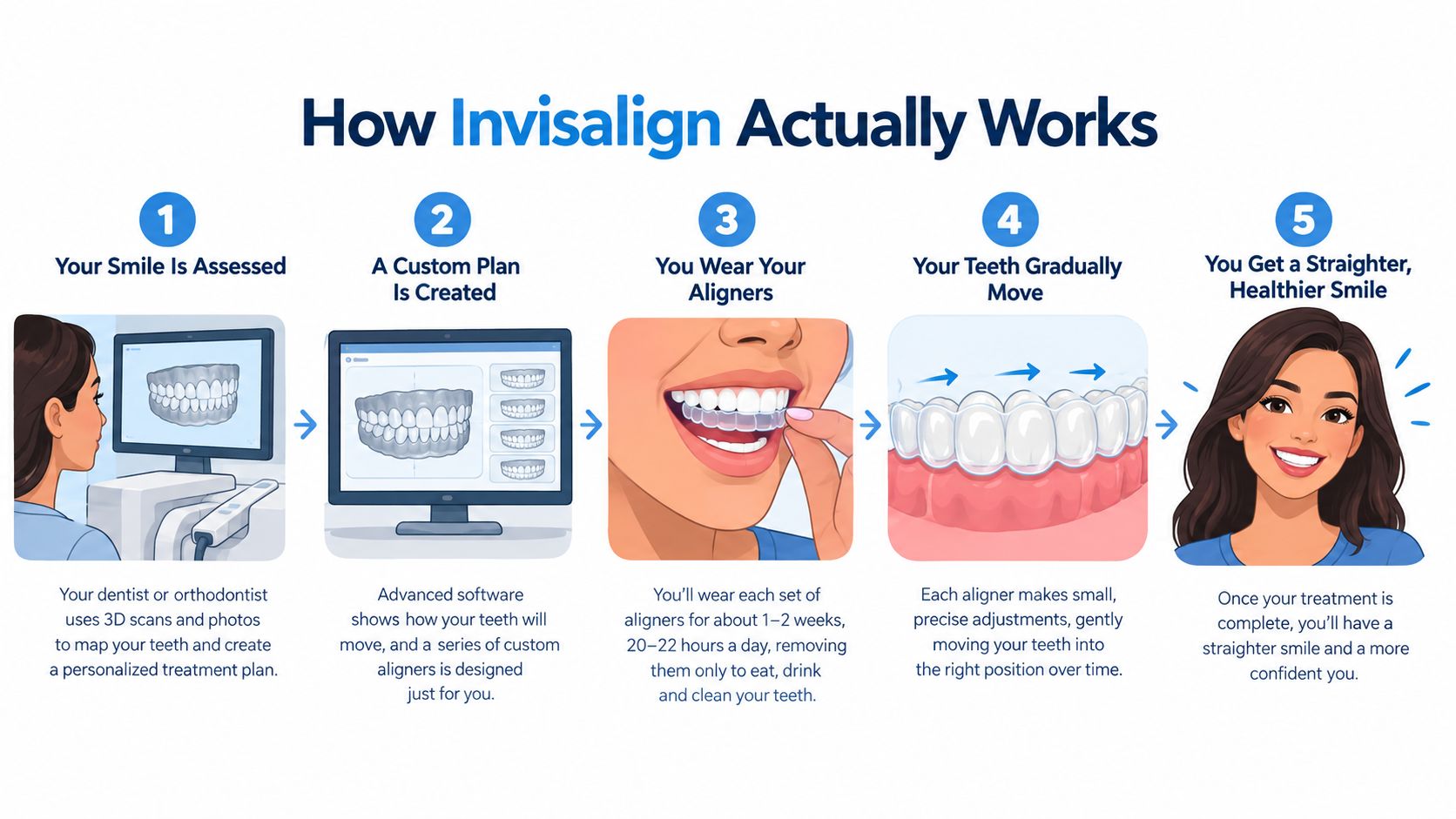
If you are raising children, commuting across Orange County, or managing a full weekend schedule, the day-to-day routine matters as much as the digital preview. An aligner works like a clear, removable guide. Each tray applies gentle, planned pressure to selected teeth and moves them toward the next position in the sequence.
Treatment usually starts with an examination, photographs, a digital scan, and a bite assessment. The clinician uses these records to build a three-dimensional plan. Before starting, you should be able to review the proposed tooth movements, possible attachments, bite changes, and whether additional trays may be needed.
The tray sequence
You receive a series of custom aligners. Patient education materials commonly describe changing trays about one to two weeks per tray, while many patients wear them approximately 20 to 22 hours each day. See an educational overview of Invisalign timing and wear.
Remove the trays for meals and drinks other than water. Brush and floss before replacing them when practical. A new stage may feel tight at first. Most patients notice pressure or tenderness rather than the cheek and lip irritation associated with brackets and wires. Temporary speech changes are also possible while your tongue adjusts.
Daily life can make the routine harder than the scan suggests. School lunches, sports, travel, and family meals all require a plan for storing and replacing the trays. A case, a cleaning routine, and a consistent place to keep the aligners can reduce the chance of losing or damaging them.
Some movements need added support. Small attachments help the aligner grip a tooth. Interproximal reduction, or IPR, may create limited space between selected teeth when clinically appropriate. These choices depend on your anatomy and treatment goals, rather than a single template for every patient.
Why refinement trays are common
Teeth do not always respond exactly as a computer simulation predicts. A 2020 systematic review found low-to-moderate certainty for specific tooth movements and concluded that many movements may not be predictable enough to finish with one set of trays. Review the evidence on clear aligner movement predictability.
A plan may therefore include a refinement stage. Refinement trays can make smaller adjustments, improve the bite, or address teeth that have not tracked closely enough. This does not automatically mean treatment failed. It reflects the difference between a digital plan and a living mouth, and it makes follow-up assessment part of responsible treatment.
Who Makes a Good Invisalign Candidate
A Santa Ana parent may want straighter teeth for a teenager who plays sports, while an adult may need treatment that fits around work, meals, and family schedules. In both cases, candidacy is a clinical decision, not a simple yes-or-no label. A dentist considers tooth positions, bite, gum health, existing restorations, jaw relationships, treatment goals, and whether you can follow the prescribed wear routine.
Situations that may fit aligners well
Aligners often work well for mild-to-moderate crowding and spacing, especially when treatment does not require extractions. Selected overbites, underbites, and crossbites may also respond when the underlying cause and amount of correction fall within a treatable range.
Adults may manage treatment comfortably because they control their own schedule and trays. Mature teens can also be good candidates, provided they remember aligners during school, sports, meals, and social activities. For younger children, parents may need to handle reminders, cleaning, and safe storage. A busy Orange County household should decide in advance where trays will go during school lunches, practices, travel, and family meals.
The evidence supports careful case selection. As noted above, the choice between aligners and fixed appliances depends strongly on whether the case involves extractions, along with its complexity and the patient's follow-through. A clear appliance should not determine treatment by itself.
Situations that may call for another approach
Severely rotated teeth, major skeletal bite differences, and cases involving jaw surgery may be less suitable for aligners alone. Large vertical corrections or substantial tooth movements may require fixed braces, combined treatment, or evaluation by a specialist.
| Case Type | Typical Invisalign Fit | Notes |
|---|---|---|
| Mild crowding or spacing | Often a reasonable fit | The clinician evaluates available space, tooth angulation, and gum health. |
| Mild-to-moderate bite concerns | Possible in selected cases | The underlying cause and amount of correction matter. |
| Severe rotations | More limited | Some teeth are harder to rotate predictably with removable trays. |
| Extraction or surgical cases | Often less suitable as an aligner-only plan | Fixed appliances or combination treatment may offer more control. |
| Adults and mature teens | Depends heavily on routine | Age matters less than consistent wear and follow-through. |
The deciding factor usually isn't age. It's whether the planned movements match what aligners can predictably accomplish and whether you can maintain the daily routine.
Treatment also includes the period after the final tray. Teeth can shift without retainers, so ask how retention, replacement trays, and ongoing checkups will fit your household's routine. A consultation with Dr. Finley can clarify whether aligners alone make sense or whether traditional braces or combination therapy would provide better control.
A Realistic Invisalign Treatment Timeline
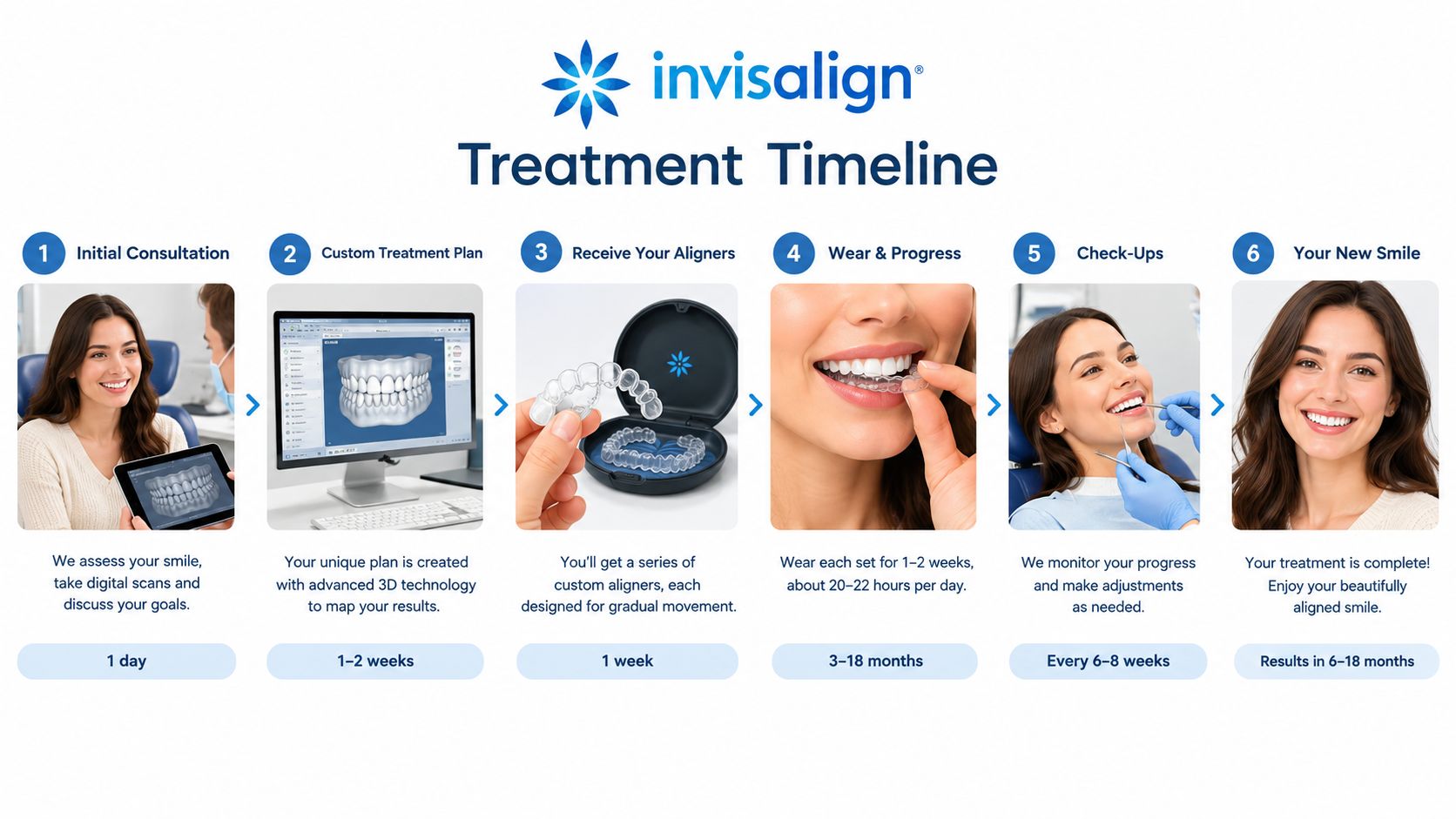
A clear-aligner timeline is a working estimate, not a promise. Many adult cases take six to 18 months, while complex movements, missed wear time, or a slower response can lengthen treatment. Review patient education on Invisalign treatment time.
Your first visit may include photographs, a digital scan, and bite records. The dental team uses these details to plan the tooth movements and order custom trays. At delivery, you will learn how to insert, remove, clean, and keep track of them. A busy Orange County household may need a simple storage and cleaning routine so trays are not misplaced during school runs, travel, or long workdays.
What the middle months look like
During active treatment, you move through the trays on the schedule your clinician provides. Some patients change trays every seven to 14 days, though that timing may change if a tray does not fit as expected.
Progress visits are usually brief. The team checks whether your teeth are following the plan, examines attachments, reviews wear habits, and provides additional trays when appropriate. If a tray feels unusually loose or tight, contact the office rather than forcing the next one.
Some movements require more time and monitoring than others. Rotating canines, closing extraction spaces, and correcting vertical bite relationships may be slower than treating straightforward spacing or mild crowding. The original estimate can change if teeth respond gradually or the plan needs refinement.
Refinement and retention
After the planned sequence, the clinician evaluates the result instead of assuming the last tray is the final answer. Refinement trays may adjust small spaces, improve alignment, or help settle the bite.
Retention is part of treatment, not an optional final detail. Teeth can shift after active orthodontic treatment, much like furniture can slide back after being moved unless it is kept in place. Before starting, ask which retainer is planned, how replacements are handled, and what nighttime wear may be expected over the long term. This helps your family plan for maintenance after the active trays are finished.
Invisalign vs Traditional Braces
The choice between Invisalign and traditional braces often comes down to a clinical matchup. Appearance matters, but so do the movements required, your habits, your bite, and how much control the appliance needs to provide.
| Factor | Invisalign | Traditional Braces |
|---|---|---|
| Appearance | Clear trays are generally less noticeable than metal brackets. | Brackets and wires are visible, although they provide a fixed treatment system. |
| Removability | You can remove trays for meals, brushing, and flossing. | The appliance stays in place throughout treatment. |
| Hygiene | Removal can make brushing and flossing more straightforward, but trays must be cleaned and replaced consistently. | Cleaning around brackets and wires requires extra attention. |
| Comfort | Smooth plastic avoids many bracket and wire irritations, but new trays can create pressure or temporary speech changes. | Brackets and wires may irritate the cheeks and lips, especially after adjustments. |
| Complex movements | Works well for selected cases, but predictability varies by movement. | Fixed brackets can offer more control in complex tooth movements. |
| Compliance | Depends on wearing the trays as prescribed. | Since the appliance is fixed, the patient can't remove it during the day. |
Clear aligners may appeal to adults who want discretion during work meetings in Newport Beach or family events in Tustin. They can also simplify meals and daily brushing because you remove the trays. That convenience has a tradeoff. A removable appliance depends on memory and follow-through.
Traditional braces may be preferable when the case involves severe rotations, significant vertical discrepancies, a large overbite, or skeletal correction. They aren't automatically more comfortable or more convenient, but their fixed design can help the clinician apply consistent control.
The better option is the one that fits both the diagnosis and the patient's habits. A discreet appliance won't help if it isn't worn, and a highly controlled appliance may not be the right lifestyle match for everyone.
Ask the provider to show you the movements that matter in your case. “Will this work?” is useful, but “Which teeth are hardest to move, and what would you do if they don't track?” leads to a more informative discussion.
Choosing an Invisalign Provider in Orange County
A consultation should feel like a clinical planning appointment, not only a preview of a future smile. Orange County patients can compare practices by asking how each one evaluates the bite, handles complex cases, and manages the months after the first trays.
Questions worth asking
- Who will plan the treatment? Clarify whether an orthodontist or a general dentist is overseeing the case and which types of treatment the clinician manages personally.
- How much aligner experience does the provider have? Provider tiers such as Diamond or Platinum reflect annual case volume, but volume alone doesn't tell you whether the clinician routinely handles a case like yours.
- What records are taken? Ask whether the practice uses an intraoral scanner, such as an iTero or 3Shape system, and whether three-dimensional imaging is available in the office or through a partner when needed.
- What happens if a tooth doesn't track? Find out how the practice handles refinements, mid-course corrections, lost trays, and delays.
- What happens after active treatment? Retainers, replacement policies, monitoring, and relapse prevention should be explained before you commit.
A provider should also explain whether complex cases are treated in-house or referred elsewhere. That answer isn't necessarily negative. Knowing when another clinician's expertise would benefit you is part of responsible care.
Look beyond the first tray
Patient testimonials can help you understand communication and office experience, but they shouldn't replace a diagnosis. Before-and-after photos are more useful when they show cases similar to yours, including comparable crowding, spacing, or bite concerns.
A transparent fee presentation should identify what's included, such as scans, active aligners, refinements, retainers, and follow-up visits. Bristol Dental & Orthodontics provides Invisalign treatment plans at its Santa Ana practice, where patients can discuss their orthodontic goals with Dr. Andrew Finley.
The best consultation leaves you with questions answered, alternatives explained, and enough time to decide. You don't need to choose an appliance because a digital preview looks appealing.
Understanding Cost, Insurance, and Financing
The first quote isn't always the full financial picture. Invisalign treatment can involve the active aligners, diagnostic records, refinements, retainers, replacement trays, and follow-up care. Families comparing options in Santa Ana should ask for an itemized explanation rather than focusing only on the headline fee.
Insurance benefits vary by plan. Some dental plans include an orthodontic benefit, while others may have age limits, waiting periods, lifetime maximums, or restrictions on when benefits can be used. A plan that renews during treatment may also handle timing differently from a plan that has already paid toward orthodontic care.
Health savings accounts and flexible spending accounts may be available for eligible dental expenses, but patients should confirm the rules that apply to their own account. The dental office can explain its billing process, while your insurer or account administrator can clarify benefit eligibility.
Build the long-term picture
Ask whether the quoted treatment includes:
- Diagnostic records: Digital scans, photographs, and bite analysis.
- Active aligners: The planned initial series and the process for receiving them.
- Refinements: Additional scans and trays if the teeth need further adjustment.
- Retention: The first retainers, replacement terms, and follow-up expectations.
- Monitoring: Appointments during active treatment and after the final tray.
- Unexpected changes: What happens if trays are lost, damaged, or no longer fit.
| Cost Component | Typical Range | What's Included |
|---|---|---|
| Examination and records | Varies by practice and case | Evaluation, photographs, digital scanning, and bite records. |
| Initial aligner series | Varies by treatment complexity | The planned trays for the active phase. |
| Refinement trays | May be included or billed separately | Additional trays used to fine-tune tracking and the bite. |
| Retainers | Confirm before starting | Appliances intended to help maintain the result. |
| Replacement aligners | Practice policy applies | A process for lost or damaged trays. |
| Follow-up care | Depends on the treatment plan | Progress checks and retention monitoring. |
The phrase “financing available” doesn't answer every important question. Ask about down payments, interest, payment timing, missed payments, and whether optional services change the total. Bristol Dental & Orthodontics can explain its payment structure during the consultation, but you should compare written treatment plans carefully.
A lower initial quote may not be lower over the full treatment lifecycle. Compare what each practice includes, especially refinements, retainers, and follow-up care.
Next Steps and Common Patient Questions
If you leave work in Santa Ana, pick up your child, or rush between appointments before a consultation, bring the questions that matter in daily life. A visit at Bristol Dental & Orthodontics can connect your concerns with an examination, digital records, a discussion of your goals, and a treatment preview when appropriate.
Before you arrive, write down whether you care most about crowding, spacing, bite comfort, appearance, hygiene, treatment timing, or removing the appliance. For a teen, add questions about school, sports, meals, travel, and who will check that the trays are being worn. Clear aligners work more like a routine than a one-time procedure, so the plan needs to fit the household that will manage it.
Use the consultation to confirm these next steps:
- Which tooth movements are realistic with aligners?
- Is any cleaning, filling, gum care, or other dental treatment needed first?
- How many hours each day should the trays be worn, and how will missed wear be handled?
- Who should be contacted about a lost, damaged, or poor-fitting tray?
- What appointments are needed during treatment and after the final tray?
- What is included in the fee, including refinements, retainers, and replacements?
- How will retention be monitored once active treatment ends?
A consultation does not require you to start treatment that day. Review the written plan, alternatives, fees, and retention instructions before choosing a start date.
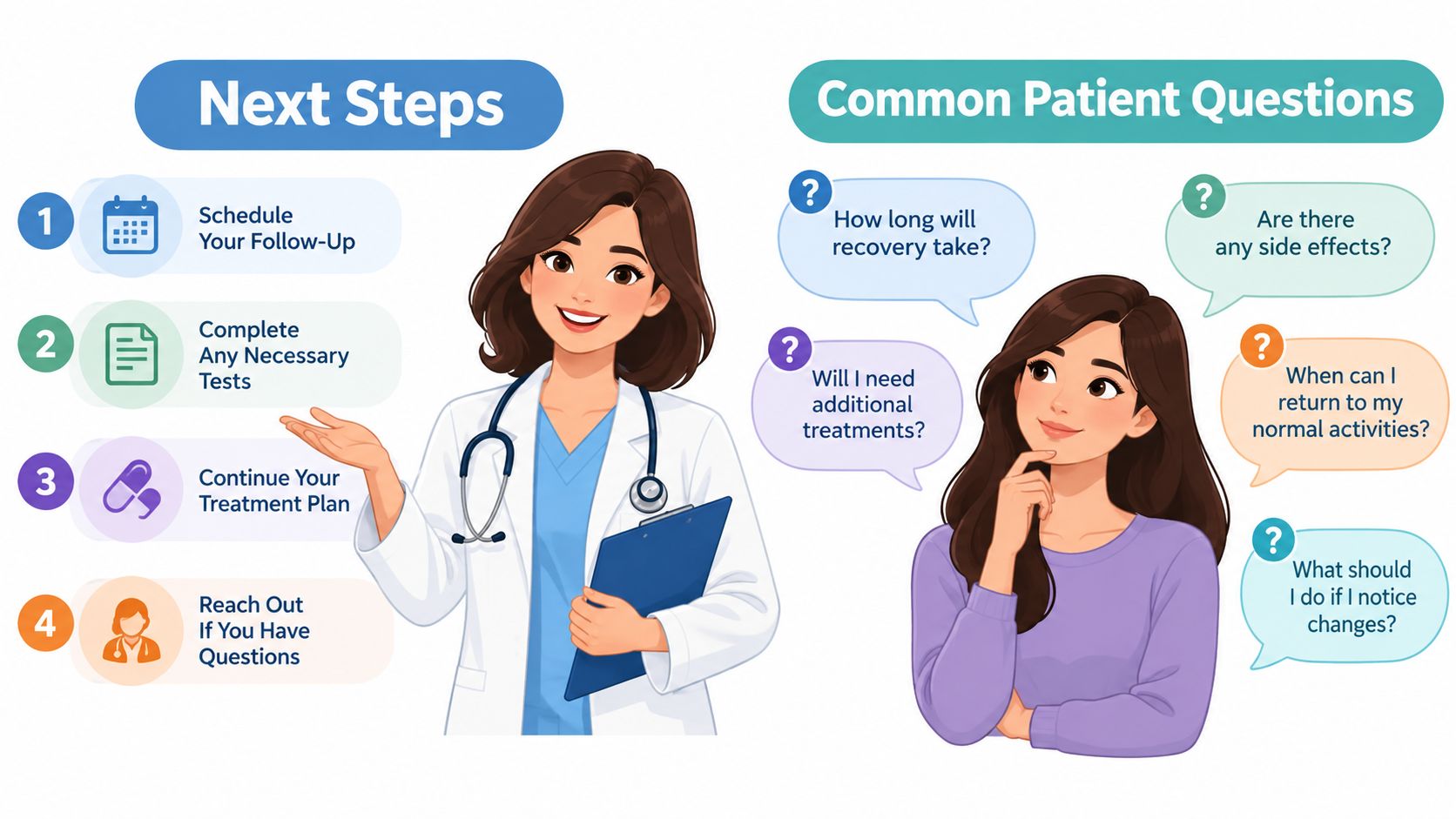
Questions patients often ask
How long will I need retainers? Retention is a long-term part of orthodontic care and often includes nighttime wear. Ask for the recommended schedule, replacement process, and instructions if a retainer becomes loose, damaged, or uncomfortable.
What should I do if I lose an aligner? Contact the dental office instead of guessing whether to continue, skip ahead, or return to an earlier tray. The correct instruction depends on your place in the sequence and how the surrounding trays fit.
How soon should I start after a consultation? There is no universal waiting period. Some patients begin after reviewing the plan and completing recommended dental treatment. Others compare options or arrange finances first. Start only after you understand the diagnosis, alternatives, fees, wear routine, and retention plan.
What if aligners are not the right choice? Traditional braces or a combined approach may control certain movements more effectively. A responsible consultation should explain that possibility rather than present aligners as suitable for every patient.
For Santa Ana families, a sound decision balances appearance, clinical suitability, daily habits, and long-term maintenance. Clear trays can simplify meals and brushing, but they still depend on consistent wear and ongoing retainer care.
Bristol Dental & Orthodontics offers Invisalign and orthodontic consultations in Santa Ana, along with family, cosmetic, restorative, sleep apnea, and emergency dental care. Visit Bristol Dental and Orthodontics to learn more and schedule a consultation with Dr. Andrew Finley about whether clear aligners fit your smile and routine.