
A Santa Ana parent may search “orthodontics vs orthodontist” after a dentist mentions crowding, or an adult may wonder whether clear aligners belong with a general dentist or a specialist. The confusion is understandable because the words look similar, but they describe different things.
Orthodontics is the dental specialty and the care itself. An orthodontist is the licensed dentist with advanced specialty training who provides that care. The distinction matters when a patient needs more than a cosmetic change, such as bite correction, growth guidance, or complex tooth movement.
Orthodontic need is widespread. Pooled research estimates the global prevalence of orthodontic treatment need at about 46.0%, with a 95% confidence interval of 38.0% to 53.0%, while functional need alone is about 45%. Research in the United States and other Western markets has found that roughly 57% to 59% of people show some level of orthodontic need, and one U.S. population analysis reported that about 20% of adults ages 18 to 50 had received orthodontic treatment. These figures are summarized in pooled research on orthodontic treatment need.
For families in Santa Ana, Costa Mesa, Tustin, Irvine, and Garden Grove, the practical question isn't just which word is correct. It's whether the person evaluating the bite has the right training for the problem, whether treatment can be managed locally, and whether timing matters for a growing child. This guide explains the difference in plain language, including braces, Invisalign-style aligners, retainers, referrals, digital planning, access, and related dental concerns. Your individual needs can't be determined from an article, so Dr. Andrew Finley should review your specific situation before you choose a treatment path.
Table of Contents
- Introduction to Orthodontics vs Orthodontist for Santa Ana Families
- What Orthodontics Means and What an Orthodontist Does
- How Training and Credentials Differ Between General Dentists and Orthodontists
- Common Orthodontic Treatments and How They Are Planned
- Who Should Provide Your Care and When to Seek a Referral
- What to Expect for Cost Timelines and Access in Orange County
- Choosing the Right Next Step With Bristol Dental and Orthodontics
Introduction to Orthodontics vs Orthodontist for Santa Ana Families
A family might arrive at a dental visit expecting a routine cleaning and leave with a recommendation to explore orthodontic care. Their child's teeth may look fairly straight, but the bite could be uneven. An adult may have a small space or rotated tooth and assume a short aligner plan is all that's needed. Both patients may then type the same search into Google: orthodontics vs orthodontist.
The simplest answer is this:
- Orthodontics refers to the specialty, diagnosis, treatment planning, and appliances used to address tooth and jaw alignment.
- An orthodontist is the specialist dentist who evaluates those concerns and manages orthodontic treatment.
That distinction is more useful than treating the terms as two competing types of treatment. Braces and clear aligners are examples of orthodontic treatment. The orthodontist is the trained provider who decides whether those appliances are suitable, how the bite should be managed, and how the teeth should be monitored.
Orthodontics can address appearance, but it also concerns function. A patient might seek help for crowding, spacing, an overbite, an underbite, a crossbite, or a bite that makes chewing difficult. Some cases are relatively straightforward. Others involve jaw relationships, tooth eruption, previous treatment, or growth, and those factors can change the appropriate plan.
The practical distinction: orthodontics describes the field and care, while orthodontist describes the specialist who delivers it.
Historically, the field developed separately from general dentistry through milestones that included Norman Kingsley's 1880 text, A Treatise on Oral Deformities, and Edward H. Angle's 1890 publication, Treatment of Malocclusion of the Teeth and Fractures of the Maxillae. A history of orthodontics overview describes how these developments helped establish malocclusion treatment as a distinct discipline.
For a Santa Ana family, the next step is usually a careful evaluation, not a decision based only on an appliance advertisement. A consultation can clarify whether the concern is primarily cosmetic, functional, developmental, or connected to another dental issue. Keep reading for the distinctions that can help you ask better questions at Bristol Dental & Orthodontics.
What Orthodontics Means and What an Orthodontist Does
The word orthodontics names a dental specialty. The word orthodontist names the specialist dentist who practices in that field. Once that difference is clear, many confusing treatment questions become easier to answer.
The American Dental Association describes orthodontics and dentofacial orthopedics as the specialty involving the diagnosis, prevention, interception, and correction of malocclusion, along with neuromuscular and skeletal abnormalities affecting developing or mature facial structures. An orthodontist is a dental specialist whose practice is limited to intercepting and treating malocclusion and related abnormalities. You can review the terminology in the ADA glossary of dental terms.
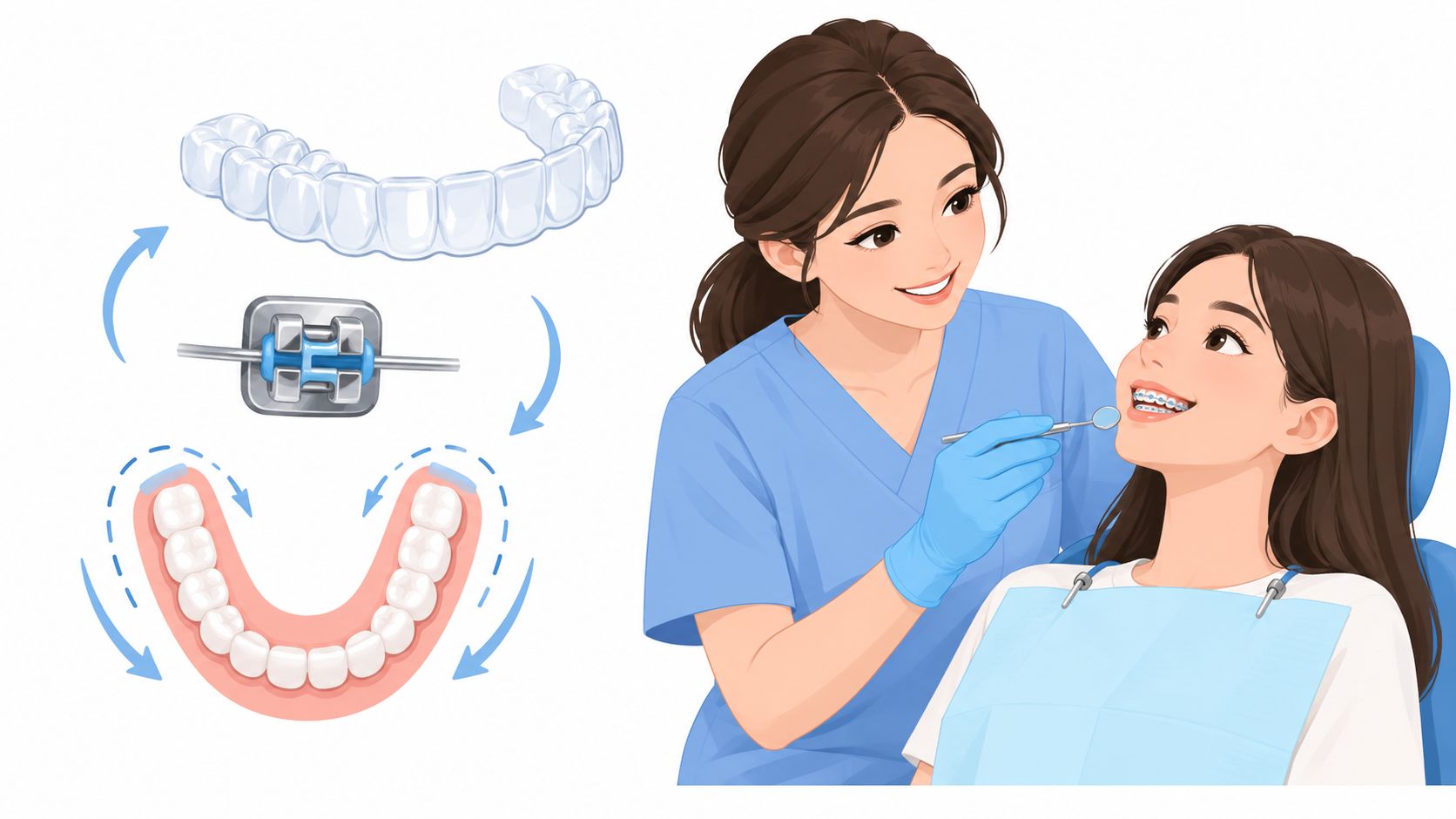
Orthodontics describes the care
Orthodontic care can include observation, preventive guidance, interceptive treatment during growth, braces, clear aligners, retainers, and bite correction. The right option depends on the patient's teeth, supporting structures, growth pattern, oral health, goals, and ability to follow the plan.
“Malocclusion” is the clinical term for a bite or alignment relationship that isn't ideal. It can involve the way individual teeth line up, the way the upper and lower arches meet, or the relationship between the jaws. A concern that looks small in a photograph may require a more complete evaluation before anyone can recommend treatment.
An orthodontist manages the specialty
An orthodontist doesn't just select an appliance from a menu. The specialist evaluates the problem, determines what movement is appropriate, watches for changes, and adjusts treatment as needed. For children, the assessment may also consider growth and the timing of tooth eruption. For adults, the plan may need to account for restorations, gum health, missing teeth, or previous orthodontic treatment.
A general dentist may identify an orthodontic concern during a regular examination and provide initial guidance. That referral can be helpful even when the teeth appear mostly straight, because bite problems and developing issues aren't always obvious to a patient.
At Bristol Dental & Orthodontics, Santa Ana families can discuss alignment concerns within a broader dental setting. The important question remains the same for every practice: What is the diagnosis, and who has the training and experience to supervise the proposed care?
How Training and Credentials Differ Between General Dentists and Orthodontists
A Santa Ana parent may hear that a general dentist and an orthodontist can both provide alignment care, then wonder whether the titles mean the same thing. Both begin as dentists, but their education and daily clinical focus differ. A general dentist usually cares for children and adults across preventive visits, fillings, crowns, cosmetic dentistry, emergencies, and restorative planning. An orthodontist completes dental school, then undertakes advanced residency training in tooth movement, bite relationships, jaw development, and related abnormalities.
The American Association of Orthodontists describes orthodontics as the specialty focused on diagnosing, preventing, intercepting, and treating malocclusion. It identifies an orthodontist as a specialist dentist who has completed advanced residency training and limits practice to this field. The AAO explanation of orthodontists and dentofacial orthopedists explains this distinction.
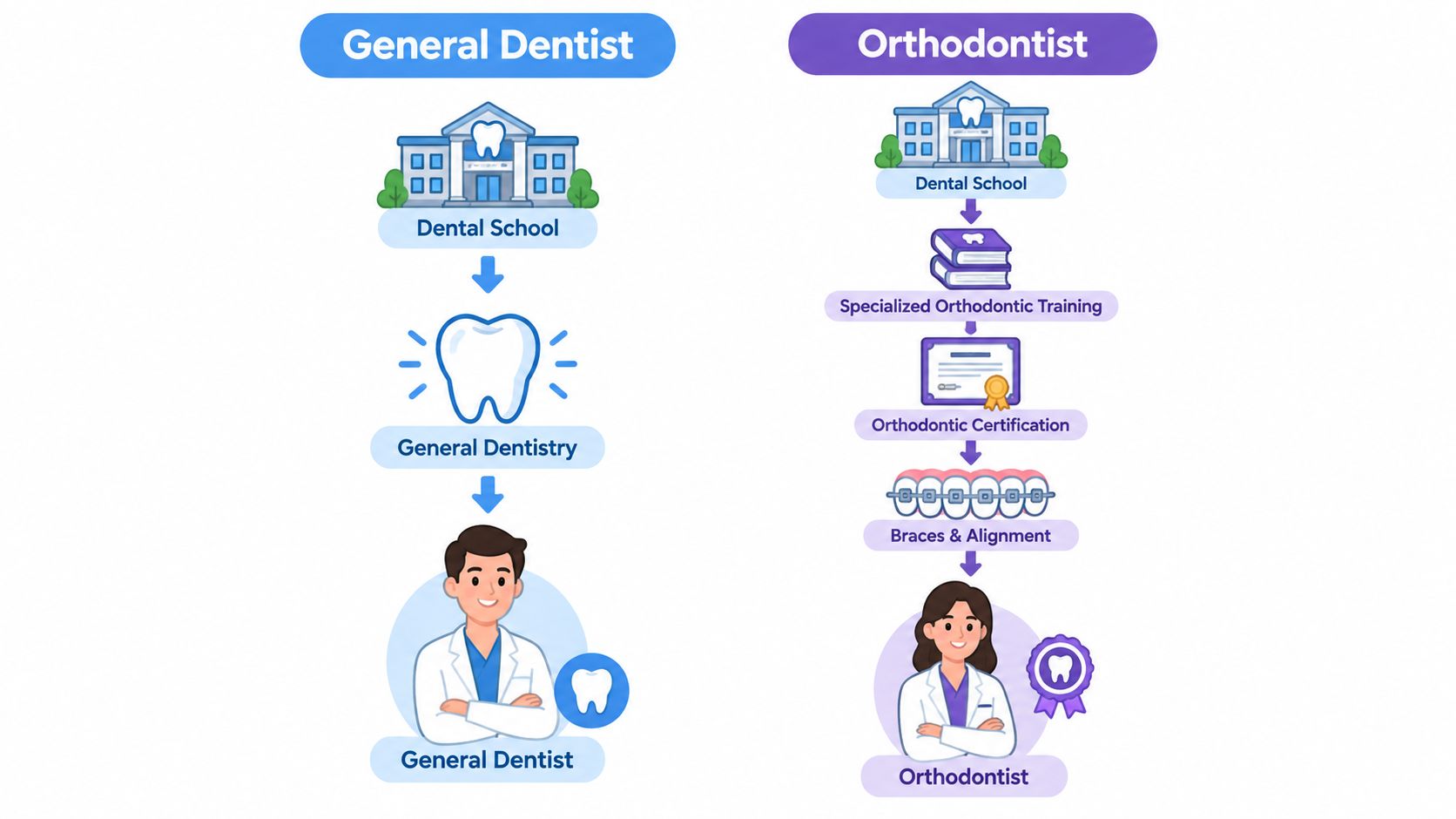
The difference in practical focus
| General dentist | Orthodontist |
|---|---|
| Provides family and cosmetic dental care | Limits practice to orthodontic and related alignment care |
| Evaluates overall oral health | Focuses on tooth movement, bite, and jaw relationships |
| May provide selected straightforward orthodontic services | Manages complex movement, growth guidance, and bite correction |
| Coordinates fillings, crowns, implants, and other dental needs | Plans and supervises orthodontic mechanics and retention |
The boundaries can overlap. After reviewing oral health and treatment goals, a general dentist may manage a straightforward aligner case. An orthodontist may be a better fit when care involves significant bite correction, complex tooth movement, relapse after earlier treatment, or growth-related concerns.
A useful decision rule is simple: as treatment depends more on bite correction, jaw relationships, growth, or complicated movement, specialist assessment becomes more relevant. For a growing child, timely evaluation can also clarify whether access and development affect the treatment plan.
Training is only one part of the choice. Families should also ask who will take records, supervise treatment, handle urgent concerns, and coordinate preventive or restorative dental care. Braces do not replace routine dental visits, and some patients need fillings, crowns, or gum care before or during alignment.
Bristol Dental & Orthodontics offers a setting where general dental and orthodontic considerations can be discussed, with treatment decisions reviewed by Dr. Andrew Finley. The appropriate provider and appliance depend on the clinical problem, the patient's oral health, and the supervision the plan requires.
Common Orthodontic Treatments and How They Are Planned
Orthodontics includes more than “straightening teeth.” The treatment plan may address crowding, spacing, rotations, overbites, underbites, crossbites, open bites, tooth eruption, or the way the upper and lower jaws relate. The appliance is a tool. The diagnosis determines how that tool should be used.
Braces, aligners, and retainers
Traditional braces use brackets, wires, and other components to apply controlled forces to teeth. They can be used for many types of movement, with adjustments made during follow-up care. Their visible design may concern some adults and teens, but their suitability depends on the case rather than appearance alone.
Invisalign-style clear aligners use a sequence of removable trays. The trays are designed to guide teeth through planned movements, and the patient must wear them as instructed for the plan to work as intended. Aligners are typically replaced in sequence about every 1 to 2 weeks, although the timing varies according to doctor instructions and the patient's treatment plan, as explained in this clear aligner system FAQ.
Retainers are used after active movement to help maintain the new tooth positions. Retention isn't an optional cosmetic extra. Teeth can shift over time, and the appropriate retainer schedule depends on the patient and the treating clinician's instructions.
Orthodontic treatment options at a glance
| Treatment | Best For | Planning Notes |
|---|---|---|
| Braces | Patients needing controlled movement across several teeth or bite correction | The clinician evaluates brackets, wires, oral hygiene, bite goals, and follow-up needs |
| Clear aligners | Selected patients seeking removable, less visible treatment | The plan must account for wear instructions, attachment needs, movement limits, and monitoring |
| Retainers | Maintaining tooth positions after active treatment | The type and schedule should follow the treating clinician's recommendations |
| Bite-focused orthodontic care | Patients with overbites, underbites, crossbites, or open bites | The provider assesses how the teeth and jaws function together, not just how the smile looks |
Planning requires records
An orthodontic plan shouldn't rely on a single glance or one photograph. Evidence supports using digital models instead of plaster casts in appropriate workflows. It also indicates that cephalograms aren't routinely needed for Class II malocclusions, while CBCT may be indicated for impacted canines. The review of orthodontic diagnostic records supports selective imaging and notes that the minimum record set remains undefined.
That approach helps the clinician gather enough information without automatically ordering every available image. Digital scans, photographs, radiographs, and clinical examination each answer different questions. At Bristol Dental & Orthodontics, Invisalign and orthodontic planning should be discussed alongside the patient's broader cosmetic and oral health goals.
Who Should Provide Your Care and When to Seek a Referral
A general dentist may be an appropriate starting point for a patient with a limited, straightforward alignment concern and healthy teeth and gums. A referral to an orthodontist becomes more important when the bite, growth, previous treatment, or complexity changes the decision.
Consider a Santa Ana child whose front teeth look crowded as adult teeth begin to erupt. The family dentist may identify the concern, monitor development, or recommend specialist evaluation. The need for referral isn't determined by appearance alone. Growth guidance and the timing of eruption can influence what a specialist wants to assess.
A teenager in Tustin might want clear aligners for mild spacing. A general dentist may evaluate whether that type of case fits their scope, while an orthodontist can assess whether the bite and tooth movement require more specialized control. The right answer depends on the records and diagnosis, not on age or the popularity of an appliance.
An adult in Irvine, Costa Mesa, or Garden Grove may have teeth that shifted after earlier treatment. Relapse risk, missing teeth, crowns, gum considerations, and the intended final bite can make the case more involved than it first appears.

Questions that help guide the decision
- Ask what is being corrected: Is the concern limited to tooth position, or does it involve the bite and jaw relationship?
- Ask how growth affects the plan: For a child, could development or eruption change the timing of care?
- Ask about complexity: Does the case involve previous orthodontics, impacted teeth, significant rotations, or extensive movement?
- Ask who will supervise treatment: Will the same clinician review progress, modify the plan, and handle complications?
- Ask how general dental needs fit: Are cleanings, fillings, cosmetic work, implants, or gum health part of the overall plan?
Technology can support care, but it doesn't replace clinical responsibility. Current 2026 orthodontic trend coverage emphasizes AI monitoring, digital scans, and virtual check-ins, while warning that AI should support triage and workflow rather than replace in-person specialist diagnosis and supervision. That position is described in current orthodontic technology coverage.
Access also matters. Specialist service mapping in South Australia found a general pattern of lower orthodontic availability and accessibility outside major cities and in lower socioeconomic areas, with some locations having no orthodontists and no compensating increase in orthodontic auxiliaries. The specialist access study illustrates why families shouldn't ignore timing-sensitive concerns because the child's teeth look acceptable today.
For Santa Ana families, a timely discussion with a dentist or orthodontist can clarify whether monitoring, treatment, or referral makes sense. The aim isn't to send every patient to a specialist. It's to match the provider's scope to the patient's needs.
What to Expect for Cost Timelines and Access in Orange County
Orthodontic cost and timing can't be estimated responsibly from a search term alone. A plan may be influenced by the complexity of tooth movement, the type of appliance, the patient's age and growth, oral health, missed visits, aligner wear, and whether other dental treatment is needed first. Two people with similar-looking crowding can still receive different recommendations.
Ask the practice to explain what the proposed plan includes. Useful questions cover the examination, records, appliance, follow-up visits, refinement or adjustment decisions, retainers, and what happens if the diagnosis changes. Families should also ask how urgent concerns are handled and whether the office can coordinate care with the patient's general dentist.
Timing depends on more than the appliance
A child's growth and eruption can affect when a clinician recommends evaluation or treatment. An adult may need restorative planning before alignment, particularly if the desired result involves dental implants, cosmetic dentistry, or replacement of missing teeth. A patient who has an urgent dental problem should address that concern rather than beginning elective alignment without an examination.
Planning also depends on records. Orthodontic diagnosis uses a multi-record dataset rather than one exam. Digital models can replace plaster casts in appropriate situations, while imaging should be selected for a clinical reason. As noted in the evidence review cited earlier, cephalograms aren't routinely needed for Class II malocclusions, while CBCT may be indicated for impacted canines.
Ask for a reason behind every record: the right image or scan should answer a clinical question, not simply add information.
Bristol Dental & Orthodontics also addresses related needs that can affect treatment planning. Dental implants may require coordination with alignment goals, sleep apnea care may involve an oral appliance evaluation, and emergency dentistry may take priority when pain, swelling, or injury is present. These services don't turn every case into an orthodontic case. They help place alignment decisions within the patient's complete oral health picture.
Orange County families can use a consultation to discuss access, scheduling, treatment alternatives, and the factors that may affect the plan. A clear conversation is more useful than expecting a universal timeline or a one-size-fits-all cost estimate.
Choosing the Right Next Step With Bristol Dental and Orthodontics
The phrase orthodontics vs orthodontist becomes easier to understand when you reduce it to one question: are you asking about the type of care, or the specialist who provides it?
Use this short checklist before scheduling:
- Describe the concern clearly. Mention crowding, spacing, bite changes, jaw discomfort, relapse, or a child's developing teeth.
- Bring previous records when available. Earlier orthodontic treatment, dental work, or imaging may help the clinician understand the history.
- Ask whether the goal is cosmetic, functional, or both. Straight-looking teeth don't always tell the full story about the bite.
- Ask who will supervise the plan. Find out how progress will be reviewed and when referral would be appropriate.
- Discuss related dental care. Implants, cosmetic dentistry, sleep apnea oral appliance therapy, and emergency needs can affect treatment order.
Digital scans and virtual check-ins may make monitoring more convenient, but convenience isn't a substitute for diagnosis, examination, and supervision. A provider should still explain the findings, the treatment choices, the expected responsibilities, and the reasons for any referral.
For families near South Bristol Street, a consultation with Bristol Dental & Orthodontics can provide a starting point for understanding whether general dental care, orthodontic treatment, or coordinated care is appropriate. The practice serves Santa Ana and surrounding Orange County communities, including Costa Mesa, Tustin, Irvine, and Garden Grove. Each patient's plan should be based on an in-person evaluation and reviewed by Dr. Andrew Finley.
Bristol Dental and Orthodontics offers family and cosmetic dental care, including braces, Invisalign, dental implants, sleep apnea oral appliance therapy, emergency dentistry, and related treatment planning. Visit Bristol Dental and Orthodontics to request a consultation and discuss the right next step for your smile or your child's developing bite.