
Losing a tooth rarely happens at a convenient time. For many adults in Santa Ana, it starts with a cracked molar, a long-delayed extraction, or a tooth that never quite felt right after a root canal. Then life gets busy. Work, school pickup, traffic on the 55, and family routines push the problem to the side until chewing on one side becomes normal.
That's usually when people start searching for a tooth implant in California and realize how much conflicting information is out there. Some articles make implants sound like a quick upgrade. Others make the process feel overwhelming. The truth sits in the middle. A dental implant can be an excellent long-term solution, but it's a planned treatment, not a one-day purchase.
Implant use has grown dramatically in the United States. One large NHANES-based study found an average covariate-adjusted 14% increase in implant prevalence per year between 1999 and 2016, and prevalence among adults with missing teeth rose from 0.7% to 5.7% during that period, according to this NHANES implant prevalence study. That tells us two things. Implants have moved into mainstream restorative dentistry, and many people who could benefit from them still haven't started treatment.
Table of Contents
- What It's Really Like to Get a Tooth Implant in California
- How a Dental Implant Actually Works
- Who Is a Good Candidate and What Options Exist
- The Implant Timeline From First Visit to Final Crown
- Planning for Cost, Insurance, and Long-Term Value
- How to Choose an Implant Dentist You Can Trust
- Your Next Step With Bristol Dental and Orthodontics
What It's Really Like to Get a Tooth Implant in California
A common Santa Ana story goes like this. A parent in their forties lost a back tooth months ago, meant to deal with it sooner, then finally booked a consultation after getting tired of chewing around the gap. They weren't looking for something fancy. They just wanted to eat comfortably again and stop worrying that the space was causing other problems.
What surprises most patients is that the first visit usually brings relief, not pressure. You sit down, review what happened, take images, and learn whether the bone and gum tissue are strong enough for an implant now or whether you need preparation first. That clarity matters. Before the visit, the situation feels vague. After the visit, it becomes a sequence of manageable steps.
The emotional side is real
People often come in with a mix of hesitation and quiet embarrassment. They may think they waited too long, or they assume the process will be painful and complicated. In reality, the emotional arc is often steadier than expected.
- At first: many patients are unsure whether an implant is even possible for them.
- During the exam: they learn that candidacy isn't a simple yes or no. Bone shape, gum health, bite forces, and timing all matter.
- After planning: many feel calmer because there's a real roadmap instead of internet guesswork.
Practical rule: If you're feeling uncertain, that doesn't mean you're a poor candidate. It usually means you need a proper exam instead of more online searching.
California life shapes the process
Orange County patients often juggle demanding schedules. A treatment plan has to fit real life. That means thinking about commute times from Costa Mesa, Tustin, Irvine, or Garden Grove, planning recovery around work, and deciding whether you want treatment phased over time.
California also adds a practical layer to the decision. A statewide fact sheet reports that projected 2026 average pricing for a complete single dental implant in California is $5,733 versus a national mean of $4,507, or about 27% higher, with substantial variation by city, according to this California dental fact sheet. The same report notes access pressure as well, including 32.6% of dentists accepting Medicaid patients and only 9 of 58 counties meeting a dental-desert definition. For patients, that means planning matters. Rushing usually doesn't.
A good implant experience feels less like buying something and more like moving through phases with a clear purpose. One visit gathers information. Another may prepare the site. Surgery places the foundation. Healing does quiet work in the background. Then the final tooth goes on top. When patients understand that rhythm, the whole process feels much more approachable.
How a Dental Implant Actually Works
A dental implant works like a small foundation built inside the jaw. The visible tooth matters, of course, but the reason an implant can feel stable is that part of the system is placed below the gumline and supported by bone.
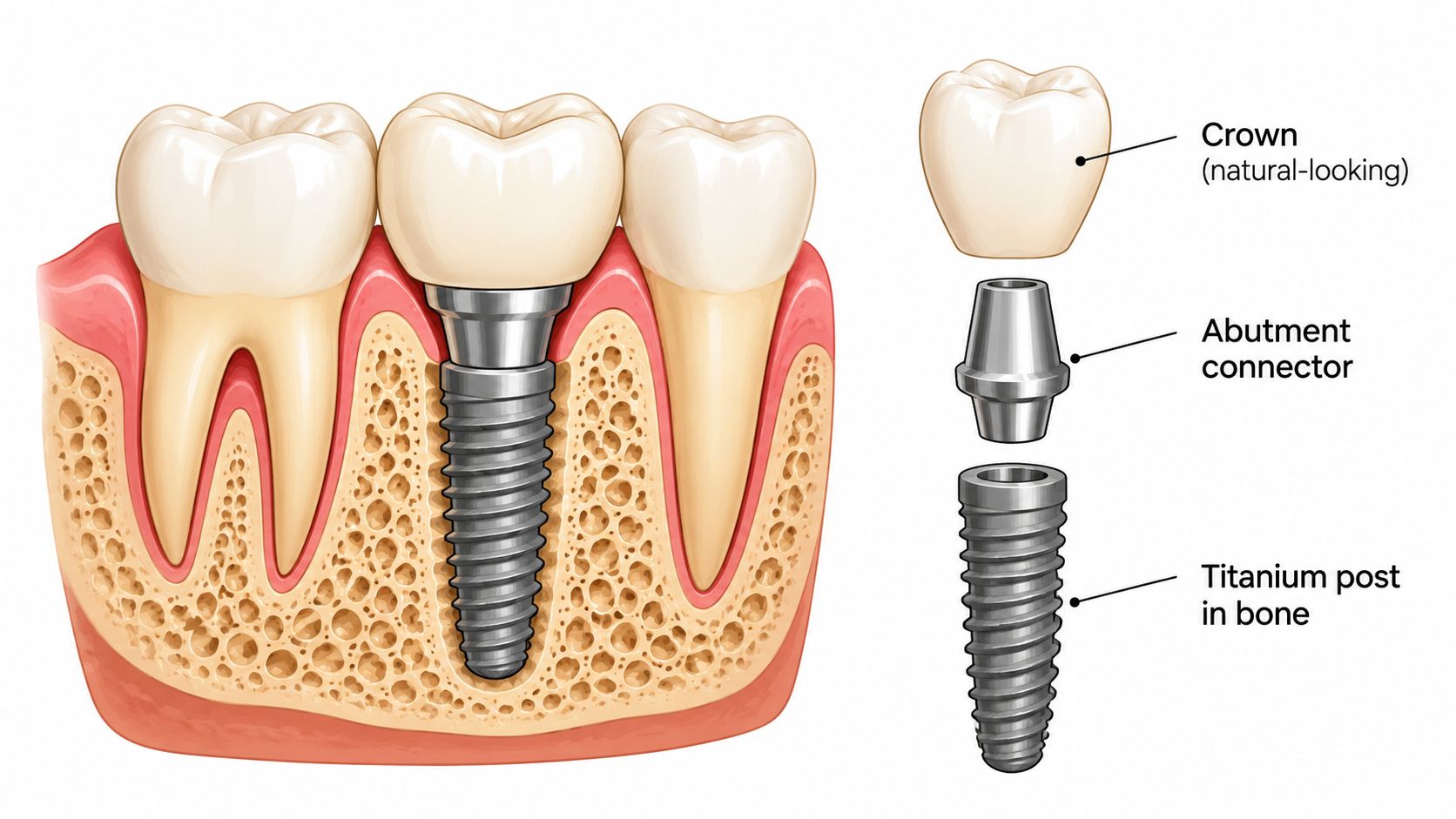
That hidden support is what makes implants different from just filling a gap. In practical terms, you are replacing both the missing root and the missing tooth above it. For California patients comparing fees between offices, that distinction matters. You are not paying for one part. You are paying for a system, careful planning, surgery, healing, and the final restoration that has to function well for years.
The three parts of the system
An implant restoration usually has three main parts.
- Implant fixture: the small post placed in the jawbone. This acts as the root substitute.
- Abutment: the connector piece that joins the implant to the final tooth.
- Crown: the custom-made visible tooth attached on top, as explained in this guide to implant components.
People often get confused. In everyday conversation, “implant” can mean the whole replacement tooth. In clinical use, the implant usually means the fixture in the bone.
That difference matters during treatment planning because each part has its own job, its own material choices, and its own fee in many offices.
Why healing takes time
After the fixture is placed, the bone has to bond to its surface. Dentists call that osseointegration. A simpler way to say it is that the jaw needs time to grip the implant tightly enough to support normal biting.
This phase is quiet, but it does the heavy lifting.
If you rush the process, the final crown may be sitting on a foundation that is not fully stable yet. A careful local implant dentist is not dragging things out for no reason. In many cases, they are protecting the long-term result, which matters even more in a state where treatment costs can be high and redoing failed work is expensive.
What makes an implant feel different
Once healed, an implant transfers chewing pressure into the jaw more like a natural tooth root than a removable appliance does. Titanium is commonly used because it has a long record of working well with the body.
Patients often describe the difference in simple terms. A removable option can sit on the gums. An implant is anchored within the bone. That design can improve stability, but it also means planning has to be precise. Position, angle, bite pressure, and gum shape all affect how the final tooth looks and how long it holds up.
The crown is the part you notice every day. The long-term value usually depends on the part underneath and the precision of the plan around it.
How implants differ from bridges and dentures
A traditional bridge is supported by neighboring teeth. A denture sits on the gums and may move more during eating or speaking. An implant-supported tooth stands on its own.
That independence is a big reason patients ask about implants, especially if the teeth next to the space are healthy. Preserving those neighboring teeth can be a meaningful advantage. It is still a case-by-case decision, not an automatic one.
Here is the plain-language version:
- Bridge: often a practical choice, but it usually relies on adjacent teeth.
- Denture: can replace several teeth at once, but it does not feel fixed in the same way.
- Implant: replaces the missing root support below the gums and the tooth above it.
The final crown deserves just as much attention as the implant itself, especially in the front of the mouth where small differences in shape, color, and gumline are easy to see. A good California implant plan accounts for both function and appearance from the start, so you are choosing a team based on long-term judgment, not just the surgery fee.
Who Is a Good Candidate and What Options Exist
Wanting a simple answer to candidacy is understandable. A quick “Am I a candidate or not?” would be convenient. In practice, it's more of a spectrum. Some patients are ready now. Some need preparatory treatment. Some are better served by a different type of restoration.
What dentists look for first
A thoughtful implant evaluation usually starts with a few big questions.
- Bone support: Is there enough jawbone height and width to hold an implant securely?
- Gum health: Are the gums healthy enough to support long-term stability?
- Medical control: If you have chronic health conditions, are they well managed?
- Tobacco use: Smoking can complicate healing, so your dentist will want an honest discussion about it.
- Bite patterns: Grinding, clenching, and heavy bite forces may affect planning and material choices.
Many of these factors aren't fixed forever. Bone can sometimes be built up. Gum disease can be treated. A timeline can be adjusted to improve your odds of success.
Candidacy factors and matching implant options
| Patient Situation | Key Candidacy Factors | Recommended Implant Option |
|---|---|---|
| One missing tooth with healthy neighboring teeth | Adequate bone, stable gums, good bite space | Single-tooth implant |
| Several missing teeth in one area | Enough support across the span, healthy surrounding tissue | Implant-supported bridge |
| Most or all teeth missing in an arch | Overall bone pattern, denture tolerance, maintenance goals | Implant-retained denture or fixed full-arch solution |
| Missing upper back teeth | Sinus position and bone height | Implant with possible sinus lift planning |
| Long-standing missing tooth | Bone loss over time may need correction | Implant after bone grafting if appropriate |
The main treatment paths
A single-tooth implant is often the cleanest option when one tooth is missing and the teeth beside it are healthy. An implant-supported bridge can make more sense when several teeth in a row are missing. For people missing most or all teeth, implant-retained dentures or fixed full-arch solutions may provide better value and function than placing one implant for every missing tooth.
That last point matters in California. Full-arch treatment can vary widely in cost and design, and treatment choice changes the plan as much as tooth count does. Reported California averages for All-on-4 or full-arch treatment are around $26,840 per arch, with broad ranges from roughly $14,640 to $42,700, according to this California full-arch cost overview. The lesson isn't that one approach is better. It's that the best answer depends on bone quality, number of missing teeth, and the kind of maintenance a patient is comfortable with.
A single missing tooth and a full-arch reconstruction may both involve implants, but they are not the same treatment problem.
When extra preparation is needed
Some patients need a bone graft before implant placement because the ridge has thinned after a tooth was lost. Others with missing upper back teeth may need a sinus lift if the sinus sits too close to the planned implant site. There are also cases where an immediate-load approach is possible, meaning a temporary tooth is attached sooner, but that decision depends on stability and bite conditions, not preference alone.
This is one reason a careful exam matters more than assumptions. Two patients with the same missing tooth may need very different plans.
The Implant Timeline From First Visit to Final Crown
The implant timeline feels easier when you know what each stage is trying to accomplish. Most frustration comes from expecting one visit to solve a problem that unfolds over several phases.
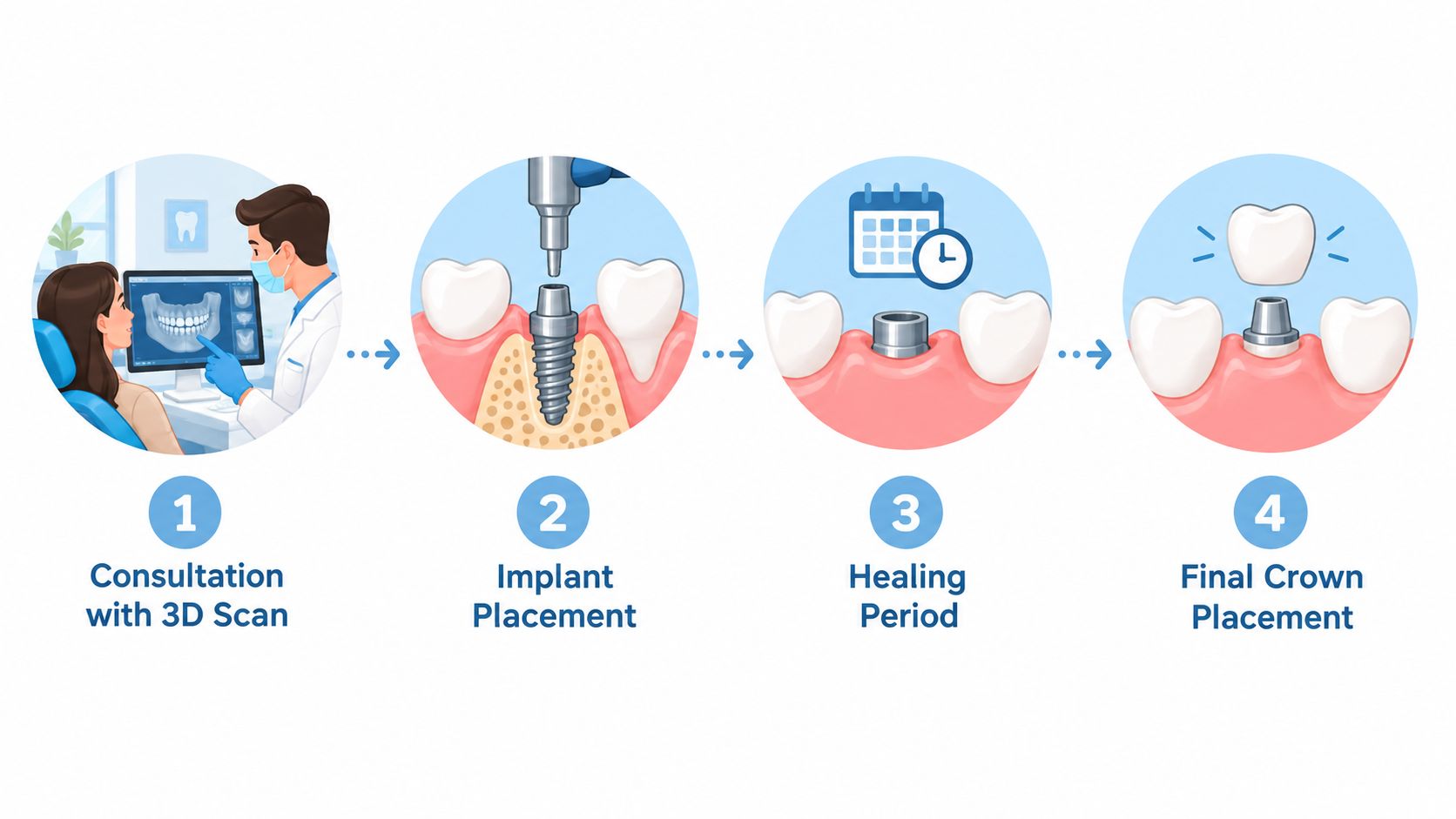
Phase one is information gathering
The first appointment usually includes an exam, digital imaging, and a review of your dental and medical history. That's when the dentist checks bone shape, gum condition, bite space, and whether any preparatory work is needed.
Sometimes the plan is straightforward. Sometimes it starts with an extraction or site development. Neither is a setback. It's just part of sequencing treatment properly.
The middle phase requires patience
If a damaged tooth is still present, it may need to be removed before or at the time of implant treatment. If the area lacks enough support, grafting may be recommended before the implant is placed. After that, the implant itself is surgically positioned in the jaw.
Most patients are relieved to learn that the surgical appointment is often less dramatic than they imagined. You'll be numb. You may feel pressure or vibration, but not sharp pain. Afterward, mild soreness, swelling, and a softer diet for a period are common parts of recovery.
Here's the key stage many patients underestimate:
- Healing after surgery: soft tissue starts closing and the area settles.
- Osseointegration: the bone bonds to the implant surface over time.
- Reevaluation: the dentist confirms the implant is stable enough to restore.
That waiting period protects the long-term result. Hurrying the process can create problems later.
The last phase is about fit and function
Once the implant is ready, the abutment is connected and records are taken for the final crown. That final tooth isn't just dropped into place. Your dentist checks color, shape, bite contact, and how the restoration feels when you chew.
The most successful implant cases usually don't feel rushed. They feel organized.
Modern implant systems have strong durability when properly planned and maintained. A recent systematic review found a 10-year implant-level survival estimate of 96.4% with a sensitivity estimate of 93.2%, and for single crowns, 5-year survival was 97.2% and 10-year survival was 95.2%, according to this systematic review on long-term implant and crown survival. Those numbers don't mean every implant succeeds. They do support the idea that patience during healing is worth it.
Timelines vary. A healthy site may move faster. A site needing extraction, grafting, or bite adjustment may take longer. Follow-up visits matter because they let your dentist monitor healing instead of guessing from symptoms alone.
Planning for Cost, Insurance, and Long-Term Value
A California patient may call three offices and hear three very different prices for what sounds like the same tooth implant. That can feel confusing fast. In practice, those numbers may reflect three different treatment plans, three different levels of planning, and three different assumptions about what your mouth needs to stay stable over time.
That is why the most useful question is not just, "What is the price?" A better question is, "What is included in this plan, and why does this version fit my situation?"
Why California planning matters
California tends to be a higher-cost dental market. Rent, staffing, lab fees, imaging technology, and specialist coordination all affect fees. That does not automatically make a higher quote better. It does mean a low quote deserves a careful second look.
For example, one estimate may include the exam, 3D imaging, implant placement, healing visits, abutment, final crown, and post-treatment checks. Another may list only the surgical phase, with the restoration and follow-up billed later. On paper, both can look like "implant treatment." In real life, they are not the same purchase.
An implant is closer to building a foundation and then placing the house on top than buying a single item off a shelf. If one part of the plan is left vague, the final cost usually becomes vague too.
What usually changes the estimate
A written treatment plan should explain the parts that drive cost, not just the total.
- Condition of the site: A tooth lost recently may leave behind more usable bone and gum tissue than a space that has been empty for years.
- How many teeth are missing: Replacing one tooth is different from supporting a bridge or rebuilding a full arch.
- Design of the final restoration: The material, shape, and complexity of the final tooth affect lab work and bite planning.
- Care needed before the implant: Some patients need an extraction, grafting, gum treatment, or bite adjustment first.
- Maintenance needs: A plan should match how you chew, how easy the area will be to clean, and how often the restoration may need service over the years.
Written estimates help. They let you compare the same components across offices instead of reacting to one headline number.
Insurance usually helps in pieces, not all at once
Insurance can contribute, but it often does so unevenly. Some plans help with the crown or other restorative parts. Some exclude the implant itself. In injury-related or medically connected cases, medical coverage may also be part of the conversation. Every policy has its own rules, so pre-authorization and clear documentation matter.
Payment planning matters too. Patients often use health savings accounts, flexible spending accounts, or monthly financing to spread treatment out. The wise choice is usually the one you can complete without stopping halfway through care.
That matters more than many people realize.
An unfinished implant plan can create its own costs later if temporary solutions fail, nearby teeth shift, or the bite changes while treatment is postponed. Sometimes phased care is the better answer, especially if you are also planning orthodontic treatment or broader restorative work. The goal is not speed. The goal is a sequence that your mouth and your budget can both support.
Long-term value comes from fit, function, and upkeep. A well-planned implant can serve for many years, but it still needs checkups, home care, and occasional maintenance, just like a car with a strong engine still needs tire changes and oil service. Price matters. So does the quality of the plan behind that price.
How to Choose an Implant Dentist You Can Trust
Many people assume choosing an implant dentist comes down to one thing: who places the implant. That's only part of it. A good experience usually depends just as much on diagnosis, planning, communication, and how complications are handled if something doesn't go exactly as expected.

Questions worth asking
A careful patient has every right to ask direct questions at a consultation.
- Training and experience: What kind of implant training has the dentist completed, and how often do they handle cases like yours?
- Imaging and planning: Will the plan be based on in-office 3D imaging and digital evaluation, or on limited records?
- System and components: What implant system is being used, and why is it a fit for your case?
- Who handles each phase: Is the surgical phase done in-house, restored in-house, or coordinated with a specialist?
- Complication planning: If healing is slower than expected or the site changes, how will the office respond?
You don't need polished sales answers. You need clear clinical ones.
Green flags and red flags
Good implant consultations usually feel unhurried. The records are reviewed with you. The dentist explains why one option may suit your mouth better than another. If you ask a basic question, nobody acts annoyed.
Watch for a different tone if the office:
- Pushes you to commit before diagnostic records are reviewed.
- Gives vague answers about what the fee includes.
- Avoids discussing risks, alternatives, or maintenance.
- Can't show how the treatment will be sequenced.
Trust isn't built by hearing that a treatment is simple. It's built when the team explains what could be difficult and how they plan around it.
Fit matters as much as credentials
This is a long-term relationship. You may be returning over months for surgery, healing checks, and final restoration. You want a team that communicates well, respects your questions, and can coordinate care if your case overlaps with other needs.
That can matter for more than implants alone. Some patients pursuing tooth replacement are also dealing with cosmetic concerns, urgent broken teeth, or airway issues that affect clenching and sleep. If snoring or obstructive sleep apnea is part of the picture, the American Academy of Sleep Medicine and the American Academy of Dental Sleep Medicine recommend a custom, titratable oral appliance when a sleep physician prescribes oral appliance therapy for an adult with OSA, according to this joint oral appliance guideline. In other words, the right dental home looks at the whole patient, not just the missing tooth.
Your Next Step With Bristol Dental and Orthodontics
A patient from Santa Ana loses a back tooth, puts off replacing it for a year, then starts noticing two things. Chewing on that side feels less natural, and the cost estimate now includes more planning because the space and bone have changed. That is common in implant care. The next step is not picking the fastest treatment. It is getting a clear read on what your mouth looks like today, and what will hold up well five or ten years from now in California's higher-cost care environment.
At Bristol Dental & Orthodontics, that first visit is meant to answer practical questions in plain language. The team starts with an exam and digital imaging, then reviews whether the area is ready for an implant, whether prep work may help, or whether another replacement option makes more sense. Some cases are straightforward. Others involve grafting, bite concerns, or coordination with a specialist. A good plan should make that difference clear instead of treating every missing tooth like the same problem.
What a local treatment plan should include
A useful treatment plan works like a building plan before construction starts. You want to know what the foundation looks like, what order the work happens in, and where the extra costs could come from.
- A clear diagnosis: what the images show about bone support, gum health, spacing, and bite forces.
- A sequence of care: whether treatment involves extraction, grafting, implant placement, healing, and the final crown in separate phases.
- A realistic schedule: how long healing may take, when follow-up visits happen, and what daily function may look like in between.
- A fee breakdown: what is included, what may change if the case becomes more complex, and whether care can be spread out over time.
That kind of written plan helps patients in Santa Ana, Costa Mesa, Tustin, Irvine, and Garden Grove compare options with a calm head.
Why the right dental home matters
Implants are rarely just about one missing tooth. A patient may also need urgent care for a cracked tooth, want a front tooth to match nearby teeth better, or have bite and airway issues that affect how forces land on dental work over time.
That broader view matters because long-term success is not only surgical. It also depends on maintenance, bite balance, home care, and whether the office can connect the pieces when your needs overlap. If sleep-related symptoms are part of the picture, oral appliance care may also belong in the conversation, and the earlier guideline cited in this article helps explain when that kind of treatment fits.
Bristol Dental and Orthodontics offers implant consultations in Santa Ana with digital imaging, candid treatment discussions, and care that can connect with broader dental needs, including cosmetic dentistry, Invisalign, sleep apnea appliances, and emergency treatment. Dr. Andrew Finley and the team can help you understand whether an implant, bridge, or another option fits your mouth, your timeline, and your budget.