
If cold makes a tooth hurt, does that mean the nerve is damaged, or could the tooth have lost some of its protection? Tooth sensitivity to cold is usually dentin hypersensitivity, which happens when dentin becomes exposed and its microscopic channels remain open. But the same cold drink can also reveal a cavity, a crack, or a problem around a filling.
The useful clue isn't just that cold hurts. It's the pattern: how long the pain lasts, how many teeth react, whether biting hurts, and when the symptoms began. Understanding what causes tooth sensitivity to cold starts with those details, not with assuming every sudden zing means the same thing.
Table of Contents
- Causes of Cold Sensitivity at a Glance
- Why Cold Triggers the Sharp Zing
- How Erosion and Gum Recession Expose Dentin
- Cracks, Fillings and Other Structural Causes
- Who Is Most Likely to Notice Cold Sensitivity
- When to See a Dentist About Cold Sensitivity
- Home Relief and Prevention That Target the Cause
Causes of Cold Sensitivity at a Glance
Dentin sits beneath enamel and beneath the protective covering of tooth roots. For ordinary dentin hypersensitivity, the main ingredients are exposed dentin, open tubules, and a trigger. Cold is a familiar trigger, but sweets, acidic foods, air, and touch can also provoke discomfort.
A review available through PubMed Central describes dentin exposure and open tubules as the conditions behind hypersensitivity and reports global prevalence estimates ranging from 1.3% to 92.1%. Differences in populations and diagnostic methods explain much of that spread, so sensitivity is common but difficult to measure uniformly.
Causes of cold sensitivity and how each exposes dentin
| Cause | How It Exposes Dentin | Typical Clue |
|---|---|---|
| Enamel erosion | Dietary or stomach acid dissolves enamel, leaving dentin less protected | Sensitivity on several teeth, often after acidic foods or drinks |
| Abrasion | Aggressive brushing wears enamel and cementum near the gumline | Gumline sensitivity and notched wear at the tooth neck |
| Attrition and bruxism | Grinding or clenching wears down biting surfaces | Flattened chewing edges and sensitivity along biting surfaces |
| Gum recession | Gum tissue pulls back, exposing root dentin without an enamel covering | Teeth that look longer and sensitivity near the gumline |
| Periodontal disease | Gum disease damages supporting tissues and exposes roots | Sensitivity with bleeding gums or a changing gumline |
| Cracked tooth | A crack can provide a pathway for temperature changes, fluid, and bacteria toward inner tissues | Sharp pain on biting or release, often involving one tooth |
| Worn or defective filling | Gaps at a filling edge can expose dentin or allow leakage | Sensitivity concentrated in a filled tooth |
| Recent dental or cosmetic treatment | Whitening, cleaning, or orthodontic movement may temporarily increase sensitivity without necessarily exposing new dentin | Symptoms beginning after an appointment that may ease over time |
These causes often overlap. Acid-softened tooth surfaces may be more vulnerable to abrasive brushing, while someone who grinds may also have a large filling in the affected tooth.
Practical rule: A recognizable symptom pattern can guide an examination, but it can't diagnose a tooth.
The table also separates two different situations: a tooth that has lost surface protection and a tooth with possible structural damage. That distinction matters because the appropriate care may be very different.
Why Cold Triggers the Sharp Zing
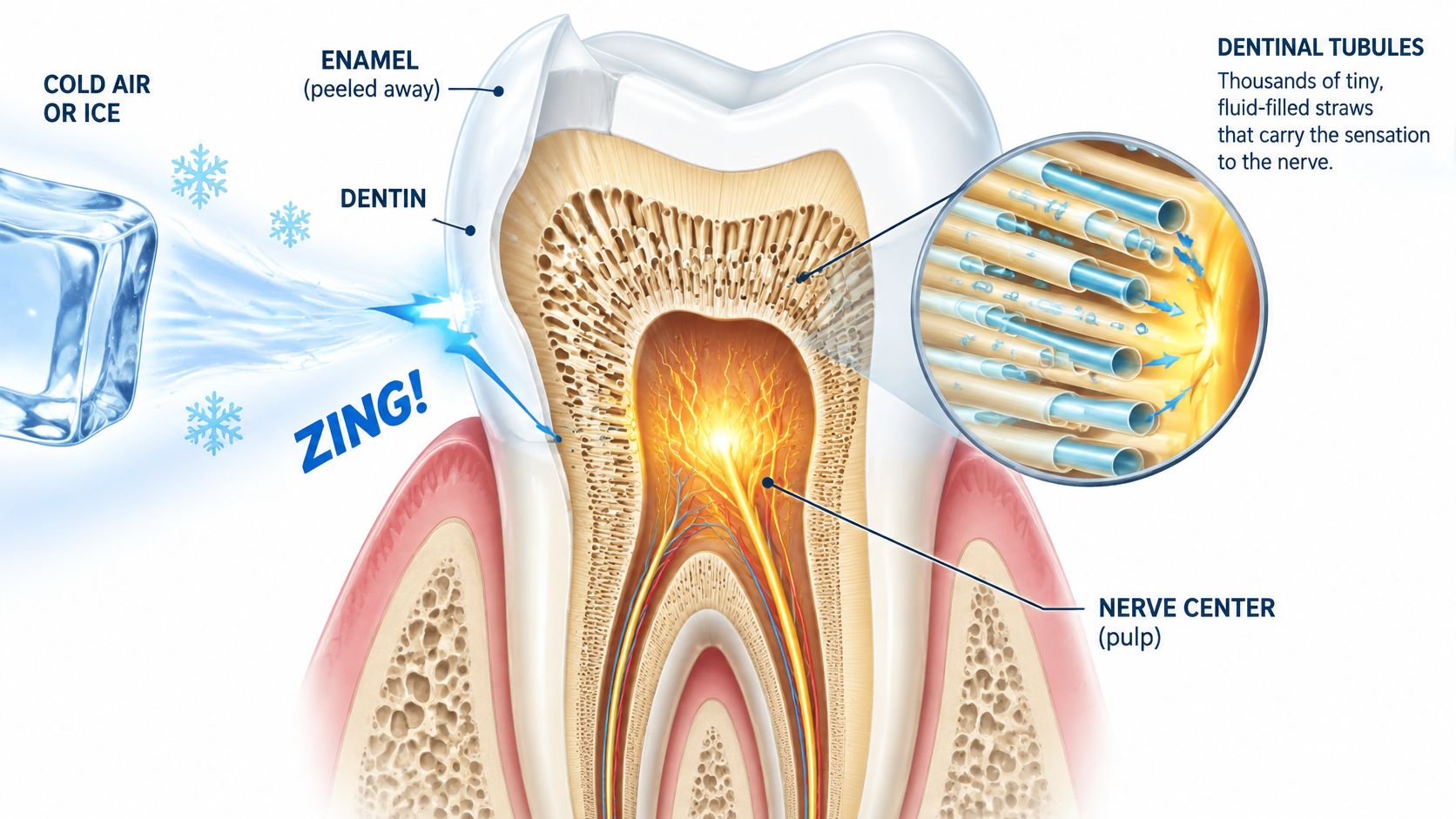
Think of dentin as a dense sponge containing tiny, fluid-filled straws. These channels, called dentinal tubules, extend through dentin toward the pulp, the inner tissue containing nerves and blood vessels. Enamel over the crown and cementum over the root help protect their outer ends.
The review in Temperature describes the hydrodynamic theory, the established explanation linking fluid movement inside open tubules with the sharp pain of dentin sensitivity. The important detail is that cold doesn't have to touch a nerve directly to provoke pain.
From a cold sip to a pain signal
- Cold changes the fluid. A temperature change alters the behavior of fluid inside exposed channels.
- Fluid moves rapidly. With cooling, movement is typically outward toward the tooth surface.
- Nerve endings respond. Mechanical forces near the pulp stimulate pain-sensitive nerve fibers.
- You feel a brief zing. Your brain receives a sudden pain signal rather than necessarily a sustained ache.
In ordinary dentin hypersensitivity, cold doesn't damage the nerve on contact. It moves fluid in channels connected to the sensitive inner part of the tooth.
Once the cold is removed, that rapid fluid shift settles. The response doesn't necessarily involve lasting pulp inflammation, which helps explain why ordinary hypersensitivity can stop so quickly.
Cold can feel stronger than heat because outward fluid movement is particularly effective at stimulating these nerve fibers. That doesn't make cold pain harmless in every case, and a different response to hot and cold isn't enough to identify the cause at home.
Why exposed dentin doesn't always hurt
Some exposed channels become narrowed or blocked by mineral deposits, a surface smear layer, or changes within the tooth, including secondary dentin formation. Less fluid movement can mean less sensitivity, even if the gumline hasn't returned to its previous position.
Say chilled water reaches an exposed root near a receded gumline. Open channels may produce an immediate sting. The same drink passing over well-protected enamel may cause no discomfort because the dentin underneath isn't directly exposed to the temperature change.
How Erosion and Gum Recession Expose Dentin
Dentin becomes exposed through two different mechanical events, and telling them apart changes what you look for. Erosion removes tooth material through acid exposure; recession shifts where the gum tissue covers the root. One process subtracts from the surface while the other moves the border, and an examination may find both at work in the same mouth.
When acid wears away the outer shell
Enamel is the hard outer covering of the tooth's crown, and the dentin beneath it is softer and less resistant to acid. Losing enamel leaves that underlying layer vulnerable. Mayo Clinic's explanation of tooth decay and enamel damage notes that acid-related enamel damage can allow bacteria and acid to reach dentin, increasing sensitivity to cold, hot, or sweet foods and drinks. Enamel doesn't grow back after it is lost, so the question that matters is how often acid touches the tooth.
Sipping an acidic drink slowly across a morning gives the enamel repeated exposures rather than one brief contact, and acid from reflux reaches teeth from the inside. Because the acid affects whichever surfaces it flows over, erosion tends to leave a broad pattern: several teeth reacting at once, often on the front or chewing surfaces where liquid pools. A dentist may also see cupping, small rounded dents on the biting surfaces where the enamel has dissolved. That spread-out pattern reads differently than a zing confined to one tooth or one spot.
When the gumline exposes the root
Roots lack the thick enamel covering found on the crown. They carry a thinner protective layer called cementum, and when the gumline moves down, the underlying root dentin is left uncovered.
Recession and mechanical wear leave different marks than acid. Where erosion produces rounded cupping, pressure against the tooth neck tends to carve a narrow groove or notch right at the gumline, a cervical wear spot you can sometimes feel with a fingernail. Clues that point toward exposure at the gumline include:
- A changed gumline: A tooth appears longer than neighboring teeth or longer than it used to.
- Localized tenderness: Cold water hurts where the tooth meets the gum.
- Cervical wear: A notch or worn area is visible near the tooth neck.
These clues don't prove that brushing caused the problem. Bite forces, gum disease, and acid exposure can produce overlapping findings, so the shape and location of the wear guide the next questions rather than settling them.
For patients in Santa Ana, Costa Mesa, Tustin, Irvine, and Garden Grove, bringing observations works better than arriving with a self-diagnosis. Where the zing occurs, how many teeth respond, and whether the sensitive spot sits on a biting surface or at the gumline all help separate surface wear from a structural problem that needs care.
Cracks, Fillings and Other Structural Causes
Some cold zings come from a damaged tooth rather than from its surface. A tooth can react because its structure or an existing restoration no longer protects the tissues underneath, giving cold a pathway that worn enamel alone doesn't explain.
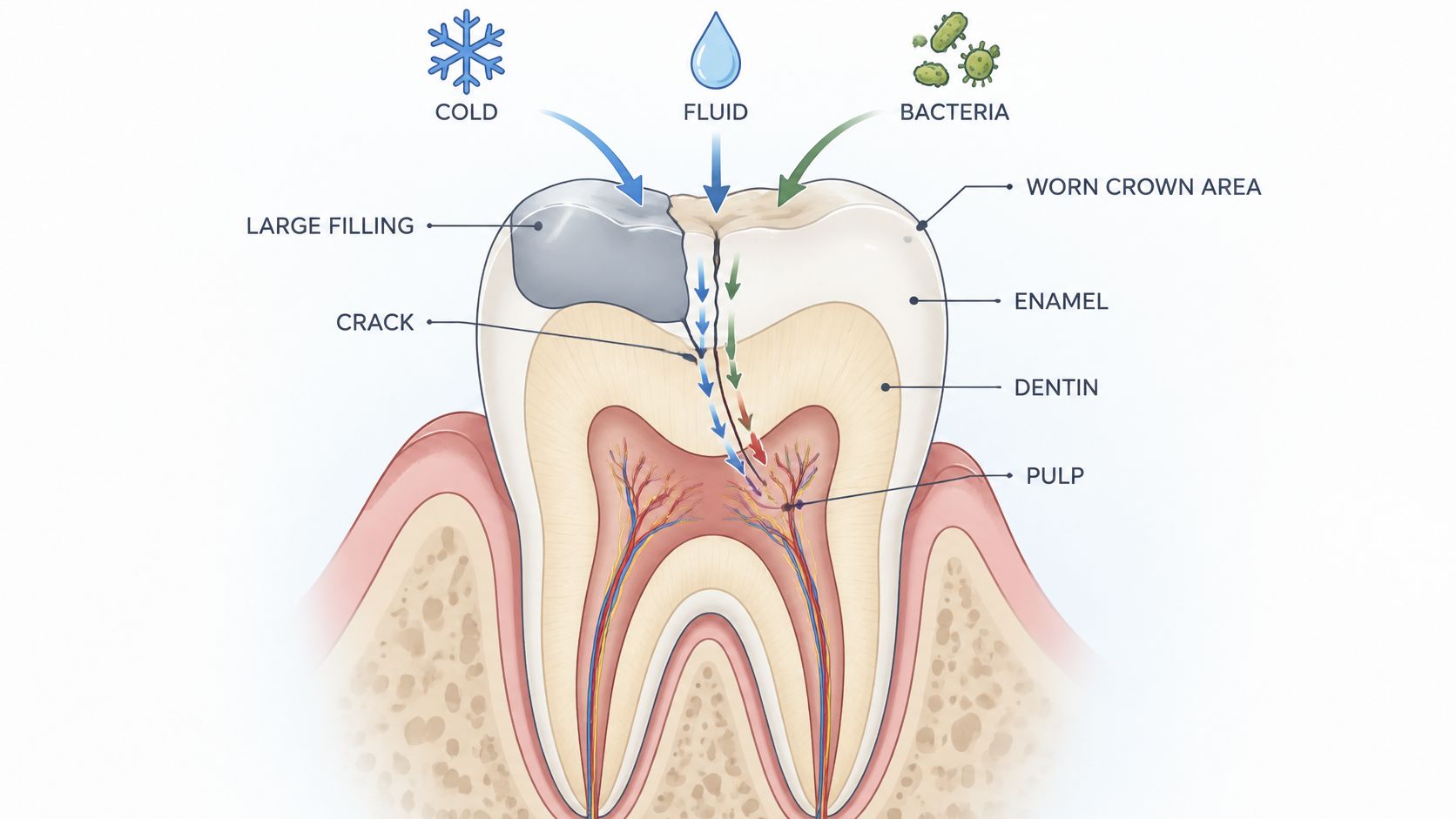
The FDI World Dental Federation document identifies cavities, cracks, defective restorations, chips, and pulp inflammation as alternatives to ordinary dentin hypersensitivity. Pain with biting or release, or symptoms consistently centered on one tooth, deserves particular attention.
Cracks and the clues they leave
A crack may develop after biting hard food, trauma, or repeated grinding forces. Depending on its depth, it can let temperature changes and bacteria reach deeper tissues, and movement of the cracked area may hurt during chewing.
The pattern is the giveaway. Surface sensitivity tends to spread across several teeth and fade within seconds, while a crack usually singles out one tooth and reacts to a specific motion, such as biting down or releasing pressure. Even so, pain from a crack can be hard to pinpoint, so pointing to a general area is still useful information.
Fine surface lines, called craze lines, aren't automatically a threat to the tooth. A deeper crack, a moving segment, or a crack associated with symptoms requires a different assessment. You can't reliably judge crack depth from a bathroom mirror.
Filling edges, decay, and repeated force
A filling doesn't make the surrounding tooth immune to future problems. Its edge can deteriorate, the tooth can fracture beside it, or decay can develop around the restoration.
A molar filled long ago that starts reacting to iced water, especially when your tongue finds a new rough edge, could have a chipped filling, damaged tooth structure, or decay. Any of these calls for an examination. On that visit the dentist works through a short checklist: whether the margin has gapped or worn rough, whether staining or softening suggests decay around the edge, whether a crack runs from or beside the filling, and whether the bite lands heavily on the restoration.
Other structural clues include:
- A cavity: Decay removes protective tooth material and may advance toward the pulp before pain becomes constant.
- Grinding wear: Flattened biting surfaces suggest repeated tooth-to-tooth contact.
- Stress near the gumline: Heavy bite forces may contribute to cervical wear alongside acid and abrasion.
Toothpaste may reduce a sensation, but it can't repair a crack, remove decay, or restore a broken filling seal.
Depending on what the examination finds, care could involve a filling repair, a protective restoration, or treatment for pulp disease. Structural symptoms shouldn't be managed indefinitely by avoiding cold drinks, because the underlying defect can widen while the pain stays manageable.
Who Is Most Likely to Notice Cold Sensitivity
Two people can sip the same iced coffee and walk away with different reports. One feels nothing; the other gets a sharp zing in a single molar. What differs is whether cold has found a route to dentin, and every mouth offers different routes.
Cold sensitivity can appear at any stage of adulthood. The tiny channels inside dentin often narrow or become blocked over the years, which can quiet a zing that used to fire easily. Gum recession, root exposure, or a new dental problem can just as easily create a fresh response later in life, so a quiet decade is no guarantee of a quiet next one.
Each reaction also carries readable clues: how long it lasts, how many teeth join in, what triggered it, and when it started. Sensitivity tends to show up at predictable moments rather than appearing randomly.
Situations where sensitivity commonly shows up
| Situation | What the Cold Reaction Often Looks Like |
|---|---|
| Whitening session or the days after | Several teeth react together during a short window |
| Recent filling or crown | One treated tooth responds in the weeks after the appointment |
| First days of a new aligner | Pressure tenderness that can come with a cold response |
| Recent cleaning or scaling | Brief reactions across teeth that were just cleaned |
A zing shared by several teeth during a short window reads differently than one tooth complaining every time cold touches it. The first pattern fits an ordinary, temporary response. The second points toward a specific spot worth having examined.
Whitening and recent dental work
Whitening is a common time to notice a cold reaction for the first time. Several teeth may respond to chilled water during or shortly after a session, spread across the smile rather than fixed in one place, and the reaction typically fades once the process ends. A single tooth that keeps reacting weeks later tells a different story.
A new filling can leave the treated tooth cold-reactive for a while afterward. The sensation usually centers on that one tooth and eases as things settle. If the tooth stays reactive or the response deepens instead of fading, bring it up at your next visit rather than avoiding cold on that side.
Sensitivity during orthodontic care
Clear aligner treatment, including Invisalign, can cause temporary discomfort during tooth movement. Some people notice it during the first days after changing aligners, and it often eases as the mouth adjusts. Pressure tenderness isn't necessarily the same as a sharp cold response, so new, worsening, or localized pain should be reported to the treating provider instead of assumed to be an expected part of orthodontics.
Patients in Santa Ana and Orange County who are planning orthodontic care can review their sensitivity history with Bristol Dental & Orthodontics before treatment begins. Mention previous gum recession, cold-reactive fillings, or discomfort during whitening so those concerns can be considered during planning.
These patterns work best as talking points for an appointment. Home observation can describe a symptom; only an examination can name its cause.
When to See a Dentist About Cold Sensitivity
Brief pain and lingering pain deserve different responses. A sharp reaction that stops promptly after cold is removed can fit dentin hypersensitivity, while pain that continues, throbs, or starts without a trigger calls for closer evaluation.
How long the zing lasts is the most useful detail you can observe at home. A reaction that fades the moment the cold water leaves the tooth points toward exposed dentin that reacts and then settles. Pain that outlasts the drink suggests the problem sits deeper than the surface.
A clinical review available through PubMed Central distinguishes the brief response of dentin hypersensitivity from lingering or spontaneous pain that warrants assessment for pulp inflammation, decay, cracks, or defective restorations. There isn't a reliable home stopwatch test that can replace clinical diagnosis.
Questions that help determine urgency
Before contacting the office, organize what you've noticed:
- Duration: Does the pain stop when the drink is gone, or continue afterward?
- Location: Do several teeth react, or does the same tooth hurt repeatedly?
- Pressure: Does chewing, biting down, or releasing a bite provoke pain?
- Timing: Did it begin after a filling, crown, whitening session, cleaning, or orthodontic change?
These answers help the dental team decide how soon you should be seen. You don't need to identify the exact tooth or know the dental terminology before calling. Even a rough description, such as "one lower tooth zings for a few seconds after ice water," gives the team a workable starting point.
Symptom patterns and what each one suggests
| Symptom Pattern | More Likely Source | Suggested Next Step |
|---|---|---|
| Brief, sharp pain that stops once cold is removed, across several teeth | Dentin hypersensitivity from erosion or gum recession | Gentle brushing, desensitizing toothpaste, and a routine exam |
| Lingering pain after cold is removed | Possible pulp inflammation or deep decay | Book a prompt visit |
| Spontaneous or throbbing pain without a trigger | Pulp involvement or infection | Seek prompt dental care |
| Pain on biting or release, usually involving one tooth | Cracked tooth or failing filling | Schedule an evaluation soon and avoid hard chewing on that side |
| Sensitivity beginning after a filling, crown, or whitening | A restoration issue or temporary post-procedure sensitivity | Tell the dentist when it started and what changed |
| Pain confined to one tooth without a clear trigger | Decay or structural damage | Book an evaluation |
Use the table to decide how soon to call, not what the problem is. A widespread reaction across several teeth usually tracks with a widespread cause, while one tooth that hurts every time points to something local. Generalized sensitivity can still need treatment, and an isolated symptom doesn't automatically mean a tooth requires extensive work.
Reasons not to keep waiting
Arrange an examination if you notice a visible chip or crack, bleeding gums, or a changed gumline. Sensitivity that doesn't improve after several weeks of gentle home care also deserves assessment, even if it remains brief.
Swelling, fever with dental pain, or rapidly worsening symptoms require urgent attention. Difficulty breathing or swallowing is a medical emergency. Don't delay care while trying different sensitivity products.
A visit may include a discussion of habits and symptoms, examination of the teeth and gums, and checks of fillings and bite contacts. Temperature testing reproduces the zing in a controlled way so the dentist can compare one tooth against its neighbors, and bite testing helps locate a crack that only hurts under pressure. X-rays may be appropriate, although not every crack is visible on an X-ray.
Bring a short record of what triggers the pain, how long it lasts, and when it started. Even a few notes on your phone can show a pattern that is hard to reconstruct from memory in the chair. Mention reflux, grinding, recent treatment, and whitening products. Avoid repeatedly testing the tooth with ice at home, since that can irritate it without clarifying the cause.
You can schedule a consultation with Dr. Finley to discuss your specific symptoms. This information is educational, not individualized medical advice, and an examination is needed to recommend care for your situation.
Home Relief and Prevention That Target the Cause
Each step in this routine matches a specific cause. Soft brushing protects exposed dentin, fluoride strengthens the surface, and timing prevents you from scrubbing enamel while acid has it softened. For mild, ordinary sensitivity, expect gradual improvement over several weeks of consistent use.
A gentler routine for sensitive teeth
Choose a soft-bristled toothbrush. Use light pressure and short strokes rather than scrubbing back and forth. Bristles that bend hard against the gumline aren't doing a better job of cleaning.
Use fluoride toothpaste consistently. Pick a desensitizing formula containing potassium nitrate or stannous fluoride. The two ingredients work through different mechanisms: one acts on the nerve's response, and the other helps block the tiny pathways that carry the cold signal inward. Use it twice daily for several weeks according to the product directions unless your dentist recommends otherwise.
Delay brushing after acid exposure. Wait about 30 minutes after acidic food or drink rather than scrubbing immediately. This helps avoid adding abrasive wear to surfaces softened by acid.
Reduce prolonged contact with acidic drinks. Rinse with plain water afterward and avoid sipping acidic beverages throughout the day. A straw may reduce contact with some teeth when drinking cold or acidic beverages, but it doesn't make an acidic drink harmless.
Discuss grinding protection with your dentist. If you wake with jaw tension or notice worn edges, ask whether a custom night guard is appropriate. A guard can protect teeth from some grinding-related forces, but it doesn't establish why a particular tooth hurts.
Address reflux or vomiting with your physician. Dental care can help protect affected teeth, while medical assessment addresses the source of repeated stomach-acid exposure. Don't change prescribed medication without speaking with the clinician who manages it.
Pause whitening while the cause is unclear. Whitening can increase sensitivity, and continuing through new pain may make it harder to understand what's happening. Ask your dentist when, or whether, restarting is appropriate.
Keep cleaning between teeth and attending professional cleanings. Gentle flossing and appropriate periodontal care help control plaque and gum inflammation. A sensitive spot still needs cleaning, so ask for help adjusting your technique rather than skipping the area.
When home care isn't enough
These measures suit mild sensitivity without warning signs. A tooth that hurts on biting, develops spontaneous pain, or repeatedly reacts in isolation needs evaluation first.
If a few weeks of consistent gentle care don't help, book an examination rather than switching products indefinitely. Treatment might involve preventive care, sealing an exposed area, correcting a restoration, or managing gum disease, depending on what the dentist finds.
Feeling less sensitivity does not confirm that decay, a crack, or gum disease has been ruled out.
These steps are general information rather than individualized medical advice. Dr. Finley should review your symptoms and dental history before recommending a treatment plan.
Bristol Dental & Orthodontics offers examinations for cold sensitivity and preventive, restorative, and cosmetic care based on the cause. To discuss a recurring zing or a newly sensitive tooth with Dr. Andrew Finley, visit Bristol Dental and Orthodontics and schedule a consultation.