
IV sedation dentistry delivers a sedative, most often midazolam, through a vein so the dental team can adjust how relaxed the patient is during treatment, without producing general anesthesia. But if sedation doesn't mean being completely unconscious, what should you expect in the dental chair?
That question matters more than the phrase “sleep dentistry” suggests. Feeling relaxed, having a tooth numbed, remembering an appointment, and being ready to drive home are separate things. Understanding those differences can help you discuss your fears and make an informed decision with Dr. Andrew Finley.
Table of Contents
- IV Sedation Dentistry in Plain Terms
- How IV Sedation Compares With Nitrous Oxide and Oral Options
- How IV Sedation Works and What It Does Not Do
- Who Is a Good Candidate for IV Sedation
- How to Prepare for Your IV Sedation Appointment
- Monitoring During Treatment and Recovery Afterward
- Talk With Dr. Finley About Your Sedation Options
IV Sedation Dentistry in Plain Terms
IV sedation dentistry uses medication delivered through a small line in a vein to reduce anxiety and awareness during dental treatment. The clinician adjusts the medication to your response rather than assuming everyone needs the same amount.
Think of sedation as a dimmer switch, not an on-off switch. Turning the dial changes the depth of relaxation. The route used to give medication doesn't, by itself, tell you how conscious someone will be.
IV sedation means giving sedative medication through a vein so a trained clinician can adjust its effects during treatment.
Say you need extensive dental work, but anxiety makes it difficult to stay in the chair. With moderate sedation, you may feel drowsy and less concerned about what's happening while still responding when the dentist asks you to open your mouth. The American Dental Association's sedation guidelines describe moderate sedation as a state in which patients remain purposefully responsive and generally maintain their own breathing and cardiovascular function.
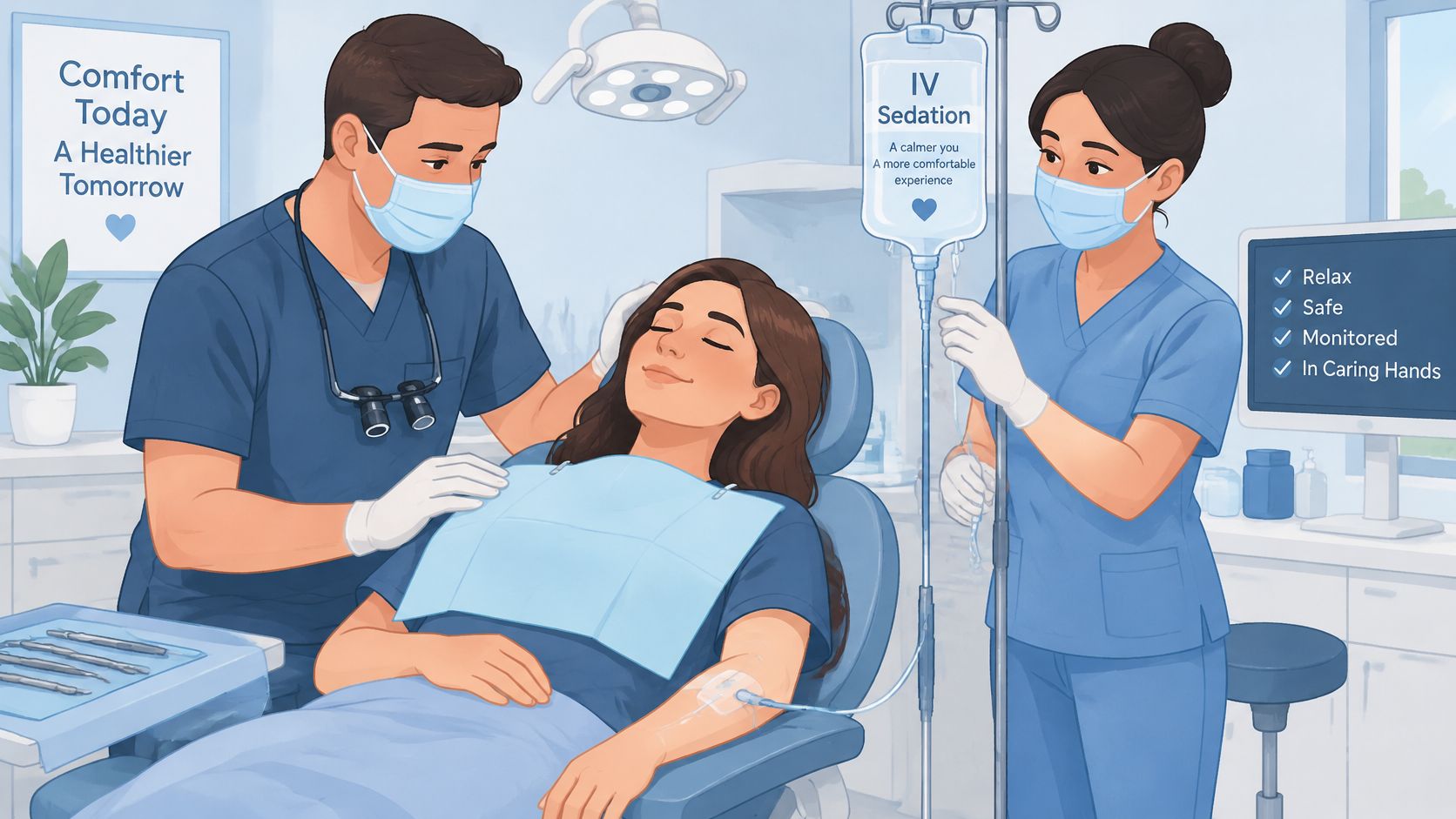
Patients commonly consider this approach because of significant dental anxiety, a strong gag reflex, or lengthy treatment that feels difficult to tolerate. Those concerns deserve a conversation, not an assumption that you should push through.
At Bristol Dental & Orthodontics in Santa Ana, Dr. Finley considers IV sedation alongside nitrous oxide and oral conscious sedation. The right choice connects your comfort needs with your health, the planned procedure, preparation requirements, and the support you'll need afterward.
How IV Sedation Compares With Nitrous Oxide and Oral Options
Sedation choices differ in how much support they provide and in the practical arrangements they require. This comparison can help you discuss which option fits your anxiety level, procedure, and recovery needs.
| Method | How it is given | Patient state | Memory of treatment | Recovery window |
|---|---|---|---|---|
| Nitrous oxide | Inhaled through a small nasal mask | Awake, calm, and responsive | Memories can remain clear | Typically brief after the mask is removed |
| Oral conscious sedation | Prescribed medication taken at the dental office before treatment | Awake, drowsy, and able to follow instructions | Often little memory, though recall is possible | Effects can last several hours; arrange an adult escort |
| IV sedation | Medication administered directly into the bloodstream by a trained professional | Relaxed and responsive; the deepest sedation option offered at Bristol Dental & Orthodontics | Most patients have little to no memory of treatment, though individual recall varies | Judgment and reactions may remain affected into the following day |
| General anesthesia | Given by an anesthesia provider, typically in a hospital or surgical setting | Unconscious, with airway management by the provider | No expected awareness or recall during the procedure | Recovery and activity instructions depend on the care plan |
Sedation methods compared for dental care: These are typical descriptions, not guarantees about an individual experience. General anesthesia is included for comparison, not as another name for IV sedation.
Practical trade-offs
- Nitrous oxide is a mild option often suited to mild anxiety or shorter procedures. You breathe it through a nasal mask and remain awake and responsive.
- Oral conscious sedation may suit moderate anxiety or longer procedures. The medication is taken at the office before treatment, and it can be combined with nitrous oxide for added comfort. Plan for an adult escort.
- IV sedation may be appropriate for significant anxiety or complex procedures. It can also help patients with a strong gag reflex, and may allow more work to be completed in fewer visits. It requires a responsible escort and a recovery plan.
- General anesthesia involves unconsciousness and a different level of clinical support. It is distinct from the sedation options offered by Dr. Finley and his team.
Sedation does not replace numbing medication, and it does not guarantee memory loss. Ask the dental team what support and recovery arrangements your chosen option requires.
How IV Sedation Works and What It Does Not Do
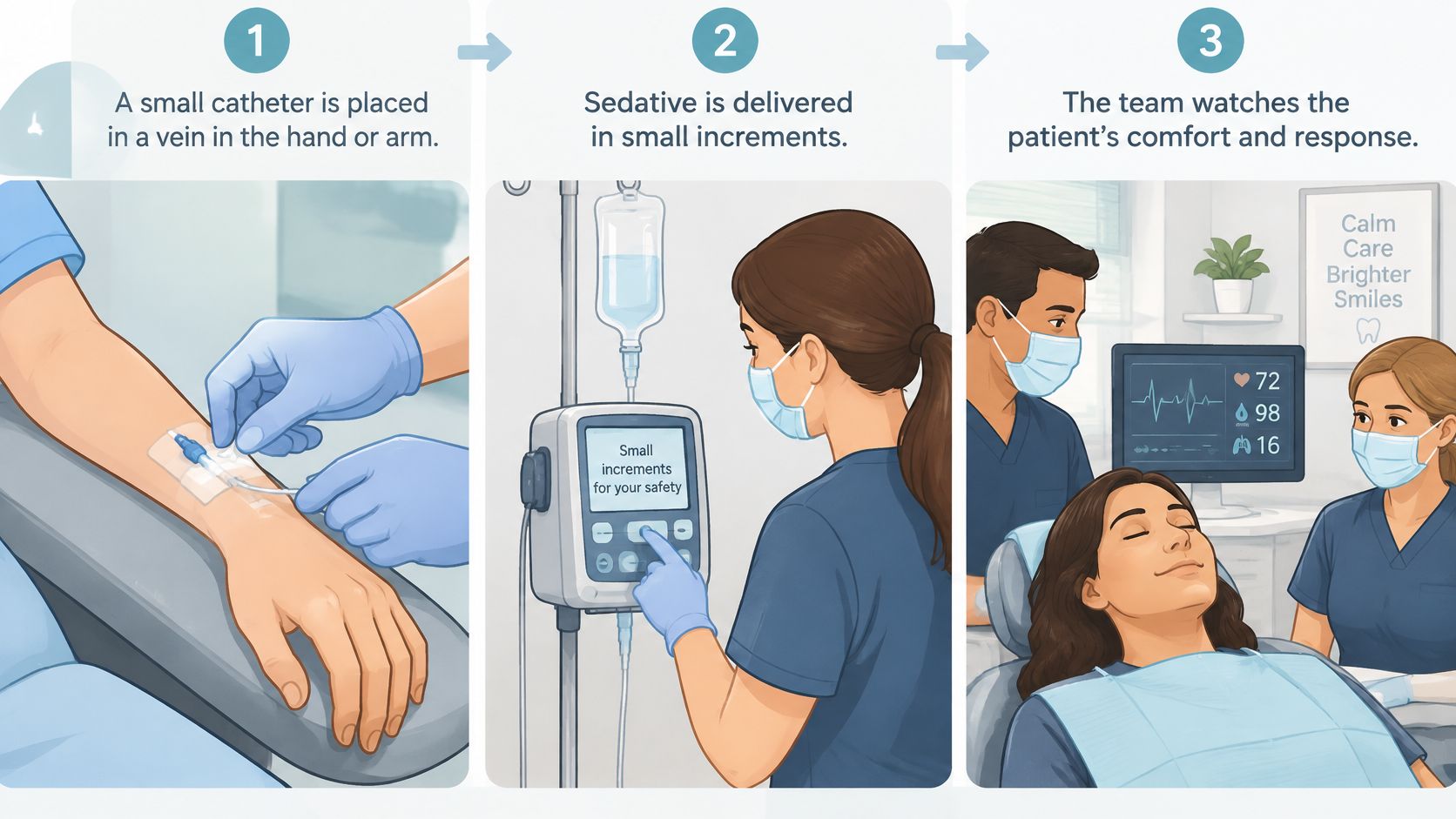
IV sedation is adjusted in steps, with the team observing how you respond along the way.
- A small catheter is placed in a vein, usually in your hand or arm. The flexible catheter gives the trained professional access to administer medication into your bloodstream.
- The sedative is given in small increments. The clinician allows time to assess your response rather than giving everyone a fixed amount.
- The team monitors you throughout treatment. Your relaxation, responsiveness, breathing, and other clinical signs help guide the care.
- Local anesthetic numbs the treatment area. The dentist performs the dental work while the team continues monitoring you.
Sedation works like a dial. Its depth can vary, and the clinician adjusts it in response to your needs and how you are doing. That means a particular level of drowsiness or memory loss cannot be promised.
A 2024 evaluation published in the British Dental Journal followed 100 consecutive adult dental patients receiving IV midazolam, reporting a mean dose of 7.8 mg, with 91% feeling they had received enough sedation and 50% remembering events during treatment.
That recall rate came from one private practice and describes that study's patients, not what every patient should expect. At Bristol Dental & Orthodontics, most IV sedation patients have little to no memory of treatment. Individual experiences can still differ.
Three common misunderstandings
Sedation does not guarantee memory loss. You may feel relaxed and have little memory of the procedure, but the effect varies. Tell Dr. Finley if concern about awareness is part of your anxiety.
Sedation does not numb your teeth. Local anesthetic provides pain control for the treatment area. If you feel discomfort, let the team know so they can respond.
Sedation does not remove the need for a recovery plan. Arrange for a responsible adult escort and follow the instructions you receive for recovery.
The University of Maryland's IV moderate-sedation guidance explains why a team must also be prepared for sedation to deepen unexpectedly. Breathing or airway support may be needed if a patient responds less than intended. Before consenting, ask who will monitor you and who is responsible for responding to a change.
Who Is a Good Candidate for IV Sedation
A patient with significant dental anxiety may find routine treatment difficult, while someone facing complex procedures may need help staying comfortable through a longer visit. IV sedation is ideal for patients with significant dental anxiety or those undergoing complex dental procedures. These situations start the conversation, but they do not determine suitability on their own.
| Situation | Why sedation may help | What to share with Dr. Finley |
|---|---|---|
| Significant dental anxiety | IV sedation is an option for patients with significant anxiety | Past experiences and specific anxiety triggers |
| Strong gag reflex | Sedation can help patients undergo procedures more easily | Gag history and situations that trigger it |
| Long or complex procedures | IV sedation is an option for complex dental procedures | Planned procedures and expected appointment length |
| Several procedures in one visit | Sedation can allow more work to be completed in fewer visits | The full treatment plan |
| Sleep apnea or airway concerns | Airway health is part of the suitability review | Diagnosis, snoring history, and CPAP or oral appliance use |
| Older adults or complex medical history | Age and medical history are considered individually | Medical conditions and prior anesthesia reactions |
| Current opioid, benzodiazepine, or sleep medication use | Medication use is part of the suitability review | A complete, current medication list |
| Limited tolerance of ordinary treatment due to disability or developmental condition | Sedation can support treatment, alongside communication and other accommodations | Communication needs and caregiver involvement |
These are common reasons to discuss IV sedation, not automatic eligibility criteria. Dr. Finley considers medical status, airway concerns, ability to cooperate, procedure complexity, and the intended sedation depth when reviewing a patient's needs.
Airway concerns deserve an early conversation
Tell the team about loud snoring, diagnosed sleep apnea, breathing problems during sleep, or previous difficulty with anesthesia. Share whether you use a CPAP machine or oral appliance. Airway health matters to sedation planning, while treatment for sleep apnea is a separate concern.
Accessibility requires more than medication
For a patient with a developmental condition or disability, planning may include familiar communication methods, caregiver participation, sensory adjustments, and appropriate consent support. Sedation does not replace those accommodations.
A federal advisory report on dental access for adults with intellectual and developmental disabilities describes provider shortages and limited operating-room capacity as barriers to care. Clinical suitability and practical access are separate considerations.
Dr. Finley and his team at Bristol Dental & Orthodontics offer sedation dentistry. Explain what makes dental treatment difficult for you so the team can discuss sedation and any accommodations you may need.
How to Prepare for Your IV Sedation Appointment
Preparation begins before treatment day. Getting the details settled early gives you time to clarify medication instructions, arrange help, and report anything that could change the plan.
Share your complete medical history. Include heart, lung, liver, kidney, and airway conditions, previous anesthesia reactions, allergies, and the possibility of pregnancy so Dr. Finley can assess relevant risks.
Review everything you take. List prescriptions, supplements, nonprescription medicines, and sleep aids; don't stop or change a medication on your own.
Follow your written fasting instructions exactly. Tell the team if you've eaten or drunk something outside those instructions, because withholding that information can affect safety.
Arrange a responsible adult escort. Confirm who will drive you home, stay with you, and receive instructions if your memory is affected.
Clear your recovery schedule. Arrange coverage for work, childcare, dependent care, driving, and important decisions rather than hoping you'll feel ready afterward.
Dress for straightforward access and comfort. Wear comfortable clothing, remove jewelry as instructed, and bring any inhaler or other medication the team specifically asks you to bring.
Confirm the discharge process. Make sure you and your escort know how to contact the office and what to do if you have concerns after leaving.
Standard fasting intervals before sedation
The American Dental Association's fasting table lists minimum intervals for healthy patients undergoing elective procedures of 2 hours for clear liquids, 4 hours for breast milk, 6 hours for infant formula, nonhuman milk, or a light meal, and potentially 8 hours or more for fried foods, fatty meals, or meat.
| Food or drink | Minimum fasting time |
|---|---|
| Clear liquids | 2 hours |
| Breast milk | 4 hours |
| Infant formula | 6 hours |
| Nonhuman milk | 6 hours |
| Light meal | 6 hours |
| Fried, fatty, or meat-based meal | 8 hours or more; longer may be needed |
These are general reference intervals, not permission to choose your own fasting schedule. Even the distinction between clear liquids and other drinks needs to be understood correctly, so ask if you're unsure about a particular beverage.
Bristol Dental & Orthodontics gives the final preparation instructions for your situation. Contact the team before your appointment if following them will be difficult.
Monitoring During Treatment and Recovery Afterward
Treatment ending does not mean the effects of IV sedation have ended. Sedation works more like a dial than an on-off switch: you may feel awake before your judgment and reactions have fully recovered. It does not replace numbing medication, and although most IV sedation patients have little to no memory of treatment, memory loss is not guaranteed.
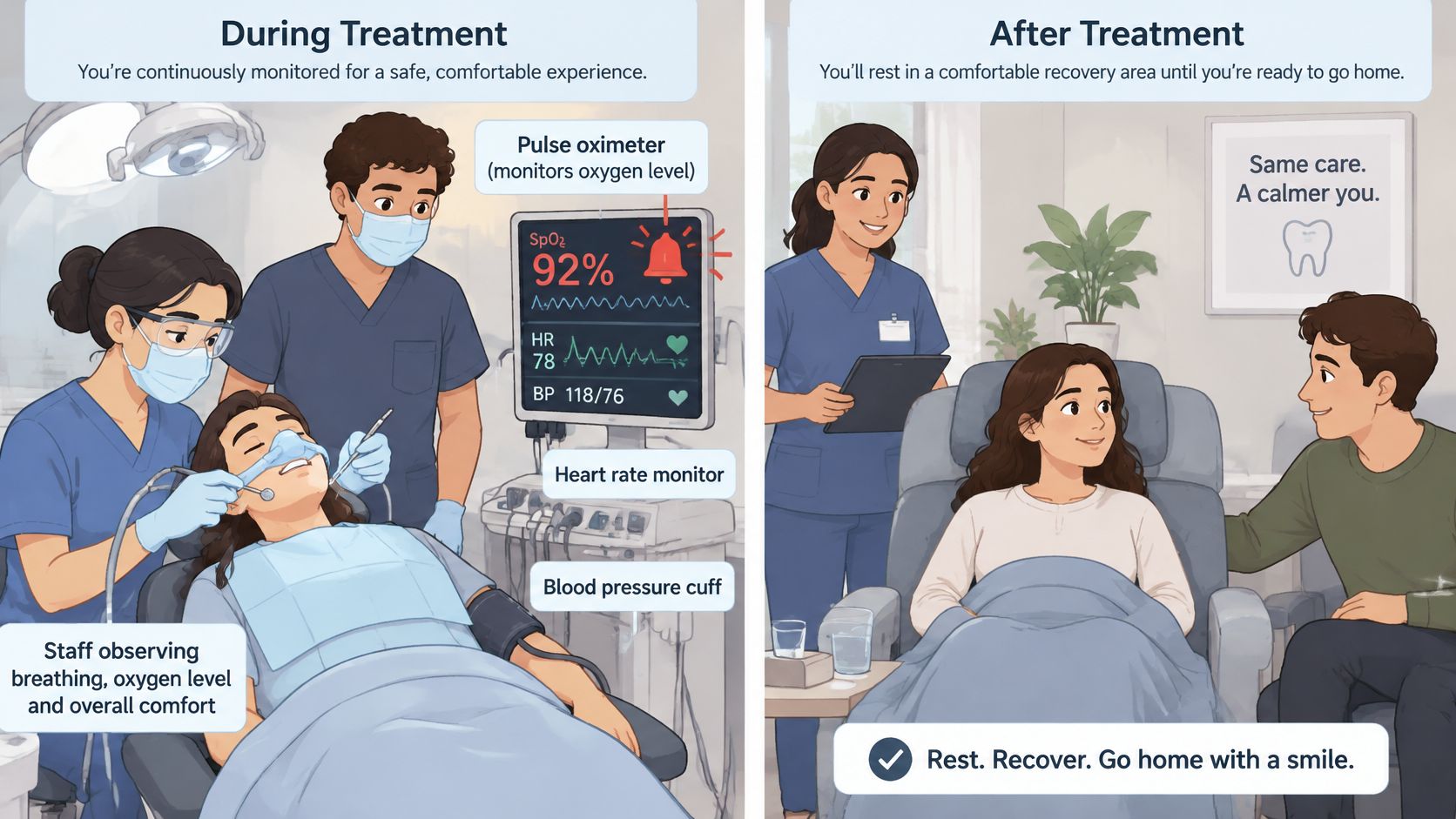
During treatment, Bristol Dental & Orthodontics closely monitors patients for safety and comfort. The American Society of Anesthesiologists' sedation guidance calls for pulse oximetry with appropriate alarms, observation of breathing, and blood pressure and heart rate recordings at five-minute intervals, unless a clinical reason prevents that schedule. The guidance also recommends assessing responses to verbal commands when practical. Electrocardiography may be appropriate for patients with significant cardiovascular disease.
Office recovery and the trip home
After the dental work, staff continue monitoring you in the office and assess whether you are ready to leave. Feeling less drowsy is not the same as being fully recovered.
The NHS guidance for dental IV sedation notes that judgment, memory, and reactions may remain affected for approximately 24 hours. During that time, patients should not drive, work, operate machinery, sign documents, make important decisions, or drink alcohol, and should not be left without adult supervision.
Plan the journey home and recovery support before your appointment. A responsible adult should take you home and stay with you as directed. Follow the office's instructions about when to resume normal activities, since both sedation and the dental procedure affect recovery.
Contact the office promptly about unexpected or persistent symptoms. Severe breathing difficulty or trouble waking normally calls for emergency medical attention.
Talk With Dr. Finley About Your Sedation Options
A useful consultation starts with what makes dental treatment difficult for you. You do not need to minimize your fear or arrive knowing which medication you want.
Tell Dr. Andrew Finley whether you are worried about needles, gagging, discomfort, feeling trapped, or remembering treatment. Those concerns are not interchangeable. Someone who fears IV placement may need a different conversation from someone who tolerates needles but struggles with lengthy dental work.
Bring questions that shape the plan
Which sedation option fits my procedure and comfort level? Ask how nitrous oxide, oral conscious sedation, and IV sedation compare for your needs. Ask where you would sit on the sedation dial and what would move you up or down.
What monitoring and discharge steps will be used? Discuss who will observe you, how changes will be managed, and what your escort needs to know.
How do my medical history and current medications affect the plan? Include any medications you take occasionally, sleep apnea concerns, and previous experiences with sedation or anesthesia.
A plan for a single filling may differ from one for a longer appointment. Dr. Finley and his team can explain how the choice would change if the appointment runs longer or your anxiety rises.
Plan the dental care as well as the sedation
For a Santa Ana patient considering dental implants, the conversation should address the procedure and recovery as well as anxiety management. For someone interested in Invisalign or cosmetic treatment, sedation should not be assumed necessary just because it is available. If you are seeking emergency dental care, explain your symptoms and concerns promptly so the team can assess priorities.
Bristol Dental & Orthodontics welcomes patients from Santa Ana and surrounding Orange County. A consultation gives you room to understand your choices without a promise of a particular result or an expectation that you must proceed.
Bristol Dental & Orthodontics offers nitrous oxide, oral conscious sedation, and IV sedation as part of family and cosmetic dental care in Santa Ana. Visit Bristol Dental and Orthodontics to learn about sedation dentistry and related services, then schedule a consultation with Dr. Finley to discuss your procedure, health history, and comfort needs.