
The first orthodontic check is recommended no later than age 7, full braces often wait until about age 12 or 13, and healthy adults can start at any age. That answer challenges the most popular advice families hear, which treats Braces at What Age like a birthday deadline that every child must hit on schedule.
A birthday doesn't tell you whether teeth have erupted, whether jaws are growing evenly, or whether a bite problem is getting worse. Two children who are both 8 can be at very different dental stages, and a healthy 45 year old may be a clearer candidate than a teenager who still has several permanent teeth to come in. If you're asking Braces at What Age for your child or for yourself, you're really asking three separate questions. When should someone first be checked, when should a specific early problem be treated, and when does full alignment make sense? Those answers are different, and mixing them up is where most confusion starts.
Table of Contents
- Braces at What Age by Dental Stage
- Signs a Child or Adult May Need Care
- Early Treatment Full Braces and Adult Options
- Why Two People the Same Age Differ
- What Happens at an Orthodontic Consultation
- Book a Timing Visit in Santa Ana
Braces at What Age by Dental Stage
Age 7 is a screening milestone, not a braces start date. Dental stage gives a clearer picture: eruption shows which teeth are present, while jaw growth and the specific problem help guide whether to treat, monitor, or wait.
Measuring a child before buying shoes is a useful comparison. The measurement helps you choose, but it does not tell you how quickly the child will grow. An orthodontic check works similarly: it shows what is developing, so decisions can match the teeth and jaws in front of you.
| Age window | Dental stage | Usual recommendation |
|---|---|---|
| No later than age 7 | Mixed dentition, baby and permanent teeth | Screening; braces if a specific problem needs early care |
| About ages 6 to 9 | Early mixed dentition | Selected interceptive care for crossbite, habits, or a jaw discrepancy |
| About ages 7 to 10 | Mixed dentition | Favorable window for some maxillary expansion before the suture resists widening |
| About ages 9 to 16 | Late mixed to early permanent teeth | Common range when many patients begin treatment |
| About ages 12 to 13 | Early permanent dentition | Typical timing for full braces after adult teeth erupt |
| Any adult age with healthy teeth and gums | Permanent teeth | Possible; health, bone, and gum support decide candidacy, not a cutoff birthday |
Why Age 7 Is a Checkpoint, Not a Start Date
Around age 7, many children have mixed dentition, meaning baby teeth and permanent teeth are present at the same time. A peer-reviewed scoping review reports that the American Association of Orthodontists recommends an initial orthodontic screening by age 7. At this stage, a clinician can assess how the bite is forming, whether the jaws are growing evenly, and whether permanent teeth are erupting off course.
The value of the visit is a timely look at development. It does not mean braces must begin then, and a child who is 8 or 9 without an earlier check has not missed a treatment deadline.
Age 7 is when you check the growth pattern. Treatment begins when the dental stage and problem call for it.
The same scoping review found that early intervention was not generally superior to later treatment in effectiveness, total appliance duration, or cost-benefit ratio. Starting early without a specific reason may extend the overall process, and a later round of treatment may still be needed.
After the visit, the plan may be to treat a specific problem, monitor while growth and eruption continue, wait until more permanent teeth are in, or recommend no orthodontic treatment. A first visit after age 7 can still help guide those decisions.
How Dental Stage Changes the Window
A 2024 expert consensus describes mixed dentition as approximately ages 6 to 12 and identifies ages 7 to 10 as a favorable window for certain forms of maxillary expansion, before the mid-palatal suture becomes more resistant to orthopedic widening. Maxillary expansion widens the upper jaw. Because it works with growth, timing matters more for this treatment than for straightening a mildly crooked front tooth.
The same consensus places treatment in early permanent dentition generally after the relevant permanent teeth have replaced baby teeth, typically after age 12. With more permanent teeth erupted, alignment and bite correction can be planned around the teeth that are present. Teeth that have not erupted cannot yet be aligned, and moving existing teeth too early may leave later teeth without a clear place to land.
Early treatment, commonly around ages 6 to 9, suits selected jaw discrepancies, crossbites, or eruption problems. Later care during the pubertal growth period, approximately ages 11 to 13, is often preferred for full braces when permanent teeth are largely present.
Families in Santa Ana and throughout Orange County can use the age 7 milestone as a reason to arrange an evaluation with Dr. Andrew Finley at Bristol Dental & Orthodontics. Come in sooner if a bite already looks unusual, teeth stick out, or crowding is obvious. Early care addresses a particular problem; it does not guarantee that later braces will be unnecessary. Sometimes a full round is still appropriate in the early teens.
Adult readers have no cutoff birthday for healthy teeth and gums. Candidacy depends on oral health and support for the teeth, while the treatment plan follows the problem and the teeth present.
Signs a Child or Adult May Need Care
Signs matter more than birthdays. A child who shows a clear bite problem at 5 shouldn't wait until 7 for a first look, and an adult with bleeding gums shouldn't start tooth movement until that gum problem is understood.
Signs in Children to Have Checked Promptly
Book an evaluation when you first notice these, even before age 7.
- Crossbite: Upper teeth sit inside the lower teeth when your child bites down, in front or in back.
- Protruding front teeth: Upper front teeth stick out far enough that a fall or sports contact could injure them.
- Severe crowding: Permanent teeth overlap, twist, or have no visible room to erupt.
- Open bite or large gap: Front teeth don't meet when biting, or there's a large horizontal gap between upper and lower front teeth.
- Jaw shift: The jaw slides to one side to get the teeth to fit together.
- Unusual eruption: Baby teeth are lost very early or very late, or a permanent tooth is coming in behind or outside the arch.
Functional clues count too. Difficulty chewing, mouth breathing paired with a narrow smile, or thumb or finger sucking that's changing the bite aren't cosmetic nitpicks. They're reasons to look while growth can still be guided, because delaying can let a tooth drift further or a jaw asymmetry become harder to guide.
Signs in Teens and Adults
For older patients, the watch list shifts. Crooked teeth, teeth that have relapsed after earlier treatment, new spacing, a bite that feels uneven, worn edges, and crowded areas you can't clean well are all reasonable reasons to ask. You don't need pain to justify the conversation.
Some signs point away from braces first. Gum recession, loose teeth, or bleeding gums call for a general dental and periodontal check before any tooth movement, since moving teeth in unhealthy tissue can create bigger problems. A knocked, painful, or broken tooth is an emergency dentistry issue first, not a routine braces question, and it should be handled before anyone talks about alignment timing.
A sign is a reason to be examined. It isn't a diagnosis, and it doesn't automatically mean treatment should start today.
These signs justify an exam at Bristol Dental & Orthodontics, where Dr. Andrew Finley can see what's happening. They don't diagnose a need for braces by themselves, and not every sign means treatment should start immediately.
Early Treatment Full Braces and Adult Options
Early treatment and later full alignment solve different problems. The right path depends on what needs attention now and which teeth have erupted.
| Pathway | Main goal | Typical approach |
|---|---|---|
| Observation | Watch eruption and growth | Recall visits, no appliances yet |
| Early or interceptive care | Correct a crossbite, create space, address a habit, or give limited jaw guidance | Expander, partial appliances, or habit guidance |
| Full braces | Align teeth and correct the bite once enough permanent teeth have erupted | Fixed braces |
| Clear aligners | Align teeth when wear time and case complexity fit | Clear aligners |
| Adult alignment care | Align teeth within gum, bone, and restoration limits | Braces or aligners after a dental and periodontal check |
Observation is an active plan. At planned visits, the dentist checks how teeth are erupting and compares changes with a recorded baseline. Some children remain under observation for years; others need an appliance sooner, and some never need orthodontic treatment.
Early or interceptive care has a specific, limited goal. It may correct a crossbite, preserve space for a permanent tooth, guide an erupting tooth, address a habit that is changing the bite, or influence a developing jaw problem. Treatment can address an obstacle while the relevant tooth or jaw is still developing.
Early care may also be the first phase of a longer plan. A child can still need further treatment after the permanent teeth come in. Before agreeing, ask what problem the appliance is meant to address and what change will show that the goal has been met.
Full Braces and Clear Aligners
Fixed braces are commonly planned after enough permanent teeth have erupted, often around age 12. With the relevant teeth present, braces can move teeth and address the bite together. Because they stay in place, they do not rely on the patient remembering to wear them.
Clear aligners, including Invisalign at Bristol Dental & Orthodontics, may suit teens and adults when the case and the patient's wear habits fit. A 2025 review of orthodontic care across age groups notes that remote monitoring for adolescents depends heavily on patient engagement and compliance. The review also reports that in 2024, most orthodontic patients aged 18 and older were treated with aligners, while only a small proportion of children and teenagers used aligners instead of fixed braces.
Aligners can be removed for eating and cleaning, but they only work when worn. For younger patients, the dentist also considers erupting teeth, bite complexity, growth needs, school and sports routines, the risk of lost trays, replacement costs, and whether a parent can supervise wear time.
Practical rule: Choose the appliance your child is likely to wear or cooperate with, not simply the one that sounds easiest in the consultation.
Tooth alignment and growth guidance are different jobs. An appliance intended to widen a jaw or guide growth is not interchangeable with braces or aligners that move teeth. Starting earlier is not automatically better; timing depends on tooth eruption, skeletal growth, the bite problem, and the patient's ability to cooperate.
Adults can consider braces or aligners after an exam that assesses existing restorations, gum support, and missing teeth. If a missing tooth may later be replaced with a dental implant, its position should be considered when planning tooth movement. Cosmetic goals are a reasonable reason to ask about treatment, but no option guarantees a particular finish date.
Why Two People the Same Age Differ
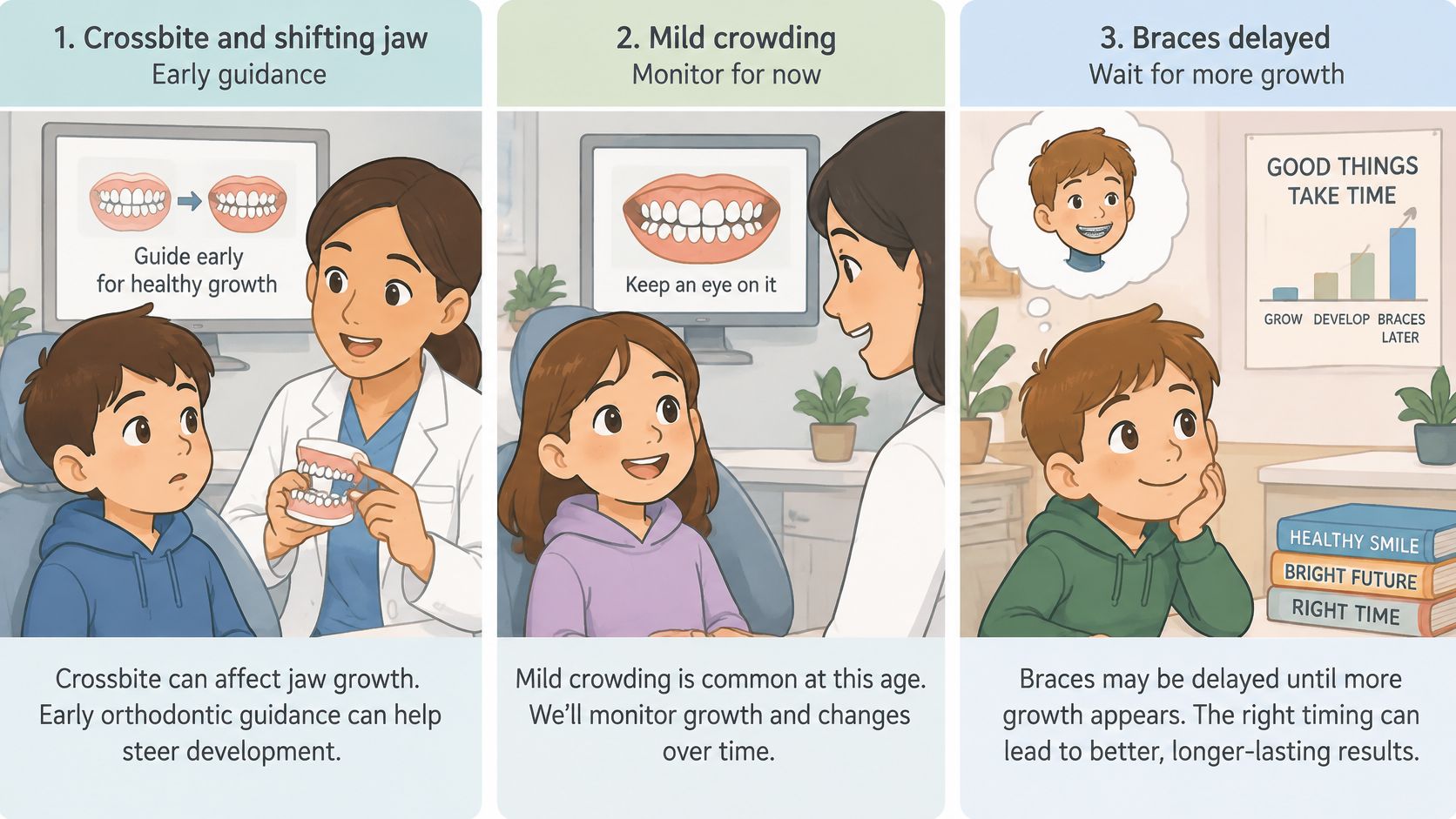
Age is a clue, not a treatment prescription. The plan depends on the problem, which teeth have erupted, and whether jaw growth can still be guided.
At 13, one teenager may have all permanent teeth in place and be ready for treatment. Another may still be waiting for several adult teeth to erupt. Starting before those teeth arrive can mean working around an incomplete set, so the same birthday can lead to different recommendations.
Is There an Age When It's Too Late
There is no automatic age when braces become too late. A 2020 systematic review summarized in an orthodontic trend statistics report found no statistically significant difference in full fixed-appliance treatment duration between adults and adolescents across seven studies. That finding does not predict an individual's timeline, but it challenges the idea that adult teeth cannot be moved.
Adults are a growing part of orthodontic care, yet some hesitate because they feel their age is a barrier. The question is less about reaching a certain birthday and more about whether the teeth and supporting tissues are healthy enough for the proposed care.
Gum and bone support, existing crowns or implants, medications, smoking, relapse risk, and personal expectations can all shape candidacy, appliance choice, and retention planning. For someone considering treatment at 30, 40, 50, or 60, a general dental examination comes first, with a periodontal evaluation when gum health is a concern. The recommendation follows those findings, not age alone, and no one should promise the same timeline or appliance for every patient.
What Happens at an Orthodontic Consultation
A consultation is an information visit, not a commitment to start braces. You'll leave knowing what was found, what the options are, and what happens next, whether that's treatment, monitoring, or nothing at all.
Six Steps in a First Visit
- Share history: Medical and dental history, including habits, past injuries, previous orthodontic treatment, and any gum concerns.
- Examine the mouth: Teeth, bite, jaws, and how permanent teeth are erupting, checked directly rather than assumed from age.
- Take records: Photos and, when needed, radiographs plus a digital scan or models, so the diagnosis is documented.
- Hear the recommendation: Treat now, monitor, treat later, or no orthodontic treatment, with the reasoning explained in plain language.
- Compare appliances if relevant: Fixed braces versus Invisalign, including what cooperation each one requires from your child or from you.
- Plan retention: How retainers and follow up fit after active movement ends, without anyone promising teeth will never shift again.
Records come before timing decisions for a reason. The American Academy of Pediatric Dentistry recommends a thorough examination supported by appropriate diagnostic records, such as radiographs, study models or digital scans, and a documented differential diagnosis, before establishing treatment timing and sequence. A differential diagnosis means weighing the possible causes of what you're seeing, rather than jumping to the first explanation.
That sequence protects you from starting too early without a defined objective. Early intervention can remove a specific obstacle, but treating without one can create a longer two phase process that still ends with full treatment later. The decision should rest on dentition stage, eruption pattern, jaw growth, and treatment objective, not age alone.
Questions Worth Asking
- What exact problem are we treating now? Ask for it in one sentence you can repeat at home.
- What change should we be able to see? A measurable benefit makes it easier to judge whether early care is working.
- Could a second phase still be needed? Knowing this upfront changes how you plan time and expectations.
- How will eruption and growth be checked? Ask how often, and what the next visit will look at.
- Does gum health or a future implant change the order? Sequence matters when restorative work is also planned.
Bring up related concerns in the same visit if you have them. Cosmetic dentistry questions fit naturally alongside alignment, since tooth position and appearance are connected. If snoring or suspected sleep apnea is part of the picture, oral appliance therapy is a separate conversation with its own evaluation, not a reason to start braces at a particular age.
This guide is general education, not personal advice for your child's mouth or your own. Dr. Andrew Finley needs to examine the specific teeth, bite, and growth pattern in front of him before recommending a timing plan at Bristol Dental & Orthodontics.
Book a Timing Visit in Santa Ana
A timing visit gives you a clearer picture of what your teeth or your child's teeth need now, and what can wait. Age can prompt a screening, but the exam focuses on dental stage, bite, and growth.
Consider booking if your child is approaching age 7, has passed 7 without a screening, or has visible crossbite, crowding, or protruding front teeth. If something looks off, you can ask sooner. Monitoring can also give your family a practical next step: what to watch and when to return.
Adults can book an evaluation at any age. The visit may include a general dental check and, if needed, an assessment of gum health before tooth movement is considered. The consultation helps connect those findings to a suitable timing plan.
Bristol Dental & Orthodontics is on South Bristol Street in Santa Ana and welcomes families from nearby communities, including Costa Mesa, Tustin, Irvine, and Garden Grove. Dr. Andrew Finley can discuss the options described in the earlier section, based on your exam. He can also explain how orthodontic care may fit alongside general or cosmetic dentistry, or planned dental implants.
A painful, broken, or loosened tooth calls for emergency dentistry before a routine orthodontic visit. Call promptly so the urgent problem can be assessed first.
Learn more about the practice and its services at the Bristol Dental & Orthodontics website. When you're ready, schedule a consultation to review your child's dental stage, or your own, and get a plan based on an exam rather than a calendar.
This article offers general education, not a diagnosis or individualized medical advice. An in-person exam is needed to recommend care for a specific patient.
If you're weighing timing for your child, or wondering whether your own teeth can still be straightened, Bristol Dental & Orthodontics offers orthodontic evaluations for children, teens, and adults, along with Invisalign, braces, and the general and periodontal checks that should come first. We'll look at dental stage, bite, and gum health together and explain whether to treat now, monitor, or wait. Visit Bristol Dental and Orthodontics to schedule your consultation in Santa Ana.