
An osteoporosis diagnosis alone isn't an automatic reason to rule out dental implants, and it isn't a guarantee of success for any one person; one analysis estimated implant survival in patients with osteoporosis at about 96.46%. Advice that treats osteoporosis as a blanket ban misses the more useful questions: how much bone is available at the implant site, how that bone changes over time, and whether osteoporosis medicines affect surgical planning.
Those questions deserve separate answers. For someone considering dental implants with osteoporosis, a careful evaluation is more helpful than either an automatic refusal or a promise that everything will be routine.
Table of Contents
- What the Evidence Says About Implant Survival
- How Osteoporosis Differs From Jawbone Quality
- Osteoporosis Medicines and the MRONJ Question
- How Implant Planning Changes for These Patients
- Everyday Situations Patients Bring to the Visit
- Healing Signs That Need a Prompt Call
- Book a Santa Ana Implant Consultation
What the Evidence Says About Implant Survival
Suppose a Santa Ana patient has been told that osteoporosis means an implant won't hold. That conclusion goes further than the available evidence supports. Published results generally support evaluating the person and the proposed implant site, rather than excluding someone because of the diagnosis alone.
Implant survival means an implant remains in place during the period being studied. It doesn't necessarily mean the surrounding bone stayed unchanged, the gums remained healthy, or no additional treatment was needed.
Osteoporosis and implant outcomes at a glance
| Question | Grouped finding | What it does not mean |
|---|---|---|
| Does osteoporosis alone lower implant survival? | A 2025 systematic review and meta-analysis reported a pooled risk ratio of 1.00, with a 95% confidence interval of 0.97–1.02, finding no significant difference. | A personal guarantee of success. |
| How often did implants survive in one estimate? | Another analysis summarized in that review estimated survival at about 96.46% in patients with osteoporosis. | That every site or medicine history matches that average. |
| Did osteopenia or osteoporosis show more failures than controls? | A systematic review of osteoporosis and implant treatment reported failure rates of 8.29% with osteopenia, 10.9% with osteoporosis, and 11.43% in controls. | That diagnosis is irrelevant to planning. |
| Can bone still attach to the implant? | Retrieved-implant findings in that review showed about 49.96% bone-to-implant contact in osteoporotic bone versus 47.84% without osteoporosis. | That every jaw has enough local bone. |
The first row compares survival across groups. A risk ratio close to equal supports the conclusion that the diagnosis, by itself, didn't identify a group with clearly worse survival in that analysis.
The survival estimate answers a different question: how often implants remained in place within the included evidence. It isn't a prediction that can be transferred directly to your mouth.
The failure-rate comparison included 133 patients with osteoporosis, 73 with osteopenia, and 708 controls in the review linked in the table. Osteoporosis didn't line up with more failures in that particular comparison, but that doesn't erase other health or surgical concerns.
Bone attachment is possible, but planning still matters
The bone-contact findings help address a common fear: lower skeletal bone density doesn't automatically mean bone cannot bond to an implant. Osseointegration is the term for that attachment between living bone and the implant surface.
However, studies use different osteoporosis definitions, implant locations, follow-up periods, and medication histories. Some reports also describe lower early stability or compromised integration at osteoporotic sites.
Useful distinction: An implant remaining in place, the amount of supporting bone around it, and a medication-related healing complication are different outcomes.
That distinction prevents a reassuring survival result from being mistaken for proof that every part of treatment carries identical risk.
How Osteoporosis Differs From Jawbone Quality
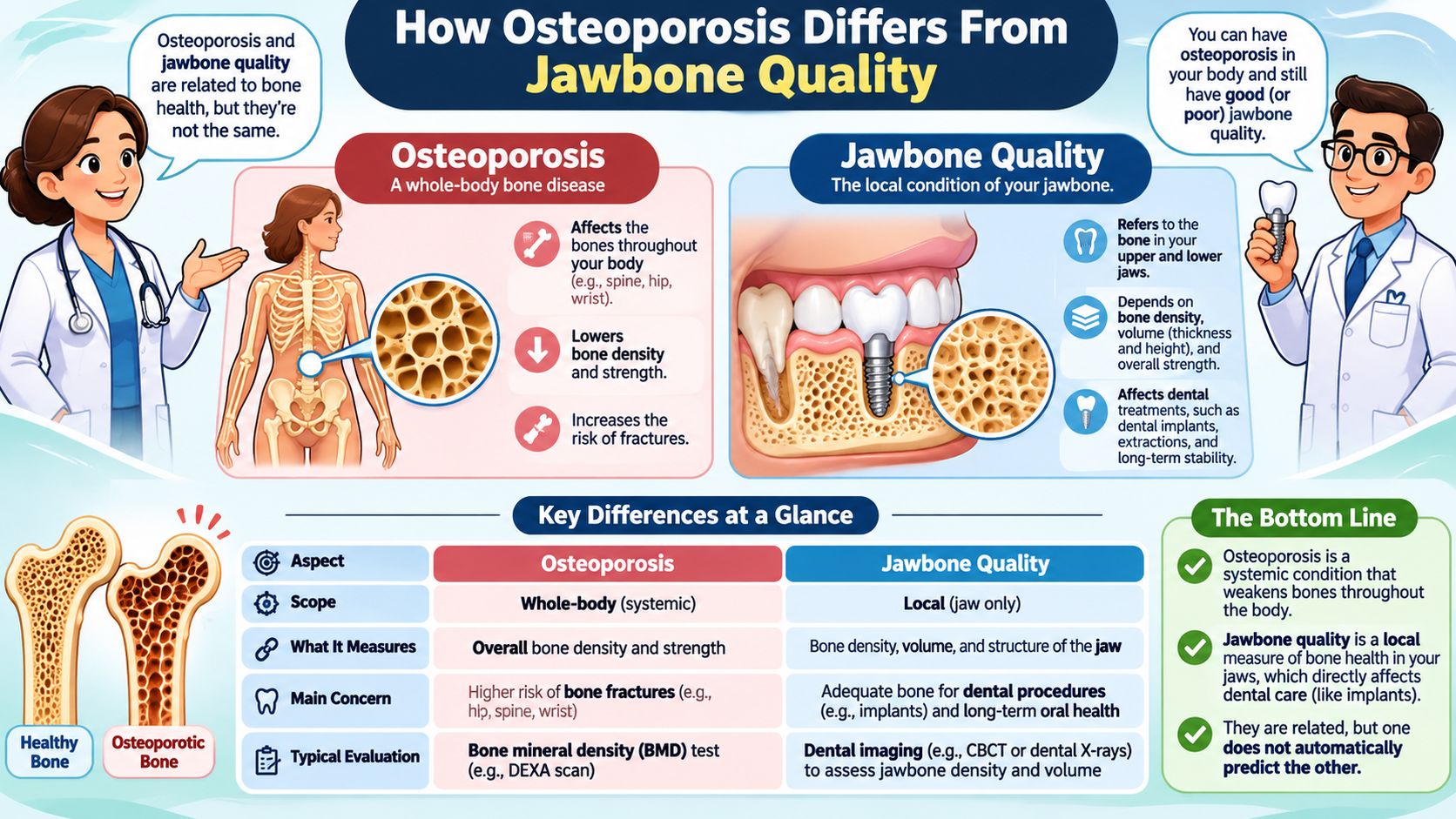
For a Santa Ana homeowner setting a support post, a general report about neighborhood soil wouldn't replace checking the ground beneath that particular post. An osteoporosis diagnosis and an implant-site examination have a similar relationship: one describes a systemic condition, while the other addresses a specific location.
Osteoporosis means bones have lost density and are more vulnerable to fractures. A dental implant is a small titanium post placed in the jawbone as a replacement tooth root. A hip or spine bone-density result isn't a detailed map of the jaw where that post would go.
Why the supporting bone deserves attention
A 2023 systematic review and meta-analysis evaluated 12 studies involving 1,132 patients and 3,505 implants, including 983 implants in people with osteoporosis and 2,522 in people without it. Most participants were women, 73.6%, and mean ages across the studies ranged from 54 to 76.6 years.
The review reported greater marginal bone loss, meaning loss of bone near the implant's upper edge, with a standardized mean difference reported as 0.71 mm, with a 95% confidence interval of 0.06–0.87 mm. The authors rated evidence certainty very low for survival and low for bone loss.
That measurement deserves caution. A standardized comparison isn't a forecast that your implant will lose that exact amount of bone, and a small change around an implant isn't proof that it will fail.
A separate systematic review associated osteoporosis with 0.18 mm more average marginal bone loss, with a 95% confidence interval of 0.05–0.30 mm. These are group comparisons, not a ruler for predicting an individual patient's future.
What this changes at checkups
The practical response is to establish a useful baseline and monitor the supporting bone. Follow-up images allow the dentist to compare the same area over time rather than judge it from memory or symptoms alone.
- Bone amount: Is there enough height and width at the proposed site?
- Bone structure: Will the site provide adequate support for placement and healing?
- Gum condition: Is inflammation or periodontal infection affecting nearby support?
- Changes over time: Do examination findings and comparison images suggest a need to adjust care?
Your medical history still belongs in this assessment. Bring the medication's name, route, dose, duration, and reason it was prescribed, not a note that says osteoporosis treatment.
Osteoporosis Medicines and the MRONJ Question
Do you need to stop an osteoporosis pill or injection before an implant? Not automatically, and never on your own. The decision requires attention to both dental healing and protection against fractures.
Implant failure and medication-related osteonecrosis of the jaw, or MRONJ, are different outcomes. MRONJ involves jawbone that doesn't heal properly, sometimes with exposed bone, and deserves its own discussion even when implant survival findings are encouraging.
A 2025 multidisciplinary task-force review found no evidence that antiresorptive therapy increases implant failure and suggested treatment generally doesn't need to be stopped before implant placement, but the recommendation was weak because evidence quality was very low. Its cited evidence associated long-term bisphosphonate use with a small MRONJ risk of about 3 cases per 1,000 patients, not a personalized estimate for every procedure.
How osteoporosis medicines change the implant conversation
| Situation | Usual planning stance | Extra caution |
|---|---|---|
| Oral bisphosphonate for osteoporosis | Placement is not generally ruled out. | Full drug history and healing watch; one review observed about 98.8% survival. |
| Intravenous bisphosphonate for osteoporosis | Individualized review, not an automatic ban. | One review's mixed intravenous-treatment group had about 91% survival and greater MRONJ concern than oral therapy; it doesn't establish an osteoporosis-dose-specific rate. |
| Denosumab | Don't casually pause it for surgery. | Interruption can raise fracture risk; coordinate with the prescriber. |
| High-dose antiresorptive therapy for cancer | Implant placement is generally avoided. | This is a different risk category from osteoporosis doses. |
| Stopping medicine before implants | The task-force review generally didn't support stopping. | Evidence is very low; MRONJ consent still matters, including the long-term bisphosphonate estimate described above. |
The American Dental Association's osteoporosis-medication guidance supports individualized evaluation rather than treating osteoporosis-dose antiresorptive therapy as an automatic contraindication. Evidence hasn't established that stopping bisphosphonates or denosumab improves implant survival or prevents MRONJ, while denosumab interruption can create skeletal risk.
Why medication studies can sound contradictory
A systematic review of bisphosphonate therapy reported 5 failures among 423 implants with oral therapy, about 98.8% observed survival, versus 6 failures among 68 intravenous-treatment implants, about 91% survival, and about 97% survival among 842 comparison implants. The studies were heterogeneous, so route alone shouldn't be used to assign your risk.
Another bisphosphonate meta-analysis included 1,727 implants in users and 21,986 in nonusers, finding an implant-failure odds ratio of 1.653, with a 95% confidence interval of 1.006–2.717, and estimated survival among users of 94.2% at 5 years and 90.1% at 10 years. That finding supports caution without establishing that every bisphosphonate user will have a problem.
Medication safety: Don't skip a pill, delay an injection, or arrange a drug holiday to fit a dental appointment without the prescribing clinician's direction.
Bring the drug name, route, dose, treatment duration, indication, and last administration date. Kidney health, oral infection, cancer history, and the extent of planned surgery may make physician coordination especially important.
How Implant Planning Changes for These Patients
At Bristol Dental & Orthodontics, the first step is an initial consultation with an examination and imaging to evaluate jawbone density and structure. The purpose isn't to repeat a general survival percentage. It's to determine what the proposed site and your overall health allow.
The planning review cited earlier supports assessing local bone, bite forces, periodontal health, smoking, diabetes, and healing capacity rather than using the diagnosis as the entire decision. The appointment turns those concerns into a sequence of decisions.
Build the plan around the site
- Examine the mouth: Check gum health, infection, neighboring teeth, and the space available for replacement.
- Review imaging: Evaluate bone height, width, structure, and nearby anatomy. Three-dimensional imaging may be appropriate when more detail is needed.
- Assess stability and bite: Consider how firmly the implant could engage the bone initially and what chewing forces it would receive.
- Review health factors: Discuss diabetes, smoking, vitamin D and calcium status, fall risk, and the complete medication history.
Primary stability means the implant's mechanical grip when it's first placed. That initial grip and the later biological attachment are related, but they aren't the same thing.
If the bone is thin or soft, options may include staged bone grafting, gentle site preparation, or delayed or protected loading. Protected loading means limiting chewing pressure on the new implant while the bone interface develops.
Give healing its own place in the schedule
After placement, the implant fuses with the jawbone over a period that typically takes 3 to 6 months. Once the jawbone has healed and the implant has bonded, a custom-made crown, bridge, or denture can be attached.
A 2024 retrospective observational study in the International Journal of Implant Dentistry reported that 1.4% of implants failed within one year in its broader study population. That isn't an osteoporosis-specific rate, but it illustrates why early follow-up remains necessary even when treatment appears to be progressing normally.
The diagnosis is the background. The jawbone, oral health, and medical history in front of the dentist guide the decision.
For a useful first visit, gather:
- Current records: A medication list and the name of the clinician treating your osteoporosis.
- Dental images: Recent x-rays, if available, so the team can determine what additional imaging is needed.
- Daily-health notes: Smoking history, dry mouth symptoms, and any problems cleaning or chewing.
These details help distinguish a straightforward single-site evaluation from a situation that requires infection treatment, additional bone preparation, or medical coordination before surgery.
Everyday Situations Patients Bring to the Visit
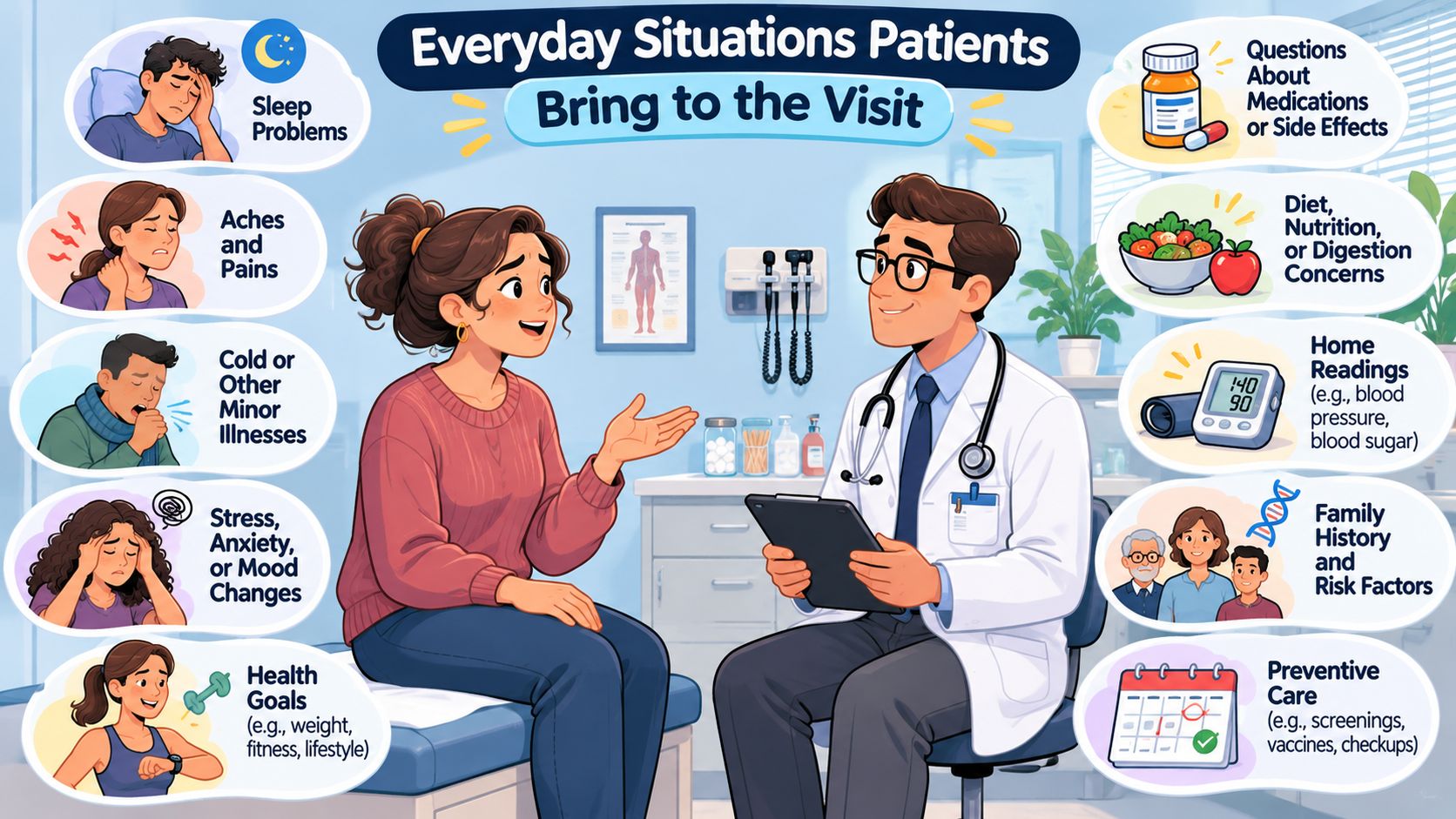
The same diagnosis can lead to different treatment plans. These illustrations describe possible conversations, not actual patient results or recommendations for anyone with a similar history.
A Tustin patient with a previous wrist fracture
Consider a woman in her sixties who has osteoporosis, takes no antiresorptive medicine, has healthy gums, and appears to have enough bone on imaging. Her single-tooth evaluation may resemble a routine implant assessment, with particular attention to bite force and support at that site.
Her fracture history matters to the medical review. It doesn't, by itself, establish that her jaw cannot support an implant.
A Garden Grove patient taking an oral bisphosphonate
A patient who has taken an oral bisphosphonate for several years needs several adjacent teeth replaced. An implant-supported bridge may be an option, but the decision requires more than counting missing teeth.
The dentist and prescribing physician may need to exchange the drug name, route, duration, and information about infection or healing concerns. The discussion should also address how the patient would clean beneath the bridge and maintain the supporting implants.
An Irvine patient taking denosumab or receiving cancer treatment
For a patient taking denosumab, the surgical date shouldn't be arranged around a self-directed missed injection. If coordination is needed, scheduling waits until the prescribing clinician and dental team have agreed on the medical considerations.
If the medicine was prescribed at cancer-treatment doses rather than for osteoporosis, the conversation changes substantially. A nonsurgical replacement may deserve greater consideration than an elective implant.
- Dry mouth matters: Report persistent dryness because it can make daily oral care more difficult.
- Gum health matters: Bleeding, swelling, or untreated periodontal disease needs attention regardless of the bone-density label.
A 2025 retrospective study in the Journal of Korean Association of Oral and Maxillofacial Surgeons evaluated 267 patients treated with osteoporosis or osteopenia medication, reporting 92.8% patient-level survival and 96.2% implant-level survival. Patient-level and implant-level measures answer different questions, especially when a person has multiple implants.
A 2025 prospective study in the International Journal of Implant Dentistry placed 45 implants in 36 postmenopausal women and reported 100% cumulative survival at one year. These selected groups and follow-up periods aren't personal forecasts, and they don't replace watching how your own surgical site heals.
Healing Signs That Need a Prompt Call
Some tenderness and swelling can occur after implant surgery. Your postoperative instructions should explain what's expected for your procedure and how to contact the dental team if recovery isn't following that pattern.
Symptoms that worsen, persist unexpectedly, or suggest an open wound deserve attention. People taking antiresorptive medicines shouldn't assume a slow-healing area is harmless, but they also shouldn't try to diagnose MRONJ themselves.
Call about changes rather than naming the complication
- Exposed bone: Report an area where bone appears visible through the gum.
- A sore that won't close: Contact the dental team about a persistent opening or delayed healing.
- Increasing pain or swelling: Call if symptoms worsen instead of settling as expected.
- Drainage: Report pus, discharge, or a persistent unpleasant taste.
- New numbness: Describe where it occurs and when it started.
These findings can have different causes. An examination is needed to determine what's happening and whether additional treatment is appropriate.
Don't wait for a routine maintenance appointment to report exposed bone or a wound that isn't closing.
Maintenance continues after the tooth is attached
With proper care, dental implants can last a lifetime. That's a possibility, not a warranty, and it remains tied to oral health, bite forces, supporting bone, and continued professional care.
Cleaning also changes with the restoration. Around a single crown, the goal is to clean the gumline and between neighboring teeth; beneath a bridge, you need access under the replacement teeth as well as around the posts.
For a denture that clips onto implants, follow instructions for cleaning the attachments and the denture, including whether it should be removed for daily cleaning. Ask the dental team to demonstrate the technique rather than guessing which spaces need attention.
Plaque can still contribute to gum problems around implants. Checkups and appropriately timed x-rays help the dentist assess tissues and supporting bone that you can't evaluate at home.
If anxiety or complex surgery is a concern, discuss sedation during planning. Whether it's appropriate requires the dentist's assessment of the procedure and your medical history.
Patients traveling from Costa Mesa, Tustin, Irvine, or Garden Grove should report medication changes, including a new injection date, before their next visit. If healing is delayed or a warning sign appears, call promptly rather than waiting until you're already scheduled to return.
Book a Santa Ana Implant Consultation
A consultation with Dr. Andrew Finley at Bristol Dental & Orthodontics can help turn a general concern about osteoporosis into specific questions about your mouth. Bristol Dental & Orthodontics is a family and cosmetic dental practice serving Santa Ana and Orange County, including patients from Costa Mesa, Tustin, Irvine, and Garden Grove.
Dr. Andrew Finley has advanced training in implants from the California Implant Institute. The evaluation should still begin with your examination, medical history, and images, not a predetermined treatment recommendation.
Bring the details that make the discussion useful
- Medication information: The osteoporosis medicine's name, dose, route, duration, and last dose date, including relevant past treatment.
- Prescriber contact: The name and contact information of the physician managing your bone health.
- Dental records: Recent images and notes about previous extractions, gum treatment, or healing problems.
- Your priorities: Whether you're most concerned about chewing, appearance, surgery, maintenance, or the effect of medication.
The visit reviews jawbone volume, density, and structure before deciding whether a single crown, bridge, or denture attached to implants is realistic. You should leave understanding what additional information is needed, what might change the plan, and which alternatives deserve consideration.
A worn bite, a cosmetic gap, Invisalign, or a sleep-related oral appliance can also be raised as separate care concerns. Keeping the implant evaluation focused helps ensure the osteoporosis and medication questions receive enough attention.
This article is general education, not a diagnosis or a promise of an individual outcome, and it requires Dr. Finley's review before publication. If osteoporosis or its treatment is part of your story, an informed conversation is a reasonable next step; no result can be promised before the examination.
Bristol Dental & Orthodontics offers dental implant evaluations that consider your oral health, jawbone, and osteoporosis medication history. Visit Bristol Dental and Orthodontics to schedule a consultation with Dr. Andrew Finley, and bring your medication list and recent dental images so you can discuss what's appropriate for your situation.