

You may be searching for dental implants in Santa Ana, CA after a tooth loss, a loose denture, or an extraction that left you unsure what comes next. Perhaps you're avoiding crunchy foods at a family dinner near South Bristol Street, covering your mouth during a work meeting, or wondering whether “same-day implants” means you'll leave with your permanent teeth.
Those questions deserve clear answers rather than a sales pitch. Dental implants can be an effective way to replace missing teeth, but the right treatment depends on bone, gum health, bite forces, medical history, and your willingness to allow healing. Bristol Dental & Orthodontics, a family and cosmetic dental practice in Santa Ana led by Dr. Andrew Finley, can help you understand those factors during a consultation.
Table of Contents
- When a Missing Tooth Starts Changing Everyday Life
- What a Dental Implant Actually Is and How It Works
- Single Tooth, Multiple Teeth, and All-on-4 Options
- Who Makes a Good Candidate for Dental Implants
- A Realistic Look at the Treatment Timeline
- Understanding the Cost of Dental Implants
- Recovery, Healing, and Long-Term Care
- Choosing Bristol Dental and Next Steps for Your Smile
When a Missing Tooth Starts Changing Everyday Life
A missing tooth rarely disrupts everything at once. More often, the changes arrive in small moments. You may chew on one side during dinner, avoid apples or crusty bread, or notice that certain words sound less clear. If a denture moves while you're talking, you might start concentrating more on keeping it in place than on the conversation itself.
Confidence can change, too. A Santa Ana resident might smile less in family photographs, keep a hand near the mouth in a meeting, or feel self-conscious while talking with friends in Tustin, Irvine, or Garden Grove. These reactions aren't unusual, and they don't mean you're being overly concerned about appearance. Teeth affect eating, speech, facial support, and how comfortably you interact with people.

The quiet changes after tooth loss
Over time, nearby teeth can drift toward the open space. The opposing tooth may move into the gap, and the bite can feel different even when the shift is subtle. The jawbone beneath the missing tooth also loses some of the stimulation it previously received from the tooth root. The degree of change varies from person to person, but the area doesn't remain biologically identical to how it was before the tooth was lost.
The broader need for replacement is substantial. In a peer-reviewed analysis of NHANES data, implant prevalence among U.S. adults missing at least one tooth increased from 0.7% in 1999–2000 to 5.7% in 2015–2016, showing how implants moved from a niche option toward a mainstream restorative treatment. The study included 32,758 adults with at least one missing tooth and 618 with at least one implant. Read the peer-reviewed implant prevalence analysis for the underlying methodology.
Replacing more than the visible tooth
A dental implant is designed to replace the root as well as support a visible replacement tooth. That distinction matters because a crown alone restores the part you see, while the implant post provides an anchored foundation below the gum.
The treatment isn't automatically right for every gap. A bridge, removable partial, or another approach may make more sense depending on the neighboring teeth, bone volume, health history, and goals. The important first step is understanding what the missing tooth is changing and then evaluating which option can restore function without creating a new problem.
What a Dental Implant Actually Is and How It Works
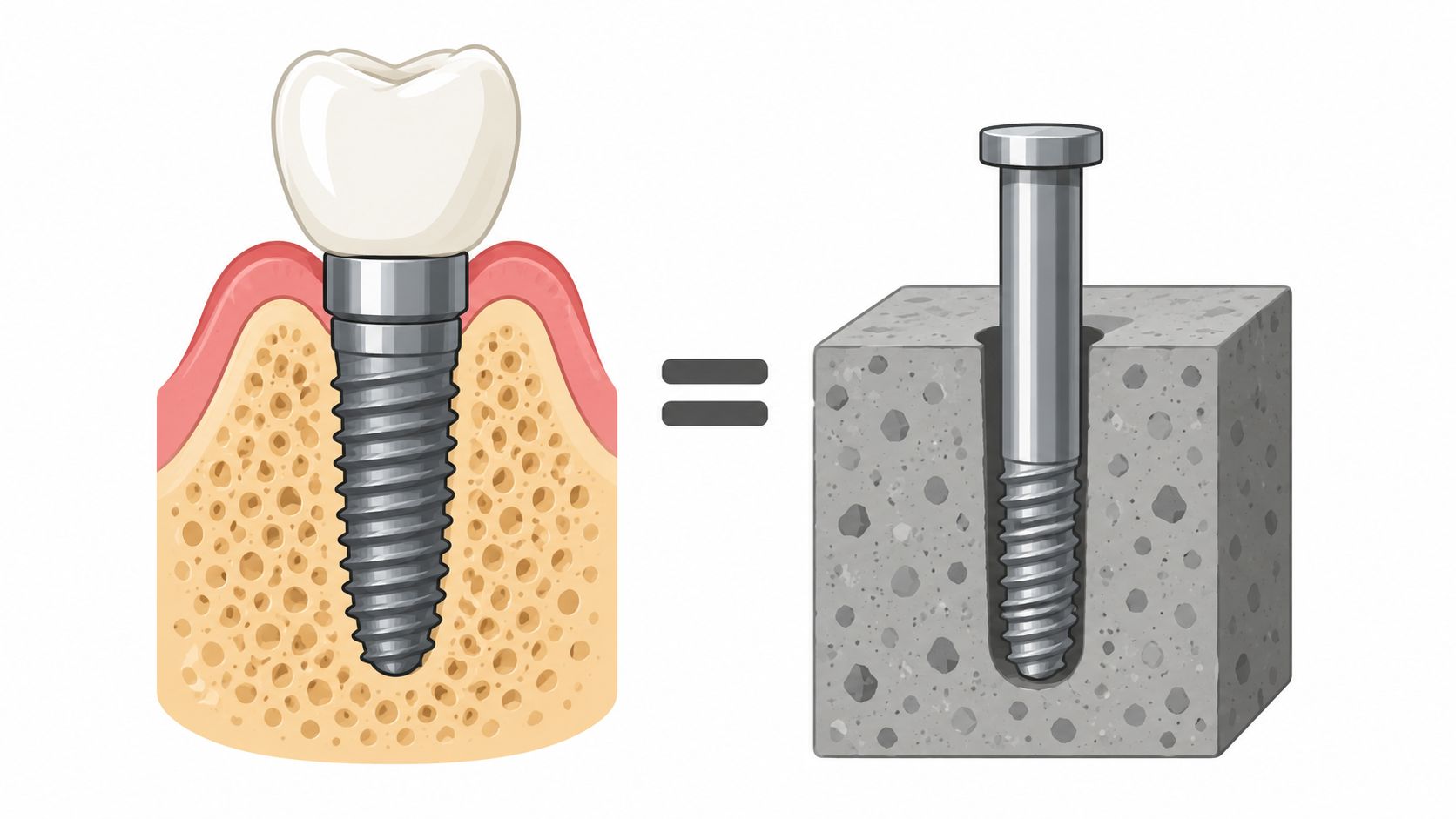
Think of an implant like a post set securely into concrete. The post isn't the finished structure, but it gives the structure a stable base. In the mouth, a dental implant uses a small titanium post placed in the jawbone to act as an artificial tooth root.
The replacement is built in three connected parts:
- The implant post: This sits inside the jawbone beneath the gum.
- The abutment: This connector joins the implant post to the visible restoration.
- The crown or prosthesis: This is the custom-made tooth or group of teeth that you see and use.
Why the root matters
A traditional bridge can replace a visible tooth by attaching to neighboring teeth. A denture can replace several teeth or a full arch and can be removable. An implant differs because it places an anchor in the bone rather than relying only on adjacent teeth or gum support.
That doesn't mean an implant is always the superior choice. It means the treatment solves a different structural problem. Your dentist still needs to assess whether the surrounding teeth should be preserved, whether enough bone remains, and whether your bite can support the planned restoration.
Osseointegration in plain language
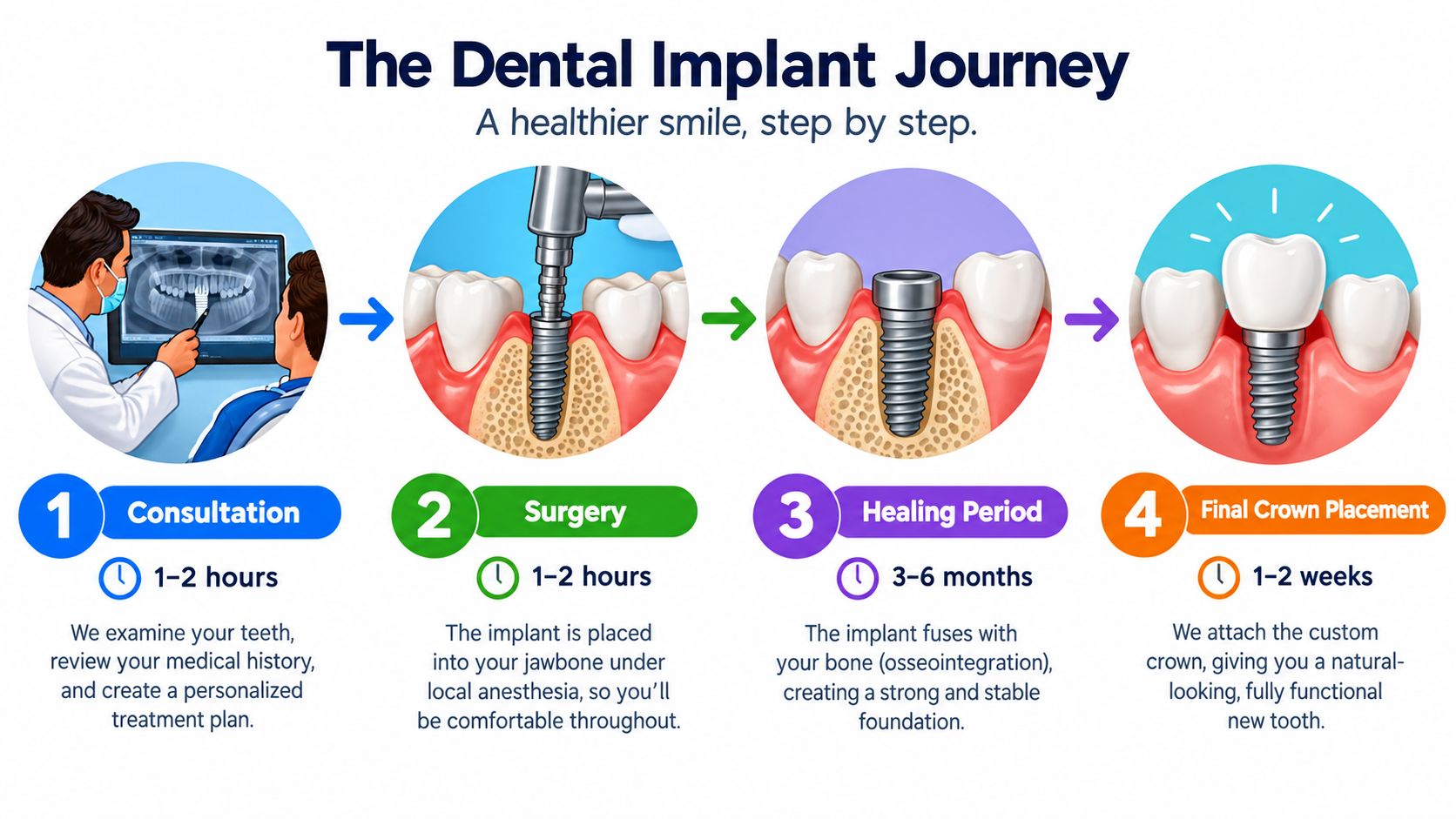
After placement, the jawbone needs time to heal around the titanium surface. This biological bonding process is called osseointegration, but you can think of it as the bone gradually accepting the post as a stable part of the foundation.
Healing takes weeks to months and can vary with the implant location, bone density, surgical plan, and overall healing capacity. The final crown is made to fit your bite and blend with neighboring teeth. Its shade, shape, and proportions are planned as part of the restoration, not chosen as an afterthought.
The post may be hidden beneath the gum, while the crown is designed to look like a tooth. A consultation helps determine whether replacing the root is beneficial in your specific situation or whether a bridge, partial, or denture would provide a more suitable path.
Single Tooth, Multiple Teeth, and All-on-4 Options
The best implant configuration depends mainly on how many teeth are missing and what condition the remaining teeth are in. It isn't a menu where more implants automatically means a better result. Each arrangement solves a different everyday problem.
| Option | Best For | Typical Implants Used | Key Consideration |
|---|---|---|---|
| Single-tooth implant | One isolated missing tooth | One | Requires adequate bone and a healthy site around the gap |
| Implant-supported bridge | Several adjacent missing teeth | More than one, depending on the design | Can replace a section without preparing every neighboring tooth |
| Full-arch treatment, including All-on-4 | A full arch of missing or failing teeth | Four in the described All-on-4 configuration | Bone, bite forces, cleaning ability, and prosthesis design all matter |
One gap in an otherwise healthy smile
A single-tooth implant can suit someone who lost one tooth through injury, decay, or a failed root canal while the teeth on either side remain sound. Instead of trimming those neighboring teeth to support a bridge, the implant and crown occupy the space independently.
That independence can be useful, but it still depends on the site. Long-standing tooth loss, infection, gum disease, or bone shrinkage may change the sequence before a crown can be placed.
A short row of missing teeth
When several adjacent teeth are gone, an implant-supported bridge or partial may replace the section without using every neighboring tooth as a support. The design depends on the number and position of missing teeth, available bone, bite pressure, and how the patient can clean around the restoration.
This option may be more practical than placing a separate implant for every missing tooth. The dentist needs to plan the bridge as one functional unit, rather than treating each gap in isolation.
A full arch with All-on-4
All-on-4 uses four strategically angled implants to support an entire fixed arch. Some treatment plans provide a temporary fixed restoration on the day of surgery, but that isn't the same as receiving final teeth. Bone volume, bite force, gum health, and daily hygiene all influence candidacy.
Practical rule: “Same day” describes a treatment step, not a guarantee that the permanent final restoration will be finished that day.
A Santa Ana implant consultation should identify which of these situations resembles yours. The right plan may involve an implant, bridge, implant-supported denture, conventional denture, or treatment to preserve an existing tooth.
Who Makes a Good Candidate for Dental Implants
Candidacy starts with the proposed implant site, not with age or enthusiasm for a particular procedure. Dr. Finley can evaluate the area, review your health history, and use appropriate imaging to determine whether the bone can provide stable support.
Bone is the foundation
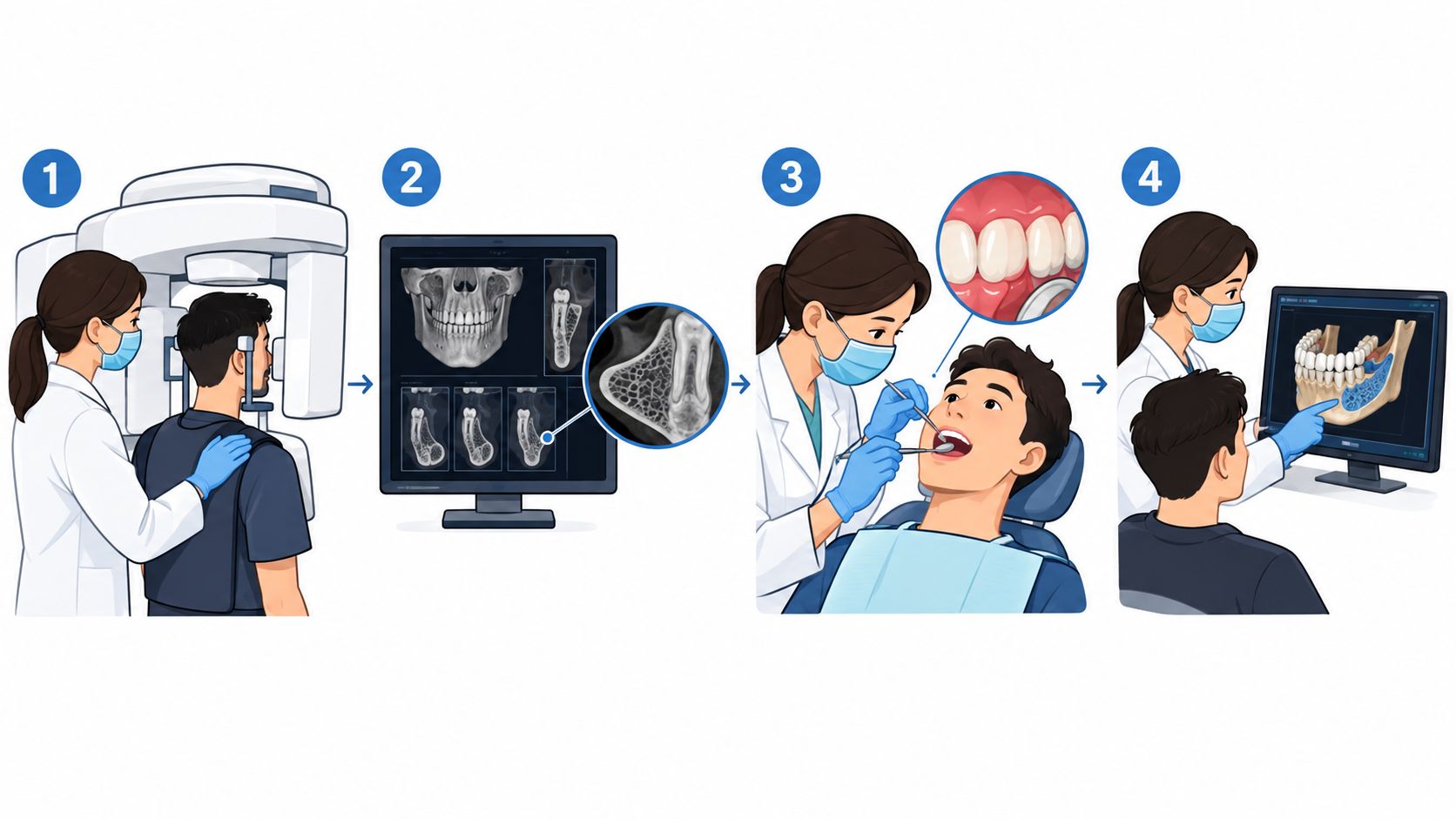
A clinical examination and imaging, sometimes including a CBCT scan, help show the height, width, density, and anatomy of the jawbone. The scan can also reveal nearby structures that matter to surgical planning. A gap that looks simple in a mirror may have limited bone beneath the gum.
If bone is insufficient, that doesn't automatically close the door. It may mean bone grafting or a sinus lift must happen before, or sometimes alongside, implant placement. Some patients can receive a graft and implant in the same visit, while larger defects commonly require staged healing first. The decision depends on the defect shape, residual bone, and whether safe primary stability can be achieved. Review the patient guidance on bone grafting for implants.
Gums and general health matter
Untreated periodontal disease can make implant treatment inappropriate until the infection and inflammation are stabilized. Healthy gum tissue supports easier cleaning and provides a better environment for the restoration.
Your medical history also deserves a direct conversation. Controlled diabetes, heart conditions, smoking, medications such as bisphosphonates, and other health factors may affect healing or change the recommended sequence. These details aren't reasons to hide information or assume treatment is impossible. They help the dental team plan safely and decide whether medical coordination is needed.
Age is only one part of the picture
Adults are evaluated more by skeletal maturity, bone condition, healing capacity, and daily habits than by a birthday alone. Someone older may be a candidate if their health and oral condition support treatment. Someone younger may need to wait until jaw growth is complete.
You'll also need to commit to cleaning around the restoration, attending maintenance visits, and addressing habits such as smoking or clenching. An implant is a replacement tooth, not a replacement for home care.
A Realistic Look at the Treatment Timeline
Implant treatment is a sequence of decisions and healing stages. A straightforward case can move efficiently, while an extraction, infection, graft, sinus lift, or unstable bite can add separate steps. The plan should be built around biology, not a calendar promise.
The planning appointment
The first visit usually includes a discussion of your goals, examination of the teeth and gums, medical history review, and diagnostic imaging. Digital scans or impressions may help the team design the proposed crown or prosthesis and check how it will fit your bite.
Planning also answers practical questions. You can discuss whether a damaged tooth should be removed, whether a temporary tooth is needed, how the restoration will be cleaned, and what appointments may be required before surgery.
Surgery, healing, and the temporary phase
During surgery, the implant post is placed into the planned area of bone. You may have swelling, tenderness, or dietary restrictions during the first few days. Your office will provide instructions for medication, cleaning, activity, and follow-up.
The key biological stage is osseointegration. Immediate loading means a restoration is placed within one week, while delayed or conventional loading uses a healing period longer than two months, according to expert consensus and the evidence review available here. These categories describe timing, but they don't decide candidacy by themselves.
Primary stability is central. Immediate loading is generally supported when insertion torque reaches about 35–45 N·cm or resonance frequency analysis exceeds ISQ 70. Values around 25–35 N·cm may shift planning toward early loading, while readings below 25 N·cm often favor delayed loading. See the contemporary review of stability and loading protocols.
What “same day” really means
Low-density posterior maxillary bone, often described as D3 or D4, can increase micromotion risk. If the implant cannot remain sufficiently stable, placing a temporary tooth too soon may interfere with healing. A same-day implant placement may therefore be possible while the visible final crown still waits for healing and laboratory fabrication.
Extraction healing, grafting, sinus procedures, and complex lab work can extend the schedule. Plan important work, travel, and social events around the possibility of staged visits rather than assuming the fastest advertised pathway applies to you.
Understanding the Cost of Dental Implants
An implant estimate is made of several parts, so two plans that both say “implant” may not include the same treatment. The number of implants, the restoration design, surgical complexity, imaging, materials, and laboratory work all influence the total.
| Cost Factor | Why It Matters |
|---|---|
| Number of implants | A single tooth and a full-arch restoration require different surgical and restorative designs |
| Crown, bridge, or full-arch prosthesis | Each restoration uses different materials, fabrication steps, and appointment sequences |
| Bone grafting or sinus lift | Additional procedures may be needed when the existing bone cannot support the planned implant safely |
| Imaging and planning | Detailed diagnostics help evaluate anatomy, stability, and the proposed bite |
| Laboratory work | The final restoration requires custom design, shade selection, and fabrication |
| Maintenance and protective care | Hygiene visits and appliances such as nightguards may be part of long-term planning |
Why Santa Ana quotes differ
Practices may use different imaging and planning workflows, surgical approaches, materials, and laboratory arrangements. Some work with an in-house laboratory, while others send cases to an outside facility. Those differences can affect what appears in an estimate and how many appointments are included.
Ask for a written sequence rather than comparing one headline figure with another. A clear plan should identify the implant procedure, temporary restoration, final crown or prosthesis, grafting needs, follow-up care, and what happens if the clinical findings change.
Insurance often treats the restoration differently from the implant post, and medical coverage tends to apply only in narrow accident or reconstructive situations. Financing may include third-party healthcare lenders, practice payment arrangements, or health savings account funds, depending on your circumstances. Ask Bristol Dental & Orthodontics what payment choices are currently available without assuming a specific plan applies.
Before committing, ask:
- What is included: Does the estimate cover imaging, surgery, temporary teeth, the final restoration, and follow-up?
- What could change: Which findings might require grafting, a sinus lift, or a different restoration?
- Who provides each phase: Will the same dental team coordinate surgery and restoration?
- How is maintenance handled: What visits and protective appliances might be recommended after completion?
Recovery, Healing, and Long-Term Care
The first week usually requires practical adjustments rather than heroic endurance. Swelling, tenderness, and sensitivity can occur after surgery, and soft foods may be more comfortable while the area settles. Follow the written instructions from your dental team instead of judging healing by how another patient felt.
You may need to avoid chewing directly over the surgical site for a period of time. Your dentist will tell you how to manage rinsing, brushing, medication, and any stitches. Don't probe the area with a finger or sharp object, and don't improvise with household remedies.
What deserves a call
Some discomfort after surgery can be expected, but worsening pain, persistent bleeding, increasing swelling, fever, a bad taste, drainage, or a restoration that feels loose should prompt a call to the office. Breathing difficulty or rapidly increasing facial swelling requires urgent medical attention.
The office can tell you whether a symptom fits the expected recovery pattern or needs examination. A quick phone call is better than waiting several days while hoping a problem resolves.
Cleaning around an implant
Once your dentist says the site can be cleaned normally, treat the implant crown as part of your everyday smile. Brush the crown and surrounding gumline, clean between teeth with the method recommended for your restoration, and attend professional hygiene visits.
Implants can remain functional for many years, but they still depend on the tissues around them. Smoking, untreated gum inflammation, heavy clenching, and skipped cleanings can make maintenance more difficult. A nightguard may be appropriate for someone who grinds or clenches, particularly when bite forces place extra stress on the restoration.
A useful mindset: The implant procedure is one appointment sequence. Protecting the result is an ongoing partnership between your home routine and your dental team.
Your maintenance plan may change as your bite, gums, and restoration change. Report bleeding around the implant, persistent tenderness, food trapping, or movement early. Small concerns are easier to assess before they become larger restorative problems.
Choosing Bristol Dental and Next Steps for Your Smile
A sound implant decision rests on four questions. Is the site healthy enough? Is there enough bone or a safe way to build it? Which restoration fits the missing teeth? Can you commit to healing and long-term maintenance? The answers matter more than a promise of speed.
An implant may be difficult to notice when the crown is shaped and shaded to suit the surrounding teeth, but no restoration should be described as invisible in every person. Older adults may qualify when their skeletal maturity, health, bone, gums, and healing capacity support treatment. If an implant fails, the next step depends on why it failed, the condition of the site, and whether infection, bite pressure, bone, or healing contributed. Your dentist may recommend removal, healing, additional treatment, or a different replacement option.
Questions worth bringing to your visit
Bring a list of concerns, not just a request for a specific procedure. Ask whether the tooth can still be saved, whether an implant-supported bridge or denture would be more suitable, and whether a temporary restoration is expected. Ask how a graft or sinus lift would affect the sequence, what symptoms should trigger a call, and how the final crown will be maintained.
If you're also considering Invisalign, cosmetic dentistry, sleep apnea care, or emergency dentistry, mention those goals during the consultation. Invisalign treatment can begin with a three-dimensional scan, and digital planning can show tooth movements such as rotation, intrusion, extrusion, translation, crown angulation, root torque, and crown tip before aligners are made. Learn how Invisalign's digital experience works, and review the ClinCheck planning tools for more detail.
Sleep concerns deserve the same careful distinction. The American Academy of Sleep Medicine and the American Academy of Dental Sleep Medicine recommend a custom, titratable oral appliance for adults with obstructive sleep apnea who can't tolerate CPAP or prefer an alternative, but an oral appliance isn't the same as CPAP. It can also be appropriate for selected adults with primary snoring when behavioral measures aren't suitable or haven't worked, while severe obstructive sleep apnea may require other management. Read the joint clinical practice guidance on oral appliance therapy and the guidance on snoring and sleep apnea treatment.
A local starting point
Bristol Dental & Orthodontics provides family, cosmetic, orthodontic, implant, sleep apnea, and emergency dental care in Santa Ana. The practice can use digital imaging and treatment planning to discuss single implants, implant-supported bridges, implant-supported dentures, and full-arch options, while keeping the sequence focused on your clinical findings rather than a one-size-fits-all shortcut.
For patients in Santa Ana and nearby Orange County communities such as Costa Mesa, Tustin, Irvine, and Garden Grove, the next step is a consultation with Dr. Andrew Finley. Bring your medical history, current medications, questions about healing, and any concerns about appearance or downtime. You don't need to decide on surgery at the first visit. You need a clear roadmap that explains what can happen now, what must heal first, and which option fits your smile and daily life.
Every article published by the practice should be reviewed by Dr. Finley before publication, and your personal treatment plan should come from an in-person clinical evaluation rather than from an online guide.
Bristol Dental and Orthodontics offers dental implant consultations, restorative options, Invisalign, cosmetic dentistry, sleep apnea care, and emergency dental services for Santa Ana families. To discuss your missing tooth and receive a staged, personalized treatment roadmap, visit Bristol Dental and Orthodontics and schedule a consultation.