
You've booked a wedding photographer, accepted a job interview, or agreed to attend a class reunion. Then you look in the mirror and notice that your smile doesn't look as bright as you'd like. A quick search brings up laser teeth whitening, with polished before-and-after photos and the promise of a noticeably whiter smile in one visit.
That appeal is understandable, especially for patients in Santa Ana and nearby Orange County communities such as Costa Mesa, Tustin, Irvine, and Garden Grove. But the word “laser” can make the treatment sound more powerful than the evidence supports. In many cases, the peroxide gel does most of the whitening, while the light or laser serves as an activating tool.
Table of Contents
- Why People in Santa Ana Are Asking About Laser Teeth Whitening
- What Laser Teeth Whitening Really Means
- How the Appointment Actually Works Step by Step
- What the Evidence Says About Results and Longevity
- Side Effects and Candidacy Questions to Ask First
- Laser Whitening Compared to Other Whitening Options
- Preparing for Treatment and Caring for Your Smile Afterward
- Is Laser Whitening Worth It and How to Get Started
Why People in Santa Ana Are Asking About Laser Teeth Whitening
A brighter smile can feel timely when a major event is close. You may want to look more confident in family photos, feel comfortable during a presentation, or refresh your appearance after years of coffee, tea, tobacco exposure, or normal aging. An in-office procedure sounds appealing because it places the treatment under dental supervision and may fit into a busy schedule.
Social media has also made fast cosmetic treatments more visible. Glossy images can create the impression that laser activation is the main ingredient responsible for dramatic shade changes. The more useful question is simpler: what does the laser add to the whitening gel?
Laser teeth whitening is a professional bleaching procedure. A dental team applies peroxide to the teeth, protects the gums and nearby tissues, and may use light or laser energy during the process. The treatment can brighten natural teeth, but it doesn't guarantee a particular shade, and the final appearance depends on the starting color, the type of discoloration, enamel condition, and the protocol used.
A practical way to think about it: the gel is the whitening treatment. The laser is an optional part of how some offices activate that treatment.
The evidence matters because a light-assisted appointment may cost more than bleaching without light. If activation doesn't create a clinically meaningful improvement, paying a premium may not make sense for every patient. Your decision should also account for comfort, supervision, timing, restorations, and whether a gradual option would suit you better.
At Bristol Dental & Orthodontics, led by Dr. Andrew Finley, a consultation can help Santa Ana patients discuss those trade-offs before scheduling. The same careful planning is useful when whitening is part of a broader cosmetic plan involving Invisalign, dental implants, or other restorative work.
What Laser Teeth Whitening Really Means
Laser teeth whitening is a professional bleaching procedure. A dental professional places a hydrogen peroxide bleaching gel on the visible surfaces of natural teeth and may apply laser or light energy during the appointment. Clinical research has examined diode lasers and other wavelength classes, but the equipment does not replace the gel. It delivers energy to the material already on the teeth.
The history also shows why the laser should not receive all the credit. The first documented professional dental bleaching attempt dates to 1867. A commercially available bleaching agent appeared in 1895 as a 5:1 mixture containing 25% hydrogen peroxide and diethyl ether. An early power-bleaching attempt was reported in 1937, using heat from electromagnetic radiation with 35% hydrogen peroxide gel. The modern laser period is often traced to 1996, when the U.S. FDA approved Argon and CO2 lasers for bleaching. Nd:YAG and some visible and near-infrared diode lasers followed in 2004, while remaining infrared diode lasers were approved in 2007. This historical review of power bleaching and dental laser development places current treatment within more than a century of bleaching research.
The gel does the chemical work
Peroxide breaks down into reactive oxygen compounds that help disrupt discoloration inside natural tooth structure. Light or laser energy may heat the gel or affect the reaction speed, but it is not a separate whitening substance. In practice, the gel does the whitening work, while the laser is an optional activation step.
That distinction makes treatment comparisons clearer. Conventional in-office bleaching uses professional-strength peroxide without necessarily adding light. Custom trays use dentist-selected gel over a slower schedule, while over-the-counter products generally use lower-strength formulations with less individualized fitting.
The American Dental Association notes that in-office whitening commonly uses hydrogen peroxide concentrations from 15% to 43%, which can shorten treatment time and produce visible results after a single appointment. The ADA's overview of in-office and take-home whitening explains why concentration and professional supervision matter when considering whitening choices.
How the Appointment Actually Works Step by Step
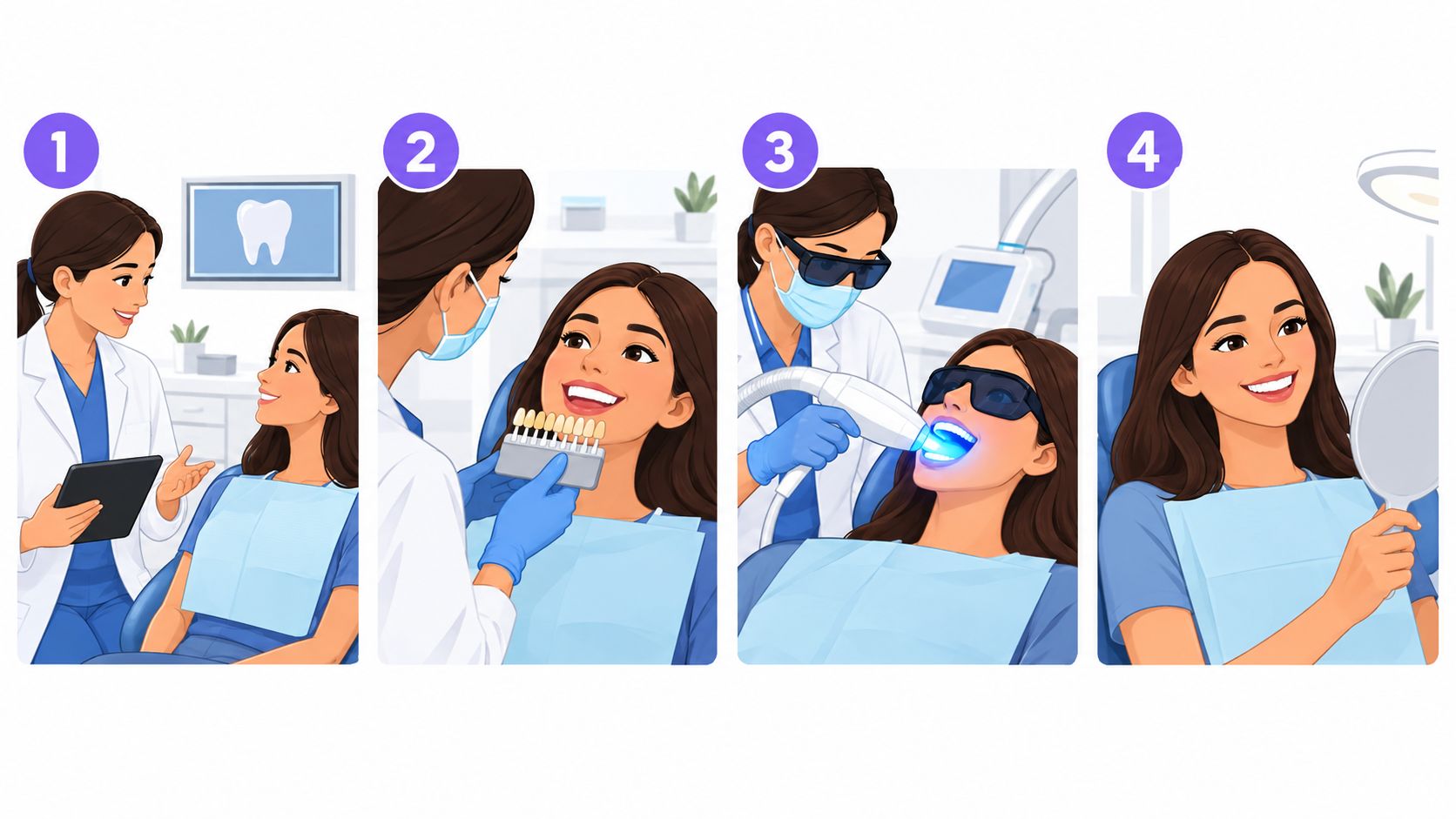
A professional appointment begins before anyone activates a laser. The dentist or dental team first checks whether whitening is appropriate for your mouth and whether the visible discoloration comes from natural teeth that can respond to peroxide.
Consultation and preparation
The team may record your starting shade with a shade guide and examine your teeth and gums for cavities, active inflammation, worn enamel, exposed roots, or other concerns. This visit also gives you a chance to explain your deadline. Someone preparing for wedding photos may value a single supervised appointment, while another patient may prefer a gradual approach because sensitivity is a concern.
Before gel application, the clinician places cheek retractors to keep the lips and cheeks away from the treatment area. A protective gum barrier, liquid dam, or similar isolation material helps prevent peroxide from contacting soft tissue. Some protocols also use a desensitizing varnish or liquid before whitening begins.
Gel application and activation
The dental professional brushes the peroxide gel onto the facial surfaces of the teeth, usually focusing on the upper and lower front teeth that show in your smile. The exact area depends on your goals and on whether crowns, veneers, fillings, or bonding are present.
The laser handpiece is then moved over the treated teeth according to the office's protocol. Some systems use short exposure periods and repeated rounds, with fresh gel applied between cycles. Patients may notice bubbling, foaming, or a change in the gel's appearance. Those visible changes don't prove that the final shade will be better than with gel alone.
Rinsing and reviewing the shade
At the end, the team removes the gel and protective materials, rinses the teeth, and compares the result with the starting shade. The appointment length and number of rounds vary by system and patient. A single visit may produce a visible change, but the final appearance can continue to settle after treatment, and no responsible clinician can promise a specific shade.
The appointment should also include aftercare instructions. Ask what level of sensitivity is expected, what to eat and drink afterward, and when to contact the office if gum irritation persists.
What the Evidence Says About Results and Longevity
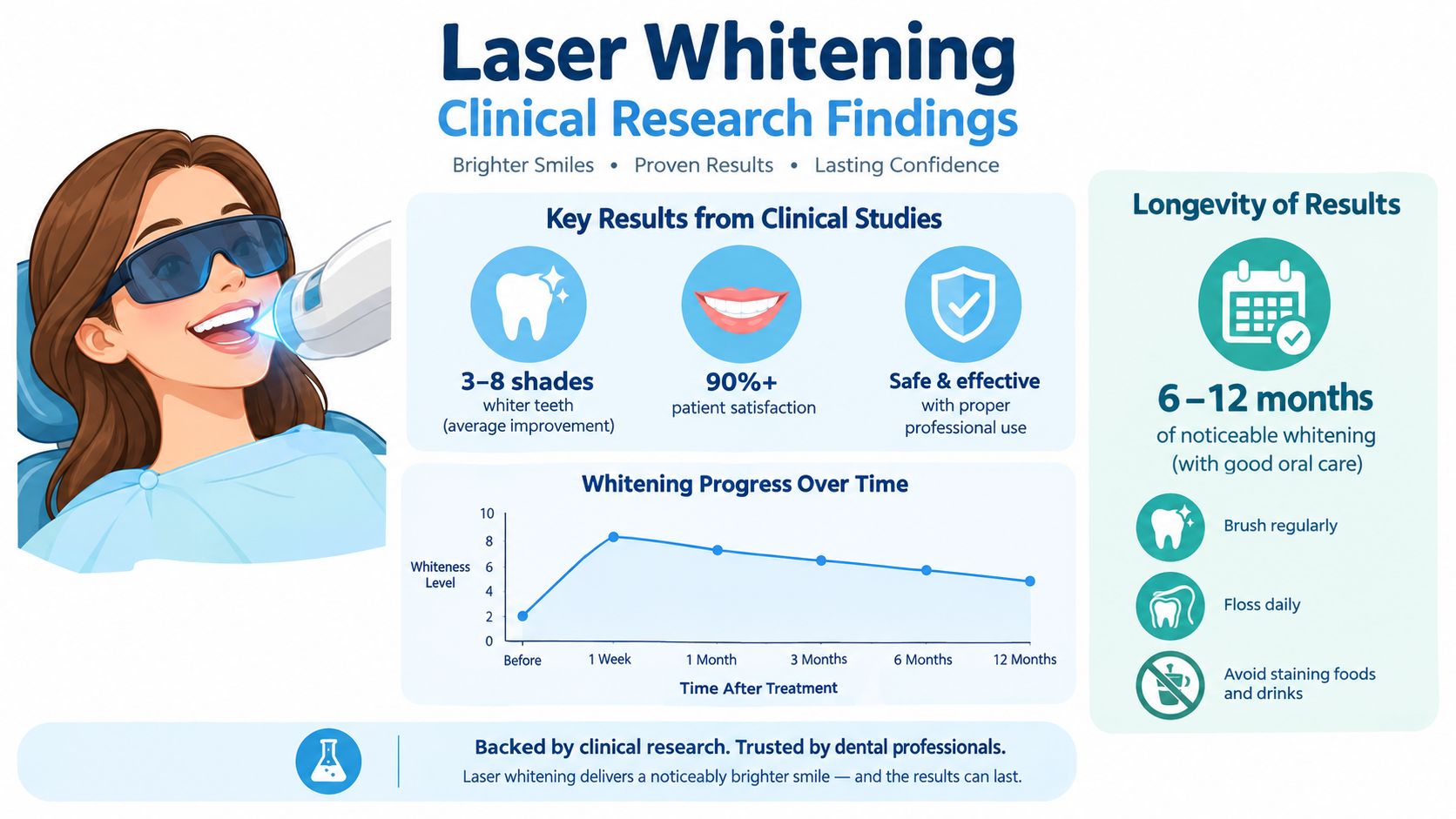
The central finding is easy to miss in promotional content: laser activation hasn't consistently produced better final whitening than peroxide bleaching without activation.
A clinical study involving 20 patients compared Nd:YAG-assisted bleaching with non-activated treatment. Both approaches whitened teeth, but the analysis found no statistically significant additional benefit from laser activation, with P > 0.05. An umbrella review covering six clinical trials and 136 patients also found no statistically significant advantage. Its pooled mean difference in subjective color change was -2.2, with a 95% confidence interval from -6.4 to 1.9, and p = 0.3. The review reported very high heterogeneity, I² = 97%, meaning the protocols and results varied substantially. The clinical evidence summarized in the PubMed review supports caution about treating the word “laser” as a guarantee of superior whitening.
Why studies can look different
A 2024 systematic review of 40 studies found that diode lasers were the most frequently studied wavelength category, appearing in 29 of 40 publications. About 10 of those diode-laser studies concluded that activation increased whitening compared with classical methods, while KTP, Er:YAG, and Er,Cr:YSGG systems showed promising but variable findings. The systematic review of laser types and bleaching protocols illustrates why results can differ. Wavelength, gel formulation, exposure time, isolation, measurement method, and patient characteristics all influence the outcome.
A 2026 umbrella review of 10 systematic reviews reached a similar overall conclusion. Laser or light activation didn't provide a consistent, clinically meaningful improvement in final whitening compared with nonactivated in-office bleaching, and it didn't reliably reduce post-treatment sensitivity. Some high-energy protocols were linked with less favorable sensitivity outcomes, while photobiomodulation reduced sensitivity without reducing color change. The full umbrella review is useful because it evaluates the combined direction of several reviews rather than relying on one small trial.
Longevity depends on maintenance
Whitening isn't permanent. Coffee, tea, tobacco, diet, oral hygiene, and the natural return of staining can affect how long the result remains noticeable. A clinician can discuss whether and when maintenance makes sense, but a fixed touch-up schedule won't fit everyone.
Your measured shade and your perception may also differ. A smile can look brighter in photographs or under particular lighting without producing a large instrument-measured change. That's why realistic goals are more helpful than promises of a dramatic number of shades.
Side Effects and Candidacy Questions to Ask First
“Is laser whitening safe?” is too broad to answer usefully. A better question is, under what conditions does the protocol minimize sensitivity and protect the gums?
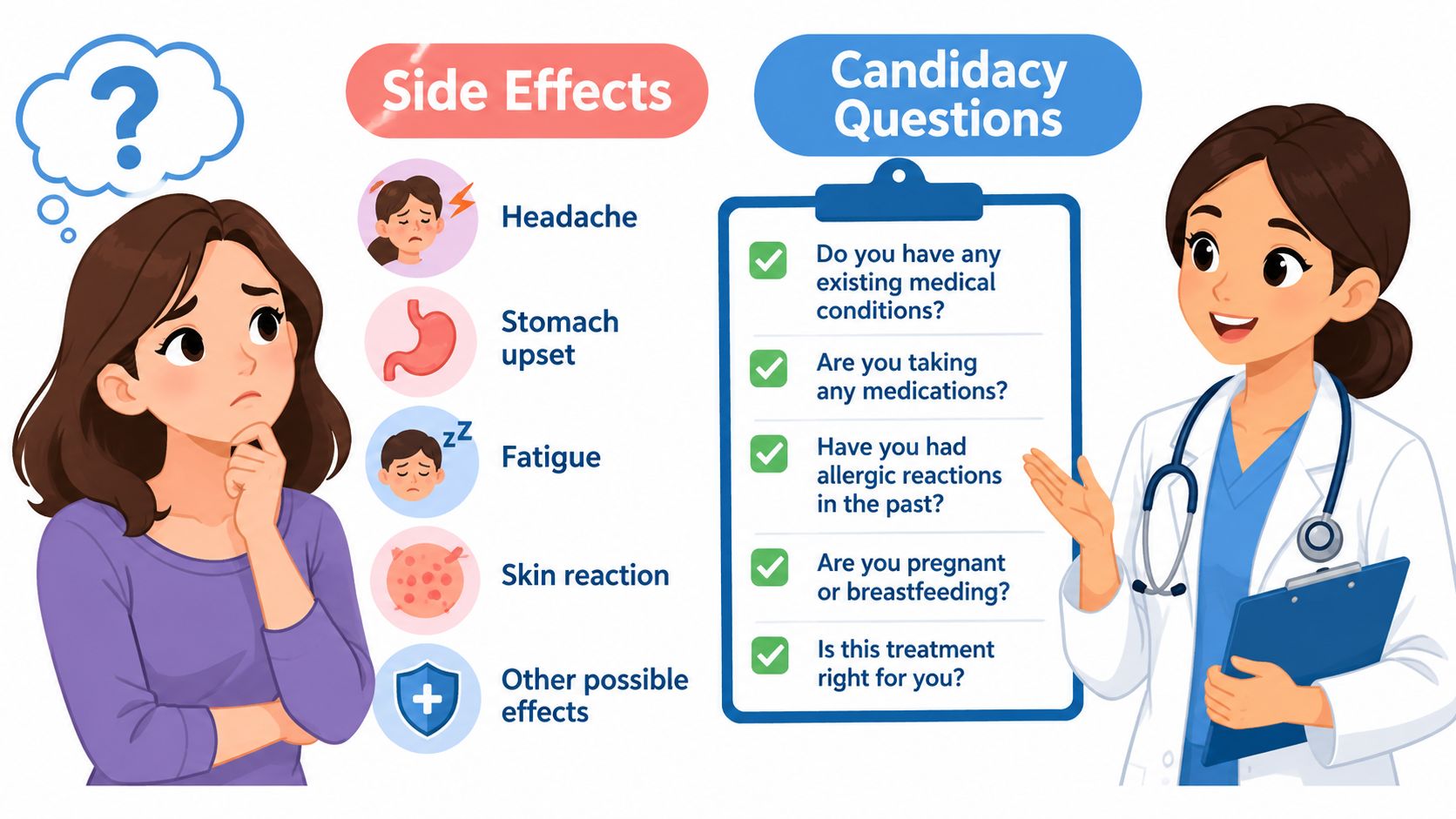
The most common whitening side effects are temporary tooth sensitivity and gingival irritation. Risk can vary with peroxide concentration, contact time, treatment frequency, and your personal history of sensitivity. The dental education review of whitening side effects explains why two patients can receive similar treatments yet experience different levels of discomfort.
A poorly sealed barrier can allow gel to reach the gums, causing irritation or a soft-tissue burn. Existing enamel wear and exposed roots can make the teeth react more strongly because those areas don't provide the same protection as intact enamel.
Conditions that deserve a pause
A dentist may recommend treating an underlying problem before whitening if you have:
- Active gum disease: Inflamed tissue may react poorly to peroxide and needs attention first.
- Untreated cavities: Whitening can aggravate an already vulnerable tooth.
- Worn enamel or exposed roots: These areas may be more sensitive during treatment.
- Pregnancy: Discuss postponing elective whitening with your healthcare and dental professionals.
- Recent dental work: The timing may matter, particularly if visible restorations need shade coordination.
Laser activation doesn't eliminate the general sensitivity associated with peroxide-based whitening. A nine-month comparison of diode laser and LED activation found similar tooth sensitivity, gingival irritation, and long-term color stability, while LED produced less surface temperature rise. A separate 2024 clinical study using a 450 nm laser reported zero pain, hypersensitivity, or gingival inflammation under its specific protocol. The clinical comparison and follow-up discussion shows why one favorable protocol can't be treated as a universal promise.
Questions worth bringing to the consultation
Ask which peroxide formulation and pH the office uses, how the gums will be isolated, which wavelength is planned, how long each activation period lasts, and whether a desensitizer is appropriate. You can also ask what the office considers a normal response and what symptoms should prompt a call.
Laser Whitening Compared to Other Whitening Options
A wedding or job interview in less than two weeks can make a rapid whitening appointment appealing. A history of sensitivity may point you toward a slower plan instead. Your enamel and gum health, treatment deadline, budget, and preference for supervision should guide the choice, not the word “laser.”
Whitening Options Side by Side
| Method | Treatment Time | Best for | Typical Shade Change | Sensitivity Risk | Supervision |
|---|---|---|---|---|---|
| Laser-activated in-office bleaching | Often concentrated into one office visit, with the exact schedule set by the protocol | A near-term event when teeth and gums are healthy and an office appointment is preferred | Can create a visible change, with the final result varying by the starting shade and stain type | Temporary sensitivity and gum irritation are possible | Direct dental supervision |
| Conventional in-office bleaching without light | Concentrated office treatment, with timing based on the gel and clinical plan | Patients who want an in-office result without paying for light activation | Peroxide can whiten without light activation, and the outcome depends on the clinical plan and tooth response | Temporary sensitivity is possible | Direct dental supervision |
| Custom take-home trays | Gradual treatment over a dentist-directed schedule | Patients with a flexible timeline, or those who want to pause between applications | More controlled and incremental, with results shaped by wear time and compliance | Often easier to manage because treatment can be paused, but sensitivity still can occur | Dentist-designed and monitored |
| Over-the-counter strips or pens | Usually repeated applications rather than one supervised visit | People seeking a readily available option for mild surface staining | Less predictable because fit, concentration, and application vary | Gum irritation or sensitivity can occur, especially with incorrect application | Limited or no clinical supervision |
The practical difference is control. An in-office appointment gives the dental team a chance to protect the gums, check how your teeth respond, and adjust the plan. Custom trays trade speed for flexibility. Store-bought products offer convenience, but they cannot assess cavities, gum disease, or restorations before use.
Laser activation may suit someone with a firm event deadline, but the light does not replace peroxide gel. It is an added part of the appointment, not a guarantee of a whiter or longer-lasting result. If conventional in-office bleaching fits the same goal, it may offer better value.
Custom trays can be a sensible choice for patients who want gradual control or have previously experienced sensitivity. A dentist can help set the wearing schedule rather than asking you to tolerate discomfort until the treatment ends.
Decision rule: choose the method that fits your dental condition, timeline, comfort needs, and budget, not the method with the most impressive name.
Preparing for Treatment and Caring for Your Smile Afterward
A good candidate usually has healthy teeth and gums, no untreated decay, and realistic expectations about natural tooth color. Whitening should pause when active gum disease, significant enamel wear, exposed roots, or pregnancy makes elective treatment less appropriate.
Before booking, consider a recent cleaning if plaque or surface staining is present. Tell the dental team about existing sensitivity and any recent fillings, crowns, veneers, bonding, implants, or orthodontic treatment. Whitening changes natural tooth structure, but crowns, veneers, fillings, and bonding don't whiten. This explanation of restorations and laser whitening explains why shade matching may need to happen before or after bleaching.
The first period after treatment
For the first 48 hours, follow the instructions provided by your dental team and limit foods and drinks that commonly stain. Coffee, tea, red wine, dark sauces, and tobacco can work against the appearance you're trying to maintain. Rinsing with water after a staining drink can reduce contact time, and using a straw for suitable beverages may limit contact with front teeth.
Brush gently with a sensitivity toothpaste if your clinician recommends it. Don't scrub aggressively in an attempt to speed up whitening. Continue daily brushing and flossing, and keep routine cleanings so surface deposits don't obscure the result.
The Bristol Dental & Orthodontics team in Santa Ana reviews candidacy before booking a whitening visit. That assessment is especially important when whitening is part of a larger cosmetic plan, such as Invisalign or restorative treatment, because the timing of shade matching can affect the final appearance.
Is Laser Whitening Worth It and How to Get Started
The value question deserves a direct answer. If peroxide is doing most of the chemical work and reviews don't show a consistent final-shade advantage from light activation, the laser may not justify an added fee for every patient.
Some patients may still prefer the structure of an in-office protocol. A dental professional controls the application, protects the gums, monitors comfort, and can stop or adjust treatment if sensitivity develops. A concentrated appointment may also fit a patient who has a fixed event date and doesn't want to manage a longer home routine.
The trade-off is that faster doesn't necessarily mean better. A conventional in-office bleaching appointment may provide a comparable clinical result without light activation. Custom trays may offer more control for patients who want to spread treatment over time. The most appropriate choice depends on the condition of your teeth, the cause of discoloration, existing restorations, sensitivity history, and the result you consider acceptable.
Questions that make the consultation useful
Bring a specific goal rather than asking for an undefined “Hollywood smile.” You might say that you want your natural teeth to look brighter for family photos, that you're concerned about sensitivity, or that you're planning veneers and need shade coordination. Those details help Dr. Finley assess whether whitening should happen now, later, or not at all.
Ask how the office will measure your starting shade, whether the proposed treatment uses light activation, what alternative protocols are available, and what happens if your restorations don't match afterward. You can also ask whether a take-home option would better fit your habits and schedule.
Patients from Santa Ana, Costa Mesa, Tustin, Irvine, and Garden Grove can discuss these choices during a cosmetic consultation at Bristol Dental & Orthodontics. The practice also provides broader family and cosmetic care, including Invisalign, dental implants, sleep apnea and oral appliance therapy, emergency dentistry, and other services when whitening is only one part of a larger oral health plan.
Laser teeth whitening can be a reasonable option when you understand its limits. It may provide a supervised, time-efficient experience, but it isn't a guarantee of a superior shade change, zero sensitivity, or permanent results. A careful examination and an honest discussion of alternatives will give you more useful information than a before-and-after image alone.
Bristol Dental and Orthodontics offers professional cosmetic dental consultations for patients considering laser teeth whitening and other ways to brighten natural teeth. Visit Bristol Dental and Orthodontics to learn more and schedule a consultation with the Santa Ana team, led by Dr. Andrew Finley, so your treatment plan can match your smile, comfort needs, and timeline.