
It's Sunday morning in Santa Ana, and a molar cracks while you're eating breakfast. Or your child wakes up in Garden Grove with a swollen cheek, and your usual dental office is closed. You need help, but it's hard to tell whether to call a dentist, head to a hospital, or keep searching.
Finding an emergency dentist open Sunday starts with choosing the right destination, not the nearest listing. Some problems need immediate medical care. Others need a dentist who can examine and treat the tooth. Published hours are only a starting point, so confirm availability before you drive.
Table of Contents
- Where a Sunday Dental Emergency Should Go
- How to Reach an Emergency Dentist Open Sunday
- First Aid While You Arrange Care
- What a Sunday Emergency Visit Can Treat
- Aftercare Until Your Follow-Up Visit
- Schedule Urgent Care with Dr. Finley
Where a Sunday Dental Emergency Should Go
A cracked tooth with localized pain and a swollen neck with swallowing trouble need different kinds of care. Breathing, bleeding, spreading swelling, and overall illness matter more than pain intensity alone. Someone with modest tooth pain can still have a serious infection.
The NHS England urgent dental care guidance calls for clinical triage within 60 minutes for possible airway or intracranial compromise or uncontrollable bleeding, while other urgent dental problems generally need assessment within 24 hours or as soon as practicable. These are clinical triage targets, not permission to wait at home when symptoms are dangerous.
Sunday dental problem and where to go
| Problem | Go here | How fast | What that setting usually can do |
|---|---|---|---|
| Bleeding that will not stop | 911 or hospital emergency department | Seek help now, with emergency clinical triage | Control bleeding and assess medical risk |
| Swelling of face, neck, or eye with trouble breathing, swallowing, or speaking | 911 or hospital emergency department | Immediately | Protect the airway and treat serious infection |
| Major facial or jaw injury, or altered consciousness | 911 or hospital emergency department | Immediately | Trauma and medical evaluation |
| Fever with rapidly spreading facial swelling | Emergency department if airway or systemic signs; otherwise urgent dentist | Same day, immediately for rapid progression or serious illness | Medical care for systemic infection, or dental drainage when safe |
| Severe toothache lasting beyond a couple of days, or pain that stops sleep or daily activity | Urgent dentist | Urgent assessment, sooner if worsening | Diagnosis and definitive dental treatment |
| Lost filling, broken crown, or chipped tooth with localized pain | Urgent dentist | As soon as practicable | Stabilize or repair the tooth |
| Knocked-out tooth without other trauma | Urgent dentist; emergency department if there is also serious injury | Minutes matter for the tooth | Replant or stabilize when appropriate |
The NHS toothache guidance recommends dental evaluation for toothache lasting more than two days and emergency medical care for swelling around the eye or neck, or swelling that makes breathing, swallowing, or speaking difficult. Don't use the duration of a toothache as a reason to postpone care when other warning signs are present.
Why the destination matters
Hospital emergency departments assess medical threats and stabilize patients, but they generally don't complete routine root-canal treatment, extractions, or crown repairs. Hospital-based dental or surgical services may be involved when needed, but a discharge often still leaves a patient needing outpatient dental treatment.
The scale is substantial: the CDC's National Center for Health Statistics reported an annual average of 1,944,000 emergency-department visits for tooth disorders during 2020–2022. That doesn't mean every toothache belongs in a hospital. It means patients need a clear path to the setting equipped for their problem.
For families in Costa Mesa, Tustin, Irvine, and Garden Grove, use the same destination decision for children. Don't wait out facial swelling or fever because a child can still play. This is general guidance; Dr. Andrew Finley can assess an individual dental problem, while emergency medical symptoms require immediate medical help.
How to Reach an Emergency Dentist Open Sunday
A website advertising weekend care doesn't establish that a dentist can treat you today. The office might offer limited appointments, telephone advice, or an answering service rather than an available treatment room. Call before traveling, and ask what can happen during the visit.
Start with the right call
Use emergency medical services when necessary. If the problem belongs on the hospital side of the destination table, don't spend time comparing dental offices. Call 911 or go to the nearest emergency department.
Call your usual dentist first. Listen to the entire after-hours message for instructions or a designated contact. The American Dental Association's emergency treatment guidance advises dental offices to tell after-hours callers with a life-threatening emergency to call 911 or go immediately to the nearest hospital emergency department.
Confirm a real appointment before driving. If your usual office can't help, search for an emergency dentist open Sunday serving Santa Ana or nearby Orange County communities. Ask whether a dentist is physically available and whether the office can evaluate your particular symptoms.
Describe the problem clearly. Explain when it started, whether swelling is increasing, whether there's fever, and whether the patient is a child or adult. Mention medicines, allergies, pregnancy, immune conditions, and blood thinners.
Ask for arrival instructions. Confirm when to come, what to bring, and whether the office has specific first-aid directions. Bring a medication list and any tooth or tooth fragment you've recovered.
Confirm treatment capability, not just hours
A useful question is: “Can the dentist examine the tooth and take any necessary X-rays today, and what treatment could be available afterward?” Ask whether local anesthesia, drainage, or extraction can be provided when appropriate, or whether the visit would be limited to assessment and temporary stabilization.
Also ask what the examination includes, what payment options are available, and how referrals work if treatment can't be completed there. These questions help you avoid traveling to an office that can't meet the immediate need. They don't commit you to a procedure.
Bristol Dental & Orthodontics provides same-day emergency care in Santa Ana. Call 714-874-8579 for direction and the next available urgent appointment. Same-day emergency care does not establish Sunday availability, so don't arrive assuming the office is open.
Our published hours are:
- Monday: 10 AM to 7 PM.
- Tuesday through Thursday: 9 AM to 6 PM.
- Friday: 10 AM to 2 PM.
If you reach voicemail outside those hours, follow the recorded directions. Don't wait for a dental callback when emergency medical care is needed.
First Aid While You Arrange Care
Home care can protect an injured area or make the wait more manageable. It doesn't repair a tooth, remove an infection, or replace an examination. Follow any instructions from the treating clinician over general suggestions, especially after recent surgery.
Protect the area without adding injury
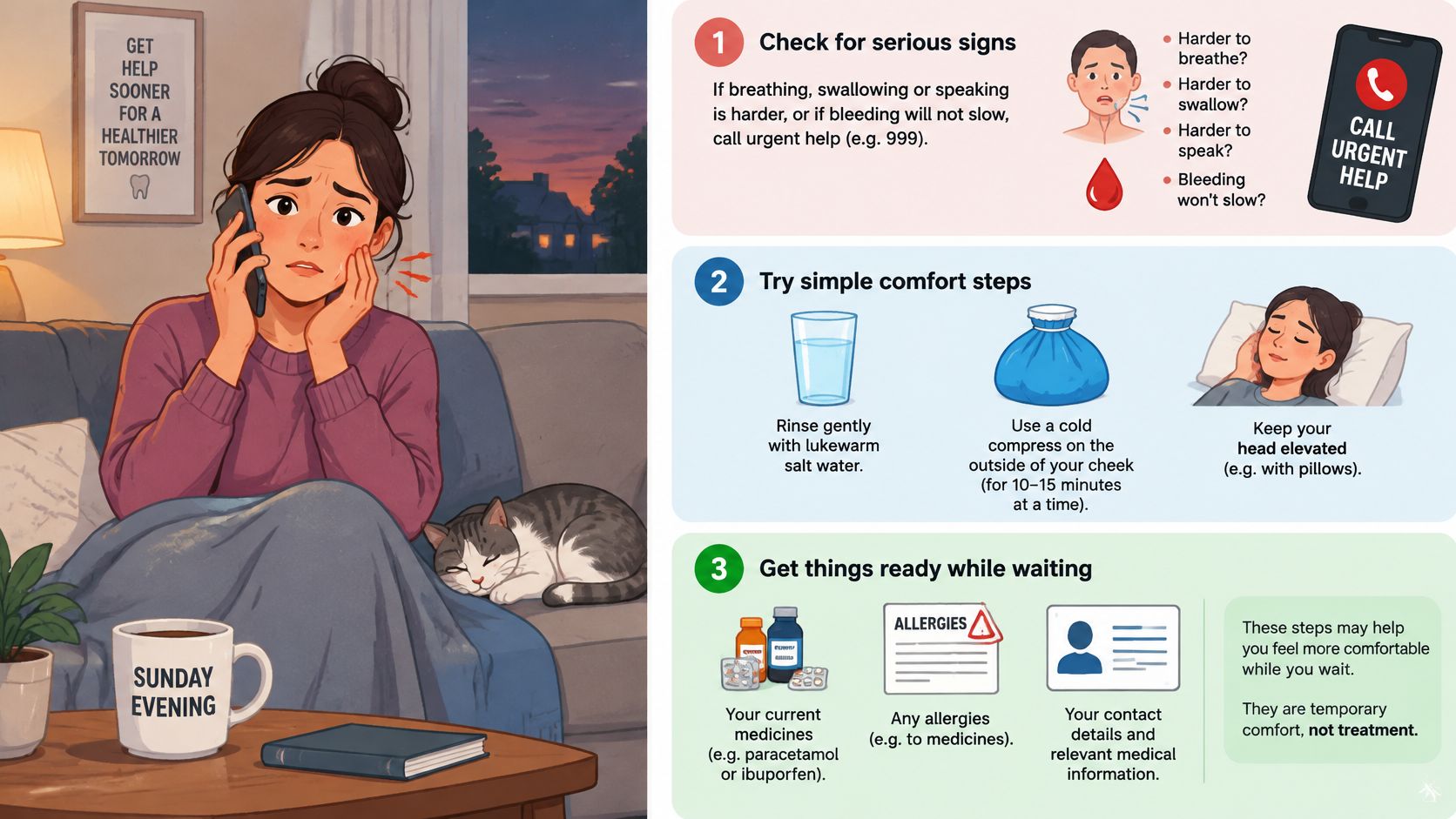
Stop home care for an immediate medical threat. If breathing, swallowing, or speaking is becoming difficult, or bleeding won't slow with pressure, call 911. Don't keep trying rinses or searching for another remedy.
Handle a knocked-out adult tooth by its crown. That's the visible chewing portion, not the root. If dirty, rinse it gently without scrubbing, and try to place it back in its socket only if the person is alert and can do so safely. Don't force it, and don't replant a baby tooth.
Keep an adult tooth moist if it can't be replaced. Put it in a clean container with milk or the person's saliva and seek dental care promptly. Don't leave it wrapped in a dry tissue, and don't hold it loose inside a young child's mouth because of choking risk.
Save fragments from a chipped or broken tooth. Rinse the mouth gently with lukewarm water and bring the fragment to the appointment. A small amount of dental wax can shield a sharp edge; sugar-free gum may serve briefly if it can be used safely without choking. Don't use household glue or push material into a deep break.
Apply steady pressure to a minor bleeding site. Use clean gauze over a small gum or soft-tissue cut. Avoid lifting it repeatedly to check, which can disturb the forming clot. A missing filling itself shouldn't be assumed to explain persistent bleeding.
Keep comfort measures gentle
Clean around a localized toothache carefully. An adult who can rinse and spit may try warm salt water. Gently floss to remove trapped food without forcing the floss into sore tissue, and use a wrapped cold compress outside the cheek in short intervals. Don't dig around the tooth with sharp objects.
Avoid remedies that can injure tissue. Don't place aspirin against the gum, apply heat to a swollen face, or repeatedly apply large amounts of numbing gel. For children, check with a clinician before using oral numbing products; more product isn't a safer way to control pain.
Record the details and watch the child, not just their behavior. Note symptom onset, temperature if feverish, medicines already taken, allergies, pregnancy, immune conditions, and blood thinners. Keep a child with facial swelling comfortably upright, and offer small sips only if swallowing is normal. Don't assume that playing means the swelling can wait.
Modest pain does not make spreading swelling safe to watch overnight.
What a Sunday Emergency Visit Can Treat
Once you're in the dental chair, the first task is to identify the source of the problem. A broken filling, irritated tooth pulp, fractured tooth, and dental infection can produce overlapping symptoms, yet they don't all need the same treatment.
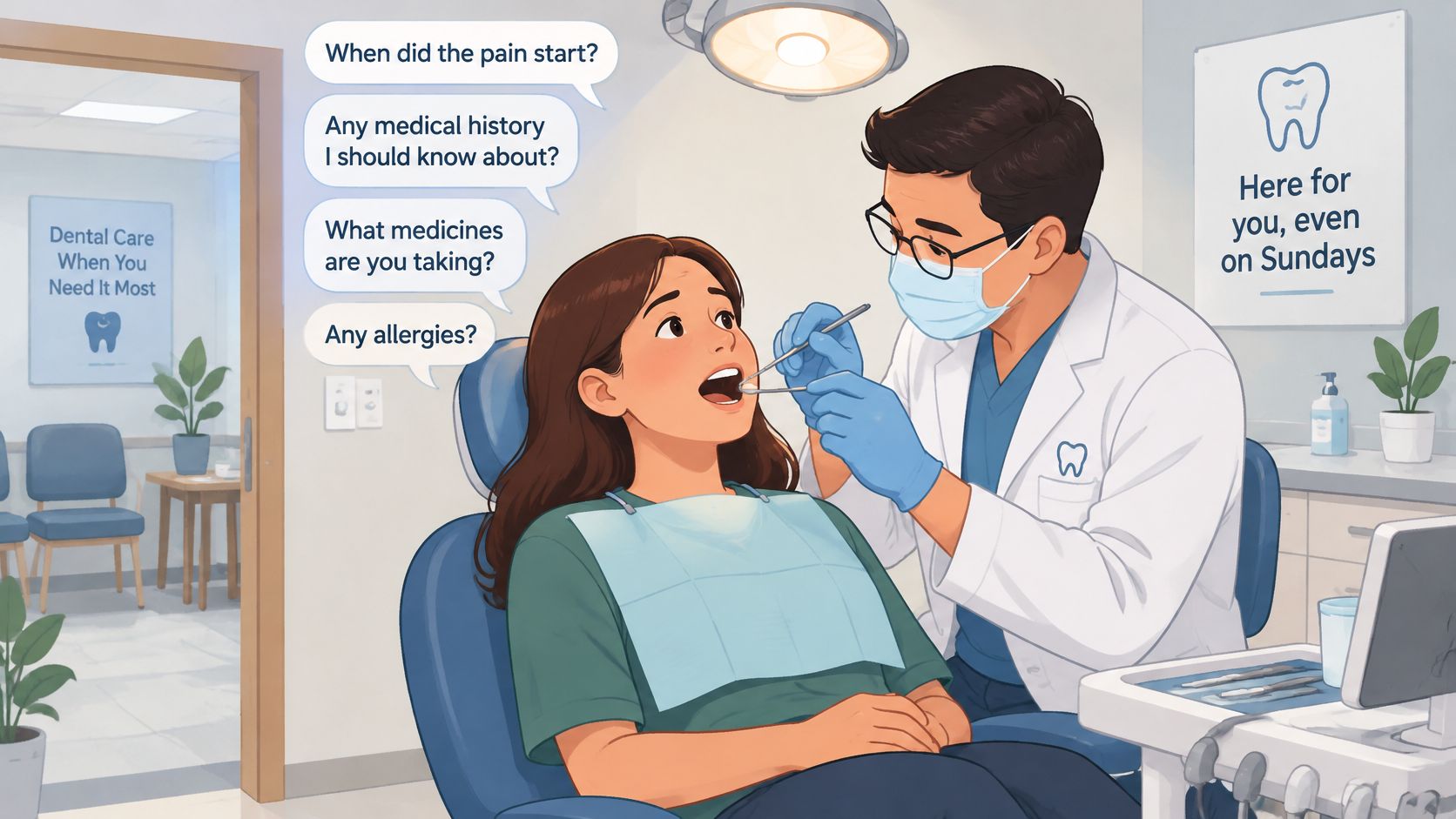
The dentist asks about onset, medical history, medicines, and allergies, then examines the tooth and surrounding tissues. They may check temperature, the extent of swelling, and how comfortably you can open your mouth. X-rays are often needed when the tooth and surrounding structures can be imaged.
What definitive dental treatment looks like
For tooth pain and localized swelling inside the mouth, the American Dental Association's guidance on antibiotics for dental pain and swelling prioritizes appropriate dental treatment. Options include pulpotomy, pulpectomy, nonsurgical root-canal treatment, or incision and drainage when clinically indicated.
In plain language, the dentist may need to remove inflamed or infected tissue from inside a tooth, clean its root canals, or drain a localized collection of infection. Extraction may be considered when a tooth can't appropriately be retained. Which of these applies depends on what the examination shows, since the same throbbing ache can come from very different causes that can't be distinguished over the phone.
Antibiotics generally aren't recommended for most pulp or root-tip conditions in otherwise healthy adults when definitive dental treatment is available. A prescription alone doesn't repair a crack or remove damaged tissue inside a tooth.
Antibiotics may become appropriate with fever or feeling systemically unwell. Deep or rapidly spreading infection, difficulty opening the mouth, swallowing problems, voice changes, airway concerns, or suspected sepsis can also require urgent hospital referral, since a dental office isn't equipped to manage those situations. A clinician must account for immune conditions and other significant medical problems.
Complete treatment or temporary stabilization
An urgent visit may resolve a straightforward problem, or it may be the first stage of a longer plan. For example, a dentist might protect a broken tooth with temporary material while arranging a longer restorative appointment.
Before leaving, understand:
- What was diagnosed: Ask which tooth or tissue is involved and whether more testing is needed.
- What was completed: Know whether the source itself was treated or a temporary measure was placed to protect it.
- What remains: Confirm whether you need further restoration, root-canal treatment, extraction, or referral.
No office can promise a same-day crown, implant, or completed root canal before assessing the case. Outcomes and treatment timing vary with the tooth, the infection, your medical history, and available clinical resources, so the examining dentist should explain which path fits your tooth after the exam.
Aftercare Until Your Follow-Up Visit
After an urgent visit, follow the written instructions for the procedure you received. Advice for a temporary filling isn't interchangeable with advice after an extraction or drainage. If the instructions are unclear, contact the treating office rather than guessing.
Protect the work that was done
If a temporary filling or protective material was placed, chew on the opposite side and avoid very hard or sticky foods. A repaired surface can feel unfamiliar, but a tooth that hits first when you close your mouth deserves a call to the dentist. Don't try to file down the material yourself.
Brush gently around a tender area and follow the clinician's instructions about flossing. Don't push floss or a brush into a wound, and leave a site undisturbed if you were specifically told to do so. Careful cleaning is different from repeatedly touching the area to see whether it still hurts.
Use only the pain-control approach recommended for you. Don't restart a home remedy the clinician ruled out, share someone else's medicine, or change prescribed treatment without advice. A wrapped cold compress may help outside swelling after a simple procedure if your dentist recommends it; avoid heat on a face that remains puffy.
Know when to contact the clinician again
Seek reassessment rather than waiting for the scheduled follow-up if something changes:
- Growing swelling: Contact the treating clinician urgently, particularly if swelling spreads beyond the original area.
- Breathing or swallowing changes: Call 911 or seek immediate emergency medical care.
- New fever or worsening illness: Arrange prompt clinical reassessment.
- Bleeding that restarts: Follow the procedure-specific pressure instructions, and seek emergency care if bleeding is heavy or won't stop.
- Temporary material that falls out: Call the treating office, including if it happens the same day, so they can decide how quickly it needs replacement.
- Unexpected numbness: Contact the clinician if numbness isn't consistent with the explanation you received about anesthesia or recovery.
- Pain you can't control: Ask for reassessment rather than repeatedly adding medicines.
If an emergency department discharged you, arrange dental follow-up rather than assuming the medicine completed treatment. Give a child's caregiver the discharge instructions and warning signs directly, so responsibility doesn't become unclear during a weekend handoff.
Once the urgent problem is stable, follow-up can address the final restoration and any longer-term questions. That planning should build on the examination, not distract from completing treatment of the painful tooth.
The urgent visit buys safety and a plan; it is not always the last appointment.
Schedule Urgent Care with Dr. Finley
You do not need a diagnosis before you call. Saying what changed, when it began, and how it affects eating, sleeping, or opening your mouth gives the team a workable starting point. Some questions only an examination can answer.
Dr. Andrew Finley leads Bristol Dental & Orthodontics, a family and cosmetic dental practice in Santa Ana. He is a USC-trained dentist with advanced orthodontic training. Patients from Santa Ana and surrounding Orange County communities can call 714-874-8579 to schedule an appointment or ask about the next available urgent appointment.
The published schedule runs Monday 10 AM to 7 PM, Tuesday through Thursday 9 AM to 6 PM, and Friday 10 AM to 2 PM. A Sunday problem is therefore a routing decision, not a booking. If breathing, swallowing, or spreading swelling is involved, emergency medical care comes first. If the tooth needs definitive treatment, the next opening is confirmed by phone.
Make the consultation easier to plan
A short call goes further when the practical details are ready:
- Your timeline: Say when the pain, break, injury, or swelling began and whether it has changed.
- Your health information: Bring your medication list, allergies, and relevant medical history.
- Your temporary care: Explain what you have applied or taken, and bring any discharge paperwork from another treating facility.
- Your main concern: Tell the team if you are worried about tolerating treatment, caring for a child, or understanding the next steps.
A phone conversation helps organize care. It does not replace an examination or promise that a particular procedure fits your case.
Keep urgent and longer-term decisions separate
Once the immediate problem is controlled, a consultation can address whether a final restoration is needed and when broader concerns belong on the schedule. Questions about Invisalign, dental implants, oral appliance therapy for sleep apnea, or cosmetic dentistry are all reasonable at that stage. None of them should delay evaluation of an active dental problem.
This guide is educational and does not replace personal medical advice. Consult Dr. Finley about your specific situation. Life-threatening bleeding, major trauma, or swelling that affects breathing or swallowing goes to 911, not a booking line.
Bristol Dental & Orthodontics offers same-day emergency dental care for urgent tooth problems, with availability confirmed by phone rather than assumed from a Sunday search. Call 714-874-8579 or visit Bristol Dental and Orthodontics to request a consultation and discuss the next available appointment.