
In-house dental financing means your dentist acts as the lender, letting you pay the practice over time without a bank or credit card company. In-house plans often work best for balances of about $500 to $1,500, with short repayment periods, although each office sets its own terms.
You may be sitting in a consultation room in Santa Ana, looking at a treatment plan and wondering how you'll manage the total cost. Perhaps you need an implant, want to begin Invisalign, or need urgent care after a broken tooth. The treatment may make sense, but paying the entire amount immediately may not fit your budget.
That's where payment flexibility can help. The important question isn't only whether a dental office offers financing. You also need to know who is lending the money, who owns the balance, how payments are collected, and what happens if your treatment changes. Those details can differ significantly between a direct office plan and financing arranged through an outside company.
Table of Contents
- Understanding In-House Dental Financing
- How Direct Practice Payment Plans Work
- Comparing In-House Plans to Third-Party Options
- Qualifying for Dental Payment Plans
- Sample Payment Scenarios for Common Treatments
- Hidden Costs and Important Questions to Ask
- Next Steps for Santa Ana Patients
Understanding In-House Dental Financing
A patient learns that a tooth needs restorative treatment. The office explains the recommended care, but the patient hesitates because the full payment feels difficult to manage at once. Instead of sending the patient to an outside lender, the practice may agree to accept a deposit and scheduled payments directly.
That arrangement is in-house dental financing. The practice extends credit, records the agreement, collects the payments, and follows up if a payment is late. There's no separate finance company serving as the lender.

Why offices offer direct payment arrangements
Dental care has long depended on patients paying directly or using private coverage. The National Academies reported that private out-of-pocket payments and private coverage financed more than 90% of dental expenditures for over 50 years, which helps explain why payment flexibility remains part of dental access and treatment discussions. You can review the supporting context in the 2024 state-of-dental report.
Dental patient financing has also become more common in practices. The same report found that the share of dental teams with no patient financing solution fell from 17% in 2022 to 10% in 2023, while the share offering two or more financing options increased. That doesn't mean every patient should finance treatment, but it does show that offices are discussing payment choices more often.
For a family and cosmetic practice such as Bristol Dental & Orthodontics, a direct plan may be considered alongside other arrangements for care such as implants, orthodontics, cosmetic dentistry, or emergency treatment. The practice, not the patient, must decide which plans it can responsibly administer.
Practical rule: “In-house” should mean the dental practice itself is the lender. If another company approves the account, owns the balance, or collects the debt, ask what type of third-party financing you're actually using.
How Direct Practice Payment Plans Work
An in-house plan usually begins after the dentist examines you and explains the recommended treatment. You and the office then discuss the amount due before treatment, the remaining balance, payment dates, and the consequences of a missed payment.
The office may request a fixed upfront amount followed by a short series of scheduled payments. Some practices offer no-interest arrangements, while others may charge fees or interest. A plan that sounds simple still needs to be written clearly so you know exactly what you'll pay and when.
A typical structure
Industry guidance describes in-house plans as most workable for balances of about $500 to $1,500, often with repayment windows of 2 to 6 months. A common structure may involve 50% down, followed by 2 to 5 monthly installments, although those figures are examples of industry structures, not terms Bristol Dental & Orthodontics has promised. The details should always come from the office agreement you receive. See the industry guidance on dental patient financing options.
For example, if a treatment plan has a manageable balance, the office might collect an initial payment and divide the rest into several agreed installments. The office would then reconcile each payment internally. If a payment fails, staff may contact you directly rather than a finance company handling the account.
That direct relationship can feel straightforward, especially for an established patient who already knows the office. It also means the practice carries the administrative work and the risk that a patient may not complete the schedule.
Why the burden matters
Patients often face meaningful out-of-pocket dental costs. A 2026 survey of CareCredit cardholders found that, among the 77% who received dental care in the prior 12 months, 56% had out-of-pocket expenses, with average out-of-pocket dental spending of $1,316 over the prior year. The figures appear in this patient financial journey information from CareCredit.
That burden can arise with restorative care, cosmetic treatment, orthodontics, and implant-related care. A payment schedule may make a recommended plan easier to budget for, but it doesn't make the treatment free and shouldn't encourage anyone to take on payments they can't maintain.
Ask for the complete written schedule before agreeing. It should identify the amount due at signing, each payment date, any fees, whether interest applies, and what happens if treatment is delayed or canceled.
Comparing In-House Plans to Third-Party Options
A Santa Ana patient may hear “financing” used for two different arrangements at the same appointment. The key question is simple: who is lending the money? With an in-house plan, the dental practice lends the money and manages your account. With third-party credit, an outside finance company reviews the application, owns or services the balance, and sets the contract terms.
Neither option fits every patient. A direct office plan can suit a smaller balance and may allow a personal conversation with the dental team. Third-party credit may provide a longer repayment period for extensive treatment, although it can involve an application, credit review, separate disclosures, and obligations that continue after the dental visit.
| Feature | In-House Plan | Third-Party Credit |
|---|---|---|
| Lender | The dental practice | An outside finance company |
| Application | May involve no credit check or formal application, depending on the office | Usually follows the lender's application process |
| Payment collection | Managed by the practice | Managed by the finance company or its servicing partner |
| Repayment period | Often short and set by the office | May offer a longer period, subject to approval and contract terms |
| Practice risk | The office carries repayment and collection risk | The outside lender generally assumes the credit risk |
| Patient questions | Ask the office about fees, missed payments, and cancellation | Review the lender's contract, interest rules, and account ownership |
The arrangement affects more than the payment date. With an in-house plan, the practice carries default risk, billing work, and compliance obligations. Because the office also handles collection if payments stop, it may refer larger balances to an outside lender instead of extending its own schedule. Dental financing guidance describes this operational trade-off.
What changes for the patient
A third-party account usually has a formal approval process and separate contract. An in-house plan may feel more personal, yet the office still needs accurate records and clear terms. If an agreement extends beyond four payments or adds interest or fees, written details such as the annual percentage rate, total finance cost, and payment schedule may be required under Truth in Lending-style rules. Ask the practice how those requirements apply to your agreement.
Use this checklist before signing:
- Who owns the balance?
- Who receives each payment?
- Which contract controls the account?
- What is the total amount paid, not only the monthly amount?
- What happens after a missed payment, canceled treatment, or billing dispute?
- Could the account be reported to a credit bureau?
For larger treatment, compare repayment length, late-payment consequences, credit reporting, and the correct contact for problems. A lower monthly payment can still cost more overall when the schedule lasts longer or includes finance charges.
Qualifying for Dental Payment Plans
Qualification for an office plan isn't necessarily the same as approval for a credit account. Some practices make decisions using their own policies, while others may ask for information that helps them confirm identity, residency, income, or the ability to follow the payment schedule.
Bristol Dental & Orthodontics can explain which options are available for your specific treatment and circumstances, but patients should request the actual requirements before assuming they'll qualify.
A simple application process
Discuss the treatment first. Ask Dr. Finley or the dental team what care is recommended, whether it can be staged, and which services may be involved. This could include Invisalign, an implant, cosmetic treatment, sleep apnea oral appliance therapy, or emergency dentistry.
Ask who provides the financing. Say directly, “Is this plan with the practice, or does another lender own the account?” That answer determines which contract and privacy terms you need to review.
Provide only the requested information. Depending on the office, you may be asked for identification, contact details, proof of income, or proof of residency. Some in-house plans may require no credit check or formal application, but requirements vary by practice. The overview of common in-house payment plan mechanics describes these differences.
Read the agreement before treatment. Confirm the upfront amount, installment dates, total repayment, interest or fees, and late-payment policy. Don't rely on a verbal explanation alone.
Choose a payment method you can maintain. A schedule should fit your real monthly obligations, not just appear affordable during a consultation. Ask what happens if your income changes or you need to reschedule care.
A payment plan is a financial agreement, not a replacement for a treatment consultation. Dr. Andrew Finley can discuss clinical options, while the office team can explain the payment terms available for your case.
Sample Payment Scenarios for Common Treatments
A payment schedule can look different depending on the type of care, the timing of treatment, and the office's policies. The examples below show how to think about the structure without assigning a price to any procedure.
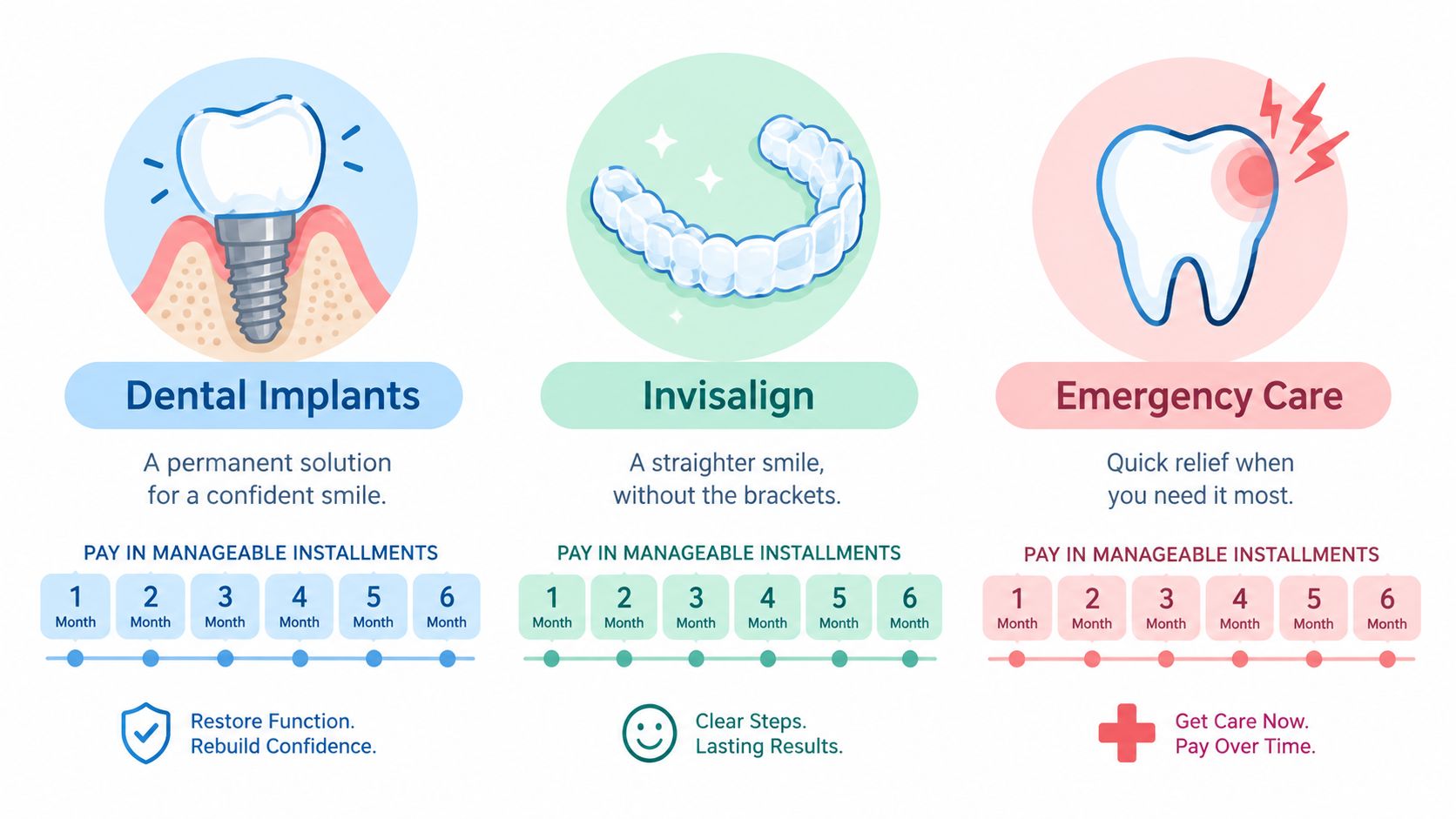
For an implant plan, ask whether the treatment includes separate stages and whether payments are due before each stage. A plan could use an upfront payment followed by scheduled installments, but you'll need to confirm whether the payment schedule follows the clinical sequence or uses fixed calendar dates.
For Invisalign or another orthodontic plan, ask whether the office expects payments throughout treatment or before treatment begins. You should also clarify what happens if appointments change, refinements are needed, or you pause care.
Questions for each type of care
- Dental implants: Ask which portions of the treatment are included, when each payment is due, and whether a delayed stage changes the agreement.
- Invisalign: Confirm whether the plan covers the full agreed orthodontic program and how the office handles changes to the treatment schedule.
- Emergency dentistry: Ask whether the plan applies to the urgent visit only or also to follow-up care. An emergency appointment may address immediate needs, while later treatment requires a separate discussion.
- Cosmetic dentistry: Request a written description of the planned services and payment milestones before committing to elective care.
- Sleep apnea care: Ask what happens if an oral appliance needs adjustment or if your clinician recommends additional evaluation. Financing terms shouldn't obscure the need for appropriate care planning.
Cost influences how patients choose a provider. In a 2023 patient journey study cited by Synchrony, 71% of patients rated cost as extremely or very important when choosing a provider, while 59% said the same about having a variety of payment options. The findings are summarized in this patient financing discussion from CareCredit.
A lower monthly payment isn't automatically a lower total cost. Compare the full agreement before you compare the installment amount.
Hidden Costs and Important Questions to Ask
“No interest” can sound like “no extra cost,” but those phrases aren't always identical. A plan may have administrative fees, missed-payment penalties, or deferred-interest rules that apply if the balance isn't paid according to the contract.
With deferred interest, interest may accumulate during a promotional period and become payable if the required conditions aren't met. The exact rule depends on the agreement, so don't assume an interest-free description tells you everything.
Use this checklist before signing
- Who owns the balance? Is it Bristol Dental & Orthodontics, or an outside lender?
- Is there a credit check? Ask whether the application affects your credit and what information the lender reviews.
- Will payments be reported to credit bureaus? The agreement should explain whether the account appears in your credit history.
- What is the total repayment amount? Look for interest, administrative charges, application fees, and other costs.
- What happens after a missed payment? Ask about late fees, loss of promotional terms, collection activity, and treatment scheduling.
- What happens if treatment is delayed or canceled? Confirm how refunds, remaining balances, and completed services are handled.
- Who answers billing questions? Know whether you'll contact the dental office or a separate finance company.
The American Dental Association recommends asking who the lender is, which regulatory issues apply, and what belongs in the financing plan. Its patient financing guidance also supports asking about account ownership, credit checks, credit reporting, and treatment changes.
A trustworthy consultation should leave you comfortable saying, “I understand the agreement.” If any answer is unclear, pause and request an explanation in plain language.
Next Steps for Santa Ana Patients
Start with the treatment, not the financing. Schedule a consultation so Dr. Finley can examine your concerns and explain which options may be appropriate. The right payment arrangement depends on the care recommended, the treatment sequence, and your ability to make payments consistently.
Then ask the office to walk through the financial side before you approve care. Bring a short list of questions:
- Is this an in-house plan or third-party credit?
- Who owns the balance?
- What do I pay upfront?
- How many payments will follow, and on what dates?
- Are there interest charges, administrative fees, or missed-payment penalties?
- What happens if treatment is postponed, changed, or canceled?
- Who should I contact about billing?
This approach works whether you're exploring Invisalign, dental implants, cosmetic dentistry, emergency dentistry, or an oral appliance for sleep apnea. Patients in Santa Ana and nearby Orange County communities, including Costa Mesa, Tustin, Irvine, and Garden Grove, can ask these questions before choosing a payment path.
Financing can make a treatment plan easier to budget for, but it shouldn't pressure you into care that you don't understand or can't afford. Compare the total obligation, keep a copy of the agreement, and contact the office promptly if your circumstances change.
Bristol Dental & Orthodontics can review your treatment recommendations and explain the payment options available for your situation. Schedule a consultation with Dr. Andrew Finley so you can discuss your dental goals and financing questions openly.
Visit Bristol Dental and Orthodontics to learn about family, cosmetic, orthodontic, implant, sleep apnea, and emergency dental care in Santa Ana. Schedule a consultation to review your recommended treatment and understand exactly who is financing it, what you'll pay, and how the payment schedule works.