
For most adults, Invisalign-style aligners and braces can both work, but neither is automatically better. In a 2025 review of seven trials with 402 patients, aligners did better in two specific measures, while overall outcomes were still mixed, so the right choice comes down to case complexity, daily wear habits, and personal priorities rather than appearance alone (systematic review).
If you're weighing treatment while juggling work, meetings, meals out, and family life, that trade-off matters more than most ads admit. The question isn't just which appliance looks better, it's which one fits your mouth and your routine.
| Factor | Invisalign-style aligners | Braces |
|---|---|---|
| Visibility | More discreet | More noticeable |
| Daily responsibility | Must be worn consistently | Fixed in place |
| Cleaning | Easier around teeth | Harder around brackets and wires |
| Complex movement | Can work in selected cases | Often stronger for complex control |
| Comfort | Often feels smoother | Can irritate cheeks and lips |
| Compliance risk | Higher, because you can remove them | Lower, because they stay on |

Table of Contents
- Why Choosing Between Invisalign and Braces Matters for Adults
- Effectiveness and Treatment Outcomes Compared
- Comfort, Oral Hygiene, and Daily Lifestyle Impact
- Case Complexity and When Braces May Be the Stronger Choice
- The Compliance Factor Most Comparisons Overlook
- Treatment Duration and Long-Term Retention Expectations
- Making Your Decision and Scheduling a Consultation
Why Choosing Between Invisalign and Braces Matters for Adults
An adult patient in Santa Ana is not just choosing a way to straighten teeth. They are choosing how treatment will fit around client meetings, school pickups, coffee runs, restaurant dinners, and the simple wish not to think about orthodontics all day. That is why Invisalign vs braces for adults is never only a cosmetic conversation, it's a practical one.
I see this trade-off often. Some adults care most about how visible treatment will be in public. Others want the option that asks less of them day to day. Both concerns are valid, and they should be stated clearly during a consultation at Bristol Dental & Orthodontics in Santa Ana.
A 2025 review found that aligners were especially good in selected tooth-position measures, including buccolingual inclination and marginal-ridge alignment, while the evidence did not show aligners were better in every outcome (review). For adults in Orange County, including Costa Mesa, Tustin, Irvine, and Garden Grove, that means the right choice depends on what needs to move, how much movement is needed, and how reliably the patient will follow the plan.
A treatment that depends on daily behavior brings lifestyle into the orthodontic decision. If aligners are not worn as directed, they cannot do their job. Braces remove that variable because they stay in place, which is one reason many adults do better with fixed treatment when routine is unpredictable.
Effectiveness and Treatment Outcomes Compared
Adults often assume aligners are a lighter version of braces. In practice, the better question is simpler: can the appliance produce the movements your teeth need? The answer depends on the bite, the type of correction, and how well the treatment is followed.
What the numbers suggest in simpler adult cases
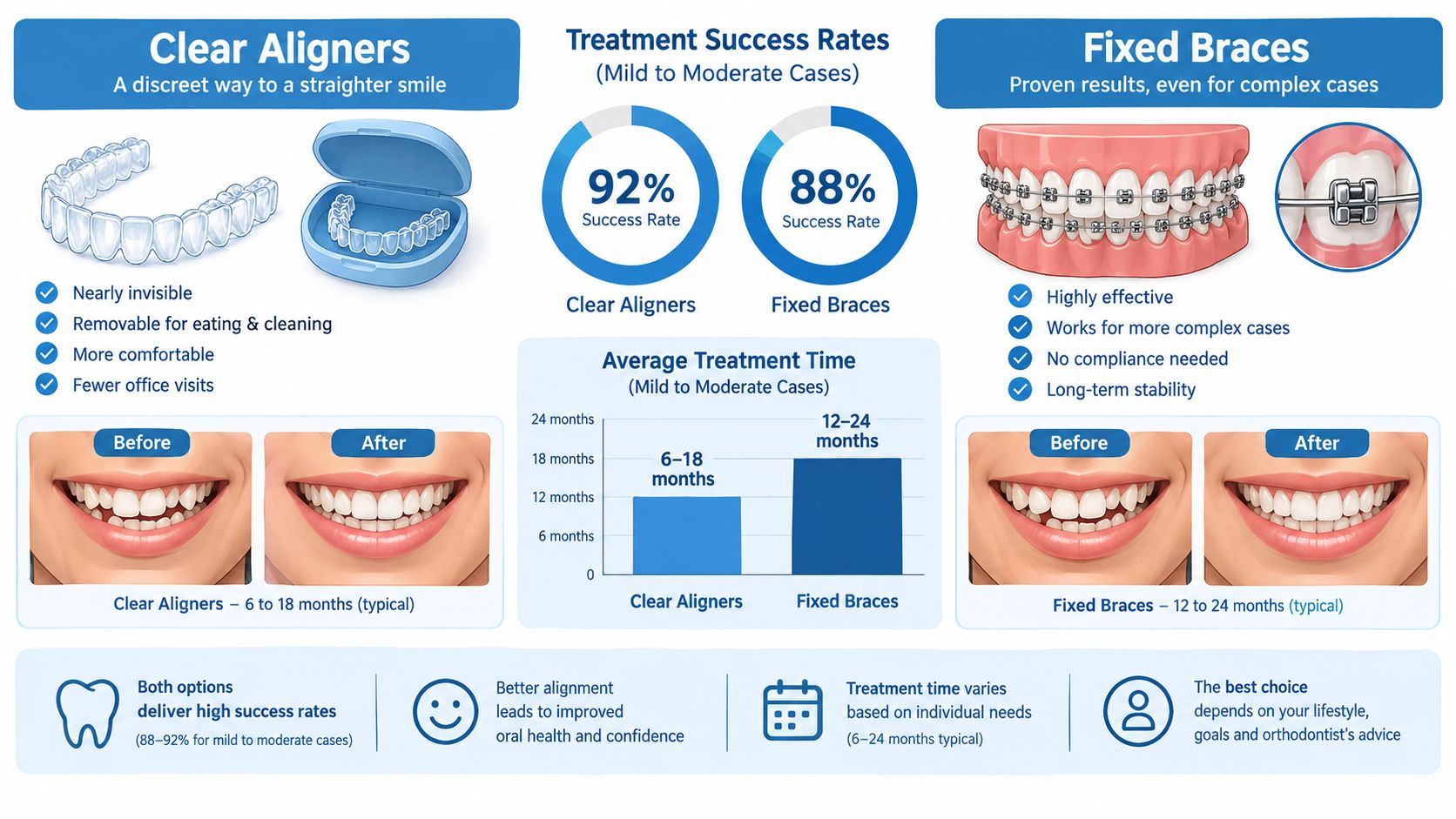
A 2024 randomized study of 100 adults aged 18 to 50 found that aligners achieved a 75% reduction in the Peer Assessment Rating index, compared with 80% for braces after 12 months (study). The same study reported average treatment duration of 14.5 months for aligners and 16.2 months for braces. Satisfaction favored aligners, and discomfort was lower on the aligner side.
That result is encouraging, but it should stay in context. The gap in overall improvement was small, and one study with 100 people is not enough to treat aligners as the answer for every adult case.
Where aligners showed specific advantages
A 2025 systematic review pooled seven randomized controlled trials with 402 patients, split evenly between aligners and fixed appliances, and found better performance with aligners in buccolingual inclination and marginal-ridge alignment. Those are specific movements, not a blanket win across all orthodontic goals. Some corrections are easier to express predictably with trays, while others still respond better to the constant control of brackets and wires.
The same review also found no significant overall difference in patient-reported quality of life at one month, and any early advantage for aligners faded by six months. Early comfort does not always translate into better long-term results.
A useful question for adults is not whether one appliance is better in general, but whether it matches the job in front of it. A clear tray can work well for certain tooth positions and moderate corrections. Fixed braces can be the more dependable choice when tooth movement is more complex or when daily wear is likely to be inconsistent.
Adults usually do best when the decision stays specific. The question is not whether aligners or braces sound better in theory, but which one can move these teeth, in this bite, under real-life conditions.
Comfort, Oral Hygiene, and Daily Lifestyle Impact
Comfort matters because adults live with orthodontics in a way teenagers often don't. They are in meetings, eating lunch between appointments, and cleaning their teeth after a long day, so the daily difference between aligners and braces can feel bigger than it looks on paper.
Comfort is real, but it isn't the whole story
In the 2024 adult study, mean discomfort was 2.3 on a 10-point scale for aligners and 5.6 for braces (study). That fits what many patients notice, aligners usually feel smoother because there are no brackets and wires rubbing the inside of the mouth.
Comfort alone does not decide success. A smooth tray that is not worn enough will not move teeth well. A more noticeable appliance that stays on all day can be the more reliable choice.
Oral hygiene can be easier, but not effortless
A 2025 systematic review and meta-analysis found lower plaque, gingival, and bleeding-index scores with clear aligners than with fixed appliances, with mean differences of -0.76, -0.61, and -0.71 respectively (meta-analysis). Fixed braces make cleaning around brackets and wires harder, so brushing and flossing take more patience during treatment.
Aligners shift the work in a different direction. You have to remove them for eating and cleaning, then put them back in consistently. That is easier for some adults and irritating for others, especially if you snack often, drink coffee throughout the day, or dislike breaking up your routine.
Lifestyle fit is part of the treatment choice
Adults with client-facing jobs, travel-heavy schedules, caregiving responsibilities, or speech-intensive work should think about how often they can realistically remove and replace aligners. The best appliance is the one you can live with well enough to use correctly.
That is also why the question, "Can this appliance move my teeth?" is too broad. "Can it move these teeth, in this bite, with my routine?" is the question that really matters. If aligners do not fit your daily habits, braces may be the lower-friction choice even though they are more visible.
Case Complexity and When Braces May Be the Stronger Choice
A lot of adults assume Invisalign can handle any orthodontic problem because it is popular and discreet. It can handle many cases well, but it does not control teeth in the same way as fixed appliances. The difference becomes clearer as the case gets more complex.
Extraction and complex movement need more control
For premolar-extraction treatment, fixed appliances showed better buccolingual inclination and occlusal-contact outcomes and finished in less time in the evidence reviewed (review). The same extraction-focused analysis reported mean excess mesial tipping of maxillary first molars of 6.08 degrees and under-retraction of about 1.93 mm with aligners.
Those findings help explain why braces often feel more predictable for severe crowding, marked bite discrepancies, or treatment that depends on force control in more than one direction. Aligners can still work in these situations, but they may need attachments, interproximal reduction, elastics, staged overcorrection, or refinement trays to get closer to the target.
The practical takeaway for adults
Braces are usually the steadier choice when a plan requires a lot of movement at once. They are fixed, they work continuously, and they do not rely on the patient remembering to keep them in all day. That makes them less flexible, but sometimes more reliable in difficult cases.
Braces also give the clinician more direct control over tooth movement during space closure, rotation, and bite correction. For adults who want the treatment mechanics to do more of the work, that can matter more than appearance alone.
When the bite is complicated, the most convenient appliance on paper may be the one that takes more compromises in practice. The goal is to choose the appliance that can carry the case to the finish line, even when it is the less convenient option on paper.
That is why Dr. Andrew Finley may recommend braces at Bristol Dental & Orthodontics for some adults in Santa Ana and the surrounding Orange County communities.
The Compliance Factor Most Comparisons Overlook
A lot of adults like aligners for a simple reason, they fit around real life. That same flexibility is also why results can slip if wear time is inconsistent.
Wear time is not a small detail
A scoping review of 37 studies described clear-aligner therapy as compliance-dependent and cited retrospective evidence that only 36% of patients fully followed prescribed wear time. The same scoping review also reported a clinical study linking compliance with improvement in a skeletal relationship measure.
That is the core trade-off. Aligners can feel easier at the start because they come out for meals and brushing, but daily freedom can turn into daily interruption. Business lunches, coffee breaks, travel, shift work, speech-heavy jobs, caregiving, and dry mouth from medication can all make steady wear harder than patients expect.
Braces remove the compliance question
Fixed braces still need good hygiene and regular visits, but they do not depend on a patient remembering to wear them. That makes them less flexible, and often more dependable. For adults who already know they will keep taking aligners out “just for a little while,” braces may be the more realistic choice.
General discipline matters less than your actual week. If your schedule makes consistent wear a constant struggle, that uncertainty is important information, not a moral failing.
Treatment Duration and Long-Term Retention Expectations
Adult orthodontic treatment takes time, and the timeline is often less predictable than people expect. NHS guidance says treatment can last between 1 and 4 years, with another NHS source giving a typical range of 18 to 24 months (NHS guidance).
Missed appointments, broken appliances, inadequate care, slower biological response, and more complex tooth movement can all extend that timeline.
What adults should expect after active treatment
Retention is not optional. An NHS orthodontic guide explains that teeth naturally tend to move back toward their original positions and that retainers are generally needed for the rest of a person's life, according to the orthodontist's instructions (NHS guide). That applies whether the active treatment was done with aligners or braces.
The last step matters as much as the first one. A retainer is part of protecting the result, not an extra.
A better way to think about timelines
Do not treat any advertised schedule as a promise. It is an estimate based on your bite, your biology, and how closely you follow the plan. During a consultation, ask what could lengthen the timeline, what retention might look like long term, and what the practice expects if your teeth track slowly.
For adults in Santa Ana, Costa Mesa, Tustin, Irvine, and Garden Grove, that conversation is worth having before choosing an appliance. The retainer plan can shape the whole experience.
Making Your Decision and Scheduling a Consultation
If your case is mild to moderate, you care a lot about appearance, and you know you'll wear removable trays consistently, aligners can be a very reasonable choice. If your treatment involves extractions, more complex bite correction, or you're not confident about daily wear, braces may be the better tool. That is the honest version of invisalign vs braces for adults.
Use your lifestyle as a decision filter
A useful way to think about it is this:
- Choose aligners when: the case is suitable, you want removability, and you can stick to wear time without making every day harder.
- Choose braces when: the case is more complex, the movements need stronger control, or you want a treatment that doesn't depend on daily compliance.
- Expect both options to need retention: your result still needs long-term maintenance after the active phase ends.
A consultation with Bristol Dental & Orthodontics lets Dr. Finley assess your teeth, bite, oral health, and lifestyle together. That matters because the right answer for one adult in Orange County may not be the right answer for the next.
Bring your real schedule to the appointment. The best orthodontic plan fits your mouth and your routine, not just your mirror.
If you're also considering related care, it's reasonable to discuss how orthodontics fits with cosmetic dentistry, dental implants, sleep apnea treatment, or emergency dentistry needs. Those services can all affect planning, and adults often benefit from looking at the whole picture before they start.
If you're thinking about straightening your teeth, Bristol Dental & Orthodontics in Santa Ana can help you compare aligners and braces in the context of your bite, your habits, and your long-term goals. Visit Bristol Dental and Orthodontics to schedule a consultation with Dr. Finley and get a treatment plan that fits your life in Orange County.