

A lot of people search for root canal cost when they're already having a rough day. A tooth starts throbbing, cold water stings, chewing feels risky, and then the treatment plan adds a second layer of stress: how much is this going to cost?
That reaction is completely understandable. For many patients in Santa Ana and across Orange County, the hardest part at first isn't only the tooth pain. It's the uncertainty. You may hear the words “root canal,” remember stories from other people, and worry that the number on the bill will be bigger than expected.
The confusing part is that the price discussion often starts in the wrong place. People hear one fee for the procedure itself, but saving a tooth usually involves more than one step. If you're trying to make a smart decision, you need to understand the total path, not just the first line on the estimate.
Table of Contents
- Answering the Question of Root Canal Cost
- Why a Root Canal Is a Tooth-Saving Procedure
- Factors That Determine Your Root Canal Cost
- Understanding the Full Cost The Root Canal and The Crown
- Comparing Costs Root Canal vs Extraction and Implant
- Using Insurance and Payment Options for Your Treatment
- Schedule Your Consultation in Santa Ana
Answering the Question of Root Canal Cost
One patient story comes up again and again. A person feels fine for weeks, then one evening a back tooth starts pulsing. By the next morning, they can't chew on that side. They call a dental office, hear that a root canal may be needed, and the first question isn't surprising at all: “Can you tell me what this is going to cost?”
The honest answer is that root canal cost isn't one flat number. It depends on what tooth is involved, how difficult the case is, whether the problem is urgent, and what has to happen after the canal is treated so the tooth can function safely again.
That last part causes the most confusion. Many people think “root canal” means one appointment and one fee. In real life, saving the tooth often includes diagnosis, the endodontic procedure, and then rebuilding and protecting the tooth so it doesn't crack or fail later. If you only look at the first step, the estimate can feel surprising once the rest of the treatment plan comes into view.
A useful way to think about cost is this: you're not only paying to clean out an infected space inside a tooth. You're paying for a plan to keep that tooth usable.
That doesn't mean every case is huge or complicated. Some are more straightforward. Others involve a molar with difficult anatomy, prior dental work, or symptoms that started after hours and need urgent attention.
When patients understand what drives the price, the conversation usually feels less overwhelming. The goal isn't to pressure you into one choice. It's to help you understand what you're paying for, why it varies, and how to compare saving the tooth with the alternatives in a clear-headed way.
Why a Root Canal Is a Tooth-Saving Procedure
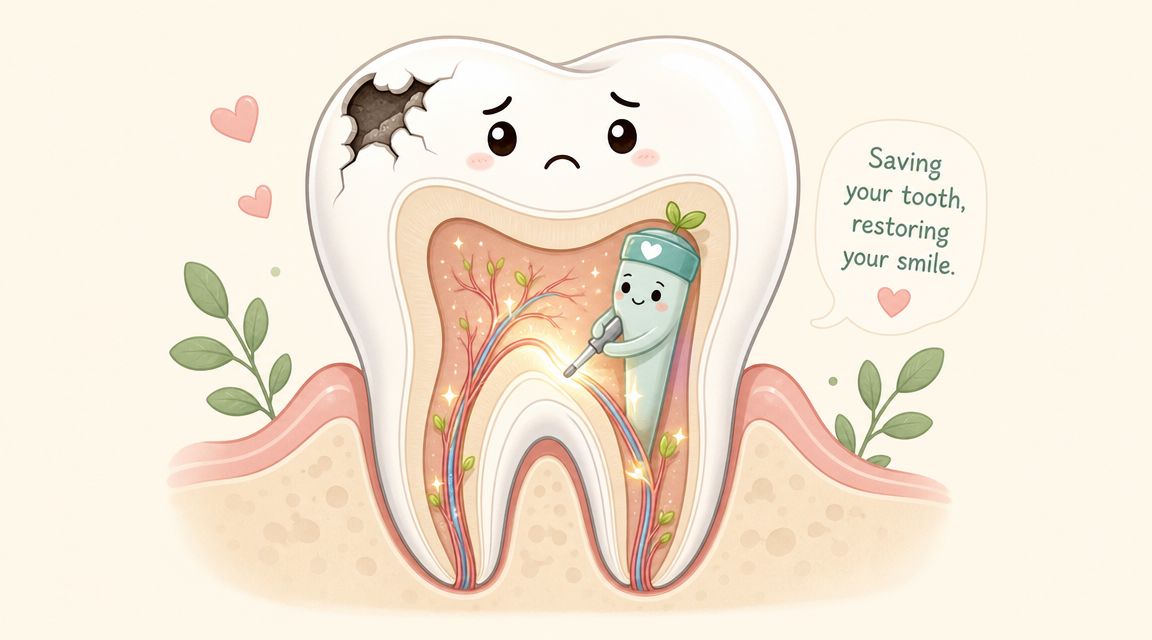
A root canal is often described in scary terms, but the purpose is very practical. It's a treatment used when the soft tissue inside a tooth becomes inflamed or infected. Instead of removing the whole tooth, the dentist cleans the inside, disinfects the space, seals it, and then restores the tooth so you can keep it.
What the treatment is actually doing
A simple analogy helps. Think of a house with a plumbing problem inside one wall. If the structure is still worth saving, you don't tear the whole house down. You open the area, remove the damaged material, clean things thoroughly, seal it, and repair the outside so the structure can keep doing its job.
A root canal follows that same idea.
- The inside is treated: The infected or damaged tissue is removed from the inner chamber and canals.
- The space is cleaned: The goal is to reduce bacteria and prepare the inside of the tooth for sealing.
- The tooth is preserved: Once restored, the tooth can often continue to function in your bite.
For patients, the most important point is that the procedure is designed to save the natural tooth, not just stop pain for the moment.
Why saving the natural tooth matters
Your natural tooth has a shape, position, and relationship to your bite that no replacement matches perfectly. When a tooth can be saved predictably, keeping it often makes eating, speaking, and maintaining the alignment of nearby teeth simpler.
That doesn't mean a root canal is always the right answer. Some teeth are too damaged to restore well. But when the tooth is restorable, saving it is often a very reasonable long-term strategy.
Practical rule: If you're evaluating cost, start by asking whether the tooth is a good candidate to keep. That answer shapes every financial decision that follows.
This is why the conversation shouldn't begin with fear. It should begin with value. A root canal isn't only a line item on a treatment estimate. It's often the step that gives you a chance to keep your own tooth instead of moving into the more complex world of removing and replacing it.
Factors That Determine Your Root Canal Cost
A root canal estimate reflects the condition of your tooth, the amount of work needed to save it, and the steps required to make that tooth usable again. That is why two patients can both need a root canal and still receive very different treatment estimates.
The tooth being treated matters
The first variable is which tooth needs care. Front teeth are usually easier to reach and often have simpler root anatomy. Molars are farther back, often have more canals, and can take more time to clean and seal properly.
General U.S. pricing data places the procedure itself at about $620 to $1,100 for front teeth, $720 to $1,300 for premolars, and $890 to $1,500 for molars, based largely on treatment difficulty. The same pricing data notes that a permanent crown often adds $1,100 to $1,700 to the total treatment path (root canal cost guide).
A simple way to read that difference is this: the more complex the inside of the tooth, the more time and precision the procedure usually requires.
| Tooth type | Why cost may differ |
|---|---|
| Front tooth | Easier access and simpler internal shape in many cases |
| Premolar | More variation in anatomy and moderate treatment difficulty |
| Molar | Harder access, more canals, more time, and more restoration needs |
The condition of the tooth can change the plan
A root canal is not priced by tooth name alone. It is also shaped by what has happened to that tooth.
One molar may have straight, easy-to-find canals. Another may have narrow canals, curved roots, deep decay, a large old filling, or a crack that changes how the case must be approached. That extra difficulty can affect the time involved, the imaging needed, and whether a specialist is the better choice.
Timing matters too. A tooth treated early is often simpler to manage than one treated after pain, swelling, or infection has progressed.
- First-time treatment: Often simpler when the problem is caught before the tooth breaks down further.
- Retreatment: Usually takes more work because previous material must be removed and missed anatomy may need attention.
- Structural concerns: A heavily restored or cracked tooth may need closer evaluation to decide whether saving it is predictable.
Provider, location, and restoration needs also affect the total
Fees also vary by region and by who performs the treatment. Overhead, local market rates, and whether the case stays with a general dentist or is referred to an endodontist can all influence the estimate.
For patients, the more useful question is not only, “What does the root canal cost?” It is, “What will it take to keep this tooth working well after treatment?” That broader view matters because the root canal is often one step in the larger cost of saving the tooth.
In practical terms, you are not only paying for a procedure code. You are deciding whether this tooth can be preserved in a way that makes sense for your bite, your comfort, and your long-term budget. That is the comparison that matters most, especially when the alternative may be extraction followed by a replacement option that costs more over time.
Understanding the Full Cost The Root Canal and The Crown
You get an estimate for a root canal, feel a little relief, and then hear that the tooth may also need a buildup and a crown. That moment catches many patients off guard because the procedure that removes infection and the restoration that lets you chew on the tooth again are usually two separate parts of the same plan.
Why the crown changes the conversation
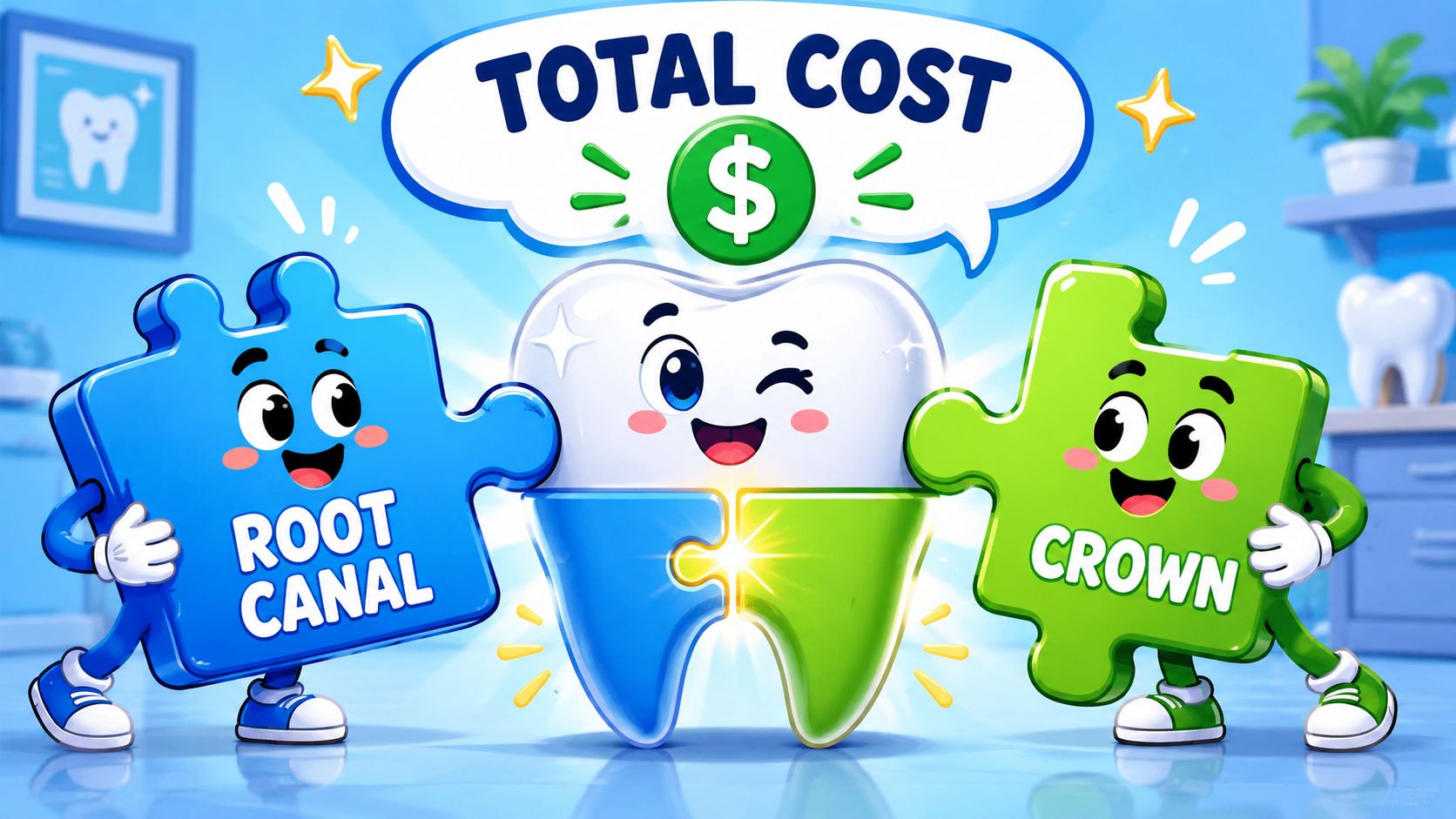
A root canal treats the inside of the tooth. The crown protects the outside. Both matter if the goal is to keep the tooth working for years, not just stop pain this week.
Back teeth often need that extra protection because they absorb strong chewing forces every day. After root canal treatment, the tooth can be more brittle, especially if a large filling or decay has already weakened it. In that situation, finishing the job usually means rebuilding the foundation with a buildup and covering the tooth with a crown.
That is why the essential question is not only, “What does the root canal cost?” The better question is, “What will it cost to save this tooth and keep it useful?” A lower number can sound reassuring at first, but it may only reflect the first step.
Why timing and complexity can change the total
Costs can also rise when treatment is no longer straightforward. Emergency care, infection, retreatment, or a tooth that has broken down further can add visits, imaging, temporary protection, or specialist involvement. The fee changes because the amount of care changes.
If you are comparing options, it helps to read the estimate like a repair plan rather than a single price tag. One line item treats the infection. Another rebuilds the tooth. Together, they answer the question of whether this tooth has a realistic chance to stay in function.
A few common items that may appear in the total include:
- Root canal treatment: Cleans and seals the infected canal system inside the tooth.
- Core buildup: Replaces missing tooth structure so the final restoration has support.
- Crown: Covers and protects the tooth during normal biting and chewing.
- Additional diagnostics or urgent care: May be needed if the tooth is painful, swollen, cracked, or difficult to evaluate.
For many patients, seeing several separate fees feels stressful. That reaction is understandable. In dentistry, separate fees often reflect separate stages of saving the tooth, much like repairing a damaged house requires both fixing the inside structure and replacing the roof.
A clear treatment plan should show the full path, not just the first procedure. That bigger view helps you compare the cost of saving the tooth now against the much larger decisions that can follow if the tooth is removed later.
Comparing Costs Root Canal vs Extraction and Implant
You may be sitting with an estimate in your hand and wondering, "Why not just take the tooth out and be done with it?" That reaction is understandable. An extraction often has the lower first fee. The harder question is what the full plan will cost once you decide how you will chew, smile, and protect the rest of your bite after that tooth is gone.
The lower upfront option can lead to a larger total plan
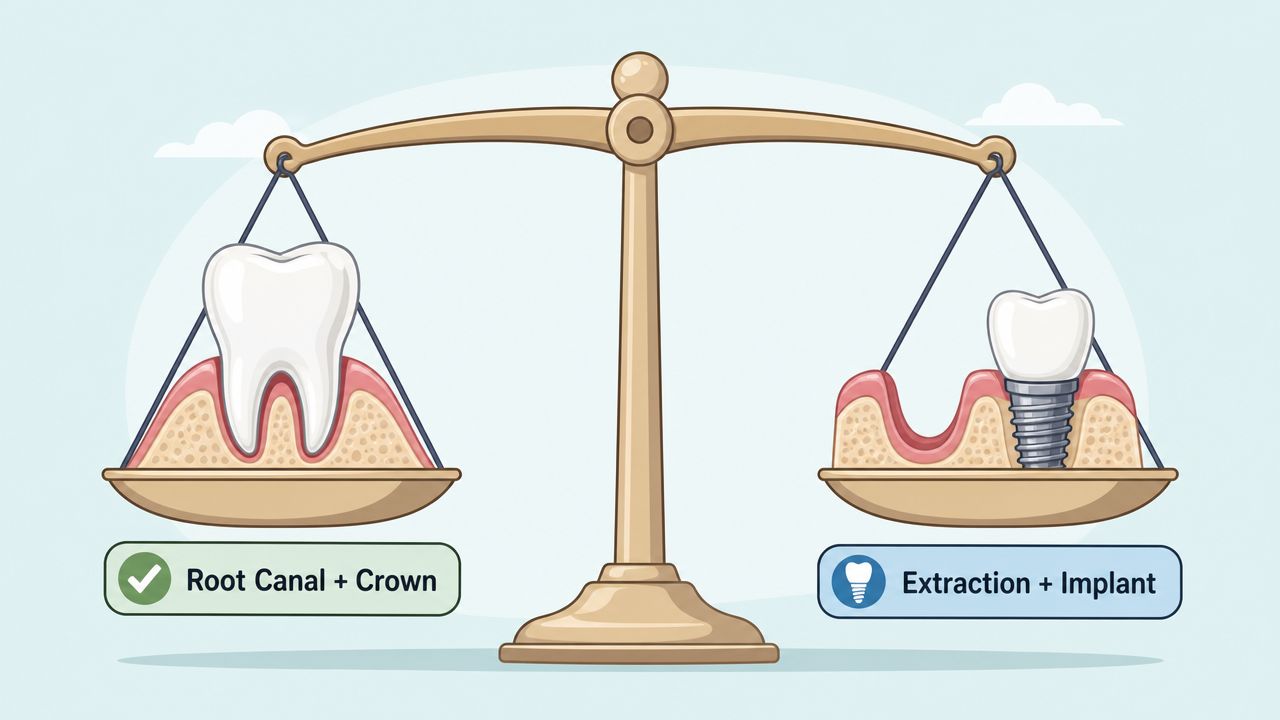
A peer-reviewed cost-effectiveness analysis found the mean total cost of root canal treatment was $689.1 versus $280.1 for extraction, and it also noted that costs rise once an extracted tooth is replaced as part of treatment.
That is why the comparison is usually broader than it first appears. Removing a tooth ends the infection or pain in that tooth, but it also creates an empty space. Then a second decision follows. Will the space be left alone, or will it be restored with an implant-supported tooth replacement or another option?
For back teeth, that question often affects chewing and how forces are shared across your bite. For front teeth, appearance may make replacement feel urgent. Nearby teeth can also drift over time, much like books leaning when one is pulled from the middle of a shelf.
So the comparison is usually root canal plus final restoration versus extraction plus tooth replacement. Looking at only the extraction fee can make the short-term option look simpler than the full path is.
A practical way to compare the paths
| Path | Main advantage | Main tradeoff |
|---|---|---|
| Root canal and crown | Keeps your natural tooth in place if it can be restored predictably | Requires treating the inside of the tooth and protecting it afterward |
| Extraction only | Lower first fee | Leaves a gap and may lead to function or spacing problems |
| Extraction and implant replacement | Replaces the missing tooth after removal | Often involves a longer, more expensive sequence of treatment |
Many patients feel less overwhelmed when they ask three direct questions.
- Can this tooth be saved well? A tooth with enough healthy structure and good support may serve for years after root canal treatment and proper restoration.
- If I remove it, what is my replacement plan? This keeps the decision grounded in the full cost, not just the first appointment.
- Which path protects my long-term oral health better? Saving a healthy enough natural tooth often preserves normal function in the simplest biological way.
A useful comparison is home repair. Fixing a damaged room may feel expensive, but removing the room entirely and rebuilding it later usually becomes a bigger project.
Extraction is still the right choice for some teeth. A severe crack, major bone loss, or too little remaining tooth structure can make saving the tooth unpredictable. But if the tooth is restorable, the better value often comes from judging the whole sequence of care, not the opening price alone.
That long-view approach matters. You are not only paying for a procedure. You are choosing the path that gives this area of your mouth the best chance to stay comfortable, functional, and stable over time.
Using Insurance and Payment Options for Your Treatment
A lot of patients reach this point feeling stuck. The dentist may have explained why the tooth needs treatment, but the next thought is often, "How am I supposed to pay for all of this?"
That reaction is normal.
Insurance can make a stressful decision feel harder because the terms are technical and the benefits do not always line up neatly with the care a tooth needs. A root canal may be covered one way. The buildup or crown that helps the tooth function long term may be covered another way. If you only look at the first estimate, it is easy to miss the total cost of saving the tooth well.
How insurance usually works
Many dental plans help with root canal treatment after a deductible is met, but the exact share depends on your plan, the tooth involved, and how the procedure is categorized. The part that confuses many patients is that insurance often treats the root canal and the final restoration as separate pieces of care.
Three terms usually shape your out-of-pocket cost:
- Deductible: The amount you pay first before insurance begins sharing the cost.
- Coverage percentage: The portion the plan pays for a given type of treatment.
- Annual maximum: The total amount the plan will pay during the benefit year.
Annual maximums matter more than many patients expect. If your plan contributes toward the root canal but you are close to your yearly limit, the crown may leave you with a larger share than you anticipated. That does not mean saving the tooth is the wrong decision. It means you need the full map before treatment starts.
Questions to ask before you agree to treatment
It helps to treat the financial conversation the same way you would treat a treatment plan. Break it into steps. Ask for each piece. Make sure the sequence makes sense.
A useful checklist includes:
- Ask for the full treatment sequence. You want to see the exam, imaging, root canal, buildup if needed, and crown or other final restoration listed clearly.
- Ask what insurance applies to each part. Benefits may differ between endodontic treatment and restorative treatment.
- Ask whether timing affects benefits. If your benefit year is about to reset, splitting treatment across two plan years may change your out-of-pocket cost.
- Ask about payment arrangements. Some offices offer staged payments or work with outside financing for larger cases.
The comparison is rarely just "Can I afford the root canal today?" The better question is "Which path gives me the most stable result for the money I will spend over time?" In many cases, saving a restorable tooth with a root canal and crown can be the more efficient long-term path than removing it and later paying for replacement.
For patients in Santa Ana and nearby communities, online averages can be a rough starting point, but they do not account for your benefits, your tooth's condition, or the full cost of keeping that area of your mouth working well. A clear written estimate, paired with a clear explanation, usually lowers stress more than any national price range.
Schedule Your Consultation in Santa Ana
If you're dealing with tooth pain, the internet can only take you so far. It can explain patterns, but it can't tell you whether your tooth is restorable, whether a crown will be needed, or whether the less expensive-looking option is the better long-term decision.
That's where an in-person exam becomes valuable. A dentist can look at the tooth, take the necessary images, evaluate the surrounding structure, and explain whether the realistic paths are saving the tooth, removing it, or considering replacement. That conversation is often what turns a stressful unknown into a manageable plan.
For patients in Santa Ana, Costa Mesa, Tustin, Irvine, and Garden Grove, Bristol Dental & Orthodontics provides general dental care and emergency dental evaluations that can help identify the source of severe tooth pain and outline next steps. Every treatment decision should be suited to the condition of the tooth, your goals, and your overall oral health. Dr. Andrew Finley should review this article before it is published, and he should also evaluate your specific case before you make treatment decisions.
If you're nervous, say so. If cost is your main concern, say that too. Those are normal concerns, and they belong in the conversation from the start. A good consultation should leave you knowing what the problem is, what your options are, and what each path is likely to involve.
If you have tooth pain or you've been told you may need a root canal, schedule a consultation with Bristol Dental and Orthodontics for a personalized evaluation. You'll be able to discuss the condition of the tooth, the full treatment pathway, and the practical next steps for your situation in Santa Ana.
Made with Outrank app