
A sleep apnea treatment dentist can provide oral appliance therapy for obstructive sleep apnea, but only after a sleep physician has diagnosed the condition and prescribed the appliance. If you snore loudly and wake up tired, shouldn't a dentist who sees your mouth and jaw twice a year be able to fix the problem alone? That question exposes a common gap in understanding, because the teeth and jaw are only part of the picture. Safe care depends on a clear handoff between medical and dental providers, with each person doing the part they're trained to do.
Table of Contents
- Who Does What in Sleep Apnea Care
- How Sleep Apnea Gets Diagnosed Before Dental Care
- Oral Appliance Types and Who Qualifies
- Oral Appliances Compared With CPAP
- What Studies Report About Oral Appliance Results
- Follow-Up Visits and When Treatment Needs to Change
- Surgical Options Specialists Evaluate
- Schedule a Sleep Apnea Consultation in Santa Ana
Who Does What in Sleep Apnea Care
You don't get an oral appliance for obstructive sleep apnea, often shortened to OSA, in a single step. A sleep physician first confirms the diagnosis through sleep testing and decides whether an appliance is a reasonable option. Only then does a sleep apnea treatment dentist examine your mouth, fit a custom device, and adjust it over time.
This split protects you. Snoring can have several causes, and some breathing problems during sleep need medical treatment that a dental device can't provide. Starting with a device before anyone has measured your breathing would be guesswork.
Responsibilities in Sleep Apnea Care
| Provider | Responsibility | When Involved |
|---|---|---|
| Sleep physician | Diagnoses obstructive sleep apnea through sleep testing and decides whether oral appliance therapy is an option | Before any dental device is fitted |
| Dentist | Examines teeth, gums, jaw joint and bite, then fits and adjusts a custom appliance | After a sleep physician prescribes or refers |
| Sleep physician (follow-up) | Confirms treatment response with objective sleep testing | After fitting and adjustment |
| Patient | Wears the device as directed, reports comfort or bite changes and attends scheduled visits | Throughout treatment |
Read the first two rows as a sequence, not as two separate services. The physician answers the medical question, do you have OSA and how severe is it. The dentist answers the dental question, can your teeth, gums, jaw joint, and bite support a device that repositions your jaw while you sleep.
The third row is the one many patients miss. Feeling better in the morning is encouraging, but it doesn't prove your breathing interruptions have resolved, so the physician checks the result with objective sleep testing after fitting and adjustment.
Your role in the last row is practical, not passive. You'll wear the device nightly, keep your appointments, and tell the dental team promptly about soreness, looseness, or changes in how your teeth meet. Small reports early often prevent bigger problems later.
Simple rule to remember: the physician diagnoses and verifies, the dentist fits and monitors your mouth, and you report what nightly use actually feels like.
How Sleep Apnea Gets Diagnosed Before Dental Care
Could a routine dental visit be the first step toward an OSA diagnosis? Often, yes. The condition is common and frequently goes unrecognized for years. The American Academy of Sleep Medicine fact sheet reports breathing-related OSA symptoms in approximately 24% of men and 9% of women, and estimates that roughly 80% to 90% of adults with OSA remain undiagnosed. Dental teams see patients regularly and examine the jaw and airway area closely, so they're often the first to spot a reason to ask questions.
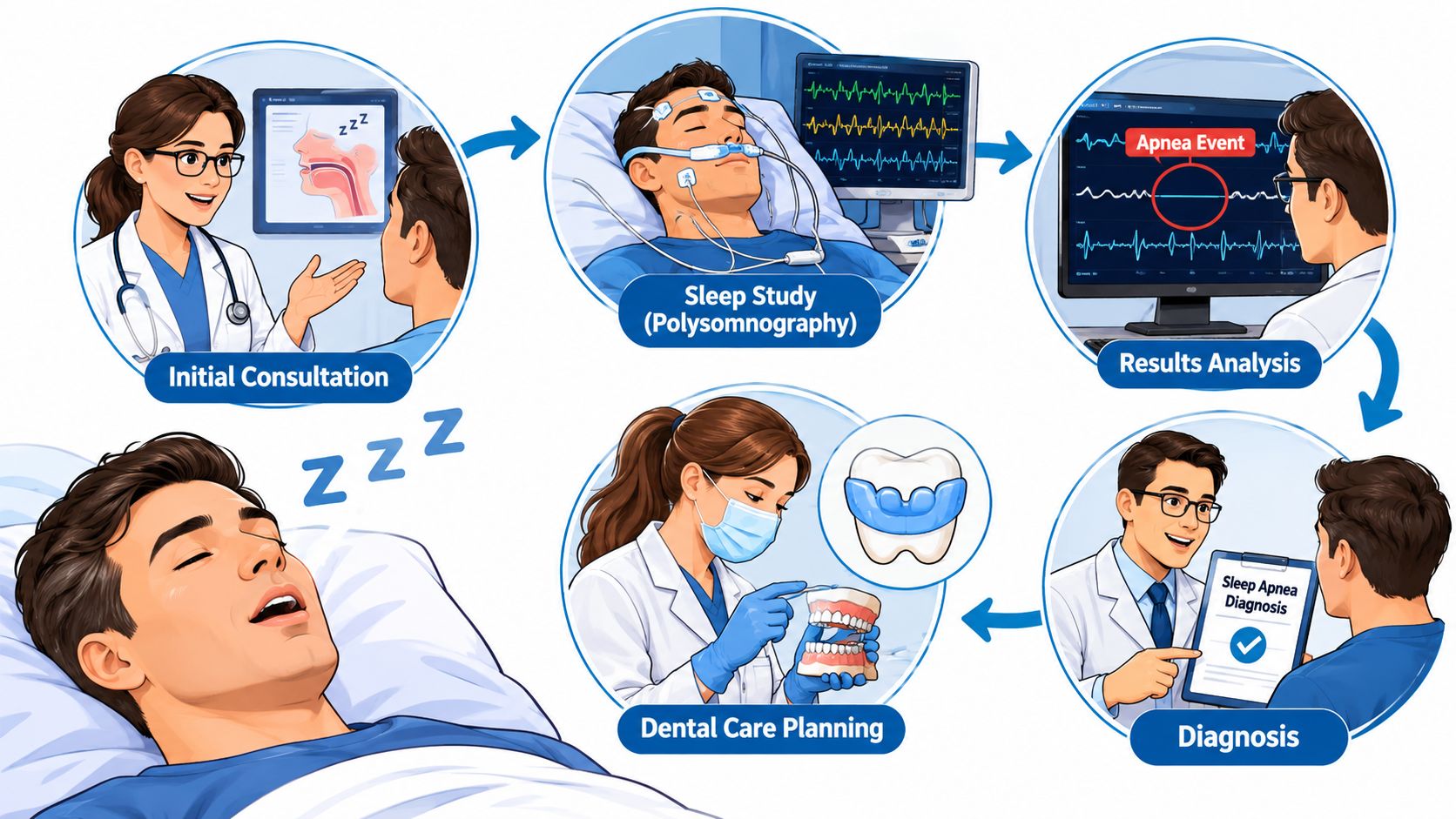
Six Steps From Suspicion to a Prescription
- Notice symptoms. Loud snoring, pauses in breathing that a bed partner has seen, morning headaches, and daytime sleepiness are worth mentioning at any dental or medical visit. None of these alone confirms OSA.
- Dental screening. The dentist documents your symptoms and notes oral and jaw features that can relate to airway space, such as jaw position, tongue posture, and tooth wear. This stays at the level of screening; the diagnosis itself comes later.
- Referral. If screening raises concern, the dentist refers you to a qualified sleep physician or other medical sleep specialist. A dentist shouldn't diagnose OSA independently.
- Sleep testing. The physician orders an objective sleep study that measures breathing during sleep. Results show whether OSA is present and whether it's mild, moderate, or severe.
- Treatment decision. The physician decides which treatments fit your diagnosis and writes a prescription if an oral appliance is appropriate. Severity, symptoms, anatomy, and overall health all matter.
- Dental evaluation. With a prescription in hand, the dentist confirms that your teeth, gums, and jaw joint can support the device. Active dental problems may need attention first.
Notice how the middle three steps all sit with the physician. The dental work happens at both ends of the process: raising the question early, then checking that your mouth is ready once a prescription exists. That sequence protects you from wearing a device chosen before anyone measured what your breathing does at night.
Families sometimes assume this only concerns older adults. It doesn't. Children can also have sleep-related breathing problems, so parents should raise snoring or restless sleep at medical or dental visits at any age rather than waiting for a child to grow out of them.
Symptoms start the conversation. Only testing confirms the diagnosis, and that distinction shapes every treatment choice that follows.
Oral Appliance Types and Who Qualifies
A custom oral appliance starts with impressions of your teeth, so the finished device matches your bite exactly. A pre-formed, ready-made device arrives in a fixed size and offers little room for fine-tuning. That difference matters because the goal is precise, gentle repositioning of your lower jaw, night after night.
The AASM clinical guideline for oral appliance therapy states that a dentist treating adult OSA should use a custom, titratable mandibular advancement appliance rather than a non-custom device when oral appliance therapy has been prescribed by a sleep physician. Titratable means the dentist can advance the jaw position gradually, in small steps, instead of fixing it in one position on day one.
Oral Appliance Types Compared
| Device Type | How It Works | Adjustable During Treatment | Guideline Position |
|---|---|---|---|
| Custom titratable mandibular advancement device | Custom-fitted to the teeth and gradually advances the lower jaw | Yes | Preferred when a sleep physician prescribes oral therapy |
| Non-custom, pre-formed device | Ready-made size, often softened in hot water to fit | Limited | Below the custom device in the guideline's preference |
| Over-the-counter device | Sold without dental fitting | No | Not favored by the guideline for prescribed therapy |
A mandibular advancement device holds your lower jaw slightly forward during sleep. That forward position helps enlarge the airway behind the palate and in the throat, which reduces how easily the upper airway collapses while you're asleep. Because the device grips your teeth to do this work, your dentist evaluates dentition, periodontal health, temporomandibular-joint status, occlusion, and retention before fitting anything. This evaluation happens after your physician writes the prescription, and it is the dental half of the handoff.
A Plain Language Candidacy Checklist
- CPAP difficulty or preference. You've been unable to tolerate CPAP, or you and your physician have discussed your preference for an alternative.
- Severity that fits. Your sleep physician judges oral therapy appropriate, which is most often the case in mild-to-moderate OSA.
- Healthy gums and tooth support. Your teeth and gums can hold the device securely through the night without undue stress.
- A jaw joint that tolerates repositioning. Your joint and jaw muscles can handle a forward position without significant pain.
- Dental problems handled first. Cavities, gum infection, or loose teeth are treated before fitting begins.
Adjustment takes a little patience. Early soreness, extra saliva, or tired jaw muscles in the morning are common at first and often settle as you adapt. Tooth movement or a bite that starts to feel different is a separate matter. Report it promptly so the fit or advancement can be reviewed.
Candidacy always comes back to two inputs: your physician's diagnosis and your full dental exam. If you're weighing this option, discuss your specific case with your sleep physician and the dentist who would fit the appliance instead of ordering a device based on snoring alone.
Oral Appliances Compared With CPAP
If CPAP works for you, it usually stays the first choice. That is the baseline for any fair comparison, because the joint AASM and AADSM guideline announcement states that CPAP is superior to oral appliances for improving oxygen saturation and reducing the apnea-hypopnea index and arousal index.
That finding shapes the handoff. Your sleep physician owns the diagnosis, severity call, and CPAP decision. The dentist steps in when an appliance is appropriate, confirms the mouth can support it, then fit and advancement are monitored in follow-up.
CPAP and Custom Oral Appliance Compared
| Factor | CPAP | Custom Oral Appliance |
|---|---|---|
| Typical role | Generally preferred first-line treatment when it can be used | Considered for adults who cannot tolerate CPAP or prefer an alternative |
| Effect on apnea measures | Superior in the joint guideline | Generally less effective than CPAP |
| Severe sleep apnea | Generally preferred and considered first | Physician-led option mainly after CPAP intolerance or refusal |
| Adherence tracking | Many machines record nightly use automatically | Measured through clinical follow-up visits |
| Dental or bite effects | No device grips the teeth or repositions the jaw | Possible jaw or bite changes that the dentist monitors |
So why choose an option with weaker average numbers? The gap between a device on paper and a device in real life is nightly wear. CPAP can deliver more effect per hour used, while an appliance may be easier for some adults to keep in place from lights-out to morning. The meaningful question is how much treatment reaches your airway across the whole night, every week.
Dental sleep medicine guidance summarized in the oral appliance therapy compliance document defines meaningful appliance compliance as wearing it at least 80% of nights, for at least five nights per week. A device used twice a week gives the airway only part-time support, even when the prescription was excellent.
Severity still sets the boundaries. With severe OSA, physicians generally want CPAP considered first whenever possible; an appliance usually enters when CPAP cannot be tolerated or is refused, and the dentist coordinates rather than decides that severity call. In milder disease, the gap between measured effect and real-world use may narrow, so the physician may weigh your sleep-study result alongside what you can sustain.
Bring one focused question to your physician: for my diagnosis, which option gives the best balance of measured effectiveness and use I will realistically maintain every night? Then let the dentist handle fit, comfort, bite checks, and advancement while the physician interprets response.
What Studies Report About Oral Appliance Results
Most results are reported with one measure, so learn it first. The apnea-hypopnea index, or AHI, counts breathing pauses and reductions per hour of sleep. A lower number generally means fewer interruptions, but your sleep physician interprets it using your full sleep study, your symptoms, and your health history, not a single figure in isolation.
A percentage improvement in AHI is not the same as a cure. If a starting AHI is high, a large percentage drop can still leave meaningful apnea behind. Studies also define success differently from one another, which is why their numbers shouldn't be compared as if they used identical yardsticks.
Reported Results From Recent Studies
| Study Type | Population | Reported Result |
|---|---|---|
| 2024 systematic review and meta-analysis on PubMed | 42 studies with 2,265 patients | AHI improved 48% in mild, 67% in moderate and 62% in severe sleep apnea |
| 2024 retrospective study on PubMed | 209 patients using custom mandibular advancement devices | 67% treatment success, median AHI fell from 22.8 to 7.45 events per hour |
| 2024 clinical study in BMC Oral Health | 40 patients comparing two device designs | 70% effective-treatment rate for one device and 50% for the other |
| 2024 randomized clinical trial in the Journal of the American College of Cardiology | Six months of mandibular advancement therapy | 24-hour mean arterial blood pressure fell 2.5 mm Hg from baseline |
Read the rows as group averages, not promises. The review suggests appliances can produce substantial AHI reductions across severity levels, while the clinical study shows that device design and individual response can shift results considerably. The blood pressure change in the trial was modest, and it's one secondary finding rather than a reason to choose therapy by itself.
Your result will depend on your severity, your anatomy, how far your jaw can comfortably advance, and how consistently you wear the device. Two patients with the same starting AHI can respond quite differently.
Less snoring and better morning energy are welcome signs, but they don't by themselves prove that breathing interruptions have resolved.
That's why objective follow-up testing matters after fitting. Ask your sleep physician whether repeat testing is planned for you, and when it should happen once adjustments are complete.
Follow-Up Visits and When Treatment Needs to Change
An oral appliance isn't a one-time fitting that ends when you leave with a case and cleaning instructions. The AASM and AADSM guideline at a glance suggests that a qualified dentist provide ongoing oversight to check for dental side effects or changes in the bite, and recommends periodic visits with both a qualified dentist and a sleep physician. At those visits, the dental team assesses comfort, retention, jaw or tooth symptoms, and whether adjustment is proceeding appropriately.
Updated dental sleep medicine standards in the Journal of Dental Sleep Medicine standards document describe follow-up every six months during the first year and at least annually thereafter. Early visits are closer together because that's when soreness, fit problems, and bite changes most often show up and are easiest to correct.
Five Changes Worth Reporting Promptly
- Jaw symptoms that don't settle. New jaw pain, clicking, or tired jaw muscles that persist beyond the early adjustment period.
- Bite changes. Morning tooth discomfort, a bite that feels off, or any sense that teeth have shifted.
- Appliance damage. A cracked, loose, or noticeably worn device that no longer stays in place through the night.
- Returning symptoms. Snoring or morning fatigue that comes back after an initial improvement.
- Residual apnea on testing. A repeat sleep study that still shows breathing interruptions despite consistent use.
Some of these lead to simple fixes, such as a small titration change, a repair, or attention to a dental problem that has developed. Others mean the therapy itself needs rethinking. Your sleep physician may recommend returning to CPAP, combining approaches, or referring you to a specialist if oral therapy isn't controlling your apnea.
Medical follow-up runs alongside the dental visits because someone needs to verify that the sleep-disordered breathing is being addressed, not just that the device feels fine. At Bristol Dental & Orthodontics, we handle the dental side of that coordinated plan, checking your teeth, gums, and bite over time and communicating with your physician when something changes.
Skipping follow-up is the quiet way treatment fails. A device that fit well in month one can drift out of tune as your jaw adapts and your teeth respond to nightly forces. Regular checks catch that drift while it's still small.
Surgical Options Specialists Evaluate
Surgery enters the conversation when other treatments aren't enough or aren't suitable for your anatomy. A sleep surgeon or ENT specialist, not your dentist, decides whether you're a candidate and which procedure, if any, fits your diagnosis.
Specialists generally evaluate a few broad categories. Upper airway surgery removes or reshapes soft tissue in the throat that narrows the airway. Jaw repositioning surgery moves the upper and lower jaws forward to increase airway space. Implanted nerve stimulation activates the nerve that controls the tongue during sleep, helping keep it from falling back and blocking the airway.
Each category carries its own risks, recovery, and follow-up, and suitability depends on where your airway collapses, your overall health, and what you've already tried. No option should be presented to you as a guaranteed fix.
Your dentist still has a role at this stage. Before any procedure, the dental team evaluates your teeth, gums, bite, and jaw joint health, and afterward helps coordinate dental care when the bite or jaw is involved in healing.
Questions to Bring to the Specialist
- Fit. Which option matches my diagnosis and anatomy, and why?
- Recovery. What does recovery involve, and what limits will I have?
- Verification. How will results be confirmed with a repeat sleep study?
- Alternatives. Does oral appliance therapy or CPAP remain an option for me?
Schedule a Sleep Apnea Consultation in Santa Ana
Bristol Dental & Orthodontics is a family and cosmetic dental practice in Santa Ana led by Dr. Andrew Finley, a USC-trained dentist with advanced orthodontic training. The practice offers customized sleep apnea solutions as part of coordinated care and serves Santa Ana and the surrounding Orange County communities.
A first visit focuses on the dental side of your care. The team evaluates your teeth, gums, jaw, and bite, reviews any sleep study or referral you bring, and explains whether a custom oral appliance evaluation fits your situation.
Prepare for Your Visit in Four Steps
- Gather your records. Bring any sleep study results or your physician's referral if you have them.
- Write down symptoms. Note what happens and when, such as loud snoring, witnessed pauses, or morning headaches.
- List medications and history. Include current medications and any history of jaw, bite, or gum concerns.
- Bring your questions. Ask about comfort, appliance options, adjustment, and what follow-up will look like.
No sleep study yet? That's fine. A consultation can still cover screening, your oral and jaw health, and whether a referral for medical evaluation makes sense as your next step. If an appliance becomes part of your plan later, fitting, adjustment, and follow-up visits happen on the dental side while your sleep physician tracks results.
Keep one boundary in mind. A dental visit does not replace a sleep physician's diagnosis, which comes from a medical evaluation and sleep testing. What the dental team adds is everything on the oral side: appliance candidacy, fitting, and ongoing checks of your bite and jaw as treatment continues.
If snoring, morning headaches, or daytime fatigue have you wondering where to start, Bristol Dental & Orthodontics can evaluate your teeth, gums, jaw, and bite and help coordinate the dental side of care with your sleep physician. Visit Bristol Dental and Orthodontics to schedule a consultation in Santa Ana and discuss whether a custom oral appliance evaluation fits your case.