
You've just noticed that your child has a toothache, your teenager needs an orthodontic consultation, and you've been postponing your own exam because finding separate appointments across Orange County is difficult. For families in Santa Ana, Costa Mesa, Tustin, Irvine, and Garden Grove, choosing an Orange County family dentist can make dental care easier to coordinate, but convenience is only part of the decision. The right practice should also provide preventive care, explain treatment clearly, respond to urgent problems, and help your family understand changing coverage and access options.
Bristol Dental & Orthodontics is a family and cosmetic dental practice in Santa Ana, CA, led by Dr. Andrew Finley. This guide explains what family dentistry includes, how to evaluate a practice, and what to consider when you need Invisalign, dental implants, sleep apnea treatment, cosmetic dentistry, or emergency care.
Table of Contents
- Why Families Choose a Single Dental Practice
- Core Services a Family Dentist Provides
- How to Evaluate a Family Dental Practice
- Specialized Services Offered In-House
- Emergency Dental Care and Insurance Realities
- What to Expect at Your First Visit
- Taking the Next Step with Bristol Dental & Orthodontics
Why Families Choose a Single Dental Practice
A family's dental calendar can become complicated quickly. One parent may need a cleaning, another may be considering an implant, a teenager may need orthodontic care, and a young child may need help building brushing habits. If every person sees a different provider, parents often have to repeat medical histories, coordinate separate offices, and keep track of different treatment recommendations.
A family practice brings many of those needs into one dental home. That doesn't mean every patient receives the same treatment. It means the dental team can provide age-appropriate care while keeping the household's appointments, concerns, and preventive goals easier to organize.
Continuity matters as children grow
A child's dental needs change over time. Early visits may focus on comfort, brushing technique, fluoride, and watching how primary teeth develop. Later appointments may involve permanent teeth, sealants, bite development, orthodontic screening, or treatment for decay.
A consistent dental team can recognize changes between visits and explain them in language parents understand. That relationship may also help children feel less uncertain about appointments because the setting and caregivers become familiar.
Orange County has a professionally dense dental market. The county's oral health strategic plan reported 3,716 professionally active dentists, a ratio of one dentist per 856 residents, compared with one per 1,312 residents statewide. It also reported 102.33 dentists per 100,000 residents in Orange County, compared with 76.79 statewide. These figures show that families have access to many dental offices, but they don't tell you which practice will coordinate care well or communicate consistently. Orange County's oral health strategic plan offers useful local context.
One relationship can support changing needs
Adults may move from preventive care to fillings, crowns, cosmetic treatment, periodontal maintenance, or tooth replacement. A family dentist who knows a patient's history can discuss how one decision may affect future care. When a case requires a specialist, the practice can also help explain why a referral is appropriate and what information should travel with the patient.
Practical rule: Choose a dental home that can manage routine care confidently and explain the next step when a specialist is needed.
For busy households, back-to-back scheduling may reduce missed work, school disruptions, and the need to retell the same story at multiple offices. Continuity gives families a place to ask questions before a minor concern becomes an urgent one.
Core Services a Family Dentist Provides
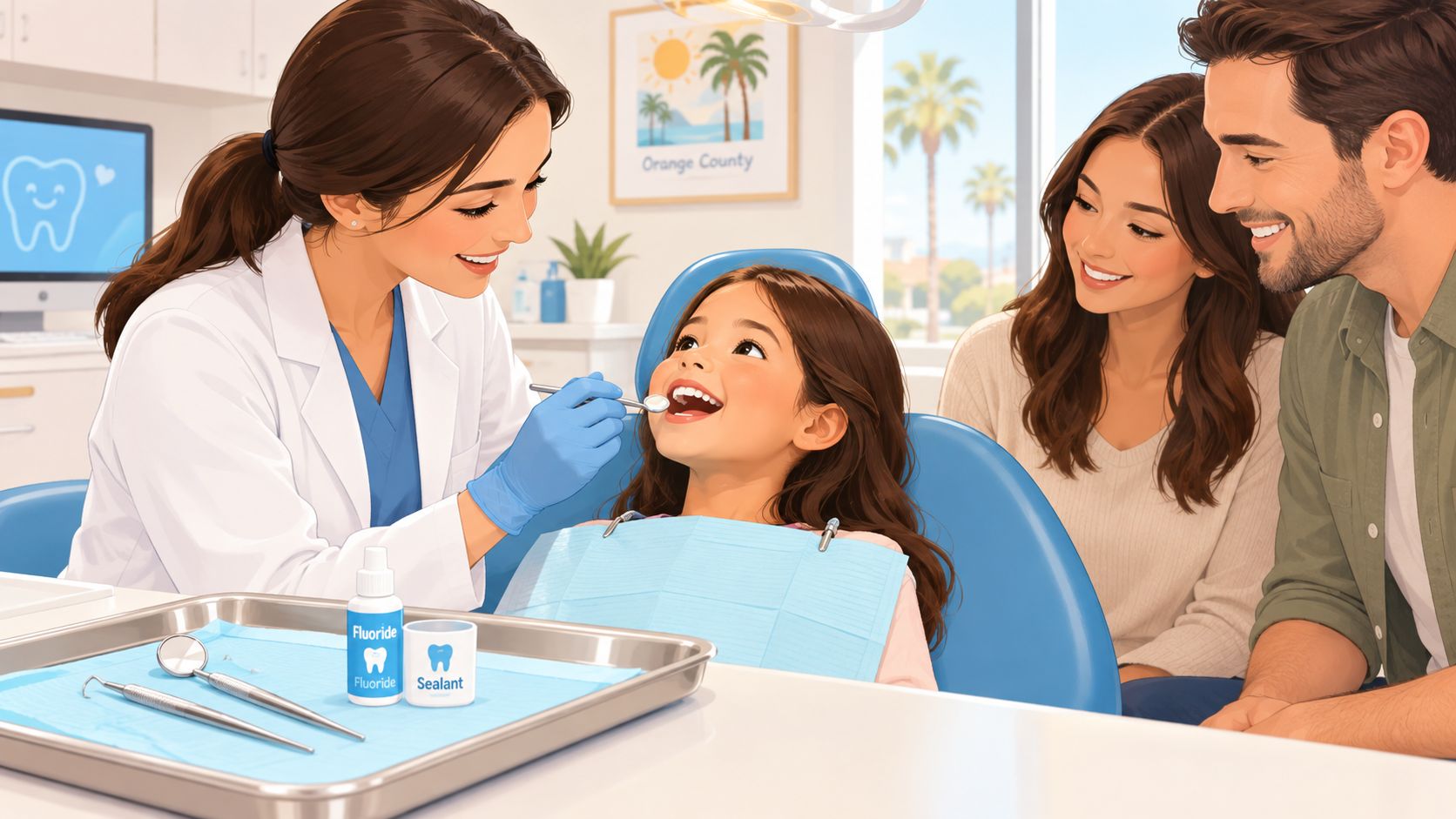
Preventive dentistry forms the foundation of family care. A typical plan may include examinations, professional cleanings, digital imaging when indicated, fluoride treatment, sealants, fillings, gum-health evaluations, and oral cancer screening. The exact combination depends on age, medical history, symptoms, oral hygiene, previous treatment, and risk for decay or gum disease.
Local data explains why those basics remain important. Orange County's oral health plan reported that annual dental visits declined from 51.0% in 2013 to 50.2% in 2016, while preventive dental visits fell from 46.2% to 45.8% over the same period. The figures are not a prediction for an individual family, but they show that having many dentists in the county doesn't automatically mean every resident receives consistent preventive care. The county plan connects local access with ongoing oral-health needs.
What routine care is designed to do
A thorough exam looks beyond visible cavities. The dentist may evaluate tooth surfaces, existing restorations, gum tissues, bite, jaw function, oral lesions, and areas that are difficult to inspect at home. X-rays may help identify problems between teeth, around roots, or beneath existing restorations when the dentist determines they're appropriate.
Cleanings remove deposits that brushing and flossing can't fully eliminate. Fluoride treatments support enamel, while sealants can protect the grooves of developing permanent molars. Fillings restore teeth affected by decay, but the larger goal is to identify why decay developed and reduce the chance of recurrence.
Prevention must fit the patient
Children benefit from simple explanations, supervised brushing at home, and regular monitoring. A systematic review found that daily fluoride toothpaste use produced about a 24.9% preventive fraction versus placebo in young permanent dentition. The same review reported that 1,500 parts per million fluoride toothpaste outperformed 1,000 parts per million by about 9.7%, and supervised brushing produced roughly 23.3% greater reduction than unsupervised brushing. These findings come from the published systematic review on fluoride toothpaste.
Professional fluoride varnish is another option for selected patients. The evidence review cited by the USPSTF found moderate net benefit for varnish in children younger than five, and reported benefit from 2.26% fluoride varnish applied at least twice per year for caries prevention in both younger children and patients aged six to eighteen. The fluoride varnish evidence review supports discussing risk-based prevention with a dental professional.
Families should expect more than a list of procedures. A strong practice explains what it sees, identifies the choices available, and coordinates with an orthodontist, oral surgeon, periodontist, or other specialist when a case falls outside the practice's scope.
How to Evaluate a Family Dental Practice
A convenient location matters, especially for families traveling from Santa Ana, Tustin, Irvine, Costa Mesa, or Garden Grove. It shouldn't be the only filter. A practice may be nearby but still be difficult to use if appointment times don't fit school and work schedules, urgent concerns aren't addressed clearly, or treatment discussions feel rushed.
Start by checking whether the dentist's services match your household's likely needs. Ask whether the practice provides general and pediatric care, orthodontic consultations, restorative treatment, cosmetic options, implant planning, sleep apnea screening, and emergency assessments. You're not looking for a promise that every case will be treated in-house. You're looking for an honest explanation of what the team handles and when it refers.
Questions worth asking before you commit
- Who leads the treatment plan? Ask how Dr. Andrew Finley and the dental team review findings, explain alternatives, and coordinate care.
- What technology supports diagnosis? Ask whether the office uses digital X-rays or intraoral cameras when clinically appropriate, and how the images will affect the discussion.
- How does the practice handle children? Find out how the team introduces young patients to examinations, manages anxiety, and communicates with parents.
- What happens after a problem is found? A responsible office should explain urgency, choices, expected visits, and what may happen if treatment is delayed.
- Who should I call with an urgent concern? Ask about same-day assessments, after-hours instructions, and what symptoms require emergency medical attention.
Reviews can reveal patterns in communication, punctuality, and patient comfort, but read them thoughtfully. One experience doesn't establish a clinical standard. During a consultation, notice whether the team listens to your priorities and answers questions without using pressure.
Look for clear communication
A useful consultation should leave you knowing what was observed, what remains uncertain, and what the next decision involves. You should be able to ask about alternatives, maintenance, risks, referrals, and the timing of care.
A good dental consultation doesn't require you to understand every clinical term. It requires the team to explain the decision in a way you can use.
Also consider practical details such as parking, accessibility, appointment coordination for multiple family members, and the process for transferring records. These details often determine whether preventive care stays consistent after the first visit.
Specialized Services Offered In-House
A family dentist may offer more than routine examinations and fillings, but the available services depend on the practice and the complexity of each case. A service list is only a starting point. Families also need to know whether the dentist can assess the problem, explain realistic options, provide treatment in the office, and arrange specialty care when that is safer or more suitable.
Bristol Dental & Orthodontics provides family and cosmetic dental care in Santa Ana, with services that include Invisalign and orthodontics, dental implants, cosmetic dentistry, sleep apnea treatment, emergency dental care, and sedation dentistry. A consultation can clarify which concerns fit the practice's services and which may require coordination with another clinician. That distinction matters for families in Orange County, where access, appointment timing, and specialist availability may affect the care plan.
Invisalign and orthodontic care
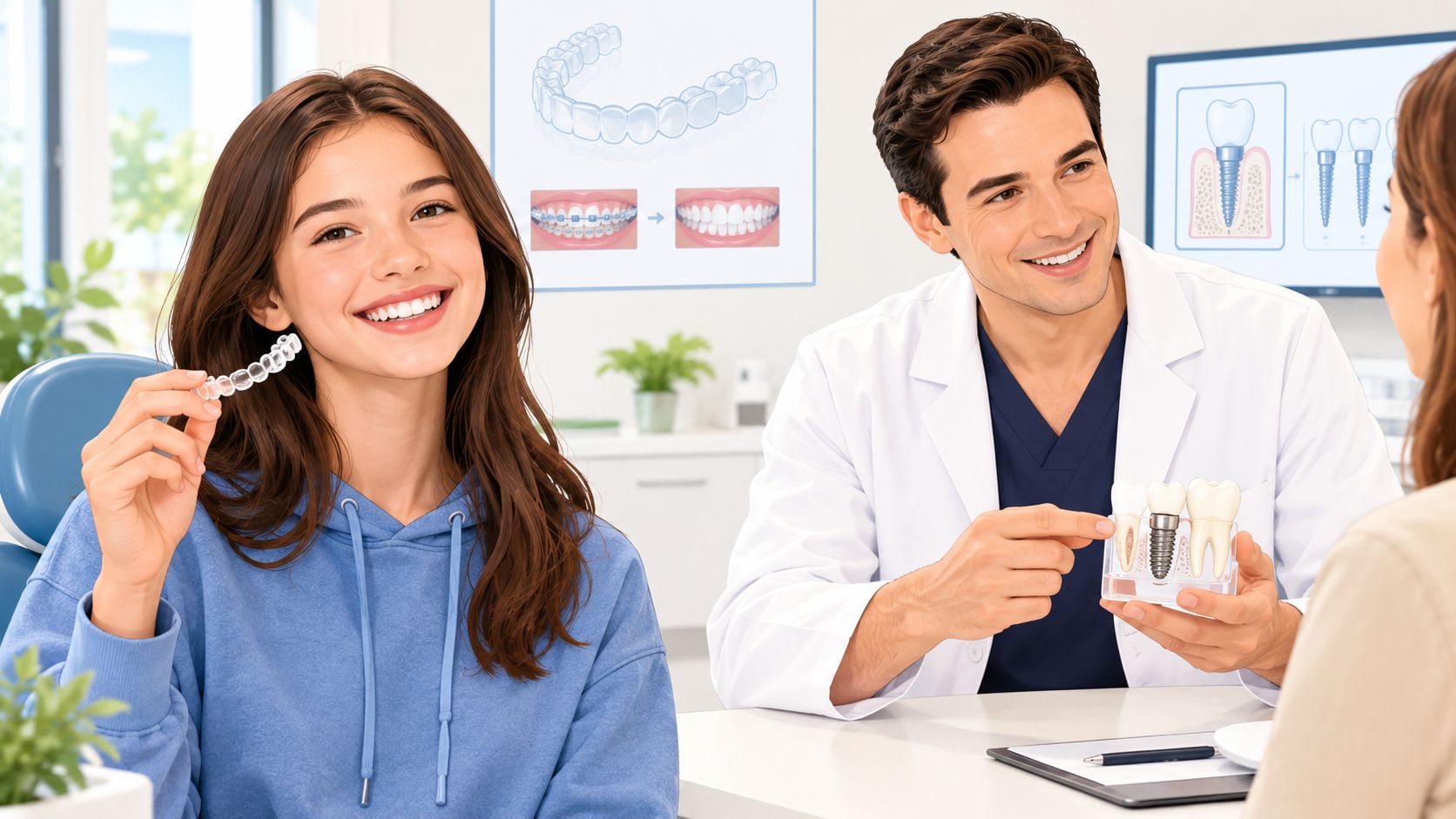
Clear aligners may suit teens and adults with selected alignment concerns who prefer a less noticeable option. Small bonded composite attachments help the aligners grip teeth and guide more controlled movement. If the first series does not reach the planned positions, refinements may require a new scan and additional aligners.
A consultation with the treating dentist clarifies whether attachments or refinements may be needed for the specific alignment concern. It also helps determine whether aligners are appropriate at all. A dentist may manage a straightforward case or coordinate orthodontic care for complex crowding, jaw discrepancies, impacted teeth, or other problems. The assessment should consider bite function, gum health, existing restorations, and whether the patient can wear the aligners as directed.
Dental implants for missing teeth
An implant consultation usually reviews the missing tooth, nearby bone, gum tissues, bite, medical history, and planned restoration. Healing takes time. A general implant-healing overview describes soft-tissue healing in about 2 to 4 weeks and osseointegration, when bone integrates with the implant, in about 3 to 6 months before full functional loading. These are general timeframes, not a personal prediction.
Some patients need further evaluation or treatment before implant placement. A family dentist may plan the restoration and coordinate surgery with another clinician when the case requires it.
Cosmetic dentistry and sleep apnea therapy
Cosmetic dentistry may involve whitening, bonding, veneers, or restorative work. The choice should account for enamel, existing fillings, bite, sensitivity, gum health, tooth structure, function, and the patient's goals. Improving appearance should not create avoidable problems with comfort or chewing.
Sleep apnea oral appliance therapy serves a different purpose. The American Academy of Sleep Medicine recommends a custom, titratable appliance provided by a qualified dentist. A titratable device allows gradual adjustment of lower-jaw advancement instead of holding the jaw in one fixed position. The AASM guidance explains the role of qualified dental management.
Technical appliance descriptions may include two trays connected by a hook-and-screw mechanism. One clinical protocol describes a horizontal screw that advances the mandible 0.5 millimeters per 360-degree clockwise turn. The clinical protocol offers technical context, while the treating dentist must decide whether the therapy fits the patient and coordinate medical sleep evaluation when needed.
Emergency Dental Care and Insurance Realities
Many families assume urgent dental care is easy to find because Orange County has many dental offices. That assumption can fail when a child wakes with severe pain, a filling is lost during work hours, or a broken tooth occurs after regular appointments have ended.
Orange County's emergency dental clinic in Santa Ana closed in 2025, and county health resources now direct residents toward referral lines and outside providers for urgent care. County public-health information about family health and dental access reflects a system in which emergency pathways may not be obvious. Orange County family-health resources can help residents identify available referral support.
Decide how urgent the problem is
A dental office can help assess many toothaches, broken teeth, lost fillings, and localized infections. Call promptly rather than waiting for pain to disappear. Delayed care may allow a problem to become more difficult to restore, but the appropriate treatment depends on the examination.
Seek immediate medical attention for signs of a serious systemic emergency, such as trouble breathing or swallowing, rapidly increasing facial swelling, or other symptoms that seem to threaten general health. Dental office instructions can help, but they don't replace emergency medical services when a person's airway or overall condition may be at risk.
When you call a family dentist, describe:
- The main symptom: Explain whether the issue is pain, swelling, bleeding, sensitivity, a broken tooth, or a lost restoration.
- The timing: Tell the office when it began and whether it's worsening.
- The trigger: Mention an injury, biting incident, recent dental treatment, or possible infection.
- The patient's health history: Include relevant medications, allergies, pregnancy, or conditions that may affect treatment.
Coverage can affect continuity
Coverage changes can create confusion for both children and adults. Orange County data show continuing pediatric access gaps. The county's community health assessment reported that 64.3% of children had visited a dentist in the past six months in 2021, with a population-to-dental-provider ratio of 827 to 1. The county's oral-health assessment also reported that preventive dental service use among low-income children fell from 54% in 2019 to 44% in 2020. The Orange County community health assessment provides the local context.
Recent county and local reporting in 2025 and 2026 described closures of public dental services and major Medi-Cal dental cuts affecting routine services for many adults. Because benefits and eligibility can change, ask the dental office and the plan administrator which services, providers, referrals, and authorization requirements apply now. Don't assume that a service covered for a child is covered in the same way for an adult.
Before treatment begins, ask for a written explanation of the recommended care, what may require authorization, and which questions should go to your dental plan.
What to Expect at Your First Visit
A first visit should give the dentist enough information to understand your current oral health and your priorities. It shouldn't feel like a race through a checklist. Bring your medical history, medication list, allergy information, relevant dental records, and coverage documents if applicable. If you're bringing a child, note habits or concerns such as thumb-sucking, mouth breathing, sensitivity, tooth grinding, or difficulty brushing.
The appointment usually follows a logical sequence
- Conversation first: Tell the team why you scheduled, what you're worried about, and whether you have pain or a specific goal. Parents should share a child's previous dental experiences and comfort level.
- Clinical examination: The dentist examines the teeth, gums, bite, jaw, and soft tissues. An oral cancer screening may be part of the examination.
- Imaging when indicated: X-rays or other images may be recommended when they can answer a diagnostic question that a visual examination cannot.
- Findings and options: The dentist explains what appears healthy, what needs monitoring, and what may need treatment. Ask which issue is urgent and which can be scheduled later.
- Personalized planning: The proposed plan should reflect the patient's health history, risk factors, preferences, and ability to complete treatment.
You don't have to accept every recommendation without understanding it. Ask what happens if you wait, what alternatives exist, how many visits may be involved, and whether another provider should participate.
Help children feel prepared
Use calm, simple language. Tell your child that the dentist will look at their teeth and that they can ask questions. Avoid describing treatment with frightening words or promising that nothing will feel uncomfortable, because either approach can increase uncertainty if the appointment changes.
For a child who feels anxious, ask the office how it introduces examinations and whether a parent can remain nearby. A familiar comfort item, a relaxed arrival, and an appointment time when the child isn't tired or hungry may help.
At the end, you should know the next step. That might be a routine follow-up, preventive instructions, a filling, an orthodontic evaluation, a sleep-related consultation, or a referral. Dr. Finley should review the proposed treatment plan before care proceeds, and you should have an opportunity to discuss questions specific to your family.
Taking the Next Step with Bristol Dental & Orthodontics
Choosing an Orange County family dentist is a practical decision about more than location. Look for a dental home that combines preventive care with clear communication, supports children and adults, explains urgent-care options, and can coordinate specialized treatment when needed.
For families in Santa Ana and nearby Orange County communities, Bristol Dental & Orthodontics provides family and cosmetic dental care under the leadership of Dr. Andrew Finley. The practice's services include general and family dentistry, Invisalign and orthodontics, dental implants, cosmetic dentistry, sleep apnea treatment, emergency dental care, and sedation dentistry.
A consultation can help clarify whether your family needs routine preventive care, an urgent evaluation, orthodontic planning, tooth replacement, cosmetic treatment, or sleep apnea screening. Every treatment plan should be personalized to the patient's examination, health history, goals, and clinical needs, with review by Dr. Finley before proceeding.
Schedule a consultation when you're ready to establish a dental home or address a concern that has been waiting too long. You can learn more by visiting Bristol Dental and Orthodontics, serving Santa Ana and surrounding communities.
Bristol Dental and Orthodontics offers family, cosmetic, orthodontic, implant, sleep apnea, and emergency dental care for patients in Santa Ana and nearby Orange County communities. Visit Bristol Dental and Orthodontics to request a consultation and discuss a personalized plan with Dr. Andrew Finley.