
Clear aligner treatment averages about $5,108 nationally, compared with $6,343 for metal braces, but the price bands overlap substantially, so appliance type alone rarely decides the bill. The cheaper-looking quote isn't always the cheaper treatment once duration, compliance, refinements, retainers, and visits are included.
You may be sitting at your kitchen table in Santa Ana with two orthodontic estimates open on your phone. One recommends clear aligners and emphasizes flexibility. The other recommends metal braces with a different total, payment schedule, and list of included services. Both may sound reasonable, yet the numbers don't line up neatly.
That confusion is normal. Clear braces cost vs metal isn't a simple contest between a modern option and a traditional one. The meaningful comparison is between two complete treatment plans, including the records, visits, appliances, adjustments, refinements, retainers, and follow-up care that may be required.
At Bristol Dental & Orthodontics, led by Dr. Andrew Finley, a Santa Ana consultation should focus on your teeth, bite, goals, and ability to follow the plan. The national figures below are planning benchmarks, not quotes for Santa Ana patients. They can help you ask sharper questions, but they can't determine which option is appropriate for your case.
Table of Contents
- Why Clear Braces Cost vs Metal Is the Wrong Question
- What Clear and Metal Braces Actually Cost
- How the Two Options Compare Beyond Price
- What Really Drives a Final Orthodontic Bill
- How Treatment Time and Visits Change the Equation
- Which Patients Tend to Get Better Value From Each Option
- What to Ask at Your Santa Ana Consultation
- Clear Braces vs Metal Questions Patients Bring Us
Why Clear Braces Cost vs Metal Is the Wrong Question
A parent in Santa Ana might receive one quote for clear aligners and another for metal braces. The first estimate may look lower at the start, while the second may include more appointments, retainers, or post-treatment monitoring. Comparing only the first number can make a complete plan appear more expensive than a limited plan.
The better question is: What will this entire treatment require from my household?
That question changes the conversation. Instead of asking which appliance costs less in general, compare:
- The treatment objective: Is the plan addressing simple spacing, crowding, or a more involved bite problem?
- The included care: Does the estimate cover scans, attachments, refinements, broken brackets, replacement aligners, retainers, and monitoring?
- The practical burden: How often will you or your child need to travel to the office, miss school, miss work, or manage daily treatment?
- The payment structure: What is due upfront, what is financed, and how long will payments continue?
- The likelihood of cooperation: Can the patient follow the required wear or care routine consistently?
A clear-aligner plan can be attractive because the trays are removable and less noticeable. Metal braces can be attractive because they remain attached and give the orthodontist continuous control. Neither feature automatically makes one plan cheaper or better for every patient.
Practical rule: Compare complete treatment plans, not appliance labels.
The research also has limits. National averages don't predict a specific quote in Santa Ana, Costa Mesa, Tustin, Irvine, or Garden Grove. Clinical studies often examine selected groups, such as patients with mild malocclusions, so their results shouldn't be treated as a promise about your treatment time or number of visits.
Bristol Dental & Orthodontics can evaluate the actual orthodontic problem before discussing whether Invisalign clear aligners, metal braces, or another approach makes sense. The purpose of that evaluation isn't to force a universal answer. It's to identify the treatment plan that fits the clinical goal and your family's ability to complete it.
What Clear and Metal Braces Actually Cost
A national benchmark based on procedural research across all 50 states reported an average cost of $5,108 for clear aligner treatment and $6,343 for metal braces. The same source reported wide ranges, from $1,800 to $8,100 for clear aligners and $2,500 to $10,000 for metal braces. These are national planning figures, not guaranteed Santa Ana prices or patient quotes. See the national cost benchmark for clear aligners and braces.
| Treatment option | Average cost | Low end | High end |
|---|---|---|---|
| Clear aligners | $5,108 | $1,800 | $8,100 |
| Metal braces | $6,343 | $2,500 | $10,000 |
The important point is the overlap. Clear aligners aren't automatically a low-cost category, and metal braces aren't automatically a high-cost category. A relatively complex clear-aligner plan can cost more than a straightforward metal-brace plan, while a simple aligner case may fall below a metal-brace estimate.
Why the averages don't settle your decision
Treatment complexity often matters more than the material or appliance name. A plan may require attachments, elastics, repeated scans, refinements, additional visits, or a fixed-appliance finish. A metal-brace plan may involve adjustments, repairs, and retention care. Provider fees, location, treatment duration, diagnostic records, and the scope of post-treatment monitoring can also change the total.
The published benchmark reported a difference of $1,235 between the averages, with the clear-aligner average approximately 19.5% lower in that dataset. That difference shouldn't be turned into a promised discount or assumed local price. It shows why patients need to examine the full plan rather than assume clear aligners always carry a premium.
Read the estimate as a treatment package
Ask whether the written estimate identifies:
- Diagnostic photographs, scans, and other records
- Attachments, elastics, or auxiliary appliances
- Refinement scans and additional trays
- Broken brackets or lost aligner replacement
- Retainers and retention checks
- Post-treatment monitoring
- The projected treatment duration and appointment pattern
- Payment terms and eligible orthodontic benefits
A monthly payment can make a plan easier to manage, but the payment amount alone doesn't reveal the total cost. Financing duration, down payment, exclusions, and retention charges can change the household burden even when two treatment plans have similar headline figures.
How the Two Options Compare Beyond Price
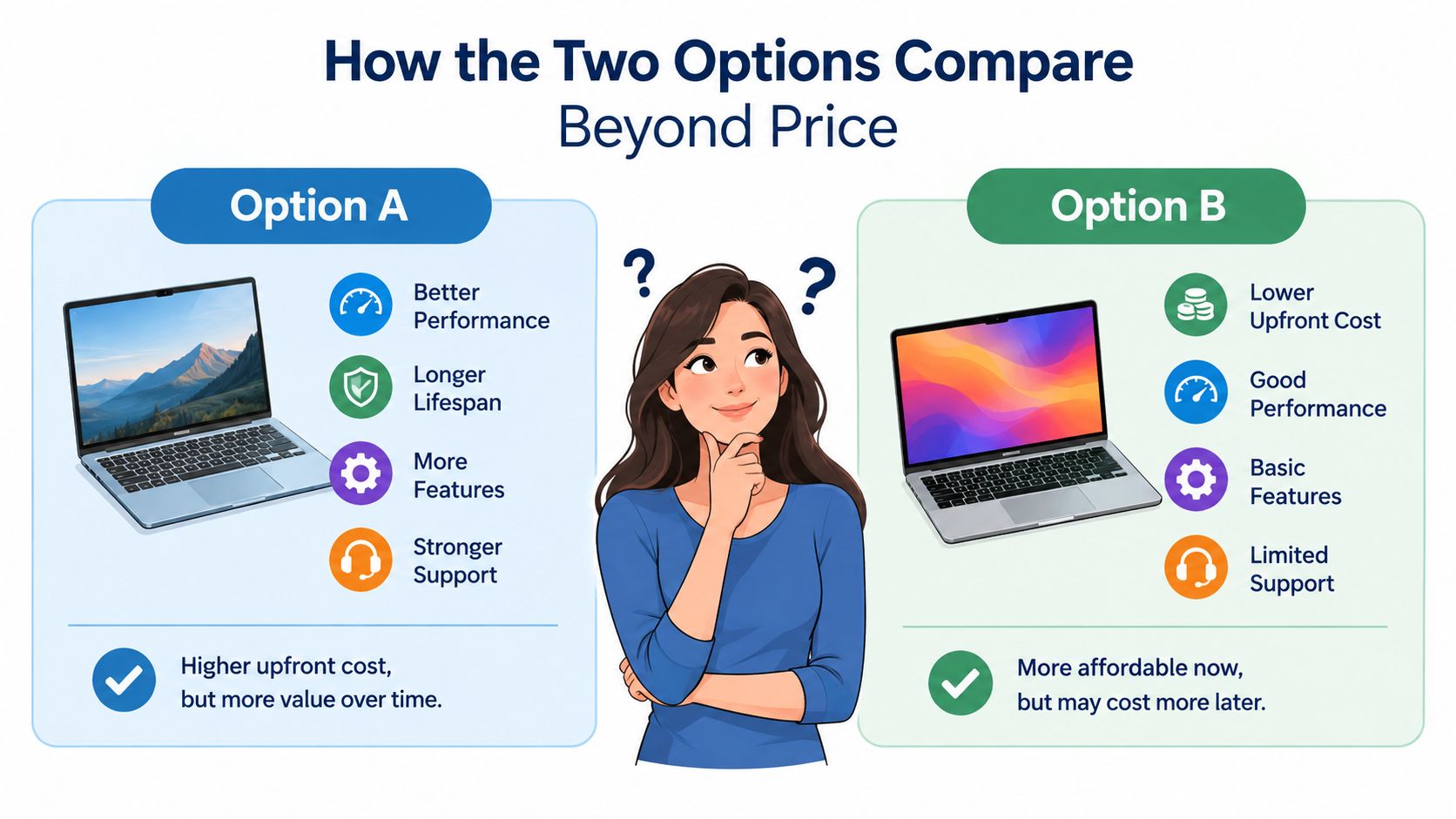
Clear aligners and metal braces change your daily routine in different ways. Clear aligners are removable trays, so you take them out for meals and oral hygiene. Metal braces use brackets and wires that stay attached, which means they continue working without relying on whether you remembered to put them back in.
Appearance often drives the first conversation. Clear aligners are less noticeable, while metal braces are visible and can include colored elastics. If you give presentations, play an instrument, participate in sports, or feel self-conscious at school, visibility may carry real value even if it doesn't reduce the treatment fee.
Removability comes with responsibility
Aligners can make eating and brushing more convenient because you remove them during those activities. That flexibility also creates a compliance obligation. Patients need to wear the trays according to the orthodontist's instructions, store them safely, and keep track of each set.
Metal braces don't depend on daily reinsertion. They do require careful cleaning around brackets and wires, and patients may need to avoid foods that could damage the appliance. A bracket or wire problem can create an extra visit, while a lost aligner can require replacement or a change to the sequence.
Ceramic or tooth-colored brackets are another low-visibility option, but they aren't the same as clear aligners. They remain fixed to the teeth and use wires, so the relevant comparison is between fixed brackets and removable trays, not just between “clear” and “metal.”
Match the appliance to your routine
Choose clear aligners only if their daily responsibilities fit your life. Choose metal braces when continuous attachment, durability, or stronger control matters more than removability or appearance. Neither option eliminates maintenance, and neither should be selected from a photograph or an advertised starting fee alone.
What Really Drives a Final Orthodontic Bill
A lower starting quote can become the higher total. The appliance is only one part of an orthodontic estimate. Diagnosis, tooth movement, appointment needs, refinements, repairs, and retainers determine what a family pays.
Patient research found that 66.3% of respondents identified high cost as the main reason people don't pursue orthodontic treatment, while 50.0% preferred monthly payments and 52.6% believed dental insurance should cover treatment (a survey on orthodontic cost barriers and payment preferences). Those concerns make the payment structure and included services as important as the appliance fee.
The quiet line items
A useful estimate explains the full treatment period, from the first records appointment through retention.
- Records and planning: Confirm whether photographs, digital scans, radiographs, and treatment planning are included.
- Active appliances: Ask whether the fee covers the planned aligners, brackets, wires, and related materials.
- Attachments and auxiliaries: Aligners may need tooth-colored attachments, elastics, or other components for specific movements.
- Refinements and extensions: Find out what happens if teeth do not track as planned or additional trays and visits are needed.
- Repairs and replacements: Clarify the policy for a lost aligner, damaged tray, broken bracket, or bent wire.
- Retention: Ask whether retainers are included, which type is planned, and whether follow-up retention checks are covered.
- Monitoring: Confirm how the practice handles care after active tooth movement ends.
Ask for exclusions in writing, not just inclusions.
A quote that lists every expected component may look higher than an advertised starting fee. It can still offer better value because it shows the likely financial exposure instead of leaving refinements, replacements, or retainers unclear.
Build a like-for-like comparison
Put both estimates side by side and ask the same questions. If one includes refinements and retainers while the other leaves them unspecified, the totals are not comparable. A plan that depends on consistent aligner wear also assigns different daily responsibilities than one using continuously attached braces.
Ask which costs are fixed, which can change, and what triggers an added charge. Dr. Finley can explain which items reflect your diagnosis and which are standard financial terms. Choose the estimate that makes the total treatment path understandable, not just the one with the lowest opening figure.
How Treatment Time and Visits Change the Equation
Treatment time affects more than the date when appliances come off. It can influence travel, missed work, school scheduling, childcare, and the number of times a family needs to arrange care in Santa Ana or another Orange County community.
A clinical outcomes study of mild adolescent malocclusions reported average treatment of 16.9 months with clear aligners versus 23.4 months with fixed appliances. The same study reported approximately 13.7 appointments versus 19.3 appointments, and 0.8 emergency visits versus 3.6, respectively. Read the clinical outcomes study comparing aligners and fixed appliances in mild adolescent cases.

Those findings can make clear aligners look attractive in a suitable, compliant case. Fewer office visits may reduce travel and scheduling pressure, and fewer emergency visits may reduce disruption. But the result came from a specific clinical group, so it shouldn't be used to promise that every aligner patient will finish sooner or need fewer appointments.
The calendar isn't the whole calculation
A patient who wears aligners inconsistently may need extra visits, replacement trays, or refinements. That can erase the practical advantage of removability. A patient with metal braces may have more routine adjustment visits but less responsibility for remembering to wear the appliance.
Cost also depends on how the practice structures its fee. Some offices bundle visits into a single all-inclusive fee, while others may define services and extensions differently. Ask how the quoted amount changes if treatment takes longer than initially projected.
Complexity changes the pattern
Extraction cases and major bite corrections may require a different balance of control and appointment planning. The clinical question is not, “Which treatment finishes sooner?” It's, “Which treatment can address the required movements predictably, with a schedule and maintenance burden the patient can manage?”
That answer requires an examination and treatment plan. A family traveling from Costa Mesa, Tustin, Irvine, or Garden Grove should compare the expected number and type of visits before deciding that a lower initial quote represents lower total cost.
Which Patients Tend to Get Better Value From Each Option
Clear aligners tend to offer better value when the clinical problem is suitable and the patient is reliable about daily wear. That often means a mild-to-moderate, non-extraction case where the patient wants a less noticeable and removable appliance and can follow the prescribed routine.
Metal braces tend to offer better value when the orthodontic objective requires sustained control or when compliance with a removable appliance is doubtful. A teenager who frequently loses belongings, an adult with an unpredictable schedule, or a patient who needs substantial bite correction may find a fixed appliance more practical despite its visibility.
Clear aligners may fit when
- The patient can wear the trays consistently.
- The goals involve appropriate tooth movements for aligner treatment.
- Removability helps with meals, brushing, work, or social situations.
- The patient understands that refinements may still be part of the plan.
- The case doesn't depend on movements for which fixed appliances offer stronger control.
Clear aligners aren't just a cosmetic version of metal braces. They use a different delivery method, and the patient's behavior becomes part of the treatment system.
Metal braces may fit when
- The case includes severe crowding or complex bite correction.
- Extractions or significant tooth movements are being considered.
- The patient needs continuous appliance wear.
- Durability and fixed control matter more than low visibility.
- The family wants to reduce dependence on remembering, storing, and replacing trays.
A systematic review of eight studies found both clear aligners and fixed appliances effective overall, but clear aligners were less effective for adequate occlusal contacts, torque control, transverse expansion, and retention. The review also found higher-quality outcomes with fixed appliances in extraction cases. Read the systematic review comparing clear aligners and fixed appliances.
The most economical appliance is the one that can complete the required movements without avoidable extensions, replacements, or retreatment.
That doesn't mean metal braces are always the better financial choice. It means value depends on suitability, cooperation, control, and the complete treatment plan. Dr. Finley should assess the bite and movement requirements before you decide based on appearance or a generic cost comparison.
What to Ask at Your Santa Ana Consultation
Bring your priorities to the consultation, not just your questions. Tell Dr. Andrew Finley whether appearance, removability, appointment convenience, durability, or predictable control matters most. Also explain who will manage the treatment, especially when a parent is evaluating options for a teenager.
Bristol Dental & Orthodontics is located on South Bristol Street and serves patients from Santa Ana and nearby Orange County communities. A consultation can compare Invisalign clear aligners and metal braces against the actual orthodontic goals instead of treating the national benchmarks as a personal quote.
Use this consultation checklist
- Ask what the diagnosis requires. Which teeth need to move, and is the concern mainly alignment, bite, spacing, crowding, or several issues together?
- Ask whether both options are clinically suitable. If one option isn't recommended, ask which movement or treatment objective creates the limitation.
- Request a written comparison. The estimate should identify records, appliances, attachments, refinements, visits, retainers, and post-treatment monitoring.
- Clarify the payment structure. Ask about the down payment, monthly schedule, financing duration, orthodontic benefits, and what happens if treatment needs an extension.
- Ask about lost or damaged appliances. This is especially important for aligner patients and families with active children.
- Discuss retention before treatment starts. Find out what retainers are planned and how follow-up care is handled after active treatment.
The national figures in this article help you recognize broad patterns, but they aren't a substitute for an examination. Your final decision should reflect your oral health, bite, movement requirements, schedule, and household budget.
If you're considering other dental needs at the same time, mention them during the visit. A family dental practice may also discuss cosmetic dentistry, dental implants, sleep apnea oral appliance therapy, emergency dentistry, and routine care when those concerns affect your overall treatment planning.
Clear Braces vs Metal Questions Patients Bring Us
Does insurance treat clear aligners and metal braces differently? Benefits depend on the individual plan and its orthodontic terms. Ask for a like-for-like explanation of the eligible benefit, exclusions, maximums, payment timing, and whether retainers or refinements are handled separately.
What should I expect to pay for retainers? Don't assume retention is included. Ask whether retainers are part of the initial estimate, what type is planned, how replacement is handled, and whether follow-up checks are included.
What if one quote is much lower than the other? Look for missing components before assuming you've found a bargain. A low figure may exclude records, refinements, additional visits, replacement appliances, retainers, or post-treatment monitoring.
What if my teenager won't wear aligners consistently? Take that concern seriously. A fixed appliance may provide better practical value when treatment depends on continuous wear and the patient is unlikely to follow a removable-appliance routine. Dr. Finley can discuss whether the clinical goals support either option.
Are clear aligners always faster? No. Treatment time depends on the diagnosis, required movements, cooperation, and the treatment plan. A shorter timeline should never be assumed from the appliance category alone.
The useful comparison isn't clear versus metal in the abstract. It's the total plan, the expected responsibilities, and the cost of completing care appropriately for your own bite.
Bristol Dental & Orthodontics offers Invisalign clear aligners, metal braces, and complete family and cosmetic dental care for Santa Ana and Orange County patients. Schedule a consultation with Dr. Andrew Finley through Bristol Dental and Orthodontics to compare your treatment options, included services, and payment structure before choosing an appliance.