
If you're dealing with both crooked teeth and a missing tooth, you're not asking a small question. You're trying to figure out how two different kinds of treatment fit together, and the order matters more than one might initially assume.
A common situation goes like this. Someone in Santa Ana has avoided smiling in photos because one front tooth is missing, but they're also bothered by crowding or a bite that feels off. They start looking into braces, or Invisalign, or implants, and then hit the same confusing fork in the road. Which comes first?
That question has a real strategy behind it. In many cases, the answer isn't just "braces first." It's understanding why teeth need to be positioned before a replacement tooth is locked into place. Once that makes sense, the rest of the planning starts to feel much less overwhelming.
At Bristol Dental & Orthodontics, Dr. Andrew Finley often helps patients think through this kind of combined treatment in a calm, practical way. The goal isn't to rush you into a decision. It's to help you understand what each treatment does, why sequencing matters, and where there may be exceptions based on your own smile.
Table of Contents
- Thinking About Dental Implants and Braces
- Understanding Your Two Main Tools
- The Golden Rule Why Orthodontics Usually Comes First
- Can You Get Braces With an Existing Dental Implant
- When an Implant Can Help Your Braces Work Better
- Planning Your Journey to a Healthier Smile
- Frequently Asked Questions
- Is there an ideal age for dental implants and braces together
- Will I have a gap in my smile during treatment
- If my implant is in the back, does it still matter for braces
- Can Invisalign work if I also need a dental implant
- Will the implant be placed on the same day braces come off
- What should I bring to a consultation
Thinking About Dental Implants and Braces
A lot of people start this process with one simple hope. They want their smile to look whole again. Then they learn that replacing a tooth and straightening teeth are connected, and that connection can affect the final result.

Take an everyday example. A patient may have lost a tooth years ago, and the nearby teeth slowly tipped into that space. At the same time, the front teeth may have shifted, creating crowding that wasn't there before. From the patient's point of view, it feels like one problem. From a treatment-planning point of view, it's usually two problems that have to be solved in the right order.
Why this topic is becoming more common
This isn't a rare combination anymore. National data show that implant prevalence among adults missing at least one tooth rose from 0.7% in 1999 to 2000 to 5.7% in 2015 to 2016, with a projected 17% by 2026 if the trend continued, according to national implant prevalence research published in the National Library of Medicine.
That matters because more adults are now considering tooth replacement at the same stage of life when they're also thinking about bite correction, crowding, or Invisalign.
Many patients assume they have to choose between improving alignment and replacing a missing tooth. In reality, the better question is how to coordinate both.
What patients usually want to know
Those inquiring about dental implants and braces are trying to answer a few practical questions:
- Which treatment should happen first: They don't want to make a decision that creates extra work later.
- Will I have to live with a gap: This is often the first emotional concern, especially when the missing tooth shows.
- Can I still use Invisalign: Many adults want a more discreet orthodontic option if it's appropriate for their case.
- What if I already have an implant: Patients worry they've missed their chance to straighten their teeth.
If you're in Santa Ana, Costa Mesa, Tustin, Irvine, or Garden Grove and this sounds familiar, you're not behind. You're just at the stage where careful planning matters most.
Understanding Your Two Main Tools
Patients often feel stuck here because braces and implants both involve teeth, but they solve different problems.
One tool changes position. The other replaces what is missing.
What a dental implant does
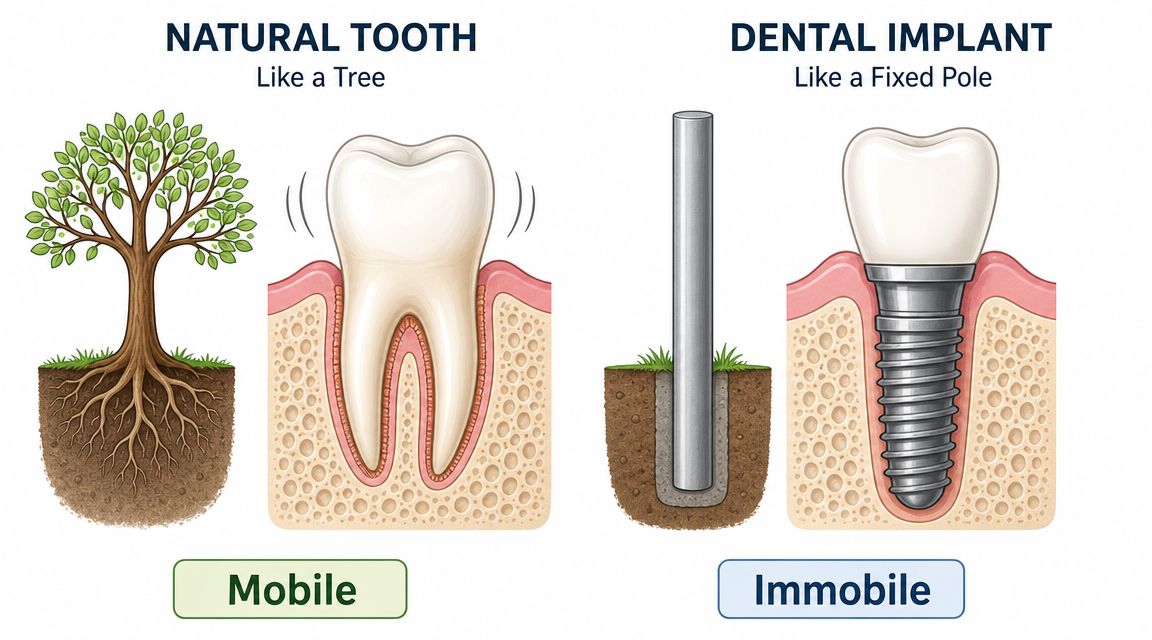
A dental implant replaces the root of a missing tooth. After it heals into the jawbone, it supports the tooth that shows above the gums. In practical terms, it works like a fixed anchor placed in a carefully chosen spot.
Its job is stability. It is not designed to shift with orthodontic pressure the way a natural tooth can.
That difference matters more than many patients expect. If Dr. Finley is planning both tooth movement and tooth replacement, the implant has to fit the final blueprint, not just the way the space looks on day one.
What braces and Invisalign do
Orthodontic treatment moves natural teeth into healthier positions over time. Traditional braces use brackets and wires. Invisalign uses a series of clear aligners that apply controlled force in stages.
Bone around natural teeth can remodel as those gentle forces are applied. That is why orthodontics can correct crowding, close or open spaces, improve the bite, and line teeth up so future dental work fits more naturally.
A natural tooth can be guided. An implant cannot.
A simple way to think about both
This distinction is key. Mixing them up makes treatment feel confusing.
| Treatment | Main purpose | What it changes |
|---|---|---|
| Dental implant | Replaces a missing tooth root | Restores support in a fixed position |
| Braces or Invisalign | Repositions natural teeth | Changes spacing, alignment, and bite |
Key distinction: Orthodontics changes where natural teeth are. An implant replaces what is not there.
That is the strategic idea behind sequencing. One tool arranges the room. The other fills the space once the room is arranged correctly.
The Golden Rule Why Orthodontics Usually Comes First
A patient will sometimes ask Dr. Finley a very reasonable question. “If I already know I need an implant, why not place it now and do braces afterward?”
The short answer is planning.
Natural teeth can be guided through bone during orthodontic treatment. An implant is fixed in place once it heals into the jaw. Because of that difference, the team usually wants the teeth and bite in their final positions before choosing the exact spot for the replacement tooth.
Why the sequence matters
The goal is not merely to fill a gap. The goal is to build a bite and smile that fit together well.
That is why orthodontics often comes first. Braces or Invisalign can straighten neighboring teeth, correct their tilt, and shape the space for the future implant crown. If the implant is placed too early, it locks one position in place before the rest of the plan is finished.
A common example is a missing tooth with nearby teeth that have drifted into the space. To a patient, the area may look close to ready. To a dentist, the roots may still be angled inward, the visible gap may be uneven, or the upper and lower teeth may not meet correctly yet. Orthodontic treatment fixes those underlying problems first, so the implant is placed for the final result rather than the temporary starting point.
What orthodontics is often preparing for
Before an implant goes in, the treatment team may need to create conditions such as:
- Enough room for the final crown: The space has to match the tooth being replaced, not just look open.
- Proper root position: Teeth next to the space need enough separation at the root level, not only at the biting edge.
- Better tooth angulation: Upright neighboring teeth usually frame the implant more naturally and make the restoration easier to design.
- A healthier bite relationship: The upper and lower teeth need to come together in a way that supports comfort, chewing, and long-term wear.
This is the strategic reason behind the usual sequence. Orthodontics sets the stage. The implant then fills the space that has been prepared with intention.
What can happen if an implant goes in too soon
Sometimes the problem is subtle. The final tooth may look slightly off-center, wider than ideal, or out of proportion with the teeth beside it.
Other times, the implant limits what orthodontics can accomplish later because it becomes a fixed stopping point inside a plan that still needs flexibility. That can force compromises in spacing, symmetry, or bite correction.
Practical rule: If the surrounding teeth still need to move, it usually makes sense to move them before placing the tooth replacement that will stay put.
There are exceptions, and a skilled team will look for them carefully. But in most cases, braces first gives Dr. Finley more control over the final blueprint, which usually leads to a result that looks better, functions better, and feels more natural to live with.
Can You Get Braces With an Existing Dental Implant
Yes, you often can. An existing implant doesn't automatically rule out braces or Invisalign.
The catch is that the plan has to work around the implant instead of expecting the implant to move with the rest of the teeth. That's where patients sometimes get frustrated. They assume orthodontics can shift everything into place evenly, but an implant behaves differently from a natural tooth.
How treatment changes when the implant is already there
If you already have a dental implant, your orthodontic plan may treat it as a fixed landmark. The natural teeth around it can still move, but the implant stays in one location.
That affects decisions such as:
- How much crowding can be corrected nearby: The team may need to accept some limits around the implant position.
- Whether a gap can be fully centered: Sometimes the final symmetry depends on where the implant already sits.
- How the bite is adjusted: Back implants can influence how upper and lower teeth fit together during treatment.
- Whether braces or Invisalign makes more sense: The answer depends on the type of movement needed and how much control is required.
What this means for expectations
This doesn't mean your outcome will be poor. It means your dentist and orthodontic planner have to be strategic.
In some cases, the existing implant is in a very workable spot and treatment can proceed smoothly. In other cases, the plan may involve compromise, such as prioritizing bite improvement and cosmetic balance rather than trying to force perfect textbook symmetry around a fixed point.
A patient with one implant in the back of the mouth may still have excellent orthodontic options because the visible smile isn't as constrained. A patient with an implant near the front may need more careful planning because tiny position differences show more easily there.
The right question isn't "Can braces work if I already have an implant?" It's "What result is realistic with the implant already fixed in place?"
If this is your situation, a consultation matters because X-rays, bite analysis, and the position of the implant all influence what's possible.
When an Implant Can Help Your Braces Work Better
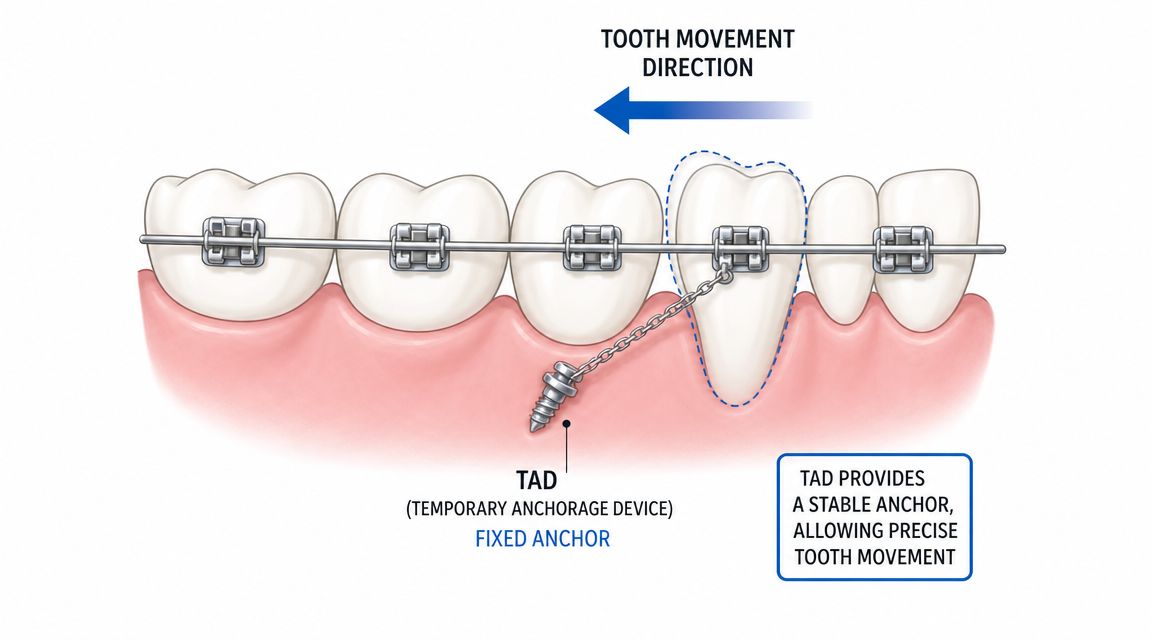
A fixed point can sometimes make tooth movement easier to control. That is the idea behind using an implant or a temporary anchorage device during orthodontic treatment.
What anchorage means in plain English
Braces work by pushing or pulling teeth in a planned direction. The challenge is that force needs a place to push from. If that support is not stable enough, the teeth you wanted to keep still may start to move too.
Anchorage works like bracing a ladder before you climb it. The steadier the base, the more precisely you can direct the movement.
Sometimes other teeth can provide that support. Sometimes they cannot, especially if several teeth are missing, tipped, or already under strain.
An existing implant and a TAD are not the same thing
This point causes confusion for many patients, so it helps to separate the two.
An existing dental implant is a permanent tooth replacement that has fused to the bone. Because it does not move with braces, it may occasionally serve as a stable point in a larger orthodontic plan.
A temporary anchorage device, or TAD, is different. It is a small temporary post placed specifically to help move teeth. It is not a replacement tooth. It is a treatment tool, and it is removed when that phase of movement is finished.
That distinction matters because a dentist usually does not place a full dental implant just to do the job a TAD can do more straightforwardly. The plan depends on the long-term restorative goal, the location of the missing tooth, and what kind of movement is needed.
How a stable anchor can improve treatment
Used in the right situation, a stable anchor gives the orthodontist more control. Instead of letting force spread across many teeth, the plan can focus that force where it will do the most good.
That can help with goals such as:
- Closing or reshaping a space: Control matters when a gap needs to be reduced without pulling other teeth off course.
- Uprighting a tooth that has tipped: Teeth often lean into an empty space over time. A stable anchor can help bring that tooth back to a healthier angle.
- Improving difficult movements with clear aligners or braces: Some movements need extra control, and anchorage can provide it.
This kind of advanced planning is part of deciding which tooth movements are realistic and how to stage them safely.
Some of the best orthodontic plans depend on controlling the teeth that should stay put, not just the teeth that need to move.
Why the sequence still matters
Using an implant as an anchor does not cancel out the usual sequencing principles. It reflects the reason sequencing matters in the first place. Every tooth movement affects the next step.
In some cases, an implant that is already present can help the braces phase. In other cases, a TAD is the cleaner option because it gives temporary support without committing to a permanent implant position too early. That is the strategic thinking behind combined orthodontic and restorative care.
At Bristol Dental and Orthodontics, those decisions depend on the bite, the condition of the surrounding teeth, and the final position needed for a healthy, functional result.
Planning Your Journey to a Healthier Smile
Once the strategy is clear, the process feels more manageable. Most patients do better when they think of this as a staged treatment journey instead of one single procedure.

Step one is diagnosis, not guessing
The first visit usually focuses on records, imaging, bite evaluation, and goals. If a patient says, "I want to replace this tooth," the team also has to ask whether the surrounding teeth are in the right place first.
At this stage, many people feel relief. They realize they don't have to solve the sequence alone.
A planning visit often looks at:
- Missing tooth location: Front tooth planning often differs from back tooth planning because esthetics and bite demands are different.
- Condition of nearby teeth: Drifting, tipping, and rotation can change how much orthodontic preparation is needed.
- Bite relationship: The way upper and lower teeth meet affects both orthodontic movement and implant restoration.
- Smile goals: Some patients mainly want function. Others care just as much about the visual balance of the final result.
Why technology matters
Modern implant planning relies heavily on imaging and guide-based precision. According to a review of CBCT-based computer-guided implant surgery, 3D imaging from CBCT scans combined with computer-guided surgery significantly improves the accuracy of implant placement, which matters for function, angulation, depth, and the final cosmetic result.
In plain terms, better planning helps the team see where bone, roots, and nearby structures are before placement. That matters even more when orthodontic treatment and final tooth position have to work together.
The timeline is usually layered
Patients often want to know how long this all takes. The honest answer is that combined treatment usually happens in phases, and those phases depend on healing, tooth movement, and the complexity of the case.
A simplified sequence often looks like this:
- Consultation and records
- Orthodontic treatment to create proper spacing and alignment
- Implant placement when the site is ready
- Healing and final restoration
Some patients also use a temporary cosmetic replacement during treatment so they aren't left feeling self-conscious about a visible gap.
Cost questions are real, but planning comes first
The overall cost can vary because you're combining different kinds of care, possibly over multiple visits and phases. Factors include the amount of orthodontic movement, the complexity of implant placement, and the type of final restoration.
What matters most early on is not the exact total. It's whether the plan is sequenced in a way that avoids redoing work later.
Frequently Asked Questions
Is there an ideal age for dental implants and braces together
There isn't one perfect age for everyone. The key issue is whether jaw growth is complete before a dental implant is placed. That's one reason implant timing in teens can be different from implant timing in adults. Orthodontic treatment, including braces or Invisalign, may still be useful earlier depending on the case.
Will I have a gap in my smile during treatment
Not always. In many cases, dentists can discuss temporary cosmetic options during the orthodontic phase. The right choice depends on where the missing tooth is, how teeth are moving, and what kind of final implant plan is being used.
If my implant is in the back, does it still matter for braces
Yes. Even when a back implant doesn't show in your smile, it can still affect bite planning. The position of a molar or premolar matters because your teeth need to meet properly when you chew.
Can Invisalign work if I also need a dental implant
Sometimes, yes. Invisalign can be a good option when the needed tooth movements are appropriate for aligner treatment. The important part is the planning, especially around space creation and final implant timing.
Will the implant be placed on the same day braces come off
Not always. Some patients move directly into the next phase, while others need a short period for stabilization, healing, or site preparation. The exact order depends on your bite, bone, and restorative goals.
What should I bring to a consultation
Bring your questions, your dental history, and any records from prior treatment if you have them. If you've had an implant placed elsewhere or were told you need one, that background can be very helpful when building a plan.
If you're trying to understand your options for dental implants and braces in Santa Ana or nearby Orange County communities, a personalized consultation can help you see what sequence makes sense for your smile. Dr. Finley reviews each case individually before treatment recommendations are finalized, and every article should also be reviewed by him before publishing.
If you'd like help sorting out whether braces, Invisalign, or implants should come first in your case, you can schedule a consultation with Bristol Dental and Orthodontics. A planning visit can help you understand your options, the likely sequence of treatment, and what questions to ask before moving forward.