

Most Invisalign cases take 12 to 18 months. Simpler cases can finish in about 6 months, while more complex cases may take 24 months or longer.
If you're thinking about straightening your teeth, that's probably the number you wanted first. The harder part is figuring out where you fit in that range. A small gap or mild shifting after past orthodontic work is very different from moving several teeth and correcting the way your bite comes together.
That uncertainty is normal. Many patients in Santa Ana and nearby communities like Costa Mesa, Tustin, Irvine, and Garden Grove want a straighter smile, but they also want to know what the process will ask of them week to week. Time matters. So does knowing what can speed things up, what can slow them down, and what your own role will be.
This guide explains Invisalign the same way I would during a consultation. Plain language. No promises. No pressure. Just a clear look at how treatment works, why timelines vary, and how Dr. Andrew Finley reviews each case to build a plan around your smile and your goals.
Table of Contents
- Your Guide to Invisalign Timelines in Santa Ana
- Key Factors That Influence Your Treatment Length
- A Typical Invisalign Treatment Timeline and Stages
- Tips to Help Your Invisalign Treatment Succeed
- How Invisalign Timelines Compare to Traditional Braces
- Is Invisalign Right for You? Find Out in Santa Ana
Your Guide to Invisalign Timelines in Santa Ana
If you've been searching how long does Invisalign take, you're probably trying to balance excitement with practical questions. You may be picturing family events, work meetings, school photos, or just wanting to know when you'll be done checking the mirror every morning. That's a reasonable place to start.
A practical benchmark is that most Invisalign cases finish in 12 to 18 months, with simpler cases around 6 months and more complex cases taking 24 months or longer, as explained in this overview of factors that affect Invisalign treatment time. That range tells patients something important. Invisalign usually isn't an overnight cosmetic shortcut. It's a planned orthodontic treatment that moves teeth gradually.
What that means in everyday terms
If your teeth need a small amount of movement, treatment may feel fairly straightforward. If your case includes crowding, spacing, or bite correction, the process naturally takes longer because the teeth need to move in a specific sequence.
What patients often need to hear: A realistic timeline is better than a rushed one. The goal isn't just to start seeing change. The goal is to finish with teeth in healthier, more stable positions.
At Bristol Dental & Orthodontics in Santa Ana, Dr. Andrew Finley reviews each case individually. That's the only reliable way to move beyond a broad average and give you a timeline that fits your mouth, your habits, and your treatment goals.
Key Factors That Influence Your Treatment Length
Some people hear a friend's timeline and assume theirs will be the same. That's rarely how orthodontic treatment works. Invisalign time depends first on what your teeth need, and second on how closely the plan is followed.

Why some cases move faster than others
The main driver is the amount and type of tooth movement. According to this explanation of how long Invisalign takes by case complexity, mild spacing or alignment cases are commonly completed in about 6 to 9 months, moderate crowding or bite issues often need 9 to 18 months, and complex bite correction can extend to 18 to 24+ months.
A simple way to think about it is this:
| Type of concern | Typical time range |
|---|---|
| Mild spacing or minor alignment | 6 to 9 months |
| Moderate crowding or bite issues | 9 to 18 months |
| Complex bite correction | 18 to 24+ months |
That doesn't mean you can diagnose your own case from a mirror. A tooth that looks slightly turned from the front may also be part of a bigger bite issue. That's one reason professional evaluation matters.
Your habits matter more than most people expect
Invisalign is collaborative. The trays do the work only when they're being worn as directed. Patients sometimes assume the technology alone determines the timeline, but your daily routine plays a major role.
A few common examples can change the pace:
- Minor relapse after past braces: Often simpler because the teeth may need limited correction.
- Crowding with bite imbalance: Usually takes longer because the teeth and bite need coordinated movement.
- Inconsistent tray wear: Even a strong treatment plan can drift off schedule if aligners aren't worn as instructed.
Teeth don't respond to good intentions. They respond to consistent wear.
Effective results stem from the partnership. Your dental team plans the sequence. You carry it out at home. When both parts work together, treatment tends to stay more predictable.
A Typical Invisalign Treatment Timeline and Stages
One reason people get confused about Invisalign timing is that they may hear two different answers online. One answer refers to when you receive your first aligners. The other refers to full treatment time. They are not the same thing.
A common source of confusion is that first aligners often arrive about 2 to 4 weeks after the scan, while the overall course can still run 6 to 18+ months depending on complexity and compliance, as described in this guide to what to expect month by month with Invisalign.
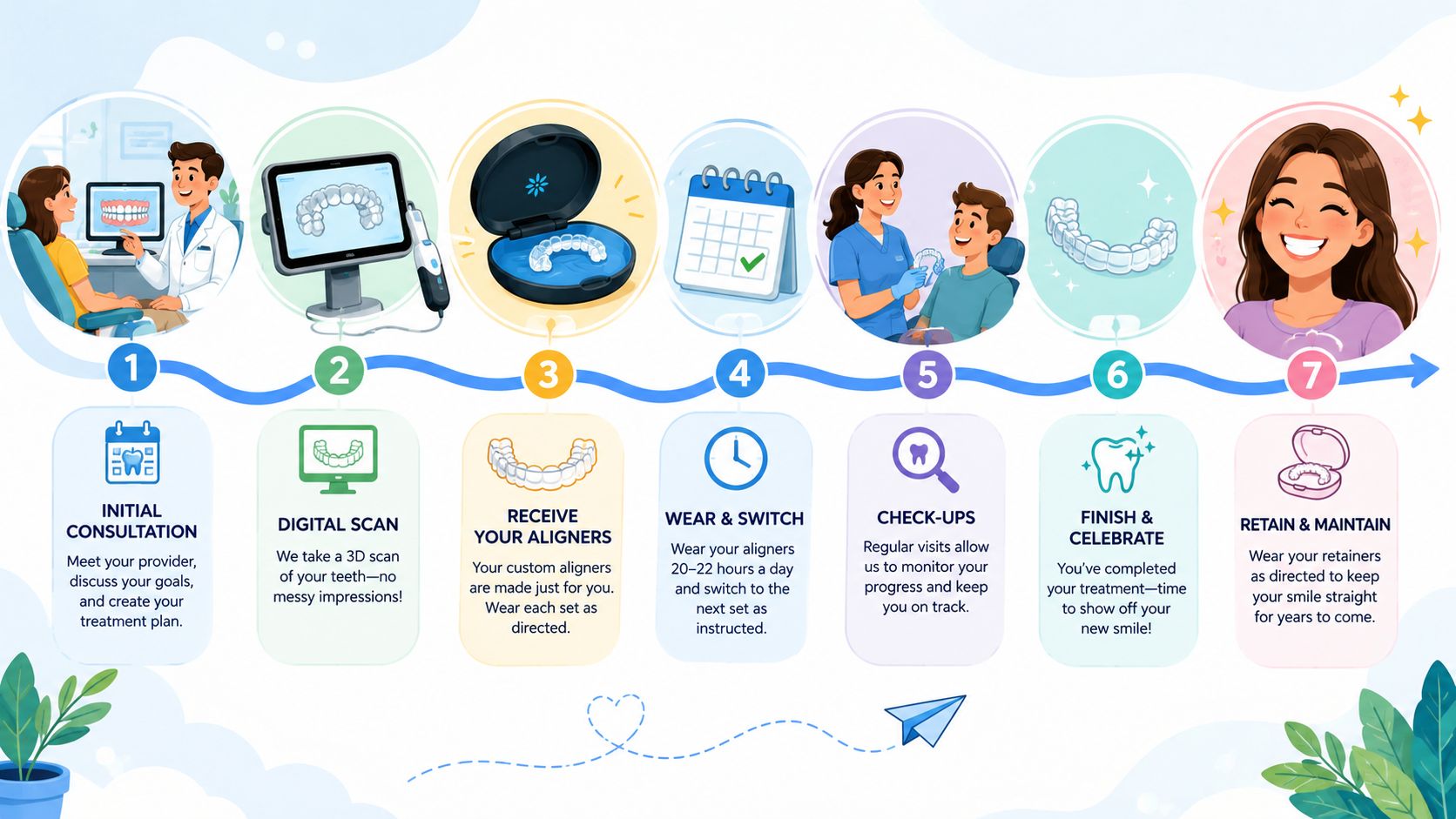
From consultation to your first trays
The process usually starts with an exam, photos, and a digital scan. That gives your dentist the information needed to map out how your teeth should move.
Then there is a short waiting period while your custom trays are prepared. During this time, some patients feel stalled because treatment hasn't visibly started yet, but this stage is part of treatment planning, not a delay in the usual sense.
Here is the general flow:
Consultation and evaluation
Your dentist checks whether Invisalign is a good match for your needs and reviews your goals.Digital scan and planning
The tooth movements are mapped in sequence.Tray delivery
You receive your first set and instructions for wear, cleaning, and follow-up.
The active phase and possible refinements
Many Invisalign protocols use aligner changes every 1 to 2 weeks, and the total length is driven by the number of trays plus any refinement phase, according to this overview of how clear aligner treatment time is determined. Patients often notice movement within a few weeks, but that early change is not the finish line.
During active treatment, your role becomes very practical:
- Wear the trays consistently: This helps the teeth follow the planned movement.
- Switch trays on schedule: Not too early and not too late.
- Attend follow-ups: Your dentist needs to confirm that your teeth are tracking properly.
Early movement is encouraging, but the real endpoint is completing the full sequence of planned movements.
Some patients also need a refinement phase. That's an additional set of aligners used to fine-tune certain tooth positions after the first series is complete. This doesn't mean treatment failed. It means the plan is being adjusted carefully to get a better final fit.
After active treatment, retainers matter. Teeth can shift if they aren't held in place. The straightening phase may be finished, but protecting the result is part of the journey too.
Tips to Help Your Invisalign Treatment Succeed
A good Invisalign timeline is built a little each day. Your dentist creates the map, but you help keep the trip on schedule through the choices you make at home.
That can feel like a lot of responsibility at first. The reassuring part is that success usually comes from simple habits, not anything complicated. Invisalign works a bit like following a recipe. If you keep using the trays the way they were prescribed, your teeth are more likely to keep moving in the planned sequence.
Simple habits that keep treatment moving
Consistency matters more than doing anything perfectly for a day or two. A steady routine gives your teeth time to respond to each aligner before the next one takes over.
- Wear your aligners as directed: If trays stay out too long, teeth may not be ready for the next set.
- Brush before putting them back in: This helps reduce trapped food and buildup inside the trays.
- Keep the trays clean: Clean aligners are easier to wear comfortably, which makes daily follow-through easier too.
- Store them safely during meals: A lost or cracked tray can interrupt progress and create avoidable delays.
- Attend your check-ins: These visits help your dental team spot small tracking problems early, while they are still easier to correct.
Many patients find it helpful to tie tray wear to the same parts of the day. After breakfast, the aligners go in. After lunch, they go back in. After dinner and brushing, they go back in again. That kind of routine removes guesswork.
When to call your dental team
If something feels off, contact your dental team sooner rather than later. A tray that cracks, will not seat properly, or suddenly feels very different should be checked instead of ignored.
This is part of the teamwork side of Invisalign. You are not expected to figure out every problem on your own. Your job is to notice changes and speak up early. Your dental team's job is to decide whether you should keep wearing the tray, move to the next one, or come in for an evaluation.
Good Invisalign patients are not flawless. They stay observant, stick to the plan, and ask for help before a small issue becomes extra treatment time.
If you're looking into Invisalign treatment in Santa Ana, Bristol Dental & Orthodontics can evaluate whether clear aligners fit your case and explain what your treatment schedule may involve. That conversation often turns a general online estimate into a plan built around your teeth, your habits, and your goals.
How Invisalign Timelines Compare to Traditional Braces
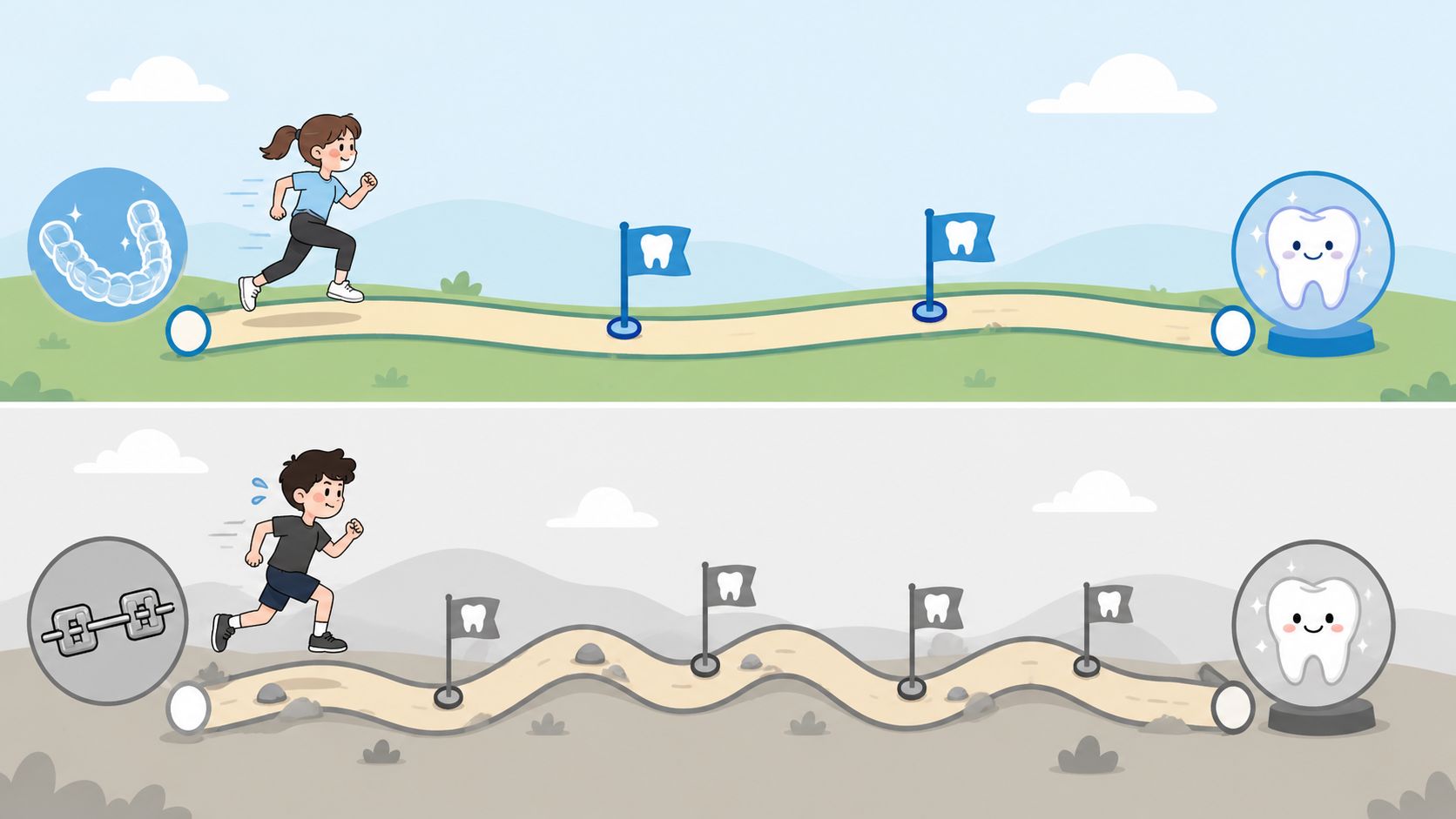
People often ask whether Invisalign is faster than braces. The honest answer is that sometimes it can be, but not always. The timeline depends more on the difficulty of the case and how well the treatment is followed than on which option sounds more modern.
When timelines can be similar
For many mild to moderate alignment concerns, Invisalign and braces may fall into a similar overall treatment window. In those cases, the decision often comes down to lifestyle and preference.
Some patients like that aligners are removable for meals and brushing. Others prefer braces because they don't have to remember to put trays back in. One option isn't universally better. The right choice depends on your priorities and the details of your smile.
A simple comparison looks like this:
| Question | Invisalign | Traditional braces |
|---|---|---|
| Visible appearance | More discreet | More noticeable |
| Removable | Yes | No |
| Depends heavily on patient follow-through | Yes | Less so |
| May be preferable for some complex movements | Sometimes | Sometimes |
When braces may still make sense
There are cases where fixed braces can be more efficient or more practical, especially when tooth movement is more challenging or when a patient may struggle with removable trays. That's not a criticism of Invisalign. It's just part of choosing the right tool for the job.
If you're deciding between the two, think about more than speed alone:
- Your daily routine: Will you reliably wear trays as directed?
- Your treatment goals: Are you correcting a small cosmetic issue or a more involved bite concern?
- Your comfort with maintenance: Are you likely to keep aligners clean, safe, and on schedule?
The shortest path isn't always the smartest one. The better question is which option gives you the best chance of finishing well.
Is Invisalign Right for You? Find Out in Santa Ana
At this point, the big takeaway is simple. How long does Invisalign take depends on your teeth, your bite, and how consistently you follow the plan. Online averages are helpful for setting expectations, but they can't tell you exactly what your case will require.

If you live in Santa Ana, Costa Mesa, Tustin, Irvine, or Garden Grove, the most useful next step is a consultation. Dr. Andrew Finley can examine your teeth, review your bite, and tell you whether Invisalign looks straightforward, moderate, or more involved. That visit is also where you can ask practical questions about daily wear, follow-up visits, and what your responsibilities would be during treatment.
A good consultation should leave you with clarity, not pressure. You should understand what treatment is trying to fix, what kind of commitment it involves, and what may affect the timeline.
Every treatment plan at Bristol Dental & Orthodontics should be reviewed by Dr. Finley before publishing guidance is turned into patient care recommendations. For your specific smile, an in-person evaluation is the safest way to get advice that fits you.
If you'd like a personalized Invisalign timeline, you can schedule a consultation with Bristol Dental and Orthodontics. The team serves Santa Ana and nearby Orange County communities, and Dr. Finley reviews each case to help patients understand their options in clear, practical terms.