
You've lost a tooth, and now every ordinary moment seems to bring it back to your attention. You notice the space when you smile in a family photo, avoid one side when you chew, or wonder whether a denture or bridge will feel like a compromise. For busy families in Santa Ana, Costa Mesa, Tustin, Irvine, and Garden Grove, the core question is not just whether a dental implant can replace the tooth. It's whether you're prepared for the planning, healing, and maintenance that help it serve you well.
Dental implants can be an excellent restorative option, but they aren't a one-visit purchase or a permanent exemption from dental care. Your bone, gums, bite, overall health, daily hygiene, and willingness to attend follow-up visits all matter. This guide explains the practical trade-offs I discuss with patients considering dental implants in Orange County.
Table of Contents
- Why Dental Implants Are the Preferred Solution for Missing Teeth in Orange County
- Understanding Dental Implants and Their Proven Success
- Comparing Dental Implants to Dentures and Bridges
- The Dental Implant Treatment Timeline From Consultation to Restoration
- Understanding Dental Implant Costs and Long-Term Value in Orange County
- Recovery, Aftercare, and Maintaining Your Dental Implants
- Why Patients Choose Bristol Dental and Orthodontics in Santa Ana
- Common Dental Implant Questions Answered by Dr Finley
Why Dental Implants Are the Preferred Solution for Missing Teeth in Orange County
A patient may come to my exam chair after months of postponing a decision. The missing tooth might be toward the back, so nobody else sees it, but chewing feels uneven. Or it may be visible, and the patient has started smiling with a closed mouth. They often ask whether an implant is excessive when a bridge or removable appliance could fill the space.
The answer depends on the individual case, but implants have an important structural advantage. An implant replaces the tooth root with a titanium post placed in the jaw, then supports a crown, bridge, or denture. That arrangement can provide a stable foundation without relying on neighboring teeth for support. It also gives us a way to address missing-tooth function rather than only covering the visible gap.
The treatment isn't new. Historical reviews trace early implant-like attempts to about 600 AD in Mayan culture, while a major modern milestone came in 1965, when Per-Ingvar Brånemark placed the first well-documented titanium dental implant in a human volunteer. Osseointegration, the process in which bone integrates with the implant surface, reached a broader professional audience at the 1982 Toronto World Conference. You can review that historical background in this archaeological and clinical review of dental implants.

That history matters because modern implant dentistry rests on decades of refinement in titanium biocompatibility, bone integration, surgical planning, and prosthetic design. The global dental implants market was valued at USD 5.00 billion in 2025 and is projected to reach USD 8.98 billion by 2034, with a projected 6.8% CAGR, according to the market context summarized in the same historical reference. Those figures don't determine whether an implant is right for you, but they do reflect a mature restorative field rather than a passing trend.
At Bristol Dental & Orthodontics, Dr. Andrew Finley evaluates the whole situation, not just the empty space. The right decision may be an implant, but it may also be a bridge, denture, orthodontic treatment, or a staged plan that first stabilizes your gums and bite.
Understanding Dental Implants and Their Proven Success
A dental implant has three functional parts. The implant post sits in the jaw and acts as an artificial root. The abutment connects the post to the visible restoration, and the crown replaces the portion of the tooth you see and use. For several missing teeth, implants may support a bridge or removable restoration instead of one crown per tooth.
The central biologic step is osseointegration. After placement, the surrounding bone needs time and stability to bond with the implant surface. Titanium has been used extensively because the body can tolerate it and bone can integrate with its surface under appropriate conditions. That doesn't mean every implant integrates, or that material alone determines the result.
What the outcome depends on
Primary stability is the technical starting point. Bone quality and quantity, implant geometry, and surgical technique affect how firmly the implant sits at placement. Dense cortical bone and suitable implant design may support stronger insertion stability, while softer bone or compromised anatomy may call for staged loading, site development, or grafting. This relationship between stability and bone integration is described in a clinical review of implant stability and osseointegration.
A systematic review found that five-year implant survival improved from 93.5% in older cohorts to 97.1% in newer cohorts, while peri-implantitis biologic complications improved more modestly, from 3.3% to 2.5%. The distinction is important. An implant can remain present while the tissues around it develop inflammation, so “the implant is still there” isn't the same as “the implant is healthy.” The evidence is discussed in this systematic review of implant survival and peri-implant complications.
Success includes maintenance
Clinicians commonly assess success by looking for implant immobility, no peri-implant radiolucency on X-rays, healthy surrounding tissue, and no infection. Long-term success also includes stable bone levels, healthy soft tissue, a functional restoration, and patient satisfaction, as described in this review of dental implant success criteria.
The factors you control matter. Inadequate plaque control, irregular supportive care, smoking, a history of periodontitis, poorly designed prostheses, and residual cement can increase the risk of peri-implant inflammation. Good surgery starts the process. Good daily care and professional maintenance help protect it.
Comparing Dental Implants to Dentures and Bridges
Patients often compare treatments as though one option is universally superior. In reality, each restoration solves a different problem, and the best choice depends on your anatomy, health, preferences, timeline, and tolerance for maintenance.
| Criteria | Dental Implants | Dentures | Bridges |
|---|---|---|---|
| Support | Anchored in the jaw or used to support another restoration | Rests on the gums and may use remaining teeth for retention | Uses neighboring teeth as supports |
| Bone considerations | Requires adequate bone or a plan to manage bone deficiency | Doesn't replace the tooth root | Doesn't replace the tooth root |
| Daily care | Brushing, cleaning around the restoration, and professional maintenance | Removal, cleaning, and monitoring of fit | Brushing and cleaning beneath the replacement tooth |
| Comfort and function | Often feels stable when properly planned and maintained | May move or feel bulky for some patients | Can feel natural, depending on the supporting teeth and design |
| Treatment demands | Surgical placement and a healing period | Usually avoids implant surgery | Usually avoids implant surgery but requires preparation of supporting teeth |
| Long-term trade-off | More involved process, with ongoing biological and prosthetic maintenance | May require adjustment or replacement as the mouth changes | Places load on neighboring teeth and may need future repair or replacement |
An implant may appeal to someone who wants a fixed restoration without reducing healthy neighboring teeth for a conventional bridge. A bridge may make more sense when adjacent teeth already need crowns. A denture may offer a non-surgical solution, particularly when several teeth are missing or when a patient wants to avoid implant surgery.
The question behind the comparison
Don't compare only the initial appointment. Consider how each option affects chewing, cleaning, future repairs, and the condition of the surrounding teeth and bone. Implants can preserve a root-like form in the jaw, but they still need careful hygiene and follow-up. Dentures and bridges can work well, but each has its own adjustment and maintenance demands.
A practical rule: Choose the restoration you can care for consistently, not simply the one that sounds most permanent.
For a patient with healthy neighboring teeth and suitable bone, an implant may offer an appealing independent replacement. For another patient, a bridge or denture may be more sensible. Dr. Finley can compare those paths after examining your teeth, gums, bite, and imaging.
The Dental Implant Treatment Timeline From Consultation to Restoration
Implant treatment is a sequence, not a single procedure. The schedule varies with the condition of the tooth site, the number of teeth involved, bone volume, gum health, and the type of final restoration.
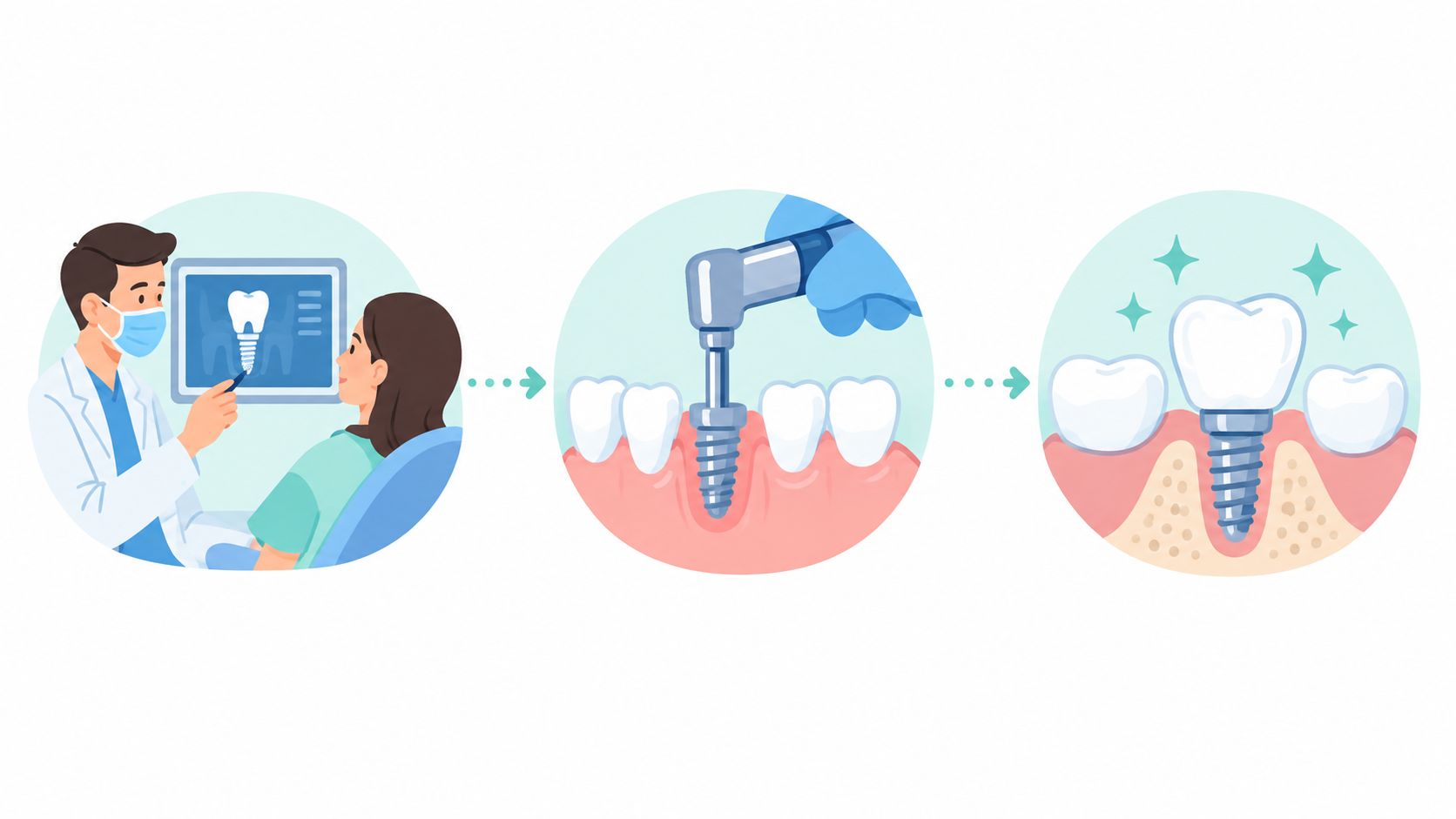
1. Consultation and examination
At the first visit, we discuss your concerns and goals, review your medical and dental history, examine your gums and bite, and evaluate the missing-tooth area. Digital imaging can help us study the available bone and plan the position of the implant in relation to nearby structures.
This appointment is also where candidacy becomes more nuanced. A history of gum disease, smoking, uncontrolled plaque, or inadequate bone doesn't automatically end the conversation, but it may change the order of treatment. We may need to stabilize the tissues, remove a failing tooth, or plan site development before placement.
2. Treatment planning and preparation
The plan should identify what happens before, during, and after implant placement. Some patients can proceed directly. Others need an extraction, periodontal care, bone grafting, or sinus augmentation. Bone loss is not always a simple yes-or-no barrier. It can require additional treatment, more healing, or a different implant position.
3. Implant placement and healing
During placement, the clinician prepares the site while limiting heat and works to achieve primary stability. Published clinical guidance describes keeping the implant isolated from the oral environment for 3 to 6 months during submerged healing in appropriate cases. You can read more about this approach in the clinical guidance on primary stability and undisturbed healing.
After surgery, you may have temporary changes to your diet and activity, along with swelling or soreness that your care team will explain. Follow the instructions you receive rather than judging healing by how the area feels on a particular day.
4. Abutment and final restoration
Once healing and integration are satisfactory, the abutment and custom crown, bridge, or denture can be completed. The restoration must fit your bite and remain cleanable. A beautiful crown that traps plaque or receives excessive force isn't a finished success, so the design and maintenance plan matter as much as the appearance.
Understanding Dental Implant Costs and Long-Term Value in Orange County
The cost of dental implants can't be responsibly reduced to one advertised figure. Your treatment may involve one tooth or a full arch, straightforward placement or reconstruction, and a crown, bridge, or denture supported by implants. The number of implants, preparatory procedures, imaging, restoration materials, and laboratory work all affect the treatment plan.
I recommend asking for an itemized explanation before treatment begins. You should know whether the proposed plan includes the surgical phase, abutment, final restoration, imaging, temporary teeth, follow-up visits, and any bone or gum procedures that may be needed. Comparing plans with different scopes can make one appear cheaper when it includes less.
Looking beyond the first bill
An implant is a meaningful investment of money, time, and attention. Its value should be judged against function, comfort, appearance, preservation of the treatment site, and the possibility of future repairs. A less expensive option may be appropriate, but it may also involve different cleaning requirements, adjustments, or replacement needs.
Financing may help some Orange County families spread treatment-related payments over time, subject to the terms of the arrangement and individual qualification. Ask the practice to explain available payment choices in writing. Don't let a monthly figure replace a clear understanding of the total treatment and ongoing care.
The maintenance burden belongs in the decision from the beginning. A 2025 narrative review emphasizes that maintenance costs, time, and effort remain meaningful parts of long-term implant care, and it discusses a randomized clinical trial evaluating maintenance over 10 years. The review is available in this patient-centered discussion of implant maintenance and long-term care.
The most useful question isn't “What does the implant cost?” It's “What care will this restoration require, and can I realistically keep up with it?”
Recovery, Aftercare, and Maintaining Your Dental Implants
Recovery usually involves a period of tenderness, swelling, and dietary adjustment, although the experience varies. Your instructions may include eating softer foods, keeping pressure away from the surgical site, taking prescribed or recommended medication as directed, and limiting activities for the period your clinician specifies.
Don't use discomfort alone to decide whether healing is progressing normally. Keep scheduled follow-up visits so the team can examine the tissues, check the implant site, and respond to concerns before they become larger problems.
The routine that protects the result
Daily cleaning around an implant requires the same seriousness as cleaning natural teeth. Brush carefully, clean the spaces your dentist shows you, and ask whether your restoration needs a particular brush, threader, water device, or other aid. The correct method depends on the shape of your implant crown or bridge and the condition of your gums.
Professional maintenance is not an optional add-on. Plaque control, supportive care, smoking status, previous periodontal disease, prosthesis design, and residual cement all influence the tissues around an implant. That evidence makes one point clear: placement is only the beginning.
Long-term care starts before surgery. If gum inflammation is active or home care is inconsistent, address those issues before expecting a new restoration to remain trouble-free.
Smoking can interfere with oral health and healing, while a history of periodontitis means the supporting tissues deserve close attention. These factors don't create an automatic verdict, but they should be discussed with Dr. Finley. At Bristol Dental & Orthodontics, the goal is to coordinate diagnosis, restoration, comfort measures, and follow-up so you understand both the procedure and your responsibilities afterward.
Why Patients Choose Bristol Dental and Orthodontics in Santa Ana
A patient may arrive expecting to hear that bone loss ends the conversation about implants. In practice, candidacy depends on the location and extent of the loss, sinus or nerve anatomy, gum health, planned restoration, and surgical approach. The right answer comes from examination and imaging, not from bone loss alone.
A 2025 scientific summary reported that maxillary sinus floor augmentation using biomaterials plus autogenous bone chips produced greater dimensional stability than autogenous bone alone. Read the 2025 sinus augmentation study A separate 2025 review found that fully guided implant placement systems can produce comparable, predictable outcomes across systems, while noting that evidence quality remains limited. Read the 2025 guided placement review These findings support careful case selection rather than a guaranteed yes or no.
What a thorough local evaluation includes
At a Santa Ana practice, the consultation should address:
- Anatomy: Digital imaging and examination show available bone and the position of nearby structures.
- Disease control: Active gum problems require treatment before, or alongside, implant planning.
- Restoration design: The final crown, bridge, or denture must fit the bite, look appropriate, and remain cleanable.
- Comfort: Anxiety, medical history, and the expected procedure guide discussions about sedation.
- Continuity: A family practice can also address general dentistry, Invisalign, cosmetic dentistry, sleep apnea and oral appliance therapy, and emergency dental care.
Bristol Dental & Orthodontics, led by Dr. Andrew Finley, provides implant consultations and dental care on South Bristol Street for patients in Santa Ana and nearby Orange County communities, including Costa Mesa, Tustin, Irvine, and Garden Grove. One dental home may make coordination easier for busy families, but the implant plan still needs to reflect each patient's anatomy, health, schedule, and ability to maintain the restoration.
Advanced imaging and guided techniques can organize treatment. They do not remove the patient's responsibilities. Biology, restoration fit, daily cleaning, and ongoing professional review still determine whether an implant remains healthy over time.
Common Dental Implant Questions Answered by Dr Finley
Are implants painful?
Placement is performed with local anesthesia, and sedation may be discussed when anxiety or the nature of the procedure makes it appropriate. Soreness and swelling can occur afterward. Your instructions should explain medication, food, activity, and warning signs.
How long does treatment take?
The answer depends on whether you need extraction, grafting, gum treatment, or staged placement. Integration itself may require a healing period, and published guidance describes 3 to 6 months of submerged healing in suitable cases, as discussed earlier. Dr. Finley can outline your likely sequence after examination and imaging.
Does bone loss rule me out?
Not automatically. Bone quantity and quality influence primary stability, but reconstruction, sinus augmentation, guided placement, or an alternative restoration may change the options. A 2025 scientific summary describes refined sinus augmentation approaches, while a 2025 review notes promising guided-placement findings but limited evidence quality. Those developments make an individualized assessment essential.
What happens if an implant doesn't fuse?
If bone doesn't fuse adequately, the implant may need removal. The site can often be retreated after about three months, according to this Mayo Clinic overview of dental implant surgery. That possibility is one reason I discuss risks, healing, and maintenance before treatment rather than presenting implants as guaranteed.
Schedule a consultation with Dr. Finley to review your missing tooth, gum health, bone, bite, and restoration choices. Bring your questions, including how much maintenance you can realistically manage, because candidacy includes both clinical conditions and your willingness to protect the result.
Bristol Dental & Orthodontics offers dental implant consultations, digital treatment planning, restorative care, and ongoing maintenance for patients in Santa Ana and throughout Orange County. Visit Bristol Dental and Orthodontics to schedule a consultation with Dr. Finley and discuss a realistic plan for replacing your missing tooth.