
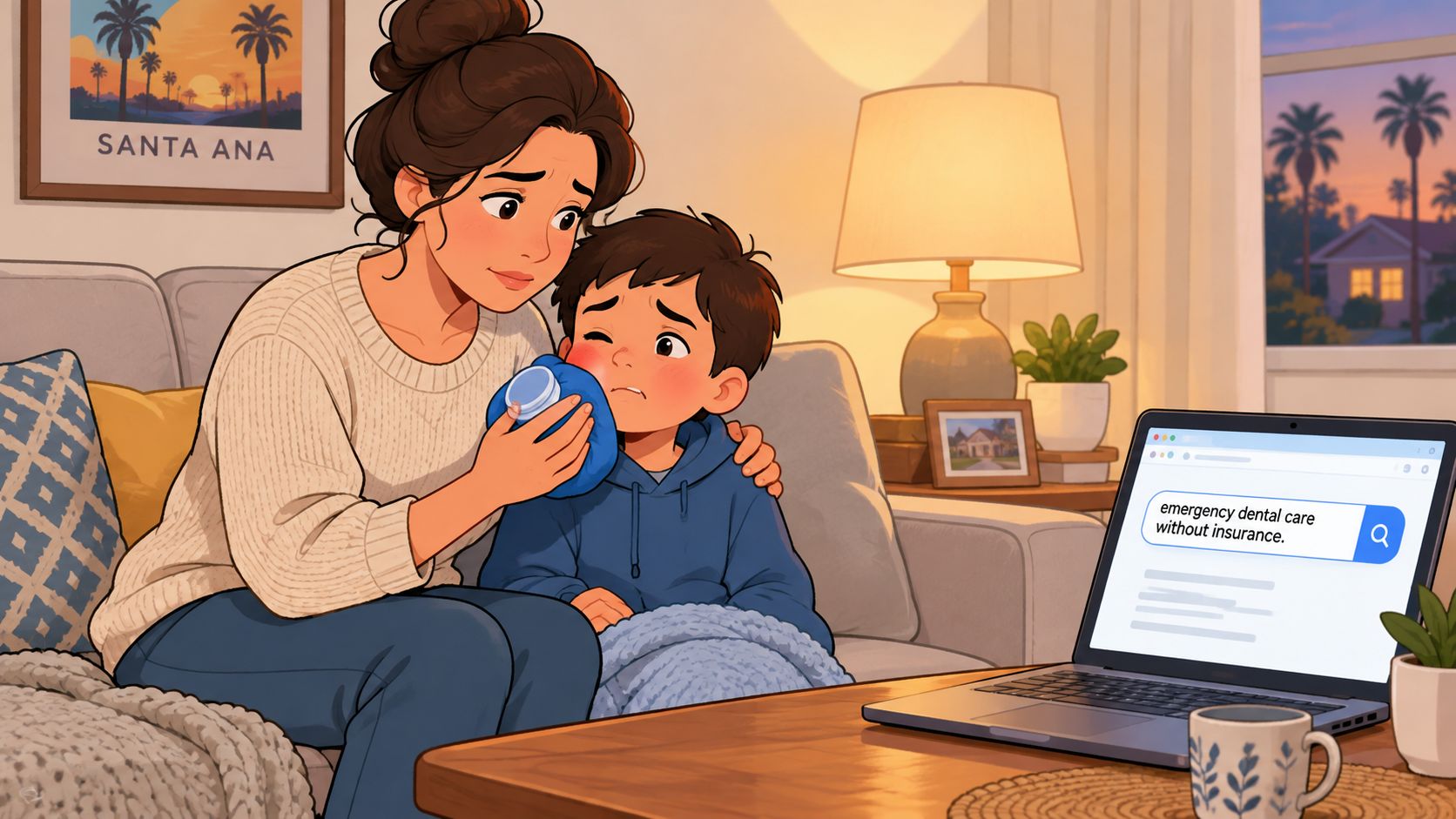
Sunday evening in Santa Ana, your child says a tooth hurts, then you notice a swollen cheek. Or you bite down on dinner, feel a crack, and suddenly you're searching for emergency dental care without insurance while holding an ice pack and trying not to panic. That moment feels chaotic because three different problems get mixed together fast. Is this a medical emergency? Is it an urgent dental problem? And if you don't have straightforward coverage, how do you get help without walking into a bigger bill than you expected?
Most articles blur those questions. That's a mistake. A dangerous swelling needs one answer. A broken filling needs another. A patient with no coverage, a patient with Medi-Cal, and a patient whose plan is useless locally also need different next steps.
This guide takes the calmer route. Think of it as a front-desk conversation in plain English. First, what to do at home in the next few minutes. Next, when to choose a hospital over a dental office. Then, how to think about affordable care in Santa Ana and nearby Orange County communities like Costa Mesa, Tustin, Irvine, and Garden Grove. Finally, how to lower the odds that tonight's problem turns into another midnight emergency later.
Table of Contents
- When a Tooth Problem Cannot Wait Until Morning
- First-Aid Moves Before You Reach the Phone
- Hospital Emergency Room or Dental Office
- Uninsured, Medi-Cal, or Underinsured in Orange County
- Affordable Emergency Dental Options Near Santa Ana
- What a Transparent Self-Pay Visit Should Look Like
- Preventing the Next Midnight Emergency
When a Tooth Problem Cannot Wait Until Morning
A lot of dental emergencies start in ordinary moments. A parent in Santa Ana is cleaning up after dinner, a teenager says a tooth “feels weird,” and an hour later there's swelling. Someone else is getting ready for bed and notices a crown came off. Another person wakes up from a throbbing toothache and starts wondering whether a hospital is the only option because there's no insurance card to reach for.
What matters first is not guessing the treatment. It's sorting the situation correctly. Some problems are dangerous because they can affect breathing, swallowing, or spread quickly. Some are urgent but belong in a dental chair, not a medical ER. Some feel dramatic but can be stabilized at home for a few hours while you line up a prompt visit.
Practical rule: Don't start by asking, “What's the cheapest place?” Start by asking, “Is this dangerous, urgent, or painful but stable?”
That one shift saves people from two expensive mistakes. The first is waiting too long when swelling or bleeding is becoming risky. The second is rushing to a hospital for a problem the hospital will likely only stabilize temporarily.
You also need a money plan that fits your situation. Uninsured, Medi-Cal, and underinsured are not the same thing. One patient may need a self-pay exam and itemized estimate. Another may need to check emergency Medi-Cal dental rules. Another may have coverage on paper but no nearby office that will see them quickly.
By the end of this guide, you should have a simple map in your head. Handle first aid safely. Decide between ER and dentist. Ask better payment and access questions. Then deal with the cause, not just the pain.
First-Aid Moves Before You Reach the Phone
When people call in a panic, they usually describe the same handful of problems. A tooth got knocked out. Something cracked. A filling fell out. There's pain, bleeding, or sudden swelling. The next 30 minutes matter, not because home care fixes the problem, but because good first aid can limit damage while you arrange treatment.
Knocked-out tooth
If a permanent tooth gets knocked out, handle it by the crown, not the root. If it's dirty, rinse it gently. Don't scrub it. If possible, place it back in the socket carefully. If that's not possible, keep it protected and call a dental office immediately.
Don't wrap it in tissue and let it dry out. Don't scrape the root.
Next action: Call for an emergency dental appointment right away and describe exactly when the tooth came out.
Cracked or broken tooth
Rinse gently and use a cold compress on the outside of the face if there's swelling. Save any broken pieces if you can. If the tooth has a sharp edge, avoid chewing on that side.
Don't test the tooth by biting on it over and over. Don't ignore it because the pain comes and goes.
Next action: Ask for a same-day or next-day exam, especially if the tooth is painful, loose, or sensitive.
Lost crown or filling
A missing filling or crown may not look dramatic, but it can expose sensitive tooth structure and make the problem worse fast. Keep the area clean and avoid sticky or hard foods.
Don't try household glue. Don't keep chewing normally because “it's probably fine.”
Next action: Ask for the earliest available dental visit and tell the office whether the tooth is painful, sharp, or recently treated.
Severe toothache
For short-term pain relief, Merck Manual's overview of dental emergencies lists acetaminophen 650 to 1,000 mg every 6 hours and ibuprofen 400 to 800 mg every 6 hours as examples of oral analgesic regimens, with combination or alternating use sometimes providing stronger short-term relief. That does not mean every patient should take them automatically. Common self-treatment errors can cause avoidable harm, especially if you have liver disease, kidney disease, ulcer or bleeding risk, anticoagulant use, pregnancy, allergy concerns, age-related dosing issues, or duplicate over-the-counter products in play.
Put differently, pain medicine can help, but only when it matches your health history and what else you've already taken.
Don't place aspirin directly on the gum. That can injure the tissue. Don't assume pain easing up means the problem is gone.
Next action: Call for an exam and mention whether the pain is constant, triggered by temperature, keeping you awake, or accompanied by swelling.
Soft-tissue bleeding and sudden swelling
Bite on clean gauze for bleeding. Use steady pressure. For swelling, a cold compress on the face may help while you arrange care.
Here's the line you should not cross at home. Go to medical emergency care, not routine dental scheduling, if you have:
- Trouble breathing or swallowing
- Rapidly increasing swelling in the face, neck, or around the eye
- Uncontrolled bleeding
- Fever or malaise
- Severe trismus, meaning you can't open properly
Next action: If any of those signs are present, seek emergency medical care immediately. If the swelling or pain is localized without those danger signs, call a dental office for prompt treatment.
Hospital Emergency Room or Dental Office
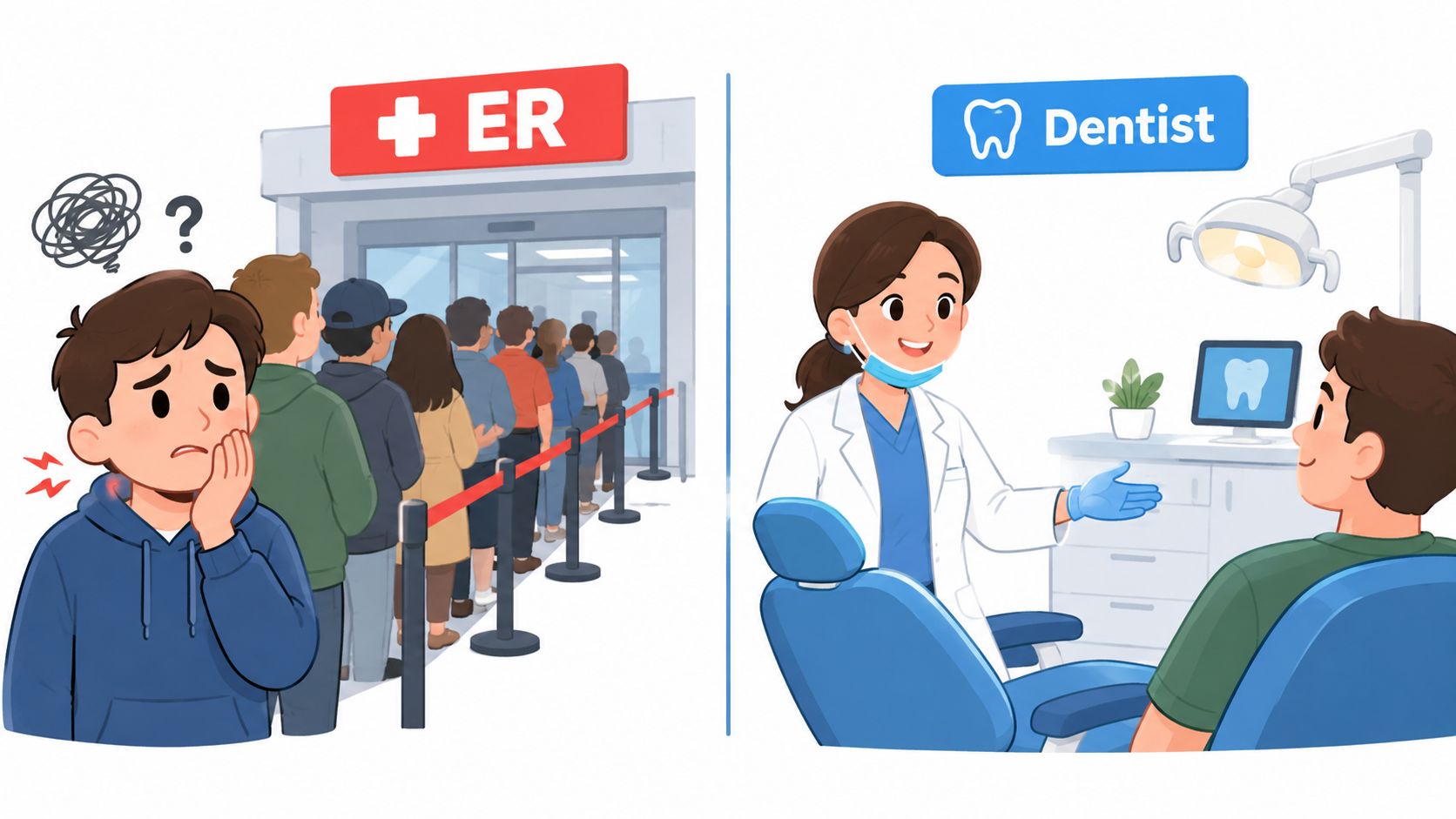
People go to the ER for tooth problems every day. That doesn't mean it's usually the right first stop. According to the CDC's national data on emergency department visits for tooth disorders, U.S. emergency departments recorded an annual average of 1,944,000 visits for tooth disorders during 2020 to 2022, equal to 59.4 visits per 10,000 people and about 1.4% of all ED visits. 12.2% of those visits were categorized as uninsured. If you're weighing this choice tonight, you are absolutely not alone.
What the ER is good at
A hospital emergency room can be the right place when a dental problem turns into a broader medical risk. That includes airway concerns, spreading infection, major bleeding, or serious facial injury. In that setting, the ER may help stabilize the situation, control pain, manage infection risk, and protect you from dangerous complications.
That matters. If you're having trouble breathing or swallowing, you should not sit around comparing routine dental pricing.
What the ER usually won't do
Many people get blindsided when they need emergency dental care without insurance. The ER generally does not function like a dental office for definitive care. It often won't provide the treatment that removes the source of the problem, such as a restoration, root canal, extraction, or permanent crown. It may get you through the night, then send you back out needing the dental treatment anyway.
Going to the ER for an uncomplicated toothache can turn one problem into two. You still have the tooth problem, and now you also have a hospital bill.
That's why a routine toothache, a chipped tooth, a lost filling, or a slowly developing localized swelling usually belongs in a dental office first.
The simplest home triage rule
Use this rule when you're stressed and short on time:
- Go to the ER: trouble breathing, trouble swallowing, rapidly spreading facial or neck swelling, uncontrolled bleeding, or other symptoms that feel medically unsafe
- Call a dentist: localized tooth pain, a broken tooth, a lost crown or filling, a knocked-out tooth, or swelling that is limited and not causing breathing or swallowing problems
If you're in Santa Ana, Costa Mesa, Tustin, Irvine, or Garden Grove, that rule is often the difference between getting temporary stabilization and getting treatment that addresses the tooth.
Uninsured, Medi-Cal, or Underinsured in Orange County
The worst advice in this space is treating everyone without easy dental access like they're in the same category. They're not. Some patients have no coverage. Some have Medi-Cal and don't realize emergency dental care may still be relevant. Others are underinsured, which means the plan exists but doesn't solve the core problem, no local provider access, limited benefits, work conflicts, transportation issues, or childcare barriers.
California gives people a more practical starting point than most guides do. The California Department of Health Care Services Medi-Cal dental emergency FAQ says covered emergency dental services are treatment needed immediately to stop severe pain or diagnose and treat a sudden serious medical problem that could cause serious harm if untreated. The state's examples include persistent bleeding, painful swelling, toothache or jaw pain, facial or jawbone injury, painful infection, and a broken or knocked-out tooth. A Medi-Cal patient with a dental emergency may go to any Medi-Cal dentist and can call 1-800-322-6384 to locate one.
Which pathway fits your situation
| Your situation | Best first call | What to ask |
|---|---|---|
| Fully uninsured | A dental office or reduced-fee clinic that sees emergency self-pay patients | Do you see emergency patients without coverage, can I get an exam first, will you give me an itemized estimate, and is same-day treatment possible if needed? |
| Medi-Cal patient | A Medi-Cal dentist, or the Medi-Cal Dental locator line | Is this likely considered an emergency dental visit, what documents should I bring, and can I be seen promptly for pain, swelling, bleeding, or trauma? |
| Underinsured or unusable plan | A local dental office that can explain self-pay options if your plan doesn't work locally | If my plan isn't accepted or doesn't help much, what are the self-pay steps, what's billed separately, and can treatment be phased if needed? |
The barriers people forget to mention
Orange County families often run into obstacles that have nothing to do with motivation. Getting time off work is hard. Transportation falls through. A parent can't leave another child at home. Language support may matter. A plan that looks acceptable online may be almost useless when you need a same-day appointment.
That's why the first question shouldn't be “Where is the cheapest place?” It should be “Which door is realistic for me today?” If you're uninsured, that may be self-pay with a written estimate. If you have Medi-Cal, check that pathway before assuming you're stuck. If you're underinsured, say that plainly on the phone and ask what happens if you proceed as a self-pay patient.
Affordable Emergency Dental Options Near Santa Ana
A cracked tooth on a weekday evening, sudden swelling before work, or a filling that has fallen out can leave you choosing between speed and cost. For emergency dental care without insurance, use a short decision process: match the clinic to the urgency, confirm what the first visit includes, and ask how follow-up will work before you commit.
Community clinics and reduced-fee settings
Reduced-fee clinics and community health center settings may be a practical first call for an exam, basic urgent care, or triage. Availability and treatment scope vary, so confirm the details instead of assuming a low-cost clinic can handle every emergency.
Ask these questions:
- Emergency access: Do you see self-pay dental patients with urgent problems this week?
- Visit structure: Is the first appointment an exam only, or can the dentist treat the problem that day?
- Separate billing: Are radiographs, prescriptions, extractions, or other procedures charged separately?
- Follow-up: If I need more care, can your office provide it, or will you refer me elsewhere?
Choose this route when cost is the main constraint and your symptoms can safely wait for the clinic's available appointment. If swelling is spreading, bleeding will not stop, or you have trouble breathing or swallowing, use the emergency pathway described earlier rather than waiting for a reduced-fee slot.
Dental schools and teaching settings
Dental schools can offer lower-fee care for patients who can work within supervised teaching schedules. They fit planned or less time-sensitive urgent care better than problems requiring a specific same-day procedure. Screening may come before treatment, and the supervising structure can make appointments take longer.
Call first and ask whether the school handles urgent evaluations, whether emergency treatment is available that day, and what happens if the case falls outside its services. A school appointment is useful only if its timing matches the problem.
Private offices with self-pay pathways
Some private offices, including Bristol Dental & Orthodontics in Santa Ana, set up self-pay pathways for emergency patients. Ask the same questions below when you call. Independent guidance on managing emergency dental bills identifies a dental discount or membership plan, a practice's cash-pay or payment-plan arrangement, and a reduced-fee clinic as common ways to manage an uninsured emergency bill. It also recommends asking about same-week emergency appointments and payment arrangements.
Use this call script:
- Do you see emergency self-pay patients?
- Can I receive an exam and itemized estimate before non-urgent treatment starts?
- Are imaging, extraction, drainage, sedation, and prescriptions billed separately?
- If the dentist finds an urgent problem, can treatment begin the same day?
- If I need more than one visit, what payment options are available?
Bristol Dental & Orthodontics in Santa Ana provides emergency care and can discuss next-step logistics for patients seeking a timely evaluation. Keep the conversation focused on diagnosis, immediate treatment, total expected charges, and whether care can be phased. If the issue is a broader treatment need rather than an emergency, ask the office to explain the next steps and scheduling before agreeing to additional work.
The lowest advertised visit fee may not be the lowest total cost. A low first-visit price that excludes imaging, diagnosis, or a usable treatment plan can lead to repeat visits and unresolved pain. Compare what each office includes, not just the opening fee.
What a Transparent Self-Pay Visit Should Look Like
A good self-pay emergency visit should feel clear, not mysterious. You should know what the office is checking, what the immediate goal is, what can be handled today, and what may still need follow-up. If those pieces stay fuzzy, surprise bills and frustration usually follow.
What should happen in the room
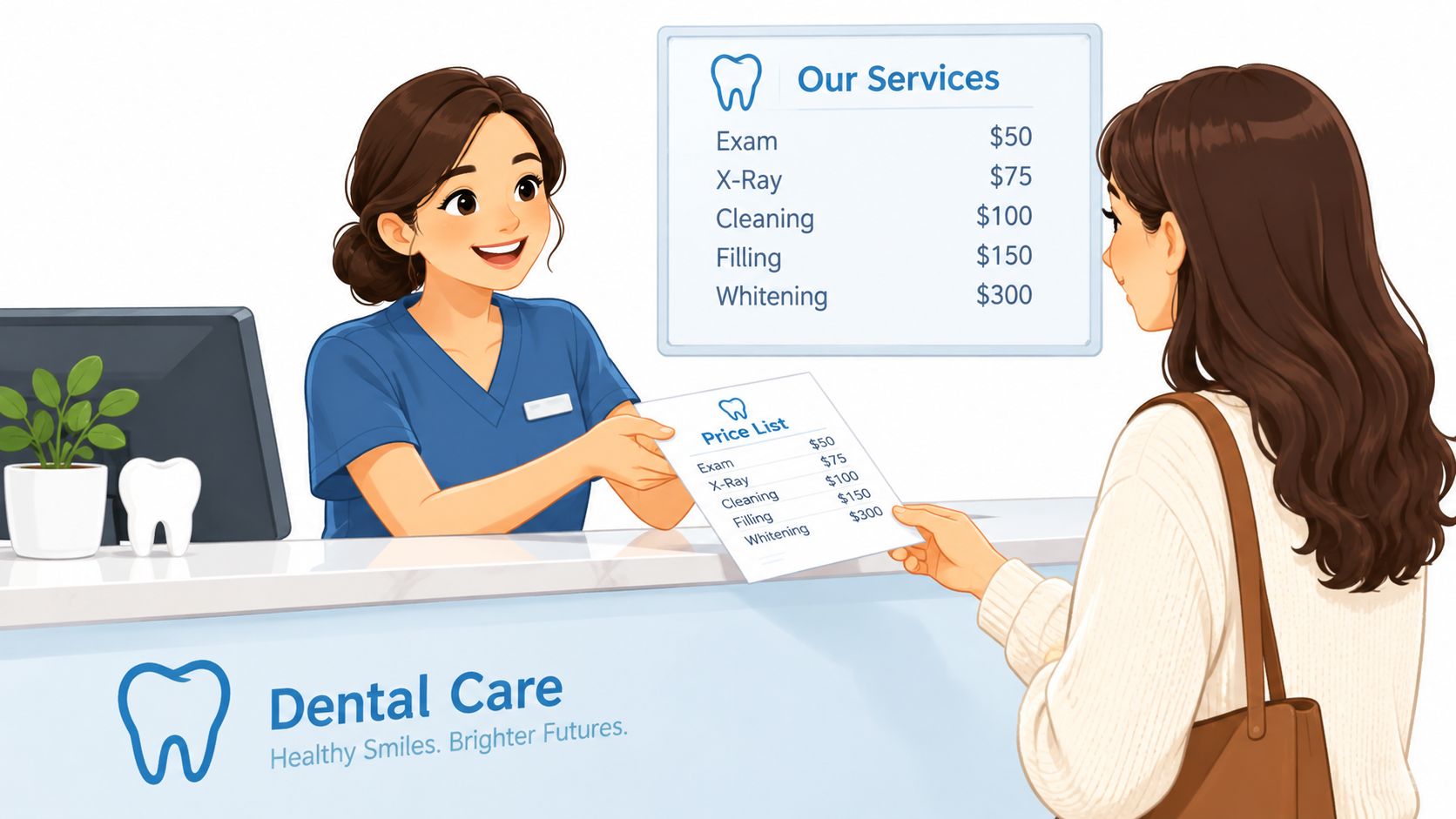
A transparent visit starts with a focused exam and any needed radiographs. Then you should receive a written estimate that separates the cost of diagnosis, short-term stabilization, and definitive treatment. That distinction matters. A patient should be able to see the difference between “what we need to do today to get this under control” and “what full treatment may look like after that.”
The next conversation should be candid. If a lower-cost option can safely control the cause, the office should say so. The ADA's antibiotic stewardship guidance supports a practical uninsured-emergency workflow that prioritizes the lowest-cost intervention that safely controls the cause, such as drainage, temporary dressing, extraction, or emergency endodontic treatment, and warns against relying on antibiotics alone or using the emergency department for uncomplicated toothache.
What should happen before you leave
You should leave with a written medication plan, clear red-flag symptoms, and a re-evaluation plan if the treatment is temporary or infection is involved. If an office hands you a prescription and vague instructions to “see how it goes,” that's not a strong self-pay workflow.
A dentist who refuses to “just prescribe antibiotics” isn't being difficult. In many cases, they're trying to stop the cycle where symptoms quiet down for a few days while the actual source keeps getting worse.
If you're in Santa Ana or elsewhere in Orange County and want to talk through your specific situation, scheduling a consultation with Dr. Andrew Finley is the right next step. He can evaluate what's happening, explain the immediate priorities, and discuss treatment options based on the actual diagnosis rather than guesswork.
Preventing the Next Midnight Emergency
The most expensive dental emergency is often the one that had warning signs for months. A little sensitivity that turned into night pain. A filling that felt loose, then fell out on a weekend. Grinding that cracked a tooth during dinner. Prevention sounds ordinary until you compare it with an after-hours scramble for care.
The long-term pattern is clear. In the National Institute of Dental and Craniofacial Research summary of oral health in America, uninsured patients had 5.2 times the odds of an emergency-department visit associated with a nontraumatic dental problem compared with commercially insured patients, and Medicaid patients had 4.0 times the odds. That doesn't mean every emergency is preventable. It does mean delayed routine care and delayed small repairs often end badly.
Habits that lower emergency risk
- Keep routine exams on the calendar: Small cavities, failing fillings, and early gum problems are easier to deal with before they start throbbing.
- Don't sit on chips or sensitivity: If cold drinks suddenly bother a tooth or you feel a sharp edge, get it checked before it becomes a pain problem.
- Use a properly fitted nightguard if you grind: Night grinding can crack teeth, loosen dental work, and make morning jaw pain feel like a surprise emergency.
- Act quickly when a crown or filling comes off: The longer exposed tooth structure stays unprotected, the more likely the problem gets bigger.
Families in Santa Ana, Costa Mesa, Tustin, Irvine, and Garden Grove do better when they have a dental home before the crisis hits. And for trust matters like this, it's worth knowing that every article published by this practice is reviewed by Dr. Finley before it goes live.
If you need guidance on emergency pain, a broken tooth, swelling, or a same-day evaluation plan, Bristol Dental and Orthodontics offers family, cosmetic, and emergency dental care in Santa Ana for patients who need clear next steps. If you're trying to sort out what's urgent, what can wait, and how self-pay treatment may work in your case, schedule a consultation and talk it through with Dr. Andrew Finley's team.