
You may be sitting at your kitchen table in Santa Ana, looking at photos of your smile and wondering the same thing many adults do. “I like the idea of Invisalign, but what does Invisalign for adults cost, really?”
That question usually comes with a few others attached. Will it fit my budget? Will it take too long? Am I paying for convenience, or is there real value behind it? If you live in Orange County, whether that's Santa Ana, Costa Mesa, Tustin, Irvine, or Garden Grove, those concerns are normal.
As a dentist, I can tell you that the most helpful way to think about cost is not as a single number pulled from the internet. It's better to think of it as an investment in a custom treatment plan. The price reflects what your teeth need, how your bite functions, and how much guidance is required to move everything safely and predictably.
Table of Contents
- Thinking About a Straighter Smile as an Adult
- The Factors That Shape Your Invisalign Investment
- Invisalign vs Traditional Braces A Cost and Lifestyle Comparison
- Using Dental Insurance for Invisalign Treatment
- HSA FSA and Other Ways to Plan for Your Treatment
- What to Expect During Your Invisalign Consultation
- Frequently Asked Questions About Adult Invisalign
Thinking About a Straighter Smile as an Adult
A lot of adults put orthodontic treatment off for years. Sometimes it's because life got busy. Sometimes it's because braces felt like something you were supposed to do as a teenager. Sometimes it's because the financial side felt unclear.
I see this often with working adults and parents. They've learned to live with crowding, spacing, or a bite that doesn't feel quite right. They may cover their smile in photos, avoid certain angles on video calls, or tell themselves they'll look into treatment “later.”
Many adults aren't trying to create a perfect smile. They're trying to feel more comfortable speaking, smiling, and showing up in everyday life.
That's why the cost conversation matters so much. If all you hear is a vague price range with no explanation, it's easy to assume treatment won't make sense for you. But when you understand what affects the cost, the question becomes more practical. What am I paying for, what matters most to me, and what are my options for making treatment manageable?
For some adults, the biggest priority is appearance at work. For others, it's being able to remove aligners for meals or brush and floss more normally. Some had braces years ago and noticed their teeth shifting again. Each of those situations leads to a different conversation.
If you're considering treatment, the best next step isn't guessing. It's getting clear information about your own mouth, your own goals, and the kind of plan that fits your life.
The Factors That Shape Your Invisalign Investment
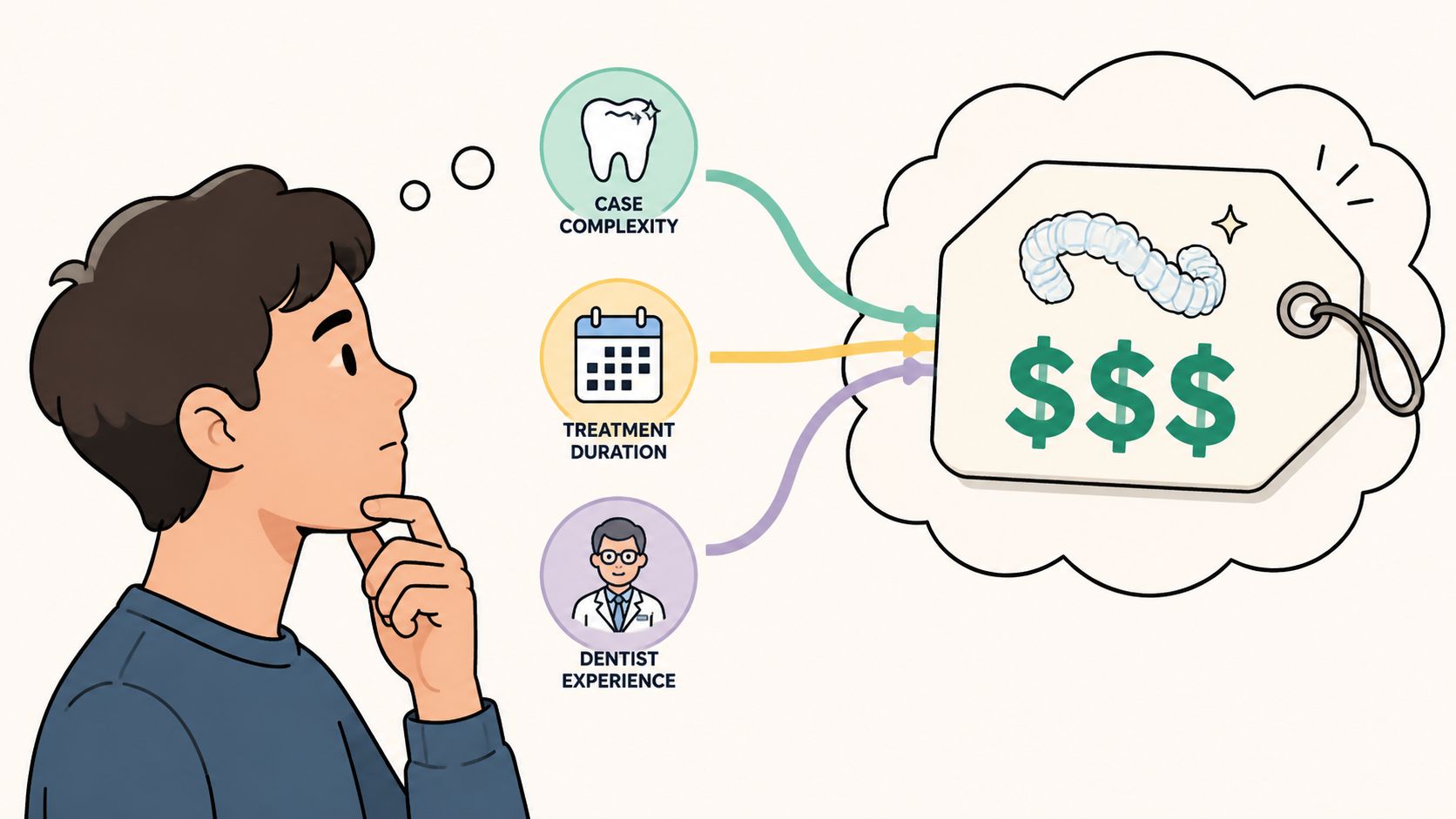
Individuals seeking Invisalign for adults cost often expect a single figure. The challenge is that Invisalign isn't a one-size-fits-all product. It's a customized orthodontic treatment, and the total investment depends on the plan your teeth require.
A helpful national reference point comes from GoodRx's overview of Invisalign cost, which notes an average adult out-of-pocket price of about $5,700, with a broad U.S. range of $3,500 to $9,500. The same source explains that cost rises with case complexity, more aligner trays, and longer wear time, and that average treatment duration is around 12 to 18 months.
Why one person's treatment looks different from another's
The first major factor is case complexity. A person with a small gap between front teeth usually needs a different level of planning than someone with crowding, rotation, or a bite issue that affects how the upper and lower teeth meet.
Complexity changes the treatment in real ways:
- Tooth movement needs: Slight alignment changes are different from broader bite correction.
- Number of aligners: More movement often means more trays.
- Monitoring and refinement: Some cases need extra adjustments as treatment progresses.
A good way to think about it is this. You're not buying plastic trays off a shelf. You're paying for a sequence of carefully planned tooth movements, plus the oversight needed to keep treatment on track.
What you're paying for besides the trays
Patients sometimes focus on the aligners themselves, but the trays are only one part of the process. The investment also reflects diagnosis, digital planning, follow-up visits, and any tools used to help teeth move more precisely.
That may include small tooth-colored attachments placed on certain teeth. These help the aligners grip and guide movement. Some people also need refinement aligners near the end of treatment if a few teeth need additional correction.
Practical rule: If a treatment plan is more involved, the cost usually reflects the time, design, and supervision needed to complete it safely.
Here's a simple way to picture the difference:
| Situation | Likely impact on cost |
|---|---|
| Minor spacing or mild relapse after past braces | Often less involved |
| Moderate crowding or visible rotation | More planning and more trays |
| Bite issues or broader alignment concerns | Higher complexity and longer care |
This is why online estimates can only take you so far. Two adults in Orange County can both ask about Invisalign and end up with very different treatment plans because their starting points are different.
Invisalign vs Traditional Braces A Cost and Lifestyle Comparison
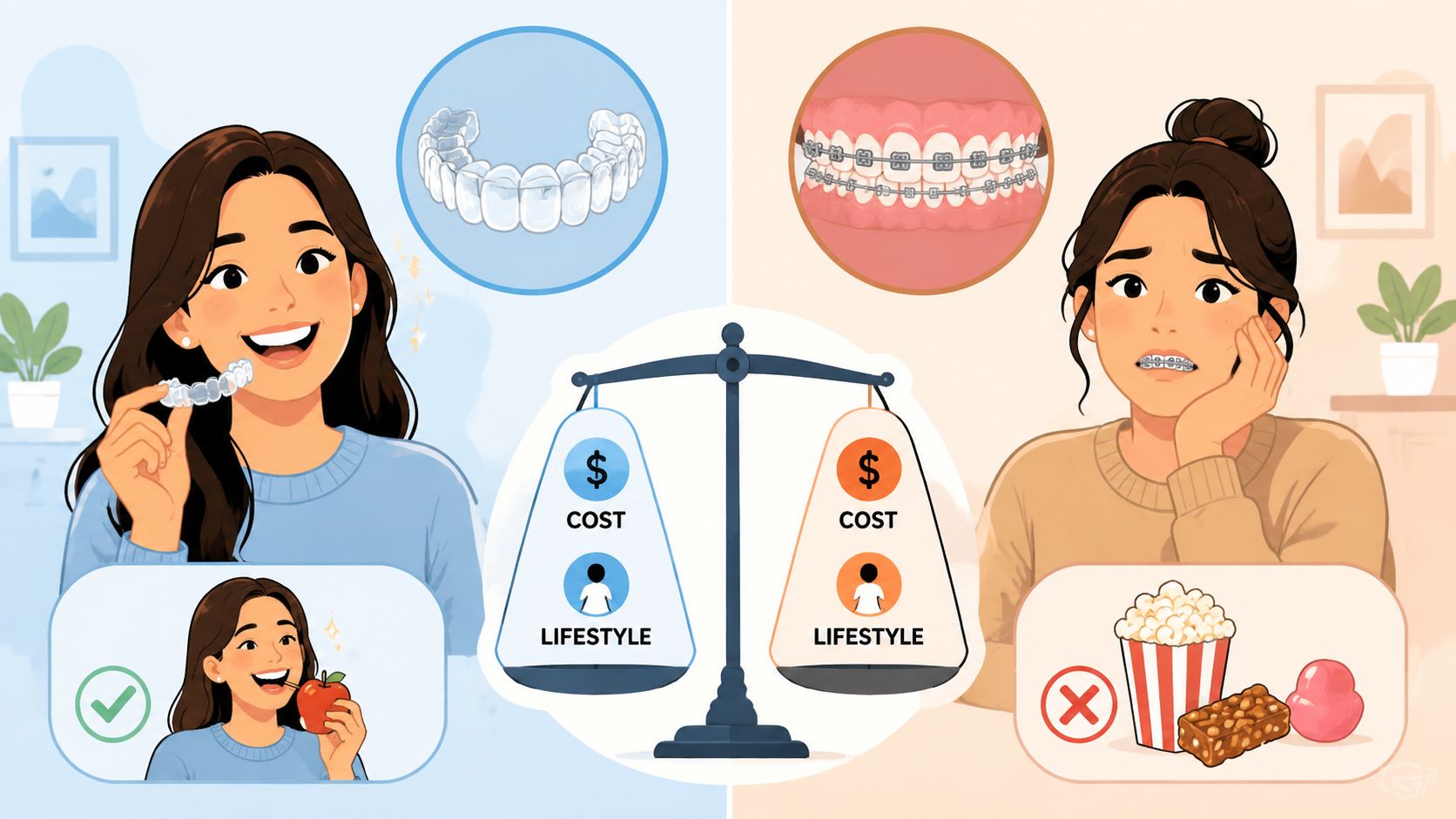
For many adults, this isn't just a cost question. It's a quality-of-life question. You're not only choosing how teeth will move. You're choosing what treatment will feel like during workdays, meals, travel, social events, and routine oral hygiene.
Traditional braces and Invisalign can both improve alignment. The better option depends on your needs, habits, and priorities.
How daily life changes with each option
With traditional braces, brackets and wires stay on your teeth all the time. That can be helpful because there's nothing to remember to put back in. On the other hand, fixed braces change how you clean your teeth and what foods you need to avoid.
With Invisalign, aligners are removable. Adults often like that because they can take them out for eating, brushing, and flossing. The tradeoff is responsibility. Treatment works best when you wear the aligners as directed by your dentist.
Some people also value the more discreet look of clear aligners. If you spend a lot of time in meetings, on video calls, or speaking with clients, that can matter. For others, appearance isn't the main issue. They care more about convenience and hygiene.
A lower sticker price doesn't automatically mean better value. Value depends on how well the treatment fits your life and whether you can realistically follow through with it.
A simple side by side view
| Consideration | Invisalign | Traditional braces |
|---|---|---|
| Appearance | Clear and less noticeable | More visible |
| Eating | Removed for meals | Food restrictions are common |
| Brushing and flossing | More familiar routine | Cleaning takes more effort |
| Convenience | Flexible, but requires discipline | Always on, less patient-managed |
| Feel in the mouth | Smooth aligners | Brackets and wires can irritate cheeks or lips |
There isn't a universal winner. A disciplined adult who wants flexibility may feel that Invisalign is worth the investment. Another patient may prefer the simplicity of a fixed appliance.
If you're trying to decide, ask yourself a few honest questions:
- Work and social setting: Will a less visible option help you feel more comfortable?
- Daily habits: Will you reliably wear removable aligners?
- Food preferences: Do you want to avoid changes to how you eat?
- Cleaning routine: Is easier brushing and flossing a high priority?
For adults in Tustin, Irvine, and nearby communities, this often comes down to fit. Treatment needs to work for your teeth, but it also needs to work for your real life.
Using Dental Insurance for Invisalign Treatment
Insurance is where many patients get stuck. They know they have dental coverage, but they aren't sure whether orthodontic treatment is included, whether adult treatment counts, or how much of the cost they'll still need to handle themselves.
A useful benchmark comes from CareCredit's discussion of Invisalign costs and financing. It notes that many dental insurance plans can help with clear aligner treatment, but insurers often place a cap on orthodontic benefits, commonly around $1,000 to $3,500 for the full course of treatment. That's why your final out-of-pocket cost depends heavily on your specific plan design.
What orthodontic benefits usually mean
The phrase many adults hear is lifetime orthodontic maximum. In plain language, that usually means your dental plan may contribute up to a set amount toward orthodontic care, rather than paying an open-ended share forever.
A few details can affect how helpful your plan is:
- Adult eligibility: Some plans handle adult orthodontics differently than treatment for children.
- Waiting periods: Coverage may not begin right away.
- Payment timing: Benefits may be paid over time instead of all at once.
- Plan limitations: Some policies cover orthodontics broadly, while others are more limited.
If you're reviewing options before enrolling, a general guide to choosing a dental plan can help you understand the kinds of features that matter when orthodontic treatment is part of your decision.
Questions to ask before you start
Before beginning treatment, call your insurer or review your benefits summary and ask:
- Does my plan include orthodontic benefits for adults?
- Is Invisalign treated the same way as braces under my policy?
- Is there a lifetime orthodontic maximum?
- Is there a waiting period before benefits apply?
- How are payments issued over the course of treatment?
A patient with strong orthodontic benefits may have a very different financial picture than someone with a plan that excludes adult aligner treatment. That's one reason broad internet estimates can feel confusing. Insurance changes the equation, sometimes significantly, and the details matter.
HSA FSA and Other Ways to Plan for Your Treatment
Even when insurance helps, many adults want another way to make treatment feel more manageable. Consequently, HSA and FSA accounts are frequently discussed.
If you have one through your employer or health plan, these accounts may let you use pre-tax dollars for qualified healthcare expenses. In practical terms, that can make planned dental treatment easier to budget for because you're using funds set aside specifically for medical and dental needs.
How pre tax accounts can help
An HSA, or Health Savings Account, is usually connected to a qualifying health plan. An FSA, or Flexible Spending Account, is often offered through an employer. The details vary, so it's smart to confirm eligibility and account rules before assuming coverage.
Patients often use these accounts strategically:
- Timing matters: Some people schedule treatment around benefit periods.
- Combined planning helps: Insurance, HSA or FSA funds, and monthly budgeting can work together.
- Documentation counts: Keep records of treatment agreements, receipts, and payment confirmations.
If you're self-employed or you like to keep careful financial records, general guidance on managing business tax deductions can also be helpful for organizing dental and medical expense paperwork.
Practical planning ideas
You don't need to solve the whole cost question in one afternoon. A calm, organized approach usually works better.
Consider this checklist:
- Review your available accounts: Check whether you have an HSA or FSA and what funds are available.
- Ask about timing: If benefits renew soon, that may affect when you start.
- Build a treatment budget: Think in terms of a healthcare plan, not an impulse purchase.
- Save your paperwork: Keep everything together from the start.
Some adults feel immediate relief once they realize they may already have tools in place to help pay for treatment. The question shifts from “Can I do this?” to “What's the smartest way to structure it?”
What to Expect During Your Invisalign Consultation
You sit down for the appointment with one question in mind. What is this really going to cost me, and what am I getting for that cost?
A good Invisalign consultation helps answer that in plain language. It should leave you with a clearer picture of your teeth, your treatment choices, and the financial commitment involved. Many adults come in worried they are about to hear a sales pitch. What they usually need is a careful evaluation and a practical conversation.
At Bristol Dental & Orthodontics, Dr. Andrew Finley reviews your teeth, your bite, and your goals to see whether clear aligner treatment fits your situation. The goal is not just to name a fee. The goal is to show you what that fee covers, how complex your case appears to be, and what options may help make treatment more manageable.
What happens at the first visit
Most adult patients want clarity right away. Are my teeth a good fit for Invisalign, and what kind of plan would I be signing up for?
The visit often starts with an exam and digital records. Many offices use a scanner to build a detailed 3D model of your teeth, which works like a blueprint before any work begins. That scan helps your dentist study crowding, spacing, tooth position, and how your upper and lower teeth meet when you bite.
From there, the discussion becomes more specific to you. A small movement of the front teeth is different from correcting a more involved bite issue, and the cost can reflect that difference. In other words, the consultation helps connect the price to the work behind it.
You may talk through questions such as:
- Smile goals: Which changes matter most to you when you look in the mirror?
- Bite concerns: Are there functional issues that need attention along with appearance?
- Daily routine: Will you be able to wear removable aligners as directed?
- Treatment scope: Does your case look relatively limited, or does it appear more involved?
- Budget planning: What payment options should you ask about before deciding?
That last point matters more than many adults expect. An online price range is like seeing the average cost of a kitchen remodel before anyone has looked at your house. It gives you a rough starting point, but your consultation is what turns a broad estimate into a treatment plan based on your mouth, your goals, and your timeline.
What to bring and what to ask
You do not need to overprepare. A short list of questions is enough.
The most useful questions help you understand both the clinical side and the financial side:
| Question | Why it matters |
|---|---|
| Am I a good candidate for Invisalign? | It tells you whether aligners fit your case |
| What are you correcting in my teeth or bite? | It shows what you are actually paying to improve |
| How long might treatment take, and what will daily wear involve? | It helps you judge whether the plan fits your life |
| What is included in the quoted cost? | It helps you understand the value behind the number |
| How are payments usually structured? | It helps you plan realistically before starting |
If you have had braces before, mention it. If your teeth shifted over time, if you clench or grind, or if cost has been the main reason you waited, say that plainly. Those details can affect both the treatment approach and the financial conversation.
A strong consultation should help you leave with fewer unknowns. You should better understand what problem is being treated, what kind of result is realistic, and how the cost connects to the care involved. That makes it much easier to decide whether Invisalign feels worthwhile for you.
Frequently Asked Questions About Adult Invisalign
Common questions adults ask
Is Invisalign painful?
Most adults describe Invisalign as pressure rather than pain. That pressure often shows up when you switch to a new aligner because the teeth are being guided into a new position. Some temporary soreness can happen, but many patients find the smooth plastic trays easier to tolerate than brackets and wires.
How long do I need to wear aligners each day?
Your dentist will give you specific instructions, and following them matters. Because the aligners are removable, consistency is a big part of success. If they aren't worn as directed, treatment can slow down or become less predictable.
What happens after treatment is finished?
Retention matters. Teeth can shift after orthodontic treatment, so most adults will need retainers to help maintain their result. Wearing retainers as recommended is part of protecting the time and money you've invested.
Can adults really be good candidates for Invisalign?
Yes, many adults are. Some have never had orthodontic treatment. Others had braces years ago and noticed relapse over time. The right answer depends on your dental health, bite, alignment goals, and whether clear aligners are an appropriate match for your case.
A good Invisalign decision isn't based on age alone. It's based on your oral condition, your goals, and your ability to follow the treatment plan carefully.
If you're ready to get clear answers about your own Invisalign options, schedule a consultation with Bristol Dental and Orthodontics. Dr. Andrew Finley can evaluate your smile, talk through what's involved, and help you understand the financial side in a calm, no-pressure way.