
You brush. You floss when you can. You swish mouthwash before heading out the door. Then a small question creeps in anyway. Is that enough?
That question is one of the most common ones patients have before a cleaning visit. It makes sense. If your teeth look fairly clean in the mirror and nothing hurts, it's easy to assume home care is handling the job. But some buildup forms in places your toothbrush can't fully reach, and once plaque hardens into tartar, brushing and flossing can't remove it at home.
That's why professional teeth cleaning remains such an important part of preventive dental care. It's also more common than many people realize. The CDC reports that 65.5% of adults age 18 and older had a dental exam or cleaning in the past year in 2023 in its U.S. dental care fast facts. That also means a large share of adults did not.
If you're in Santa Ana or nearby Orange County communities like Costa Mesa, Tustin, Irvine, or Garden Grove, understanding what happens during a cleaning can make the visit feel much more comfortable. A lot of dental anxiety comes from not knowing what the sounds mean, what each tool does, or why one person is told they need a routine cleaning while another hears the words “deep cleaning.”
Table of Contents
- Why Brushing Alone Is Not Enough
- What Happens During a Professional Teeth Cleaning
- The Health Benefits of a Dental Cleaning
- Routine Prophylaxis vs Deep Cleaning
- Your Cleaning Visit at Bristol Dental & Orthodontics
- Frequently Asked Questions About Teeth Cleanings
Why Brushing Alone Is Not Enough
A simple example helps. Think about someone who brushes carefully twice a day and does a decent job flossing most nights. Their front teeth may feel smooth, but behind the lower front teeth and along the back molars, small areas often collect plaque day after day. Saliva, food debris, and bacteria mix there. Over time, that soft film can harden into tartar.
That's the part many people miss. Home care is excellent for daily control, but it doesn't always remove everything, especially in tight spaces, around old fillings, near the gumline, or around orthodontic appliances and dental implants. Once tartar forms, it sticks to the teeth more like mineral scale in a coffee maker than a crumb on a countertop.
Why daily care still needs backup
Professional teeth cleaning works as a reset. It removes buildup that routine brushing and flossing can't fully manage over time. That's one reason preventive visits are such a regular part of modern dentistry, especially for families trying to avoid more involved treatment later.
Practical rule: If your mouth feels fine, that doesn't always mean your gums are free of irritation or buildup.
Another point often surprises patients. A cleaning isn't just about making teeth look polished for a few hours. It helps reduce the conditions that let cavities and gum problems develop subtly.
The question behind the question
When patients ask, “Do I really need a cleaning if I brush well?” they're often asking something deeper: “Am I doing enough to protect my teeth long term?”
That's a fair question. The answer is that home care and professional care do different jobs. Your toothbrush handles the daily maintenance. A professional cleaning handles the hardened deposits and gives your dental team a chance to spot early issues before they turn into pain, breakage, or more complex treatment.
What Happens During a Professional Teeth Cleaning
A routine cleaning appointment is much more predictable than many people expect. In general, a standard professional teeth cleaning typically takes about 45 to 60 minutes and is commonly performed by a dentist or a specially trained dental hygienist, as described in this NCBI overview of professional teeth cleaning.
The first look
Most visits begin with a quick review of your oral health. The hygienist or dentist looks at your gums, the visible surfaces of your teeth, and areas where plaque tends to collect. If you've had tenderness, bleeding when brushing, or sensitivity to cold, this is the time to mention it.
That initial check matters because the cleaning should match the condition of your mouth. A person with healthy gums and light buildup won't need the same type of care as someone with deeper deposits below the gumline.
Scaling removes what home care can't
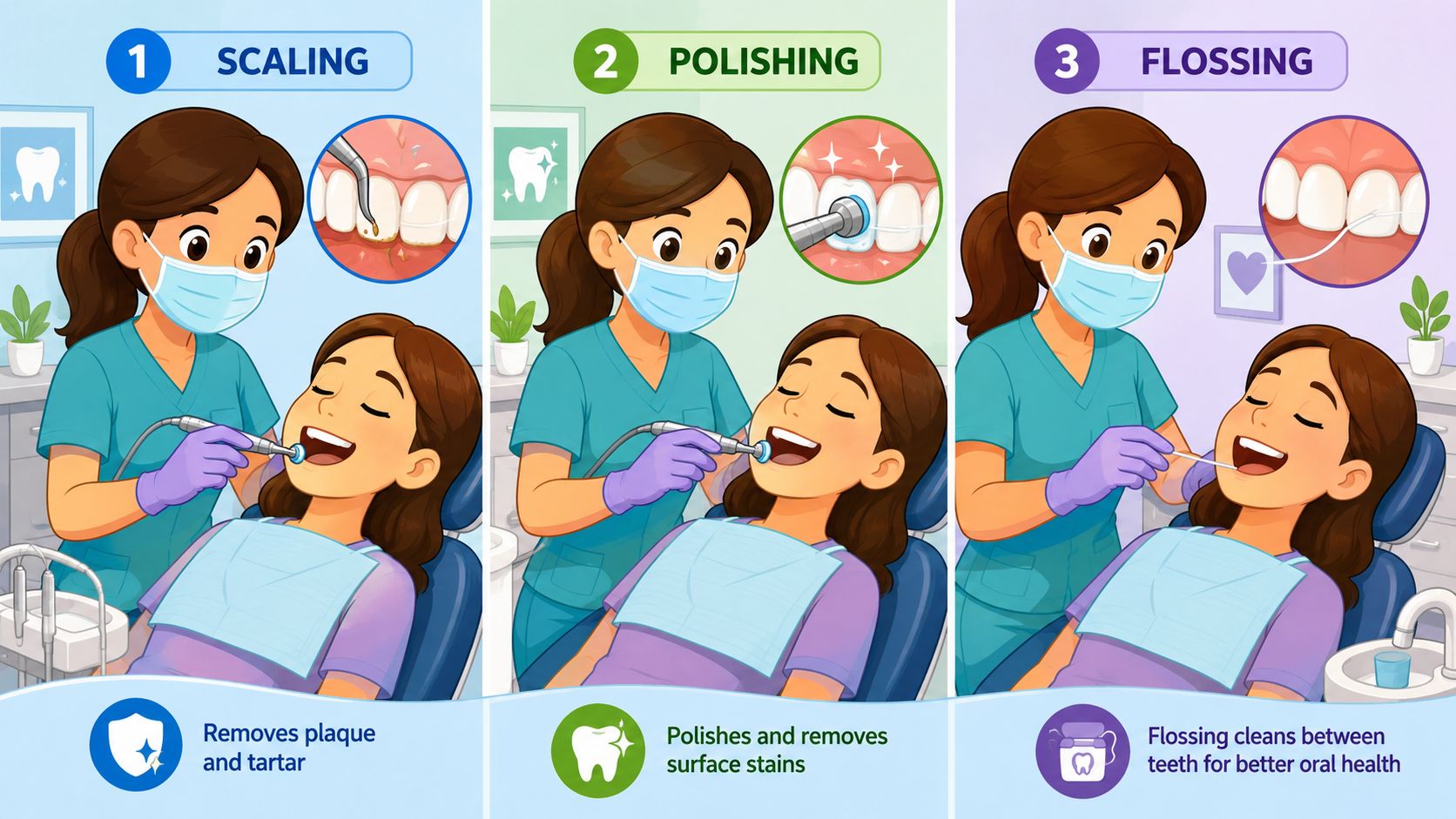
The heart of professional teeth cleaning is scaling. According to this clinical overview of teeth cleaning, scaling is the step that removes calculus, or tartar, and that hardened buildup cannot be removed by brushing or flossing at home.
If that word sounds intimidating, it helps to think of scaling as careful detail work. The hygienist uses instruments to lift away deposits from the tooth surface and near the gumline. You may hear light scraping sounds or feel pressure, but for a routine cleaning, many patients describe it as more odd than painful.
Some areas are easier than others. Behind the lower front teeth, tartar often forms where saliva collects. Around back molars, the challenge is access. Around attachments, wires, or implants, the challenge is contour. The reason the hygienist moves methodically is simple. Missing even a small ledge of tartar can leave a rough spot where new plaque collects more easily.
The scraping sound often bothers patients more than the cleaning itself. Sound doesn't mean damage. It usually means hardened buildup is coming off.
Polishing and the final steps
After scaling, many routine cleanings include polishing. This is the spinning brush and gritty paste patients usually remember. It smooths the tooth surface and helps remove some surface stain. It's not the main health step, but it does leave the teeth feeling slicker and cleaner.
The final part may include flossing and a rinse. Sometimes a fluoride treatment is also recommended as part of preventive care. The purpose is to help protect and strengthen enamel.
A simple way to picture the whole visit is this:
- Check the mouth so the team understands your starting point.
- Remove tartar and plaque through scaling.
- Polish the surfaces for a smoother finish.
- Clean between the teeth and clear away any remaining debris.
- Review what was found and whether you need routine follow-up or a different level of care.
For many new patients, the biggest relief is knowing there's a reason behind each step. Nothing is random. Each part of the appointment is there to remove buildup, check gum health, and support prevention.
The Health Benefits of a Dental Cleaning
You leave with smoother teeth, but the primary benefit starts before you notice that fresh, polished feeling. A professional cleaning helps lower the chances that small, manageable problems turn into larger ones. That matters if you have plaque buildup, tender gums, early signs of decay, crowded teeth, or dental work that creates extra corners for plaque to hide.

Prevention is easier than repair
Plaque is a soft film, almost like a sticky layer that keeps trying to return. If it sits on the teeth and near the gums for too long, it can irritate gum tissue and raise the risk of decay. Once that film hardens into tartar, brushing cannot remove it at home. Cleaning it off in the office gives your mouth a cleaner starting line.
That is the part many patients find reassuring. The visit is not about being judged for missing a spot. It is about resetting the environment in your mouth so daily brushing and flossing can work better again.
Preventive visits also help children and adults build steady habits over time. As noted earlier, regular dental visits are already part of routine care for many families. The value is consistency. A mouth that gets checked and cleaned on a regular schedule is less likely to surprise you with a problem that has been developing unnoticed.
A cleaning also helps prepare the mouth for other care. Healthier gums make it easier to plan treatment and have a more useful conversation with Dr. Finley about what should happen first.
A cleaning gives the dental team useful clues
A clean mouth is easier to read, much like wiping fog off a mirror before trying to see details. When buildup is removed, the teeth and gums are easier to examine clearly.
That matters because oral health changes are not always painful at first. Gum irritation, food traps, wear from clenching, or trouble around fillings, crowns, implants, and aligner attachments can develop slowly. A cleaning visit gives the team time to spot patterns, explain what they mean, and decide whether routine preventive care is enough or whether deeper gum treatment should be discussed.
For anxious patients, this is often the most helpful part to understand. The recommendation is based on what the gums and tooth surfaces are showing that day, not on guesswork. If Dr. Finley talks with you about the difference between a routine cleaning and a deeper periodontal cleaning, the goal is to match the treatment to what is happening under and around the gums.
For patients considering care such as Invisalign, dental implants, cosmetic dentistry, sleep apnea treatment, or emergency dentistry, routine preventive visits also help keep the bigger picture in view. A cleaning supports those goals by helping the mouth stay as healthy and stable as possible.
The benefits show up in comfort, too
Many patients notice fresher breath, smoother teeth, and less of that coated feeling after a cleaning. Those changes are not just about appearance. They often reflect the removal of buildup and a healthier gumline.
Home care can feel easier afterward.
When the tooth surfaces are cleaner and the gums are less irritated, brushing and flossing tend to feel more effective. That is one reason cleanings are so useful as preventive care. They remove what you cannot remove on your own, help the dental team check what is changing, and give you clearer information before you decide with Dr. Finley whether you need routine maintenance or a deeper level of treatment.
Routine Prophylaxis vs Deep Cleaning
This is one of the biggest sources of confusion in dentistry. A patient comes in expecting a “regular cleaning,” then hears that they may need a deep cleaning instead. That can feel surprising, and sometimes it even sounds like the office changed the plan midstream. In reality, the two services are meant for different situations.
Why the names are different
A routine prophylaxis is a preventive cleaning for a mouth that does not have active periodontal disease. A deep cleaning, also called scaling and root planing, is used when disease is present below the gumline.
An educational clinical overview explains that a healthy-mouth cleaning may take about 30 minutes, while heavier buildup or periodontal therapy often takes longer and may be split into more than one visit in this guide to teeth cleaning appointments. That difference in time reflects a difference in purpose. One is maintenance. The other is treatment.
Comparing Routine and Deep Dental Cleanings
| Feature | Routine Cleaning (Prophylaxis) | Deep Cleaning (Scaling & Root Planing) |
|---|---|---|
| Purpose | Preventive care for generally healthy gums | Treatment for gum disease below the gumline |
| Where it focuses | Visible tooth surfaces and the gumline area | Deeper areas under the gums and along root surfaces |
| What it removes | Plaque, tartar, and surface stain associated with routine preventive care | Buildup and irritants in deeper pockets where a routine cleaning can't reach |
| Typical feel | Often feels like scraping, polishing, and flossing during one preventive visit | May involve more intensive instrumentation and can be staged over separate areas of the mouth |
| Follow-up | Return on the schedule your dentist recommends for prevention | Re-evaluation and ongoing maintenance based on gum health |
Why a dentist may recommend deep cleaning
The reason is not that deep cleaning is “better.” It's that routine cleaning and deep cleaning solve different problems.
According to the CDC information referenced in this discussion of deep cleaning and gum disease, untreated gum disease is a leading cause of tooth loss in adults and can be asymptomatic until it reaches an advanced stage. That's exactly why patients can feel confused. They may not feel pain, yet the dentist sees signs that disease has moved below the gumline.
Signs that can lead to a deeper periodontal recommendation may include:
- Inflamed gums: Tissue that bleeds easily, looks puffy, or stays irritated.
- Buildup below the gumline: Deposits that can't be managed with a routine surface cleaning alone.
- Changes around the teeth: Findings on exam or x-rays that suggest the gums and support structures need more than preventive polishing.
Deep cleaning is not an upgrade package. It's a disease-focused treatment when routine cleaning won't reach the problem area.
If you ever hear this recommendation, it's reasonable to ask what was found, where it was found, and what the goal of treatment is. A good consultation should make those answers clear.
Your Cleaning Visit at Bristol Dental & Orthodontics
For many patients, the most calming part of a dental visit is knowing what the day will feel like. A cleaning appointment should feel organized, respectful, and easy to follow from the front desk to the chair.

Before you arrive
A little preparation can help the visit go smoothly. If you've noticed bleeding, sensitivity, jaw soreness, a loose retainer, or concerns around a crown or implant, jot those down before your appointment. Patients often forget the details once they sit down.
It also helps to bring context. If you're in active orthodontic care, wear clear aligners, have had dental implants placed, or are thinking about cosmetic changes, mention that early. Those details affect how the hygiene team approaches the cleaning and what home care advice makes the most sense.
What the visit feels like
At Bristol Dental & Orthodontics in Santa Ana, the goal is a comfortable, patient-focused experience. New patients from Santa Ana, Costa Mesa, Tustin, Irvine, and Garden Grove often arrive with one of two concerns: they're worried the cleaning will hurt, or they're worried they'll be judged for being overdue. Neither fear should define the visit.
A good cleaning appointment feels collaborative. The team explains what they're seeing, checks in if an area is tender, and tells you why a certain step is needed. That kind of communication matters just as much as the instruments do.
Aftercare and next steps
After a routine cleaning, many people can go right back to work, school, or errands. If you notice mild sensitivity, a softer toothbrush, lukewarm water, and gentle brushing for the rest of the day may help. If your gums were inflamed before the visit, they may feel a little tender as they settle down.
Some patients also learn that the cleaning visit connects to larger treatment plans. A person exploring smile improvements may need healthy gums before cosmetic work. Someone with missing teeth may need preventive maintenance to protect implant sites. Someone in aligners may need extra focus around areas where plaque tends to hide.
The main takeaway is simple. A cleaning isn't a disconnected errand. It's part of how long-term dental care stays stable and manageable.
Frequently Asked Questions About Teeth Cleanings
How often should you get a cleaning
The old “every six months” phrase is a common guideline, but it isn't the full story for every patient. The American Dental Association states that recall frequency should be based on individual needs and risk factors in this review of cleaning frequency guidance.
That means your recommended schedule may depend on things like gum health, smoking, diabetes, your history of buildup, or how difficult certain areas are to clean at home. One person may do well with a longer preventive interval, while another benefits from closer follow-up.
Is a cleaning painful
A routine cleaning is often more uncomfortable in spots than painful. Patients usually notice pressure, vibration, water, and scraping sounds. Areas with extra tartar or gum irritation can feel more sensitive.
If you're anxious, say so at the start. Small adjustments, such as short breaks, slower pacing, and clear explanation, can make the visit feel much easier.
Can a cleaning help with bad breath
It can, especially if buildup and gum irritation are part of the cause. Removing tartar and plaque gives you a cleaner starting point and may reduce odors that linger around trapped debris or inflamed gums.
Bad breath can also come from dry mouth, diet, sinus issues, or decay, so a cleaning is helpful but not always the whole answer. If the problem keeps returning, it's worth asking your dentist to look deeper.
What if you have Invisalign, braces, implants, or cosmetic dental work
You still need preventive care, and in some cases you may need more detailed home care instruction. Aligners, attachments, bonded retainers, implants, veneers, and crowns all create shapes and edges where plaque can hide more easily.
That doesn't mean there's a problem. It just means your cleaning and home routine should match your mouth. If you're already in treatment or thinking about future care, ask how professional teeth cleaning fits into that plan.
If you're due for a cleaning or want a personalized opinion about routine versus deep cleaning, Bristol Dental and Orthodontics welcomes patients from Santa Ana and surrounding Orange County communities. A consultation can help you understand what your gums need, what type of cleaning is appropriate, and how preventive care fits with concerns like Invisalign, dental implants, cosmetic dentistry, sleep apnea treatment, or emergency dental needs. Every article should be reviewed by Dr. Finley before publishing, and your own care decisions should always be based on an in-person evaluation.