
You've just watched the brackets come off, run your tongue over smooth teeth, and taken the first mirror photo of your new smile. It's an exciting moment, but it can also create an understandable question: Will my teeth still look this straight years from now?
The honest answer is that straight teeth after braces need ongoing support. Teeth can settle after treatment and drift gradually over time, so the retainer isn't an afterthought. It's part of a long-term plan that protects the alignment you and your orthodontic team worked to create.
Table of Contents
- The Day Braces Come Off and What Comes Next
- Why Straight Teeth Tend to Shift Over Time
- Retainer Options That Hold the Line
- Building a Daily Routine That Protects Your Result
- Spotting Relapse Early Before It Becomes a Problem
- Corrective Options If Teeth Have Already Moved
- Your Long-Term Retention Plan and When to Visit Bristol Dental & Orthodontics
The Day Braces Come Off and What Comes Next
When a patient sees their teeth without brackets for the first time, they often focus on the visible result. That's natural. Before the final retainer is delivered, though, the orthodontic team looks beyond the mirror.
What your orthodontist checks
The bite matters as much as the front view. Your orthodontist checks how the upper and lower teeth meet, whether the contacts between neighboring teeth are settling properly, and whether the gums look healthy. Small amounts of leftover adhesive may be polished away, and minor enamel cleanup may be considered when appropriate.
“Straight” doesn't mean that every tooth has stopped responding to pressure the moment the brackets are removed. The tissues around the roots and the surrounding bone still need time to adapt. Teeth may settle microscopically during the first months, which means the first-day photograph isn't necessarily the final appearance of your bite.
That's why treatment shifts from active movement to retention. Braces or aligners created the correction. Retainers help your teeth remain in their new positions while your mouth continues adjusting.
Your first retainer appointments
The practice will usually take physical impressions or digital scans promptly after treatment so the retainer matches the corrected positions. Your instructions may differ depending on your bite, the amount of movement completed, and your risk of relapse.
A follow-up appointment is typically arranged within a few weeks. The clinician checks whether the retainer seats correctly, whether it feels comfortable, and whether a fixed wire is secure if one has been placed. A retainer that pinches, rocks, or no longer fits should be reported rather than forced.
Long-term stability deserves realistic expectations. A 2025 systematic review of orthodontic retention and relapse found that only about 30% to 50% of orthodontic patients still had satisfactory alignment 10 years after treatment, while only about 10% maintained alignment at 20 years. Those findings don't predict what will happen to one individual, but they do explain why retention belongs in the plan from the day braces come off.
Why Straight Teeth Tend to Shift Over Time
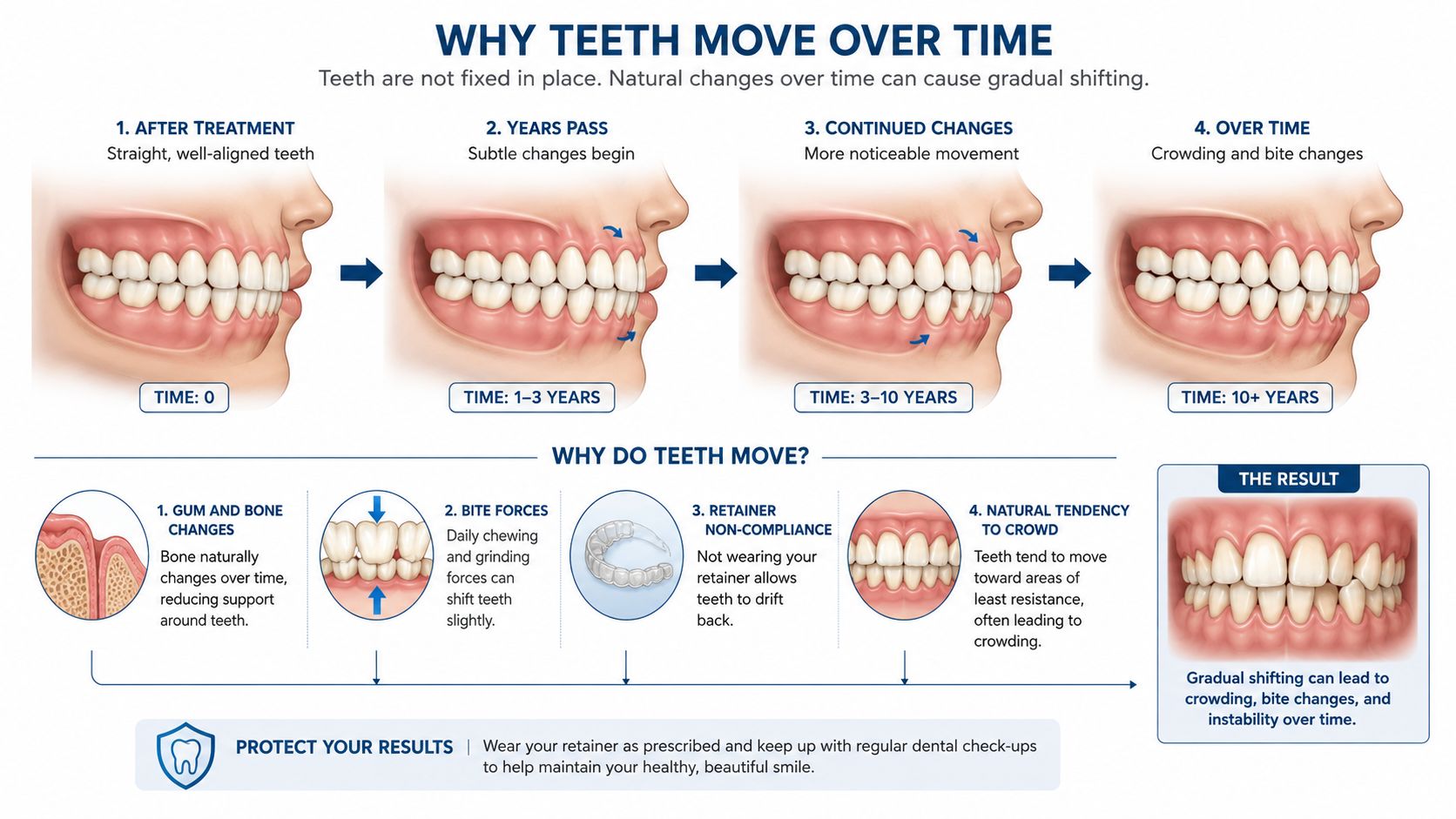
Teeth aren't set into the jaw like screws in concrete. Each tooth is suspended by a thin layer of connective tissue called the periodontal ligament. During orthodontic treatment, that tissue and the surrounding bone respond to controlled pressure. After treatment, they continue adapting to the tooth's new position.
The biology behind the movement
The fibers around a tooth can retain a tendency toward an earlier position, much like a stretched elastic band trying to shorten. Bone around the roots also remodels gradually, and everyday forces from chewing, speaking, clenching, and swallowing continue to act on the teeth.
A useful analogy is sand after a wave. The wave can create a new shape, but the sand keeps settling afterward. Retainers help hold the teeth while the supporting tissues adjust.
Common patterns include:
- Lower front crowding: The bottom incisors may begin overlapping or rotating again.
- Upper spacing: Small gaps can reopen near the lateral incisors or canine area.
- Bite changes: An overbite may deepen, or the front teeth may stop meeting as they once did.
Relapse often concentrates in the first 12 to 24 months, but that doesn't mean the risk ends afterward. Natural changes can continue across adulthood. A long-term follow-up of former orthodontic patients found that 72% had at least one measured variable outside the ideal range 12 to 35 years later, including increased lower-front crowding in 9% and increased overbite in 16%. These figures come from the long-term orthodontic follow-up study, and they show why an apparently stable smile still benefits from durable retention.
What can make drift more likely
Missed retainer nights are an obvious contributor, but they aren't the only one. Grinding or clenching can apply repeated pressure, gum disease can affect the tissues supporting the teeth, and normal aging can alter the jaw and bite. A retainer plan works with these biological realities rather than pretending they can be switched off.
A worldwide meta-analysis estimated malocclusion prevalence at 56% globally, with regional prevalence reaching 81% in Africa, 72% in Europe, 53% in the Americas, and 48% in Asia. A separate comparison of medieval and present-day skulls in Norway found that 36% of the medieval sample needed orthodontic treatment compared with 65% of the modern sample. The population and historical malocclusion research helps explain why orthodontic treatment is common, but it also reinforces a practical point: alignment is a changing biological condition, not a permanent lock.
Retainer Options That Hold the Line
Retainers differ in appearance, maintenance, and how much they depend on memory. None is automatically right for every patient. The useful question is whether the design fits your teeth, your relapse risk, and the routine you can follow consistently.
Comparing the main designs
| Feature | Clear Vacuum-Formed | Hawley (Wire + Acrylic) | Fixed Bonded Wire |
|---|---|---|---|
| Appearance | Clear and relatively discreet | Visible wire across the front teeth | Hidden behind the teeth |
| Comfort | Often slim and smooth | Durable, but includes acrylic and wire | Usually unobtrusive once adjusted |
| Compliance demands | Must be removed and worn as directed | Must be removed and worn as directed | Doesn't depend on remembering nightly wear |
| Durability | Can wear, crack, or distort | Often repairable or adjustable | Can loosen or break and needs inspection |
| Best-use scenario | Patients who value a discreet removable option | Patients who need adjustability or a long-lasting removable design | Patients with higher relapse concerns or difficulty remembering removable wear |
Clear retainers are popular because they're subtle and straightforward to insert. Hawley retainers have a wire-and-acrylic structure that can offer adjustability and a durable design. Fixed bonded wires sit behind selected teeth, often the lower front teeth, and provide continuous support without requiring the patient to take them in and out.
A 2024 clinical study comparing retainer types reported mean anterior relapse of 0.2 millimeters and posterior relapse of 0.1 millimeters with permanent retainers. Removable retainer groups showed mean anterior relapse of 0.8 to 1.0 millimeters and posterior relapse of 0.6 to 0.8 millimeters in that study. These results support fixed retention as a useful option for reducing measurable movement, but they don't eliminate the need for cleaning and professional checks.
How wear usually changes
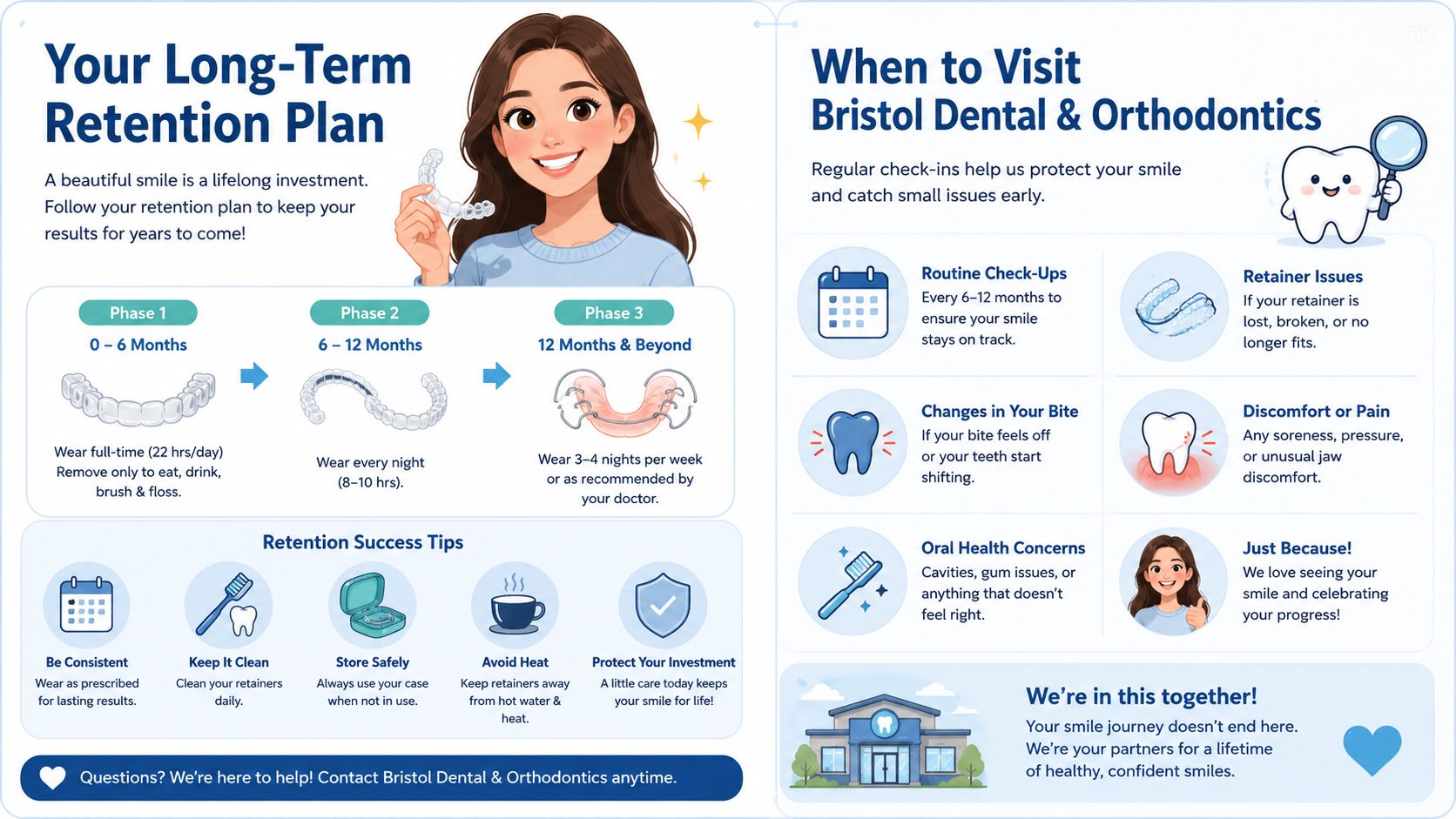
Many patients begin with full-time removable retainer wear for the first 6 to 12 weeks, taking the appliance out for meals and oral hygiene. The schedule may then move to nighttime wear, followed by a longer-term routine of several nights each week. Your clinician may use a different schedule based on your bite and treatment history.
Some patients use a combination approach, such as a bonded lower retainer with a removable upper retainer. That arrangement can provide continuous support where lower-front crowding is a concern while still allowing removable coverage and cleaning for the upper teeth.
Practical rule: A retainer plan only works when you can follow it. Tell your orthodontist honestly if an appliance is uncomfortable, difficult to clean, or easy to forget.
Retainers also need protection. Keep removable appliances away from pets, hot cars, and loose napkins. Heat can distort plastic, while a napkin can disappear during a meal. Use a rigid case and bring the appliance to appointments when you're asked to do so.
Building a Daily Routine That Protects Your Result
A reliable routine doesn't need to dominate your day. It needs clear places to fit into habits you already have, such as brushing in the morning, preparing for bed, and leaving home for work or school.
Morning and evening care
In the morning, remove a removable retainer and rinse it with cool or lukewarm water. Brush your teeth as usual, then clean the retainer gently according to the instructions from your dental team. Avoid hot water because heat can change the shape of some appliances.
At night, brush and floss before inserting the retainer. If you have a bonded wire, clean carefully around the wire and under the contact areas. A floss threader or another method recommended by your dental professional may make those spaces easier to reach.
For removable retainers, use a gentle cleaning approach rather than abrasive household products. Keep the appliance in its case during meals, sports, and any activity where it could be misplaced or damaged.
A bathroom-mirror checklist
- Rinse and clean: Wash the removable retainer gently and keep it away from heat.
- Inspect the fit: Check that it seats fully without rocking or unusual pressure.
- Clean fixed wires: Brush and floss around every bonded area.
- Store safely: Use the case instead of a napkin, pocket, or open countertop.
- Notice changes: Look for new crowding, gaps, or a bite that feels different.
A monthly self-check can be simple. Take a few phone photos in natural light, including a front view and close views of the upper and lower front teeth. Compare them with earlier photos, but don't rely on photographs alone if your retainer feels wrong or your bite has changed.

Consistency matters more than perfection. Missing an occasional night doesn't mean the result is lost, but a repeated pattern gives teeth more opportunity to move. If you've missed several nights and the retainer feels tight, contact the practice rather than forcing it into place.
Spotting Relapse Early Before It Becomes a Problem
Relapse isn't a moral failure and doesn't mean you've ruined treatment. Teeth have a biological tendency to move, and early changes are often easier for a clinician to evaluate than changes that have been ignored for a long time.
Signs worth noticing
Patients commonly notice a small front tooth edge that no longer lines up with its neighbors. Others see a new gap near the canine area, lower-front crowding, or a retainer that suddenly feels tighter or looser than usual.
A bite change can be just as important as a visual change. If chewing feels different, one tooth contacts first, or your teeth no longer meet in the familiar way, make a note of when it started.
A retainer that no longer seats fully is information, not an inconvenience. Don't force it and hope the problem disappears.
A calm home check
Stand near a window or use another source of natural light. Take relaxed photos of your teeth from the front, both sides, and slightly above and below. Compare the images with older photos taken from similar angles.
You can also place the removable retainer in your mouth without biting down forcefully. Notice whether it settles completely and evenly. Stop if you feel sharp pain, and don't try to reshape the appliance yourself.
Call sooner for a cracked or loose fixed wire, a retainer that won't seat, sudden crowding, or a new bite problem. A scheduled appointment may be appropriate for a subtle cosmetic concern that hasn't changed quickly, but your dental team can help determine the right timing.
The systematic review on orthodontic relapse summarized relapse ranges from 10% to 90%, depending on the malocclusion and retention protocol. That wide range is one reason a personal evaluation matters more than a generic prediction.
Corrective Options If Teeth Have Already Moved
A small shift doesn't automatically mean you need a complete second round of orthodontic treatment. The appropriate response depends on which teeth moved, whether the bite changed, how well the current retainer fits, and whether the supporting teeth and gums are healthy.
Common paths a clinician may discuss
A limited clear-aligner course may address a small number of shifted teeth. This can suit a patient whose bite remains generally stable but whose front teeth have rotated or crowded slightly.
A short refinement may use the existing treatment plan or retainer history as a starting point. The clinician still needs to examine the teeth and create a new plan, because a retainer isn't designed to actively correct every type of movement.
A replacement fixed retainer may be considered when the wire has loosened or broken and the teeth remain close to their intended positions. Minor reshaping or bonding can sometimes improve the appearance of a small rotation, but those approaches change the shape of the tooth rather than repositioning it.
For more substantial movement, a second full orthodontic phase may be discussed. That could involve braces or aligners, depending on the clinical findings and the patient's preferences.
| Option | Typical Timeline | Best For | Considerations |
|---|---|---|---|
| Limited clear-aligner course | Shorter than comprehensive treatment | Localized crowding, spacing, or rotation | Requires consistent tray wear and a stable bite |
| Short refinement | Focused correction after prior treatment | Small changes with a clear treatment target | Existing retainers may not provide enough active correction |
| Fixed-retainer replacement | Focused appointment and healing or adjustment period | A loose or failed bonded wire | Requires careful cleaning and ongoing professional checks |
| Minor reshaping or bonding | Often completed in a focused visit | Small cosmetic irregularities | Changes tooth contours and isn't suitable for every movement |
| Second full orthodontic phase | Longer and more comprehensive | Moderate or widespread relapse | Involves a new assessment, plan, and retention phase |
The timeline, scope, and clinical considerations vary from person to person. Cost also varies with the number of teeth involved, the appliance selected, and the amount of monitoring needed, so a responsible consultation should provide a personalized estimate rather than a generic range.
Early-stage relapse is usually simpler to evaluate and address than movement that has been allowed to progress. If your retainer no longer fits, bring it to the appointment. It can help the clinician understand what changed, even if it can't be worn comfortably now.
Your Long-Term Retention Plan and When to Visit Bristol Dental & Orthodontics
A useful retention plan should fit your real life. A student, a parent, and a busy professional may all need different reminders and appliance arrangements, but each plan should include the same basic elements: consistent retainer use, careful cleaning, periodic self-checks, and professional monitoring shaped around individual risk.
The checkpoints that matter
Wear the retainer according to your clinician's instructions, especially during the early months. Keep removable appliances clean and protected, and inspect fixed wires during brushing and flossing. Use occasional phone photos in natural light to notice changes that may be difficult to see day to day.
Your follow-up schedule shouldn't be copied from a generic calendar. The recent review of long-term retention strategies notes that some practices stop removable-retainer checks around 2 to 3 years after debonding even though stability concerns can continue beyond that period. The same review discusses fixed retention, digital retainer production, and combination strategies, while noting that improved fit and efficiency from digital fabrication hasn't clearly established superior long-term stability.
The realistic expectation is simple: teeth may settle during the first months, and slow drift may occur over the years. Retention lowers that risk, but it can't promise absolute permanence. A recent evidence summary states that absolutely stable orthodontic results aren't possible, which is why monitoring and individualized retention remain important.
When to contact the practice
Reach out sooner rather than later if you have:
- A loose or cracked fixed retainer: Don't wait for more teeth to move.
- A removable retainer that won't seat fully: Don't force the appliance.
- New crowding or spacing: Take photos and arrange an assessment.
- A changed bite: Mention when the change began and whether chewing feels different.
- Jaw discomfort: Ask for an evaluation rather than assuming the retainer is the cause.
For patients in Santa Ana and surrounding Orange County communities, including Costa Mesa, Tustin, Irvine, and Garden Grove, a retention check at Bristol Dental & Orthodontics can be a continuation of care, not a new start. Dr. Andrew Finley and the team can assess your current alignment, retainer fit, bite, and broader dental needs, then discuss whether observation, a new retainer, Invisalign, or another approach fits your situation.
Bristol Dental and Orthodontics offers orthodontic evaluations, Invisalign, retainer support, and family and cosmetic dental care for patients in Santa Ana and throughout Orange County. Visit Bristol Dental and Orthodontics to schedule a retention check or consultation with Dr. Andrew Finley and take the next step in caring for your smile.