

You leave a dental appointment with one clear message: you need a crown. Then the next thought hits almost immediately. How much is this going to cost?
That question is completely reasonable. For many patients in Santa Ana, Costa Mesa, Tustin, Irvine, and Garden Grove, the confusing part isn't just the number itself. It's that one office may talk about a crown as if it's a single item, while another talks about it as a treatment process. Those aren't the same thing.
A crown isn't just a cap placed on a tooth. It's part of a plan to protect a tooth that's cracked, weakened, heavily filled, or treated after deeper damage. The total investment can depend on the tooth, the material, what has to happen before the crown is placed, and how long you want that result to serve you well.
This article is written the way Dr. Finley would explain it in person: calmly, clearly, and without pressure. The goal is to help you understand dental crown cost in real-world terms so you can make a decision that fits both your oral health and your budget. Every article must be reviewed by Dr. Finley before publishing.
Table of Contents
- Why Understanding Dental Crown Costs Matters
- What's Included in the Total Cost of a Dental Crown
- A Comparison of Different Dental Crown Materials
- Choosing Your Crown Based on Long-Term Value Not Just Price
- Navigating Insurance and Payment Options in Santa Ana
- Your Dental Crown Questions Answered
Why Understanding Dental Crown Costs Matters
A common patient conversation goes like this. Someone comes in because a tooth cracked while chewing, or because an old filling keeps breaking down. After the exam, they hear that a crown is the most reliable way to protect the tooth. Their first question usually isn't about porcelain or zirconia. It's about cost.
That question matters because a crown often feels like a surprise expense. You may not have planned for it. You may also be comparing a few offices and hearing very different language. One place says, "Your crown will cost this much." Another says, "It depends on what's included."
That's where people get frustrated.
A dental crown is both a restoration and a process. If you only compare the headline number, it's easy to miss what you're actually paying for.
The better question isn't just "What does a crown cost?" It's "What problem is being solved, what steps are involved, and what result am I paying to keep?" A front tooth with cosmetic concerns is different from a back molar that handles heavy chewing pressure. A tooth that only needs coverage is different from one that first needs additional treatment.
Patients often feel more comfortable once the conversation shifts from a single price tag to a full picture. That includes the condition of the tooth, the material being considered, the steps before placement, and the likely long-term value. Once those pieces are clear, the decision usually feels less overwhelming and more practical.
What's Included in the Total Cost of a Dental Crown
A patient may hear, "Your crown will be this much," and assume that number covers the whole job. Then the treatment plan includes an exam, X-rays, a build-up, a temporary, or care needed before the crown can even be placed. That is where the confusion usually starts.
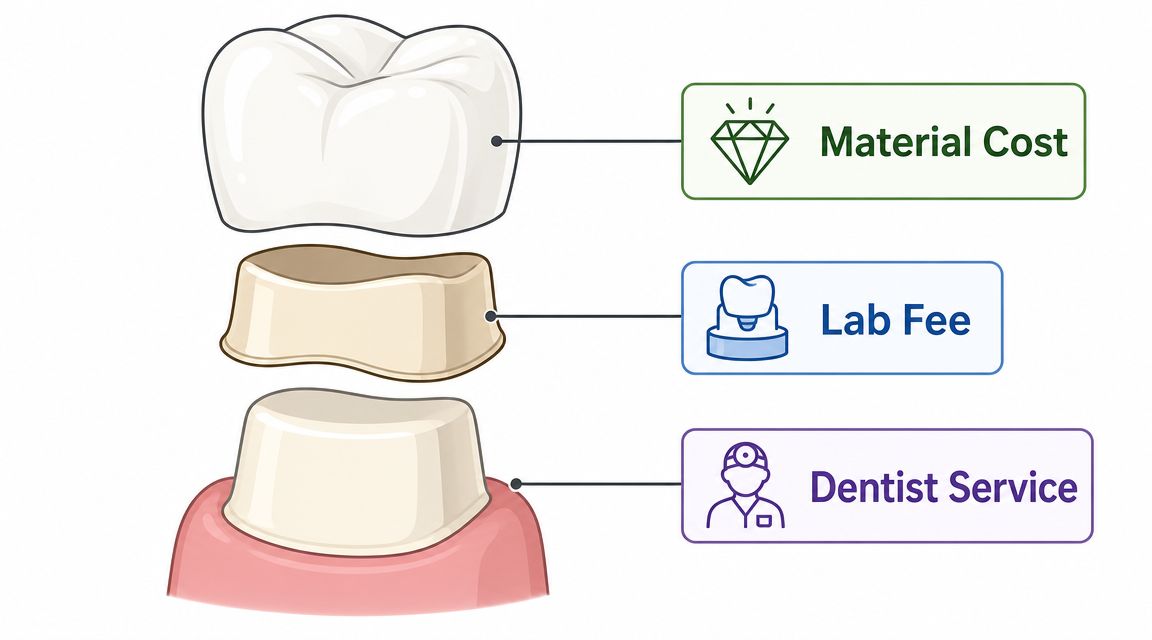
A crown fee can refer to two different things. Sometimes it means the crown restoration itself. Sometimes it means the full treatment process needed to get that crown to fit, function, and last. If two offices give different quotes, they may be describing different parts of the same project.
A useful way to look at it is to compare a crown to replacing a roof tile. The tile matters, but so do the inspection, the surface preparation, and the work that keeps the repair from failing again. A dental crown works the same way. The final crown is only one part of the total investment.
Practical rule: Ask whether the quote includes only the crown, or the steps needed before, during, and after placement.
The steps that often shape the final bill
Most crown treatment includes several parts. Each one has a job to do.
- Initial evaluation: Your dentist checks the tooth, gums, bite, and the condition of nearby teeth. This helps answer a basic question first. Is a crown the right fix, or is another treatment needed?
- Diagnostic imaging: X-rays help reveal decay, cracks, old dental work, or infection that cannot be seen from the outside.
- Tooth preparation: The tooth is carefully shaped so the crown can sit securely and feel natural when you bite.
- Impression or digital scan: This records the tooth and your bite so the lab or in-office system can make a crown that fits accurately.
- Temporary protection: If the permanent crown is not placed the same day, a temporary covers the tooth and reduces sensitivity.
- Lab fabrication: The final crown is made in the selected material for that tooth's location, appearance needs, and chewing pressure.
- Final placement and adjustment: Your dentist checks the fit, bite, comfort, and appearance, then bonds or cements the crown in place.
Some treatment plans need one more layer before the crown itself. If a tooth has broken down badly, it may need a foundation build-up first, much like repairing the frame before putting a new door on it. If the nerve is infected or badly inflamed, root canal treatment may come first. Those steps are not extras in the casual sense. They are what make the crown possible.
That is why the sticker price can be misleading on its own.
The better question is, "What needs to be done for this tooth to hold a crown well over time?" Once you ask it that way, the estimate usually makes more sense. You are paying for the diagnosis, the preparation, the custom-made restoration, and the steps that help the result last.
A Comparison of Different Dental Crown Materials
Material is one of the biggest reasons dental crown cost varies. It affects how the crown is made, how it looks, where it works best, and how much force it can handle over time.
Why material changes the cost
U.S. market guidance shows that material choice is the main technical driver of crown price because it changes laboratory cost, milling complexity, and clinical indication. That same guidance notes that porcelain or all-ceramic crowns commonly fall around $915 to $3,254, zirconia around $1,200 to $2,500, porcelain-fused-to-metal around $770 to $2,454, and resin or temporary crowns around $488 to $1,593. It also explains that all-ceramic and zirconia options are generally priced higher than PFM or resin choices because of the balance of esthetics, strength, and fabrication requirements in this dental crown cost overview from CareCredit.
In everyday terms, the more demanding the appearance and fabrication process, the more the crown tends to cost.
Dental Crown Material Comparison
| Material | Aesthetics | Strength | Best For | Longevity Potential |
|---|---|---|---|---|
| All-ceramic or porcelain | Very natural-looking, especially for visible teeth | Good, but depends on location and bite forces | Front teeth and smile-zone areas | Can last many years with proper care |
| Zirconia | Natural appearance with a stronger feel | Very strong | Back teeth, heavy-bite areas, and some visible teeth | Often chosen when durability is a priority |
| Porcelain-fused-to-metal | Good appearance with a metal base underneath | Durable and functional | Teeth that need a balance of appearance and strength | Long-standing restorative option |
| Gold alloy | Not tooth-colored | Excellent strength and wear characteristics | Back molars where appearance matters less | Known for durability |
| Resin or temporary crown materials | More basic appearance | Lower durability | Short-term protection or temporary use | Usually not intended as the longest-term option |
A few practical examples help.
If the tooth is a front tooth, many patients care most about shade, translucency, and how the crown blends with the neighboring teeth. All-ceramic options are often part of that conversation because appearance matters every time you smile, speak, or take a photo.
If the tooth is a back molar, chewing force matters more. In those cases, a stronger material may make more sense than choosing only by looks.
The right material depends on where the tooth is, how you bite, whether you grind, and what matters most to you day to day.
PFM crowns still have a role. They can be a practical middle ground for some patients who want a functional restoration without stepping into the higher end of cosmetic materials. Gold alloys may also be discussed for certain back teeth, especially when strength and wear are the main priorities.
There isn't one universal "best" crown material. There is only the material that makes the most sense for your tooth, your bite, your goals, and your budget. That's why this choice should be made with a dentist who can see the full clinical picture.
Choosing Your Crown Based on Long-Term Value Not Just Price
A patient sits down for a crown consultation, hears one lower quote and one higher quote, and assumes the lower number must be the smarter choice. That reaction makes sense. The confusing part is that the crown itself is only one part of the decision.
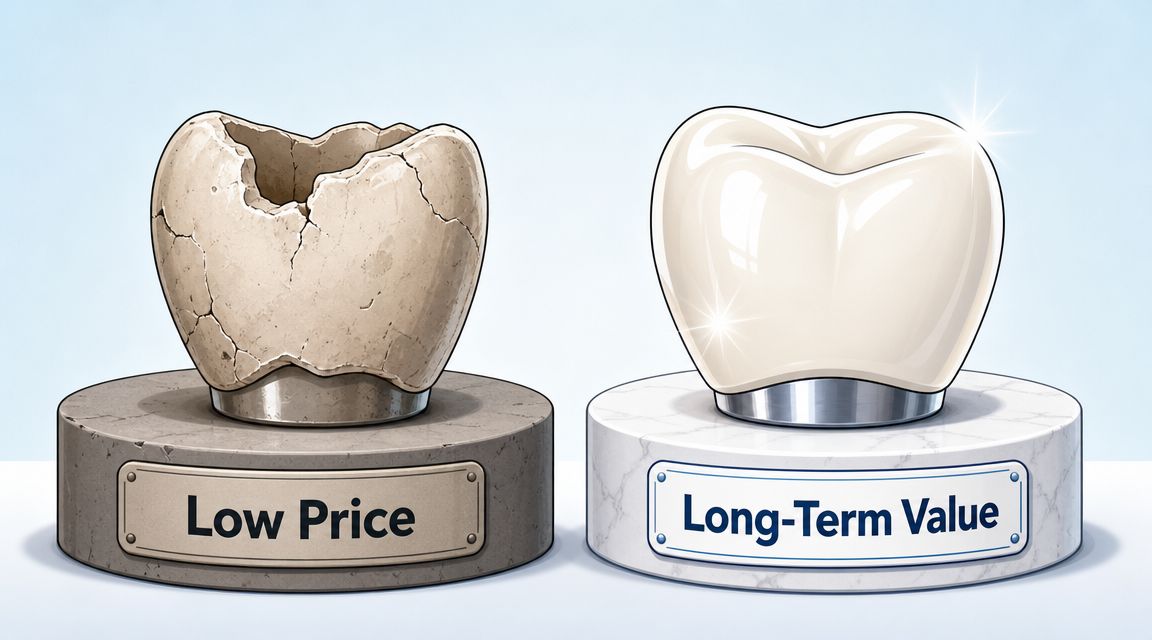
A crown works a bit like a new roof over a house. If the structure underneath needs repair first, the total investment changes. If the roofing material wears out sooner, the lower starting price may not stay lower for long.
The better question is total value over time
A crown that costs less upfront can still end up costing more if it chips earlier, wears down faster, or needs replacement sooner. Each replacement can mean another exam, another impression or scan, another temporary, more time away from work, and more stress around the same tooth.
That does not mean the highest-priced crown is automatically the right choice.
It means the complete comparison is broader than the sticker price. You are weighing durability, appearance, how the tooth functions, and how likely you are to need more treatment on that tooth later.
How dentists often help patients think this through
A useful way to compare options is to ask practical, everyday questions:
- How long do you want this solution to last: A material that holds up better under your bite may offer better value over the years.
- What kind of work does this tooth do: A back tooth that handles heavy chewing often needs a different level of strength than a front tooth.
- How important is appearance in this spot: If the tooth shows when you smile or talk, a more natural-looking material may matter more to you every day.
- Do you clench or grind: Extra pressure can shorten the life of some restorations and make a stronger option more sensible.
- What would replacement really cost you: The financial side matters, but so do extra visits, missed time, and having the tooth treated again.
Here is where many patients get tripped up. They compare crown A to crown B, but forget to include everything around the crown. If the tooth needs a buildup, root canal treatment, gum work, or replacement of an old filling first, the total plan changes. In other words, choosing a crown is not like picking a shirt off a rack. It is more like planning a repair for a part of the house that already carries daily load.
A back molar is a good example. If you grind your teeth and chew heavily on that side, choosing a stronger material may reduce the chance that you are back in the chair sooner than expected. For a front tooth, daily appearance may carry more weight because you see that tooth every time you smile in the mirror.
A crown is a repair decision, a comfort decision, and a time decision, not just a price decision.
This perspective also helps if you are planning other smile improvements later. In that case, your dentist may recommend a crown material and shade that fit the long-term plan, so you are not paying to redo work that could have been coordinated from the start.
Navigating Insurance and Payment Options in Santa Ana
Once you understand the clinical side, the financial conversation becomes much easier. Most patients don't need a lecture here. They need a clear list of questions and a realistic sense of what to expect.
Questions to ask before you schedule
If you're trying to make sense of your insurance or out-of-pocket cost, ask for answers to these points in writing if possible:
- What exactly is included: Ask whether the estimate includes the exam, imaging, temporary crown, lab work, final placement, and follow-up adjustments.
- Are there separate procedures first: If the tooth may need other treatment before the crown, ask how that changes the total plan.
- What material is being quoted: The crown material can change both the clinical recommendation and the financial side.
- Will my benefits be checked ahead of time: A pre-treatment estimate can reduce surprises.
- What happens if treatment changes during care: Sometimes a tooth looks one way at the exam and another once treatment begins.
These questions help patients compare options more fairly. They also make it easier to separate the true cost of treatment from an incomplete quote that sounds lower at first.
Ways patients make treatment more manageable
Some patients use insurance benefits. Others pay directly. Some combine available benefits with staged scheduling or financing. The best approach depends on your plan, your timeline, and how urgent the tooth is.
In Santa Ana and nearby Orange County communities, patients often feel more at ease when the office explains the estimate line by line instead of handing over a single number. That kind of conversation can also help if you're deciding between restoring a tooth now, planning around family expenses, or coordinating treatment with other needs such as emergency dentistry or orthodontic care.

At Bristol Dental & Orthodontics, patients can ask for a consultation to review the condition of the tooth, the recommended crown type, and the treatment steps before making a decision. That kind of visit is often the simplest way to turn a vague cost question into a concrete treatment plan.
Your Dental Crown Questions Answered
Can I wait if the tooth doesn't hurt much
Sometimes patients assume that if the tooth isn't painful, the crown can wait indefinitely. That's not always safe. A cracked or weakened tooth can still worsen imperceptibly, especially when you chew on it every day.
Pain is only one sign. A tooth can be structurally compromised even when symptoms are mild. If your dentist recommends a crown, it's worth asking what risk comes with delaying it and whether a shorter delay is reasonable in your specific case.
Will my crown look natural
In many cases, yes. The final appearance depends on the material, the location of the tooth, the surrounding teeth, and how carefully the shade and shape are planned.
For front teeth, the cosmetic details matter more. For back teeth, many patients care more about fit and strength than about subtle color matching. If appearance is a priority, say that early so it becomes part of the treatment planning conversation.
How long does a crown usually last
There isn't one fixed answer for every patient. Lifespan depends on the material, your bite, whether you clench or grind, your home care, and how much tooth structure remains underneath.
Some crowns serve patients well for many years. Others need earlier attention because of wear, decay at the edge, bite stress, or damage to the underlying tooth. A crown lasts longer when it's well planned, well fitted, and cared for consistently.
If you grind your teeth, ask whether you may need a night guard to help protect the crown and the teeth around it.
Is a crown the same as an implant
No. A crown covers and protects a tooth that is still present. A dental implant is used when the tooth itself is missing and needs to be replaced at the root level before a crown can be attached on top.
This distinction matters because patients sometimes search for crown cost when they need a replacement for a missing tooth. If you're unsure which category you're in, an exam can clarify that quickly.
What if I also want to improve my smile
That matters. A crown can be restorative, cosmetic, or both. If you're already thinking about straightening teeth with Invisalign, replacing a missing tooth, or improving the look of older dental work, it helps to mention that upfront. Timing matters in smile planning.
For example, a crown placed on a visible tooth may need to coordinate with future cosmetic treatment. The same is true if you're considering care for worn teeth related to grinding, or if you're exploring oral appliance therapy for sleep apnea and your bite may be part of the discussion. These treatments don't automatically overlap, but your dentist should know the bigger picture before finalizing the plan.
The most useful next step is a personal exam. Online articles can explain the general decision-making process, but they can't tell you what condition your tooth is in, which material is appropriate, or which parts of the fee apply to your case.
If you'd like a clear, no-pressure review of your options, schedule a consultation with Bristol Dental and Orthodontics. Dr. Andrew Finley and the team serve Santa Ana and nearby Orange County communities with family, cosmetic, restorative, implant, emergency, and sleep-related dental care, and they can help you understand what your crown treatment may involve before you commit.