
“Choose CPAP because it's stronger” and “choose an oral appliance because it's easier” are both incomplete advice. The useful question is whether your treatment controls breathing interruptions and whether you can use it consistently. A comfortable device that leaves significant apnea untreated isn't enough, but neither is a powerful machine you can't keep on.
When comparing an oral appliance for sleep apnea vs CPAP, your diagnosis, oxygen levels, dental health, and nightly experience all matter. For patients in Santa Ana and Orange County, the decision should involve both the sleep physician and the dentist, rather than a device purchase based on snoring alone.
Table of Contents
- Oral Appliance and CPAP at a Glance
- How Much Each Treatment Lowers Apnea
- Nightly Use Can Change the Winner
- Which Patients Fit Each Option
- Side Effects, Follow-Up, and Proving Control
- Book a Consultation to Match the Device
Oral Appliance and CPAP at a Glance
Oral appliance versus CPAP on the decisions patients make
| Decision point | Custom oral appliance | CPAP |
|---|---|---|
| Usual starting fit | Mild to moderate OSA, or CPAP not tolerated | Preferred when maximum airway control is needed, especially severe OSA |
| Airway control | Often effective, but residual events are more common | Consistently stronger reduction in apnea events and low oxygen |
| Nightly use | Adherence is often better, though it can still drop over months | Effective only while worn; reported adherence using a nightly minimum has ranged widely |
| What the patient uses | Small custom device worn in the mouth | Mask, tubing, and bedside machine |
| Common downsides | Jaw, bite, or tooth changes that need dental follow-up | Mask leak, dryness, noise, claustrophobia, or nasal intolerance |
| How success is known | Follow-up sleep testing, not comfort alone | Pressure setup plus follow-up to confirm control and use |
The practical verdict: CPAP generally offers stronger airway control, especially for severe obstructive sleep apnea. A custom, adjustable oral appliance is a recognized option for appropriate patients with mild to moderate disease and for people who can't successfully use CPAP.
What each device actually does
Obstructive sleep apnea, or OSA, happens when the upper airway repeatedly narrows or closes during sleep. Treatment aims to prevent those interruptions, not make them quieter.
A mandibular advancement appliance fits over the teeth and holds the lower jaw slightly forward. That position helps keep the airway from collapsing. “Custom” means it's made for your mouth, and “titratable” means the dentist can gradually adjust the jaw position rather than leave it at a fixed setting.
Continuous positive airway pressure, or CPAP, delivers pressurized air through a mask to help keep the airway open. It doesn't move the jaw. The sleep team manages the pressure settings, mask fit, and equipment issues that affect use.
Why comfort isn't the final test
A person might stop waking their partner with snoring after receiving an appliance. That's encouraging, but it doesn't establish whether breathing interruptions or oxygen drops remain. Likewise, owning a CPAP machine doesn't show how much of the night someone uses it.
Practical rule: Judge treatment by both measurable breathing control and usable nightly treatment, not by how comfortable the device feels during a fitting.
These are different questions, and they need different kinds of follow-up. A dental examination evaluates whether the mouth can support an appliance; a sleep assessment evaluates what happens to breathing during sleep.
At Bristol Dental & Orthodontics, we offer customized sleep apnea solutions. We discuss treatment after a confirmed diagnosis and with the sleep physician involved, so dental suitability and medical needs are considered together. The comparison therefore includes measurable apnea reduction, actual use, and the patient's ability to tolerate the chosen treatment.
How Much Each Treatment Lowers Apnea
Two different questions hide inside every comparison study: how often a treatment counted as a success, and by how much it improved the breathing numbers. The studies below answer each version differently, which is why reading them together matters.
Measured airway-control differences from published comparisons
| Finding | Oral appliance | CPAP | What it suggests |
|---|---|---|---|
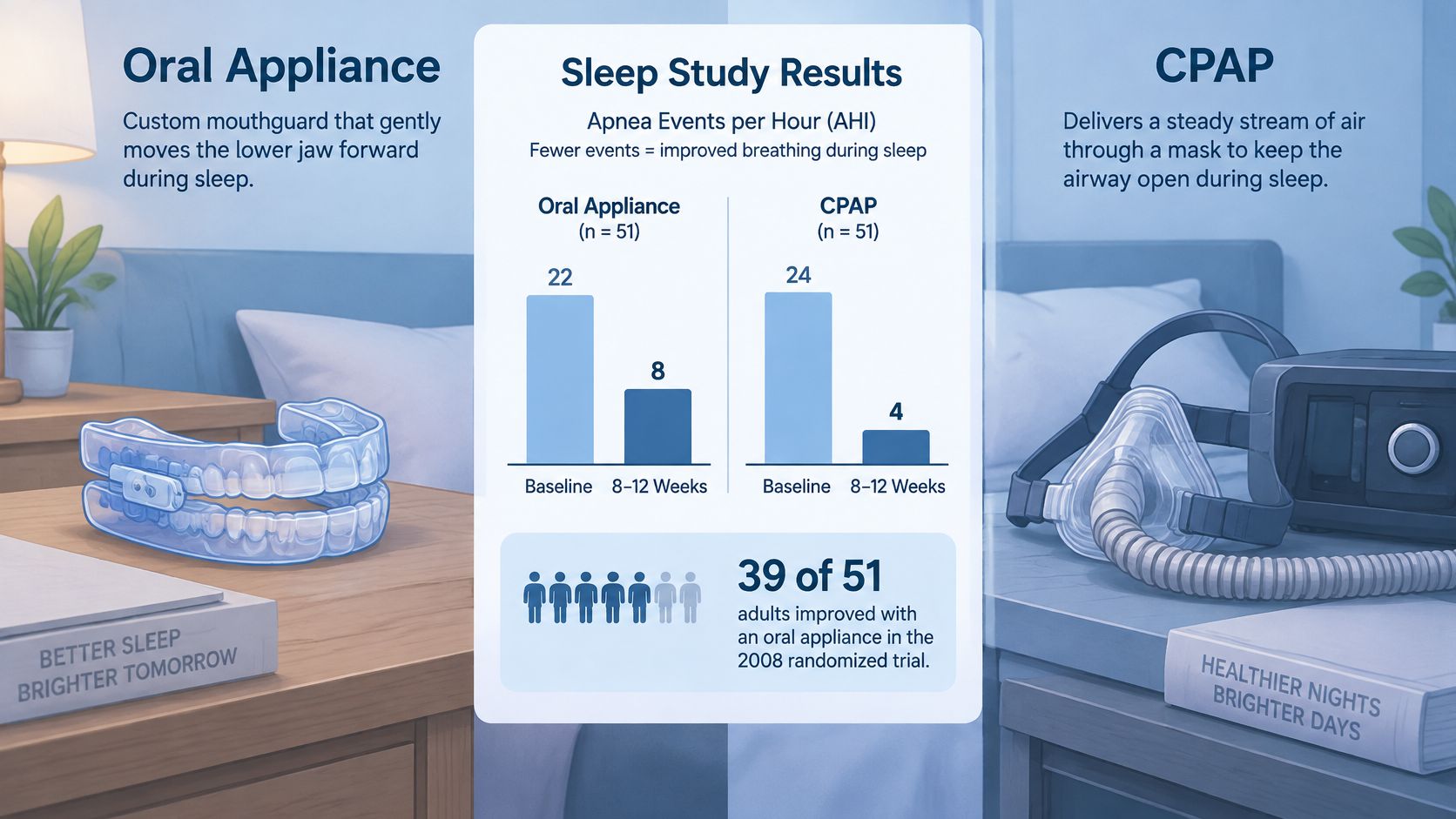
| 2008 randomized trial, effective treatment at 8–12 weeks in 103 adults | 39 of 51 patients, 76.5% | 43 of 52 patients, 82.7% | Overall success was close in this mixed group |
| Same trial, severe OSA with AHI above 30 events per hour | Weaker control than CPAP | Stronger result | Severe disease favored CPAP |
| Cochrane comparison evidence, extra AHI reduction in crossover studies | Reference device | 7.97 fewer events per hour, 95% CI 6.38–9.56 | CPAP removed more events |
| Same Cochrane comparison, minimum oxygen saturation | Reference device | 4.14 percentage points higher, 95% CI 3.25–5.03 | CPAP improved lowest oxygen more |
| Broader systematic-review evidence, average AHI advantage | Reference device | Lower AHI on average | The direction of the AHI edge for CPAP is consistent |
The trial measured treatment success in individual participants, while the pooled comparisons measured average differences in breathing events and oxygen. These outcomes measure different things, so a treatment can succeed on one and fall short on another. Meeting a study's definition of success also doesn't guarantee matching the alternative on every sleep measurement.
What the apnea index tells you
The apnea-hypopnea index, usually shortened to AHI, counts breathing pauses and episodes of reduced breathing per hour of sleep. It works like a scoreboard for the night: each interruption adds to the total. A lower treated AHI generally indicates fewer remaining breathing disturbances. It says nothing about whether the mask leaks, the appliance hurts, or the treatment stays in place all night.
The pooled AHI differences in the table represent additional breathing interruptions prevented during each hour of sleep with CPAP. That gap matters most when someone starts with heavy obstruction, or when the sleep physician needs residual events reduced as far as possible.
Minimum oxygen saturation is the lowest blood oxygen level recorded during the sleep assessment. If AHI counts how often breathing falters, minimum saturation shows how far oxygen fell when it did. Someone can sound quieter while still having medically important oxygen drops.
Why the findings don't crown your personal winner
The randomized trial's relatively close overall success rates don't mean the devices performed equally in every severity group. Its severe-disease results favored CPAP, and the broader comparison evidence consistently favored CPAP for physiological control.
The confidence intervals show the uncertainty around estimated average differences. They describe the precision of a study average, not a range of results every patient should expect. Your airway anatomy, starting severity, appliance adjustment, and ability to use treatment can produce a different individual response.
For that reason, a successful fitting isn't the same as successful sleep treatment. An appliance may fit securely and feel tolerable while leaving obstruction behind. The honest comparison weighs the treated AHI and the lowest oxygen level against whether the device gets worn, then confirms everything with a follow-up sleep study. That retest is the only way to know an easier device is controlling apnea rather than merely feeling easier, and it matters most when low oxygen or severe disease makes incomplete control a real concern.
Nightly Use Can Change the Winner
A CPAP machine left in its case can't keep an airway open. If therapy seems to be failing, the first question is which part is failing: pressure tolerance, mask fit, nasal discomfort, or another barrier that may still be adjusted.
The American Dental Association evidence brief reports CPAP adherence ranging from 17% to 60%, commonly defined as at least 4 hours per night, and describes oral appliances as generally less effective at reducing OSA severity but often better tolerated, with better adherence and fewer adverse effects that lead people to stop.
Compare actual use carefully
The AASM/AADSM evidence review found that mean self-reported oral-appliance use exceeded objectively measured CPAP use by 0.70 hours per night, with a 95% confidence interval of 0.11 to 1.30 hours. Read that gap as a measurement clue, not a personal forecast: one number came from memory, the other from machine recording.
Take two simplified examples. A sleeper who uses CPAP for only the first three hours leaves the rest of the night uncovered. Another sleeper who keeps an oral appliance in place for six hours treats more of the night even if each treated hour controls events less completely. The safer comparison is hourly control multiplied by hours worn, then checked with follow-up testing.
Consistent use of a moderately effective device can outperform a stronger device that is abandoned; the result still has to be verified by follow-up testing.
Blood pressure and apnea control answer different questions
In a 2024 randomized noninferiority trial of 220 adults with moderate-to-severe OSA, hypertension, and increased cardiovascular risk, mandibular advancement reduced 24-hour mean arterial pressure by 2.5 mmHg at six months, while CPAP produced no significant change; the between-group difference was −1.6 mmHg, meeting the prespecified noninferiority criterion described in the AASM clinical evidence summary.
“Noninferiority” means the appliance met the study's predefined limit for not being unacceptably worse on that blood-pressure outcome in that selected group. Separate questions remain: how many breathing events are prevented each night, how low oxygen falls, and whether long-term cardiovascular outcomes improve.
Before recommending a device, clinicians therefore weigh:
- Disease severity and oxygen findings, to set how much control is needed.
- Nasal comfort and mask tolerance, to judge whether PAP is workable.
- Teeth, gum support, and jaw movement, to judge appliance suitability.
- Willingness to use treatment, to identify a plan you can realistically follow.
Which Patients Fit Each Option
A person with mild OSA who strongly prefers to avoid a mask faces a different decision from someone with severe obstruction and substantial oxygen drops. Neither should have to choose from a generic claim that one device is always better.
The AASM and AADSM joint guideline supports considering oral-appliance therapy for adults who can't tolerate CPAP or prefer an alternative. It specifies a custom, titratable appliance provided by a qualified dentist, not an untitrated store-bought product.
Which way the choice usually leans
| Situation | Usually discuss first | Why | Still required |
|---|---|---|---|
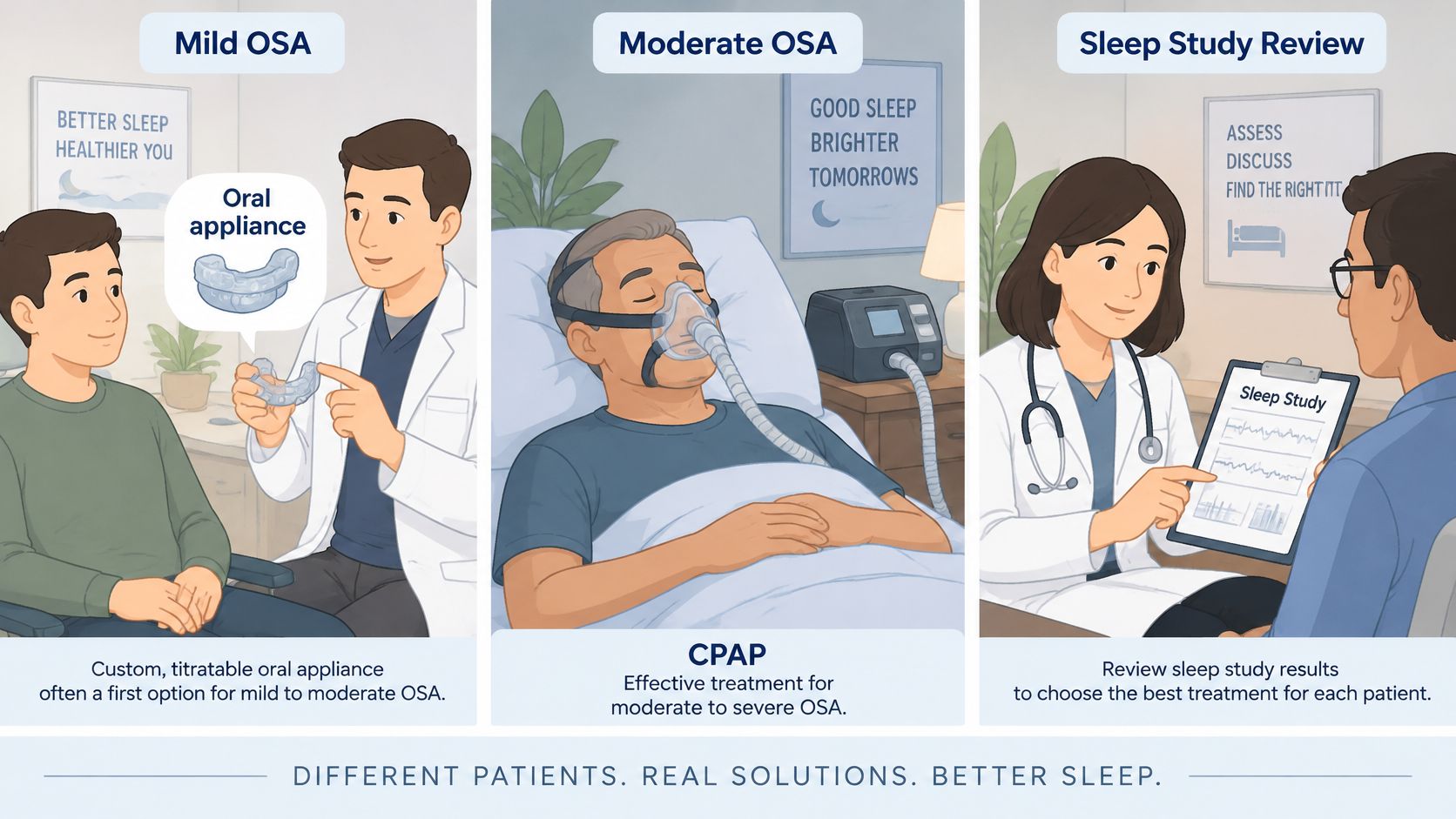
| Mild to moderate OSA and a preference to avoid a mask | Custom titratable oral appliance | Guidelines allow it as a primary option for selected patients | Sleep-physician input and follow-up testing |
| New start of PAP when PAP is chosen | Auto-titrating CPAP rather than a fixed pressure | VA guidance favors auto-titration for new PAP starts | Mask fit and use review |
| Severe OSA or a need for the lowest event count | CPAP | Stronger AHI and oxygen control | Don't switch away without a medical plan |
| CPAP tried and not tolerated | Custom oral appliance as an alternative | Recognized when PAP is unacceptable | Prove it works; don't assume comfort equals control |
| Unstable teeth, gum disease, or very limited jaw motion | Often stay with or return to PAP | The mouth may not safely hold an advancement device | Dental examination before any appliance |
| Travel, noise, or claustrophobia with otherwise suitable teeth | Appliance may be reasonable if severity allows | Usability can influence consistent treatment | Objective recheck after titration |
The clinical guidance summarized for treatment selection includes 2025 recommendations supporting oral appliances primarily for mild-to-moderate OSA and as an alternative or adjunct when PAP use is poor. The accompanying Veterans Affairs guidance permits either mandibular advancement or PAP as an initial option for mild-to-moderate disease, favors auto-titration when starting PAP, and keeps CPAP as the treatment of choice for severe OSA.
How everyday circumstances change the conversation
A frequent traveler may prefer a small oral device over packing a machine. Someone whose partner hears mask leaks may benefit from a mask-fit review before changing therapy. A patient who feels trapped by a mask needs that concern taken seriously, not dismissed as unwillingness.
For an older adult, caregiver involvement can affect equipment setup, cleaning, and consistent use. An appliance may simplify some tasks, but loose teeth, poor gum support, or restricted jaw opening can make it unsuitable.
The useful question is whether this person needs the lowest apnea index, the most reliable nightly use, or both. Those priorities can point toward different choices.
Severe disease deserves particular caution because oxygen problems and cardiovascular concerns increase the importance of adequate control. An appliance may still be considered when CPAP isn't feasible, but that requires a medical plan and objective reassessment. These scenarios are starting points for a consultation, not a personal diagnosis.
Side Effects, Follow-Up, and Proving Control
An oral appliance can cause tooth soreness, jaw-muscle aching, or changes in how the teeth meet. Gum concerns deserve attention, particularly when the teeth already have weakened support. A grinding nightguard isn't automatically a sleep-apnea appliance, even if both are worn over the teeth.
CPAP brings different challenges: leaks, dry mouth or nose, skin marks, noise that disturbs a partner, and claustrophobia. The sleep team can often address equipment and comfort problems through mask changes, fit adjustments, humidification, or review of prescribed settings. Report the problem before deciding there's no workable PAP option.
Better tolerance doesn't eliminate follow-up
A 2025 study of 81 patients whose CPAP treatment had failed found that 74.0% continued oral-appliance therapy for more than one year, with early recognition of effectiveness the strongest predictor of continued use, at an odds ratio of 9.731. Sensor-based tracking over longer periods adds a caution of its own: wear time tends to slip in the months after fitting, and a share of patients stop using the device before the one-year mark.
These findings answer different questions. Continuing treatment shows that some patients find an appliance usable after CPAP failure; it doesn't establish that every continuing patient has fully controlled apnea. Declining use over time also shows why clinicians can't assume an appliance will remain easy to wear indefinitely.
The AASM/AADSM follow-up guideline recommends dental oversight for tooth, bite, and jaw effects, periodic visits with both the dentist and sleep physician, and follow-up sleep testing to confirm effectiveness. That makes appliance therapy an ongoing course of care rather than a one-time purchase.
A follow-up path that answers both questions
Confirm the diagnosis and the CPAP difficulty. Bring the sleep findings and describe exactly what prevented use. A leaking mask calls for a different discussion from persistent claustrophobia or pressure intolerance.
Examine teeth, gums, and jaw movement. The dentist checks whether an advancement device can be supported safely and records relevant bite or jaw concerns before treatment.
Fit and gradually titrate the custom appliance. Adjustments aim to balance tolerability with airway benefit. Don't advance the device beyond the prescribed plan because snoring continues.
Report soreness or bite changes early. Persistent pain, a tooth that feels loose, or teeth that no longer meet normally should prompt a dental review rather than weeks of trying to push through.
Complete the prescribed repeat sleep assessment. The sleep physician determines the appropriate test and interprets whether important breathing disturbances remain. Feeling more rested is like reading a friendlier gauge; the sleep assessment is the actual measurement of whether apnea is controlled.
Choose the next step from the results. Continue the appliance if appropriate, revise the plan, consider a clinician-directed combination approach, or return to PAP when needed.
Don't trade treatment for a gap in care. Stopping either device without a replacement plan can leave apnea untreated, especially when disease is severe.
Keep a record of wear, discomfort, and reasons for removing the device. That gives the clinical team something specific to adjust while the sleep assessment establishes whether treatment is doing enough.
Book a Consultation to Match the Device
A consultation works best when the dental team can see both halves of the problem: how much support your airway needs and what has made treatment hard to sustain. Arriving with records turns a general conversation into a specific plan, the way a mechanic diagnoses a car faster when you bring the repair history.
- Sleep-study summary: the diagnosis, AHI if available, oxygen findings, and the current treatment recommendation.
- CPAP concerns: leaks, dryness, pressure discomfort, claustrophobia, or removing the mask during sleep.
- Dental and jaw history: grinding, jaw pain, limited opening, loose teeth, gum treatment, and any existing nightguard.
- Current treatment details: equipment information and usage reports, which help the sleep team tell a comfort problem from a control problem.
Questions worth asking at your visit
Ask whether the proposed appliance is custom and titratable, how adjustments will be managed, and which symptoms should prompt an earlier appointment. Clarify who arranges follow-up sleep testing and who reviews the results. Also ask what happens if the appliance feels comfortable but the repeat test shows breathing remains inadequately controlled. Ease of use and proven control are two separate questions, and a pleasant device that leaves apnea untreated has solved the wrong problem.
Dr. Andrew Finley leads a family and cosmetic dental practice in Santa Ana, CA, and can review whether a custom appliance is dentally reasonable while coordinating the discussion with your sleep physician, who remains central to diagnosis and assessment of apnea control.
Every patient receives a personalized treatment estimate after consultation, so bring coverage questions to that visit and ask how the proposed care fits your medical treatment plan. Related needs, such as a nightguard for grinding, can be discussed without treating that appliance as a substitute for apnea therapy.
Patients in Santa Ana and the surrounding Orange County communities are welcome to discuss their options with Dr. Finley. A successful visit ends with a device you can wear each night, a plan to measure whether it is controlling your apnea, and a clear next step if it is not.
The practice offers customized sleep apnea solutions with attention to dental health, comfort, and coordination with your sleep physician. Visit Bristol Dental and Orthodontics to schedule a consultation with Dr. Andrew Finley and discuss whether a custom oral appliance fits your diagnosis and treatment needs.